
Should writers set their stories in real places or fictional? Or perhaps more to the point, do we ever really set out work in real places?
In this issue of my irregular newsletter: DI Bolam (or should it be Redpath?) — Writing and Publishing News — Fictional Settings, Real and Invented — …My Search History — Events — And Finally… some personal bits about a recent trip to Mull. Plus other bits.
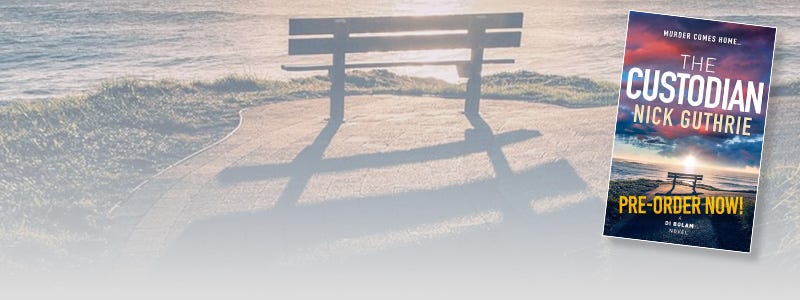
The first responses to The Custodian are coming in, and I’m delighted to see what people are saying:
“A tightly woven plot line that really delivers that page-turning crucial punch. A great start to a new series.” — Michelle Kidd, author of the DI Jack MacIntosh and DI Nicki Hardcastle books.
“The Custodian by Nick Guthrie has everything: engaging characters, an intriguing mystery, vivid action sequences and a page-turning plot. You’ll have gathered I enjoyed every page.” — Heather Peck, winner of the Page Turner Award and author of the DCI Greg Geldard series.
“While reading this novel I almost became another of its victims, having passages when I found it difficult to breathe. It’s what you want from a crime thriller, a feeling of being strongly gripped, unable to prise yourself away. Nick Guthrie has the ability to keep you firmly locked to the story, anxious to reach its denouement.” — Garry Kilworth, winner of the Charles Whiting Award for Historical War Literature, and the World Fantasy Award.
The Custodian is available for pre-order from Bookshop.org, Amazon, Waterstones, Kobo, and other booksellers.
The lead character in The Custodian, DI Bolam, is one of those people who, as soon as I started writing about him, had a tight grip on my imagination. Straight away, I knew I had to find out more about who he was, and why he’s the way he is: a somewhat quirky and private man who has a knack for understanding the relationships between people and the impact traumatic events can have on those relationships.
And what’s the best way to find out more about a character? Some writers would spend weeks or months thinking about every aspect, making notes, writing scenarios, etc. I know of some writers who give their fictional characters lengthy sets of interview questions, for example.
For me, I did some of that, yes, but the obvious thing was to drop the character into a situation and see what happened. So Bolam made his first appearance in a few short stories. Not only did I get to know him and how he worked, but this gave me a chance to build the team around him, get to know his family, and — crucially — get to know the fictional setting where he worked and lived.
He wasn’t even DI Bolam to begin with: my lead character first appeared as DI Callum Redpath. It was only when my agent came to pitching the first book to a publisher that we realised there was already a series of books featuring a DCI Ridpath that the name was changed. Bolam had a nice ring to it. But… Callum Bolam sounded too much like Callumbullum… So now he’s DI Iain Bolam.
Where are these stories? They’ve appeared in magazines, including one of my first appearances in Alfred Hitchcock’s Mystery Magazine, and maybe one day I’ll be able to gather them together into a book, along with some of my other stories. I might even post one or two of them in this newsletter — watch this space!
My story “Old Friends” was published in the Crime Writers’ Association’s anthology, Guilty Secrets (edited by Martin Edwards) in July. “Old Friends” is about an encounter between two elderly veterans of the Cold War, and a secret long buried in their previous lives in West Berlin. The book is a rather splendid-looking hardback, and I’m thrilled to be appearing in one of these volumes.
Book Two in the DI Bolam series is just about to be delivered to my agent, and then to my publisher. The working title is The Player, and it tells the story of murder, fake identities and organised crime in a port town in Suffolk.
Recently I made my fifth short story sale to Alfred Hitchcock’s Mystery Magazine, while my fourth story there appears in the September/October 2026 issue, which is now available. This is my seventh short story to be published this year, in what has been a phenomenally successful year — an eighth is due to appear in Merry Murders on Bedford Square (edited by Maxim Jakobowski; published October 2026).

“So where is your story set?”
“Erm… a place I made up…”
Is it better to set crime fiction in the real world, or in somewhere you’ve invented? I know some people have very strong views on this, but I’m much more in the middle. Stories set in real places have an extra layer of fascination, particularly if you know the location. Even if you don’t — I recently read an excellent novel that was very dependent on the location of events, and I couldn’t help following it on Google Maps as I read, and that’s perhaps when I made the very obvious realisation that… Even the real settings aren’t real, are they?
Of course they’re not. As writers we’re always twisting and redrawing the real world.
As a related example, think of how they make a TV series like the excellent Vera. One minute the characters are in the Rendezvous Café on Whitley Bay seafront, then they walk around a corner and suddenly they’re by a row of terraced houses six miles away in North Blyth. And then Vera’s driving her old Land Rover across the causeway to Lindisfarne another forty or so miles up the coast, having just left Whitley Bay a few minutes ago.
Writers do exactly the same. If a real town doesn’t have a pub in just the right place for the characters to meet up, we add one. If the owner of a restaurant is a crook, we tend to invent the restaurant, even if it’s in a real setting, because we’re not generally big fans of libel suits. Sometimes we move entire towns, or overlook places that would complicate a good car chase. Writers are frequently simplifying the real world to suit the story, and that’s always been the case.
And yes, sometimes we go the whole hog and invent an entire location. My Bolam series is set in the fictional Suffolk port town of Whitesands. This gives me the freedom to write about corruption and incompetence in the highest levels of the town (those pesky libel suits again), and it allows me to ignore the messy complications of the real world and make the geography suit the story.
I don’t always do it like that. My short story “Old Friends” (mentioned above) is set in the north-east Essex town of Dovercourt, a place I know well, and other stories have settings that are much truer to the real world than Whitesands. It comes down to making a choice that’s best for each particular story.
So is Whitesands actually based on anywhere? Oh yes. It’s a mash-up of the very real ports of Felixstowe and Harwich, and anyone who knows these towns will spot streets, buildings and other features that I’ve borrowed. It’s a bit like an all-you-can-eat buffet — a bit of this, a bit of that, a bit of that. But, of course, my murderers and corrupt leaders aren’t based on anyone real. That would be foolhardy, wouldn’t it?
Am I really going to do this?
Okay, here goes…
Writers have the weirdest search histories, don’t they? Or they should do, if they’re doing it right. If I was ever a suspect in a major crime, my web browser would be the worst of all witnesses against me.
What follows is a list of a few recent searches. Repetitions have been removed, along with some of the really dull stuff; also, one or two have been redacted to protect the plot of the second Bolam book.
agatha christie - viewed
ambleside
banorte stadium
borders railway - viewed
carlisle pubs
common riding - viewed
dutch surnames
england national football team
ford puma
hamas
historic environment scotland - viewed
hong kong names
html em dash
hyperfocal distance
i will find you
inquiry or enquiry
iopc
lahore
marine le pen
mother in law’s tongue
nigel farage
nikon z5 ii with 24-200mm lens
non-league football grounds
northumberland national park
orange order
paddle steamer
petechiae
puffins
punjabi food
red kite
sunday roast dumfries and galloway
term for police preferred interviewer
wimbledon
It turns out that this wasn’t too risky, after all. The research writers do is mostly fairly dull, despite the jokes about our search histories — probably because we already know how to kill people and dispose of the bodies…
This year I’ve been lucky enough to interview some fabulous crime authors for the Dead East newsletter:
Trevor Wood, author of the DCI Jack Parker series.
Tony White, author of Phantom at the Feast.
Ruth Dugdall, author of The Woman Before Me.
Keep an eye out on the Alfred Hitchcock’s Mystery Magazine blog, Trace Evidence, for my post about two different kinds of crime fiction author, written to accompany my story in the September/October issue.
Here are the most recent reviews I’ve written for Dead East:
I’ve written lots of reviews over the years, including close to a hundred for the Guardian, and in my time I’ve given bad reviews as well as good. I’ve reached a place now where I think there’s too much negativity around, so if I write a review it’s because I’ve liked at least something about a book. They’re not always raves, but if I don’t enjoy something I’d rather move on than spend time slating it. So read these reviews as recommendations, if you would, where I try to write about why I liked what I like.
In July I attended my first ever crime fiction festival, the Theakston Old Peculier Crime Writing Festival in Harrogate. As a newcomer, I found it quite daunting at times, but overall it was great, and I met some lovely people. I’ll definitely be back! (I’ve added a brief report on this event below.)
September is the turn of Bloody Scotland in Stirling. This time, rather than attending the whole event, I’ll just be there on Saturday 19th September. I’ll be in the audience at the two police procedural panels in the morning, then going for lunch with fellow members of the Scottish branch of the Crime Writers’ Association. After that I have no commitments, so I’ll be exploring the event (which probably means choosing between the bars at the Golden Lion or Albert Halls). If you see me, do say hello.
Later in the year, I’m hoping to do one or two launch events for the first DI Bolam novel, The Custodian. News of these and other events to follow.
This is perhaps the highlight of UK crime festivals, and this year’s event was no disappointment, with its biggest attendance ever. Harrogate International Festivals put together a very slick event, with a programme expertly curated by author Lisa Jewell. Programme items on the main stage ranged from the nitty gritty of the writing process through a wide selection of author interviews and panels, to interview bingo and even a spot of Irish dancing by Steph McGovern and Brenda Blethyn when the microphones failed. The sessions were full of insights, including forensic scientist Sue Black’s chilling observation that she would never have to be worried about prosecution if she were actually a serial killer, because she knows exactly how to undermine any evidence against her; discussions about the challenges presented by writing about bad people, with the key point being that depiction is not necessarily endorsement; and MW Craven’s straightforward explanation of why he can’t work anywhere beyond his office — “because it’s not my office.” A friendly and informative event, and above all an excellent way to discover new books and authors.
Outdoor office of the day: the Mennock Pass.
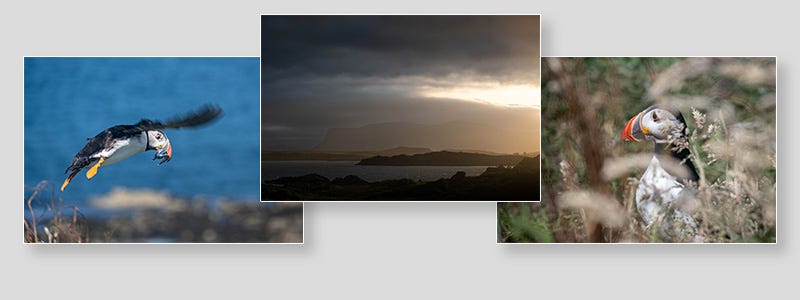
In mid-July I managed to spend a few days camping on the Hebridean island of Mull. It was my first visit, and it was absolutely stunning: the landscape was dramatic and atmospheric, and the wildlife was fabulous.
The highlight was probably a day spent out on the islands of Lunga and Staffa, surrounded by nesting seabirds and weird geology, but the whole trip was special. I watched a dolphin trying to break into a salmon farm, I spent three-quarters of an hour watching golden eagles hunting along the hilltops, I saw hen harriers, white-tailed eagles, lots of twites (a small finch that’s hard to see anywhere else in the UK), and I heard the corncrakes even if I didn’t get to see them (corncrakes are another local speciality). I’ll definitely be back again as soon as I can manage it.
No posts
Comments
Nothing yet. Say the first thing.
Sign in to join the conversation.