
In the last few weeks, you may have seen this website: Birth Lottery. Giving What We Can, the site creator, seems like a decent enough charity. They want to stop poverty and help people. I tend to be skeptical about mega nonprofits because they can be over-bureaucratized so easily, but their birth lottery spinner is particularly egregious.
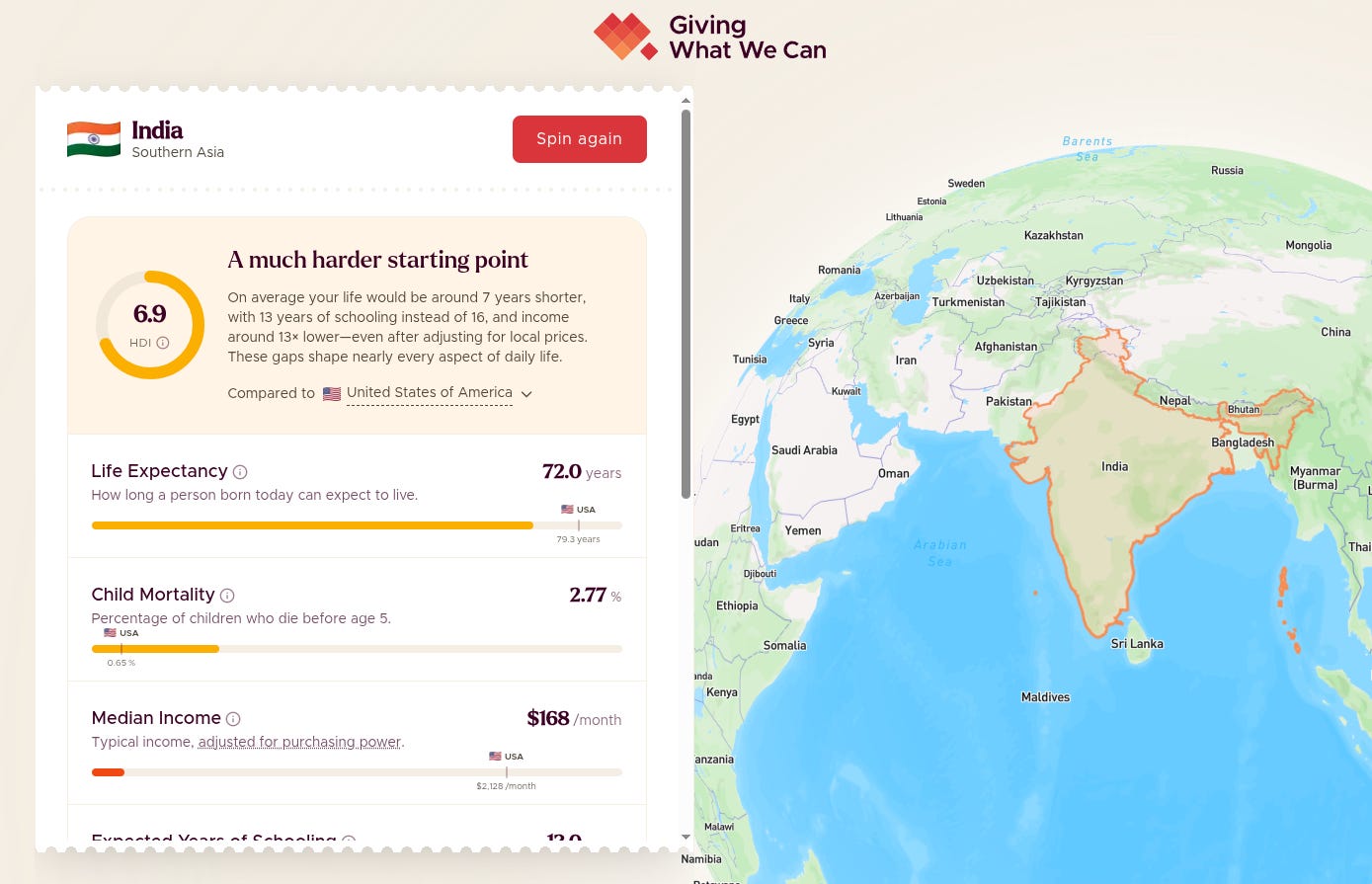
The site features the Earth and a spin button. The user clicks, and it lands on a country, with probabilities based on each country’s current relative birth rate. The user then receives statistics about the country they have landed on, such as lifespan, average income, years of education, etc. The copy states:
If you were one of the 251 people born this minute, where would you land? What opportunities would you get? And how much of your life comes down to chance?
The charity means to demonstrate global inequality, but it is a ridiculous exercise with absurd and pernicious existential assumptions baked in. These same assumptions permeate many aspects of the modern world and are contributing to the accelerating decline of the West.
What does the word “you” mean in that sentence anyway? It is easy to miss its ambiguity. “You” is a common word. But who are you? You are someone who was born at a particular time and place, to two particular parents who have given you a specific set of genes and, hopefully, a good upbringing. These are pretty critical aspects of “you.” They are actually pretty exhaustive, being nature and nurture. Nature and nurture shape every person. But this is obviously not the “you” Birth Lottery is referring to, because it replaces that. What if you were born in a different country, to totally different parents, and had a totally different upbringing? Then you would not be you, you would be someone else entirely.
Putting aside the metaphysical assumptions about personhood, this line of thinking is also emblematic of the modern idea that many aspects of reality are purely arbitrary and random. One can find this assumption in many left-wing arguments and lamentations. Why do these disparities exist? Why are some people poor? Why are there people in prison? They do not ask because they want to know the reason, but rather as an argument toward the state waving some magic wand to make it different, somehow. This approach to the world does not work. The fruit of criminal justice reform is murder on the subway.
Even still, one can understand why many are bothered by the seeming randomness of birth. How is it fair that a few people are born in affluent first-world countries, and the rest are born in developing or impoverished countries? And nobody has any say in where they are born? This line of questioning stems from modern assumptions about liberal autonomy. It is treated as an automatic good, implying that anyone should have the right to do whatever they want and the best opportunities to do so. When people cannot do what they want, that is like slavery! When someone has no say in the matter, it is literally The Handmaid’s Tale. Because nobody has a say in where they are born, that isn’t nice because autonomy and rights did not factor into it.
But does this matter? It is mostly harmless as long as it is only a marketing gimmick for a nonprofit that wants to help people in need. However, large bureaucratic nonprofits tend to bloat and lack key indicators of organizational success. And there is limited evidence that foreign aid works anyway. All of that aside, the real problems come along when the state begins to dole out taxpayer money to foreign nations under the guise of this logic. Thankfully, the dismantling of USAID has put a stop to a lot of that.
But the larger issue is that this “birth lottery” idea is demoralizing and obscures genuine goals, such as self-preservation and working for the benefit of one’s offspring. Birth seems unfair due to a lack of agency, but this complaint robs many others of agency. For one, it robs the agency of parents, grandparents, great-grandparents, and so on. My birth in the United States was not a random occurrence. Instead, it is a consequence of the actions of many taken before me. It was a consequence of my Scots-Irish ancestors, who settled America before it was a country and fought in the Revolutionary War. It was a consequence of the German Settlers who tamed the Texas wilderness and carved out their slice against the forces of nature. No aspect of this was luck, because I am their descendant and I can only ever be their descendant. I can never cease being the great-great-great-grandson of Civil War veterans. It was a consequence, not a lottery.
I call this line of thinking “temporal atomization” in an essay I wrote last year, which covers some of the same ground here. In that piece, I argue that this temporal atomization is harmful because it not only disconnects the individual from their family history and the responsibility they bear for carrying it forward, but also robs them of the opportunity and agency to build for the future of their descendants.
I have kids. Their birth was not random or a lottery in any sense, except for the specific genetic makeup they received from my wife and me. I have a clear responsibility to raise them and work for their futures. Sure, they do not have agency in the fact that I am doing so, but it is not luck, because I certainly have agency.
Reject this birth lottery thinking. Reject temporal atomization. It is a scourge on Western culture.
No posts
Comments
Nothing yet. Say the first thing.
Sign in to join the conversation.