
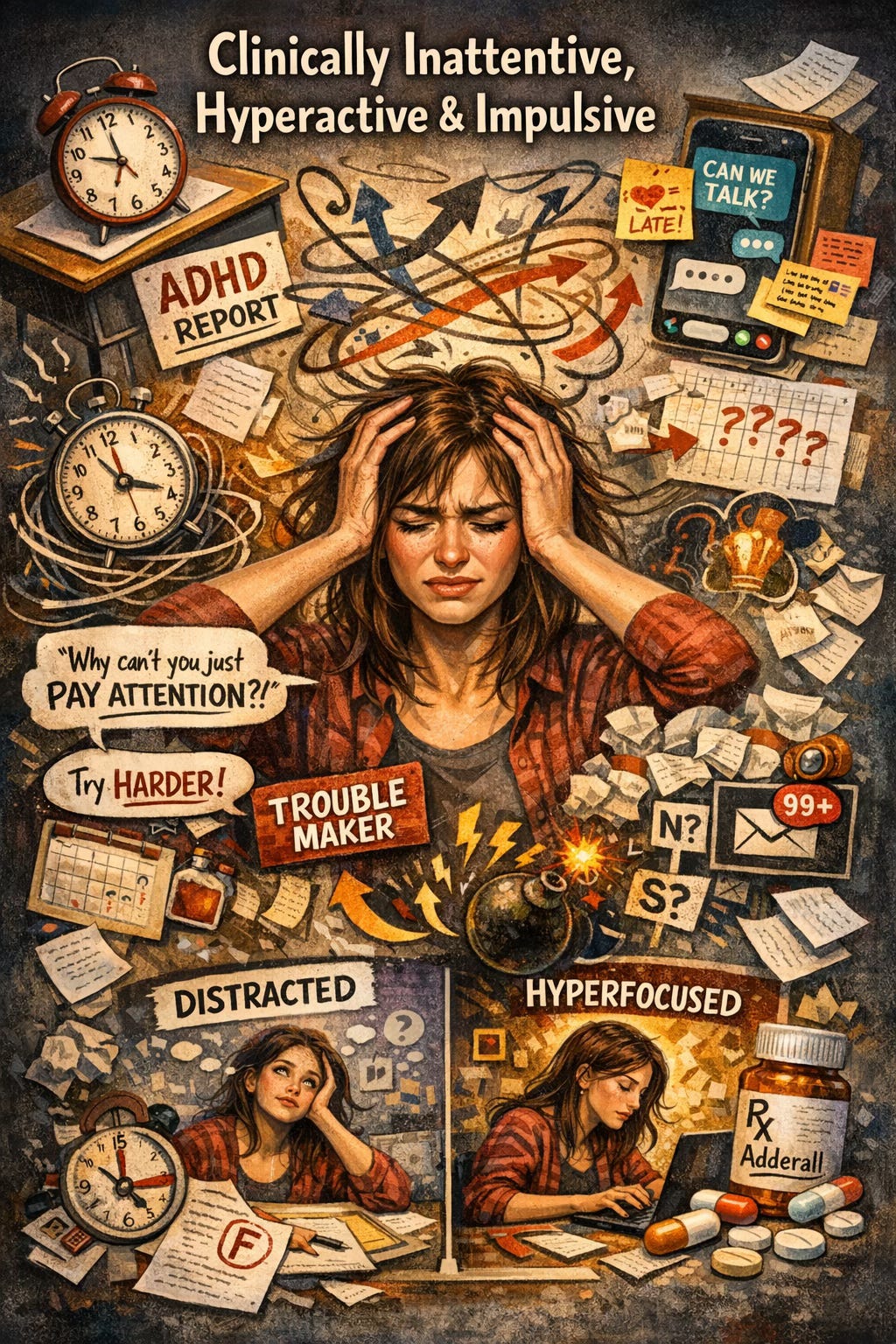
I’m not “a little ADHD.” I’m clinically inattentive, hyperactive, and impulsive at full volume.
I was diagnosed at six.
Not the cute, distracted, “she just talks a lot” kind.
The kind that gets you moved to the front of the class.
Separated from your friends.
Labeled before you understand what the label means.
Now I’m a psychologist who evaluates and diagnoses ADHD for a living.
And I still live with it.
So let’s clear a few things up.
ADHD isn’t just losing your keys or forgetting why you walked into a room.
It’s not just zoning out during a lecture, interrupting mid-story, losing your train of thought, or struggling with time, direction, or emotional regulation.
What it actually feels like is living with a brain wired for stimulation over importance.
It’s desperately wanting to focus but feeling physically unable to lock in.
It’s knowing you’re capable and still missing deadlines.
It’s understanding the material and failing the test because your attention drifts to who’s ahead and how much time is left.
It’s feeling shame before anyone says a word.
For some, it’s being calm in crisis and overwhelmed by email. Excelling under pressure while avoiding basic tasks.
It’s “Why can’t I just do this?” on repeat.
It’s rejection sensitivity that makes you feel like you’re always in trouble.
Apologizing preemptively. Scanning interactions for proof you said too much.
Avoiding help so you don’t seem incompetent.
Being hyperaware of tone and assuming someone’s bad mood is your fault.
In school, we weren’t unintelligent. We were overstimulated and under-regulated.
We interrupted to outrun forgetting.
We struggled with comprehension not because we lacked intelligence, but because sustained attention to uninteresting material was torture
We were called lazy for years, so we built guilt around rest.
We grew up feeling like we had something to prove, so we overcompensated.
The paradox: When we find something we love, we excel. Obsessively. Productively. Creatively. That’s our superpower.
If you really want to test an ADHD brain:
· Pull us away from the one thing that makes our brain light up and tell us to do something “more productive.” · Text “Can I call you?” instead of just saying what you need. · Give more than two verbal instructions at once. · Say, “Everyone is a little ADHD.” · Ask us for our Adderall. · Give directions using north, south, east, or west like we’re walking around with a compass. · Add something to the schedule that wasn’t on the schedule. · Tell us to “just pick one” during decision paralysis. · Tell a ten-minute story with no end in sight. · Give us rules that block the strategies that help us succeed. · And my favorite: Answer a different question than the one we asked.
We’re not rude. (Intentionally) Our brains either sprint or stall. Sometimes, both at once.
ADHD has become a catch-all explanation for behavior and productivity struggles.
I’ve seen countless clients misdiagnosed with ADHD when trauma was the driver. Hypervigilance can resemble distractibility. Dissociation, inattention. Emotional reactivity, hyperactivity
For others, the driver was learning disabilities, chronic stress, or environmental instability.
Presentations overlap. Causes don’t.
Proper diagnosis requires developmental history, multi-setting impairment, collateral information, and objective data. Without that, you’re guessing.
When we rely on a single subjective report instead of a comprehensive evaluation, we risk misdiagnosis. That shapes treatment, outcomes, and long-term trajectories.
Prescribing stimulants for productivity rather than true impairment can blunt personality, distort dopamine-driven interests, and artificially amplify motivation that isn’t always authentic.
I sat through hours of testing to “earn” my diagnosis.
I wasn’t medicated. I was in therapy and year-round tutoring because I missed entire lessons no matter how hard I tried. Trying was exhausting.
Teachers said I talked too much. I was disruptive. I needed to try harder. I watched their patience thin. I was constantly called out in class. It was humiliating.
So I sharpened up. Humor became armor.
Being the class clown was safer than being the problem. And if I was sent to the principal’s office, at least it was for entertainment, not failure.
I won senior superlatives for Class Clown and Talks Too Much.
I wasn’t exactly in the running for Most Likely to Succeed. I’m a doctor now.
It took years of correction and systems other people didn’t need just to keep up.
Homework got done because I had oversight.
Testing was different. I was on my own. I memorized every element on the periodic table - enough to understand chemical reactions, just not my own. I still sat there anxious… on question ten while everyone else was on twenty. All that studying got me a C.
I needed extended time on exams. People love to say that’s an advantage. It’s not.
I would have traded the extra time for a brain that didn’t require it.
Then my parents sent me to college. College hits ADHD brains like a freight train.
Total freedom exposes every executive function gap you’ve been compensating for.
Without built-in oversight, I landed on academic probation my first semester.
I didn’t seek help. That meant more hours on my TI-83, staring at symbols that might as well have been hieroglyphics.
Instead, I looked for shortcuts. Someone to plug in the equations and tell me which buttons to press on test day. Or I relied on the person next to me and hoped their confidence covered mine.
Then I found a major I loved. Straight A’s followed. The girl who hated school became a professional student.
That’s the paradox. The same brain that struggled in school thrived when it cared.
When ADHD gets reduced to a punchline, it erases the humiliation, the extra hours, the anxiety, the effort it takes just to function at baseline. It is not fun. It’s impairing.
Untreated, it breeds anxiety, depression, substance misuse, academic dropout, and years convinced you’re less capable than you are.
When it’s understood and supported correctly, it can become a strength.
When it’s diagnosed for convenience, it becomes a productivity strategy.
Accommodations start looking like advantages.
Medication starts looking like performance enhancement.
And the people who actually need support get accused of gaming the system.
I’ve lived with ADHD my whole life. I know where I struggle and where I excel. It’s not an excuse. It’s context.
Comments
Nothing yet. Say the first thing.
Sign in to join the conversation.