
The Physiology of Midlife Weight
This week, four subscriber questions all centered on metabolic adaptation and why your body fights to get you back to a higher weight. Nancy asked what to do after a big loss and a small regain. Sacred Small Things asked if “starvation mode” is real. LindaG asked how we even decide who has obesity as a disease. And Roxann Burns asked about using GLP-1 as a weight management strategy after bariatric surgery.
All clinical claims in this article were fact-checked through OpenEvidence prior to publication. References are at the end.
Paid subscribers get the weekly clinical breakdown, the ability to comment on posts, the full archive, the live Q&A, and chat conversations. It’s just $12 a month until August 1, then the monthly rate increases to $21. Annual stays at $121.
Nancy, you lost 60 pounds. You said you’ve regained 20 in the last year. You can’t afford the medication forever, don’t qualify for the Medicare bridge program, and any dose of tirzepatide above 7.5 makes you sick.
Regain is the disease progressing. It says nothing about you.
Weight loss on GLP-1 receptor agonists peaks around 12-18 months and then plateaus. Regaining while on treatment means it’s time to reassess your treatment plan. The medicine is working; the disease is fighting back.
The medication guidelines tell us to keep patients at the lowest effective dose for weight maintenance. For a patient in my practice who can’t tolerate the jump to 10 mg, I have them get vials and increase by 0.5-1 mg, assess how they’re doing, and take it from there.
In the SURMOUNT-MAINTAIN trial, patients who lost weight on 10-15 mg of tirzepatide stepped down to 5 mg and kept more weight off than those who completely stopped.
If you stopped the medication, starting again at a low dose may prevent further disease progression. If you’re still taking 7.5 mg, my honest take is to discuss a personalized dose with your functional medicine doctor. There are multiple paths to dose personalization: Lilly Direct for vials, or compounding from a reputable pharmacy with full informed consent. I have had some patients start tirzepatide at 1 to 1.5 mg weekly because of side effects. Maybe the next dose for you is an off-label use of 8 mg.
If cost is a concern, consider switching to semaglutide. It’s effective for most people and less expensive. The main drawback is less long-term weight loss when compared to tirzepatide 15 mg.
The goal should be to find the lowest dose that manages your cravings and portion control, and prevents regain. A recently published article in the American Journal of Clinical Nutrition showed that maintenance on 2.4 mg of semaglutide leads to lower energy intake during treatment. The study ran for 60 weeks. This confirms the need for long-term management of a chronic disease.
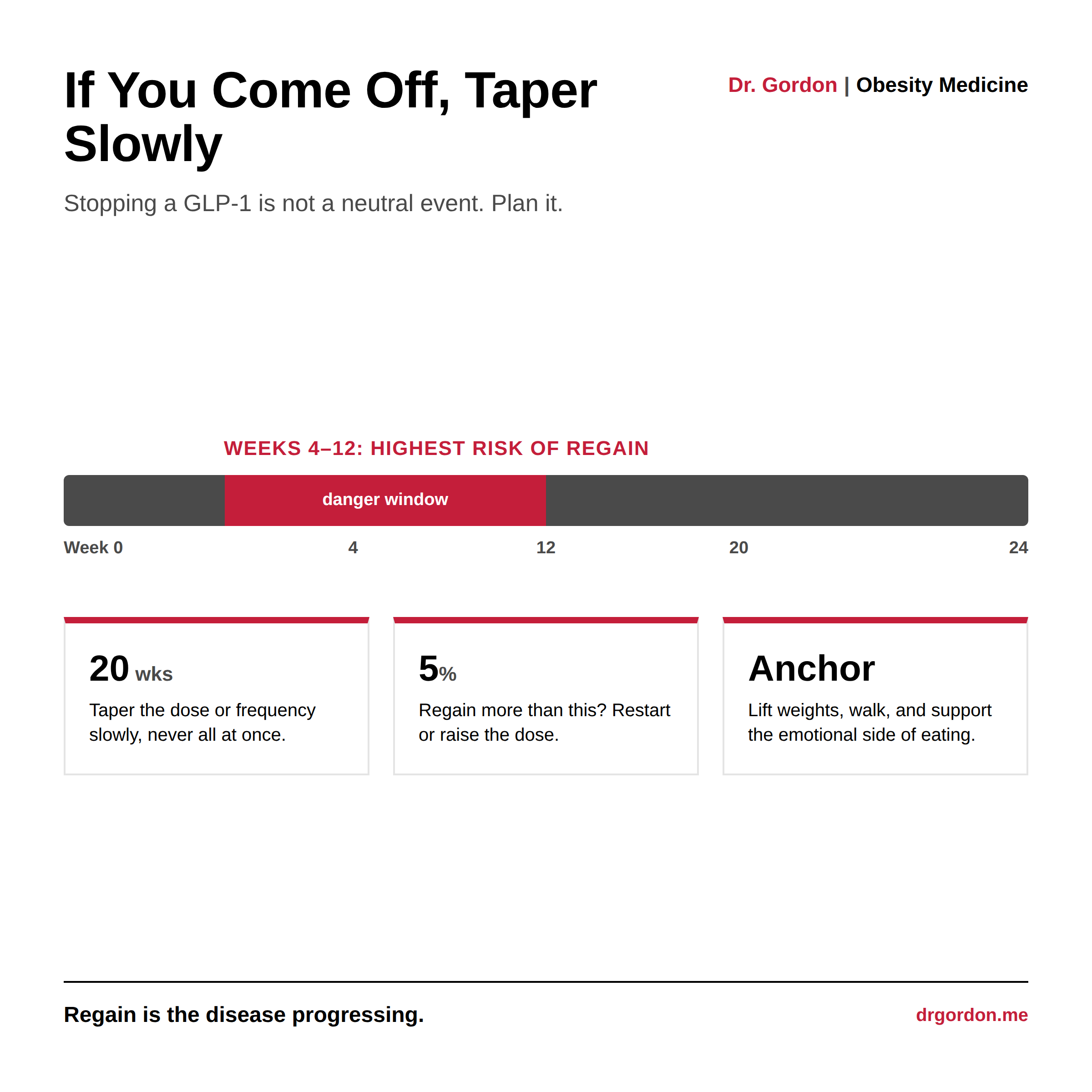
If you do decide to taper off the medication, be sure to do it slowly over about 20 weeks. When you stop abruptly, you get all the biological drive to eat along with an intense appetite.
The greatest risk for weight regain is in the first 4-12 weeks after stopping. It’s important to keep up your self-care habits. Lift weights, go for walks, and maybe even some therapy for emotional eating.
See this article for a comprehensive guide to maintenance.
Don’t forget, these medications do more than help you lose weight. In a real-world group of about 290,000 adults, people who stopped semaglutide or tirzepatide in the first year had higher one-year rates of coronary artery disease and heart failure than those who continued treatment. Some of that may be more about the type of patient who stops, but it’s something to be aware of.
Obesity is a chronic, relapsing, neuroendocrine disease.
GLP-1 medications like semaglutide and tirzepatide don’t cure it. They manage it.
In your message, you mentioned you are on testosterone pellets without estrogen and progesterone and are wondering if that’s appropriate. In menopause, estrogen and progesterone decline. Testosterone begins declining around age 40 and is independent of the menopausal stage. I always start treatment with estrogen and progesterone, then add testosterone on after assessing the patient’s reaction. Also, I don’t use pellets. Once they’re in, you can’t really take them out. I have had some patients come to me with uncomfortable side effects from supraphysiologic testosterone levels from pellets, like enlarged clitoris, facial hair, and acne. They had to wait it out in their discomfort.
Most medical societies recommend against pellet therapy for hormone replacement. And remember, there is no FDA-approved testosterone for women. Testosterone is used off-label for women all the time. My research came up with hypoactive sexual desire disorder as the only evidence-based indication. For more on testosterone in women, follow Kelly Casperson, MD. When replacing testosterone, transdermal administration is first-line. In some cases, I will use subcutaneous delivery. If you’re symptomatic with menopause symptoms like hot flashes, or if you’re having difficulty sleeping, discuss estrogen and progesterone with your functional medicine doctor.
Comments
Nothing yet. Say the first thing.
Sign in to join the conversation.