
Three questions from paid subscribers this week, all from women on a GLP-1. Val Woodring is trying to tell perimenopause apart from stress. Evee is 4 months postpartum, waking at 3 am, and scared the broken sleep is wasting her medication. Donna wants to know whether inflammation decreases with increasing GLP-1 dose.
All clinical claims in this article were fact-checked through OpenEvidence, an AI medical literature service, prior to publication. References are at the end.
Val Woodring asked:
“How can someone tell whether a poor response to a GLP-1 is more likely related to perimenopause or chronic stress (assuming other medical conditions have been ruled out)? Since the symptoms overlap so much, are there signs that help distinguish the two? If both are contributing, what interventions have the strongest evidence for improving GLP-1 response? Thanks 😊”
Val, there’s no test that separates these two situations. There’s no lab test or algorithm. Perimenopause and chronic stress are managed through similar systems. It’s hard to tell what’s causing fatigue, broken sleep, mood swings, brain fog, appetite acceleration, and increased visceral fat. So we read the pattern. Of course, reading the pattern starts with listening to the patient. A good doctor will not dismiss your concerns.
The flushing and the night sweats, especially climbing in frequency over months, are the most specific sign your ovaries are shifting. Stress can cause night sweats too, so a single sweat doesn’t rule anything out. Stress actually makes hot flashes worse. Women rattled by a stressful event reported 21 percent more of them.
The rising pattern points at your ovaries, not your stress.
Shorter intervals, longer ones, skipped periods, the whole thing going erratic. We often refer to perimenopause as the zone of chaos because your sex hormones become chaotic. The diagnosis and treatment are based on your symptoms, not your bloodwork. Stress suppresses a cycle evenly. Perimenopause is unpredictable. It waits, waits, waits, then hits.
And the timing gives it away. Stress symptoms rise and fall with your stressors. Perimenopause builds over months and years whether your life is calm or on fire.
It’s no fault of yours, and there’s nothing wrong with you. Your hormones shift dramatically in perimenopause.
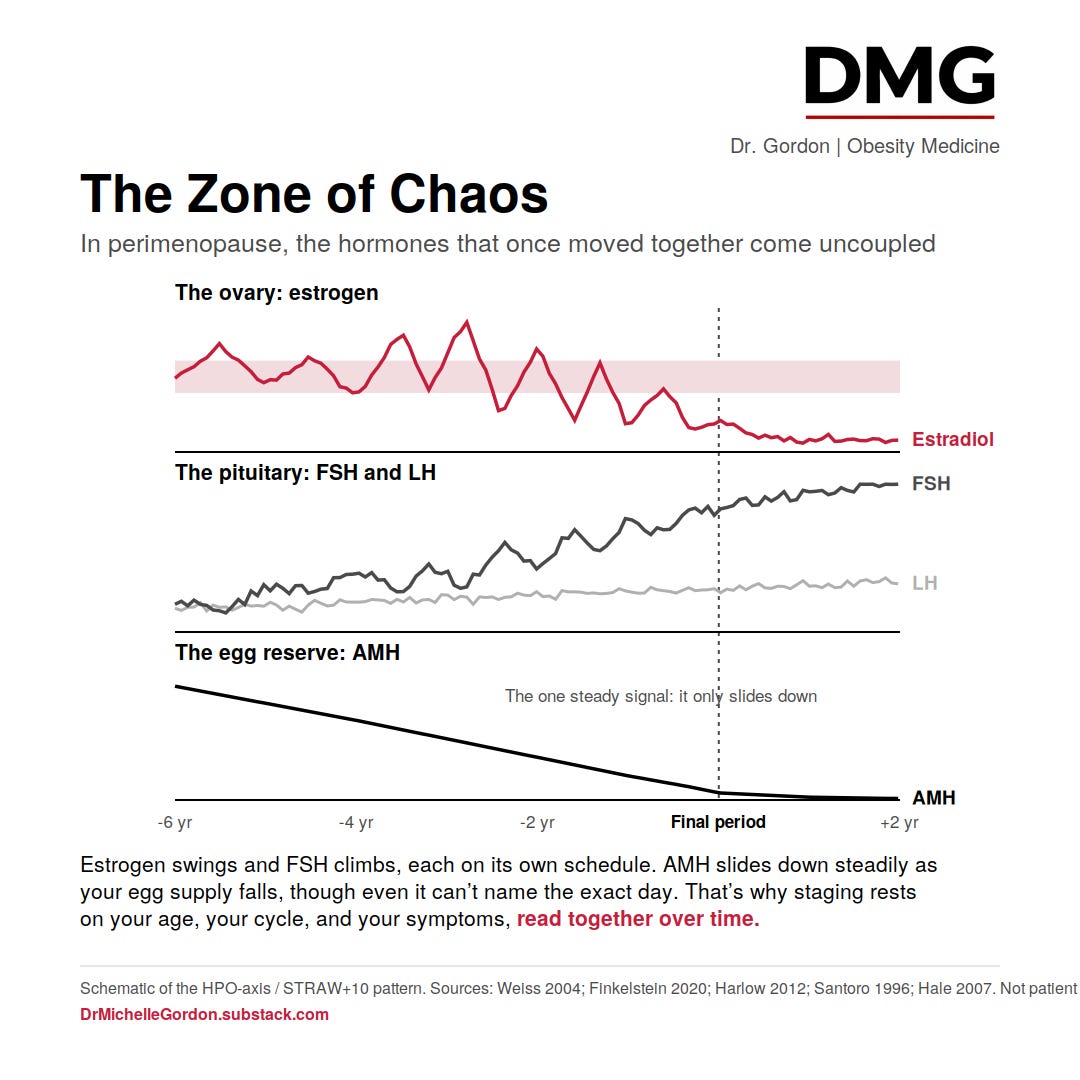
Figure 1: Perimenopause zone of chaos
As perimenopause progresses to menopause, the pituitary gland releases more FSH to get the ovaries to release estradiol. Eventually, the ovaries stop responding, and no more follicles are released.
Comments
Nothing yet. Say the first thing.
Sign in to join the conversation.