

PRESS RELEASE:
Greenwich CT, August 21, 2026
Today, Dr. Michael Goldstein, Republican nominee for Congress in Connecticut’s Fourth Congressional District, sent a letter to EPA Administrator Lee Zeldin asking the Environmental Protection Agency to examine a problem that has been treated for too long as merely local:
What happens when Hartford mandates development, but local communities are left with the sewer, stormwater, infrastructure and environmental consequences?
For Goldstein, the letter represents a central principle of his campaign:
Connecticut needs housing. But Hartford should not be able to mandate or incentivize additional development without answering whether the infrastructure necessary to support that development can actually handle it.
Goldstein is asking EPA and EPA Region 1 to review Connecticut’s 8-30g affordable-housing law and Public Act 25-1, formerly House Bill 8002, in communities draining into Long Island Sound.
His argument is not that Washington should control local zoning.
It is that Hartford cannot use state housing policy to escape federal environmental obligations.
The problem is visible right here in Fairfield County and Connecticut’s Fourth District and in my hometown of Greenwich.
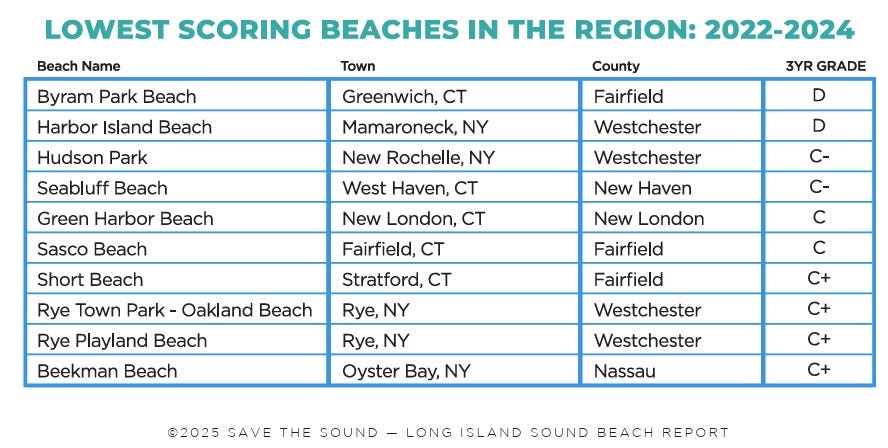
Source: Save the Sound
Greenwich’s Board of Health reported this year that the rainfall threshold for closing Byram Beach was reduced from one-half inch to just 0.3 inches following review of approximately a decade of testing.
The Town has investigated bacteria in the Tom’s Brook watershed and undertaken sewer testing and sewer-line grouting.
Save the Sound gave Byram Beach a D+ based on 2025 swimming-season data, with samples reportedly failing safe-swimming criteria 36 percent of the time overall and experiencing substantially greater problems during wet weather.
That may begin as a local problem, But the water doesn’t stop at the Greenwich border.
Long Island Sound connects Greenwich, Stamford, Darien, Norwalk, Westport, Fairfield and Bridgeport and the rest of Connecticut’s coastline.
And once pollution implicates federally protected waters and federal environmental statutes, there is a federal role.
That is what federal solutions to local problems looks like.
Hartford’s housing policies increasingly affect local land-use decisions. Public Act 25-1 also restricts aspects of municipal authority over off-street parking requirements for residential development.
Hartford doesn’t operate Greenwich’s sewer system.
Hartford doesn’t maintain Stamford’s pumping stations.
Hartford doesn’t manage stormwater in Norwalk.
Hartford doesn’t close beaches after heavy rain.
Our municipalities and taxpayers deal with those consequences.
My letter therefore asks an important question: before the state imposes additional density, shouldn’t somebody determine whether the sewer system, stormwater system, pumping stations and receiving waters can actually support it?
A wastewater plant’s average daily flow does not tell the entire story.
The real test comes during heavy rain.
Goldstein argues that infrastructure capacity must account for peak wet-weather flow, infiltration and inflow, pumping-station constraints, collection-system bottlenecks, overflow history and treatment performance.
Housing produces additional sanitary flow.
Development can add impervious surfaces that prevent rainwater dissipation.
Rain produces stormwater.
Aging infrastructure may already experience infiltration and inflow.
Those pressures can converge precisely when the system is under the greatest stress.
Infrastructure must come before mandates.
Today’s letter does not ask EPA to become a Connecticut zoning board.
It asks EPA to examine whether state-directed development in areas with documented wet-weather sewer limitations or recurring bacteria problems can create foreseeable conditions that cause or contribute to violations of the Clean Water Act or degradation of coastal recreational waters protected under the BEACH Act.
Goldstein specifically asks EPA to use Byram Beach and the western Long Island Sound watershed as a case study, while examining the broader Fourth District shoreline.
Instead of waiting for a sewer overflow or another beach closure, government should be asking these questions before additional infrastructure loading occurs.
Too often, Washington politicians talk about national issues while residents struggle with problems right outside their doors.
Goldstein’s approach is different:
Find the federal connection to the local problem—and use it.
When federal environmental law can help protect a Greenwich beach or any beach in Connecticut, use it.
When federal resources can help modernize wastewater infrastructure, pursue them.
When state mandates potentially collide with federal clean-water requirements, ask the federal agency responsible for enforcing those requirements to investigate.
As Goldstein wrote in today’s letter:
“As a candidate for Congress, I believe federal solutions are required when local problems raise federal questions.”
That is the philosophy behind this campaign.
We can build housing.
We can modernize wastewater and stormwater infrastructure.
We can protect local decision-making.
We can keep our beaches open.
And we can restore Long Island Sound.
Federal Solutions to Local Problems.
Dr. Michael Goldstein is the Republican nominee for Congress in Connecticut’s Fourth Congressional District.
Doctor. Lawyer. Father. Fighter.
Learn more about Dr. Goldstein, his grassroots campaign and how you can get involved or donate: goldsteinforcongress.com
Support Dr. Michael Goldstein for Congress.
Vote November 3.
Paid for by Goldstein for Congress
No posts
Comments
Nothing yet. Say the first thing.
Sign in to join the conversation.