
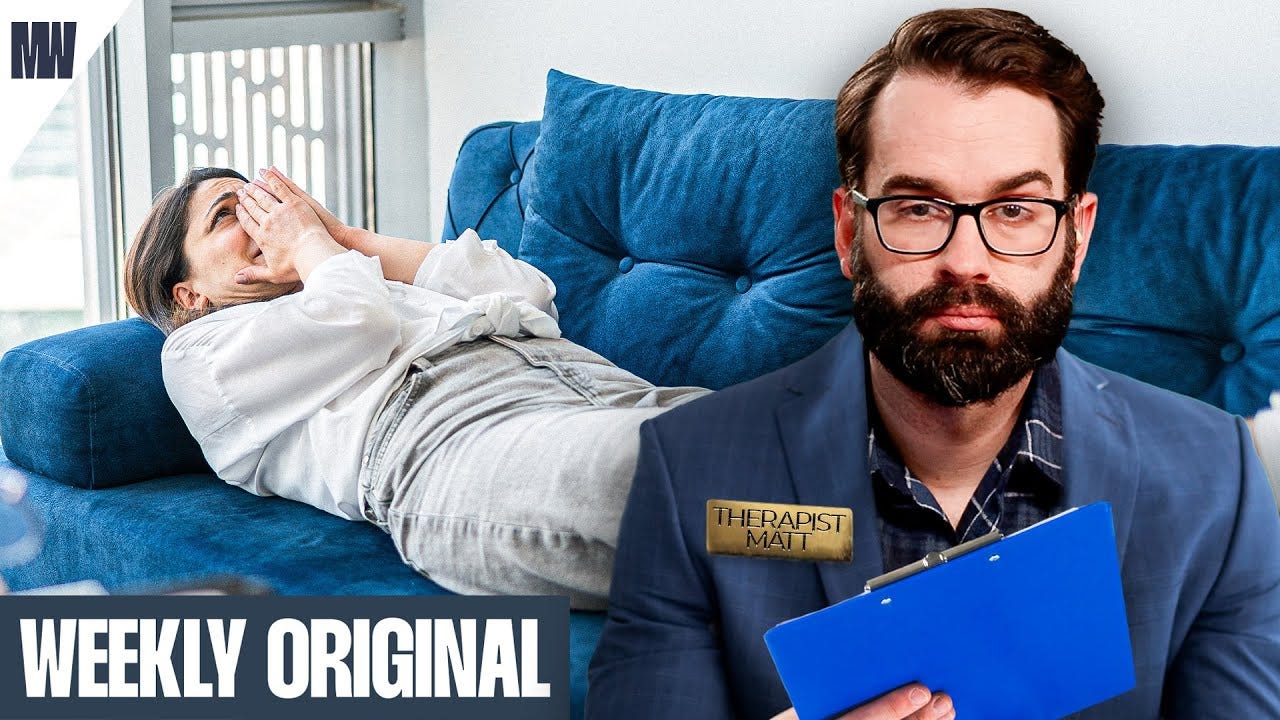
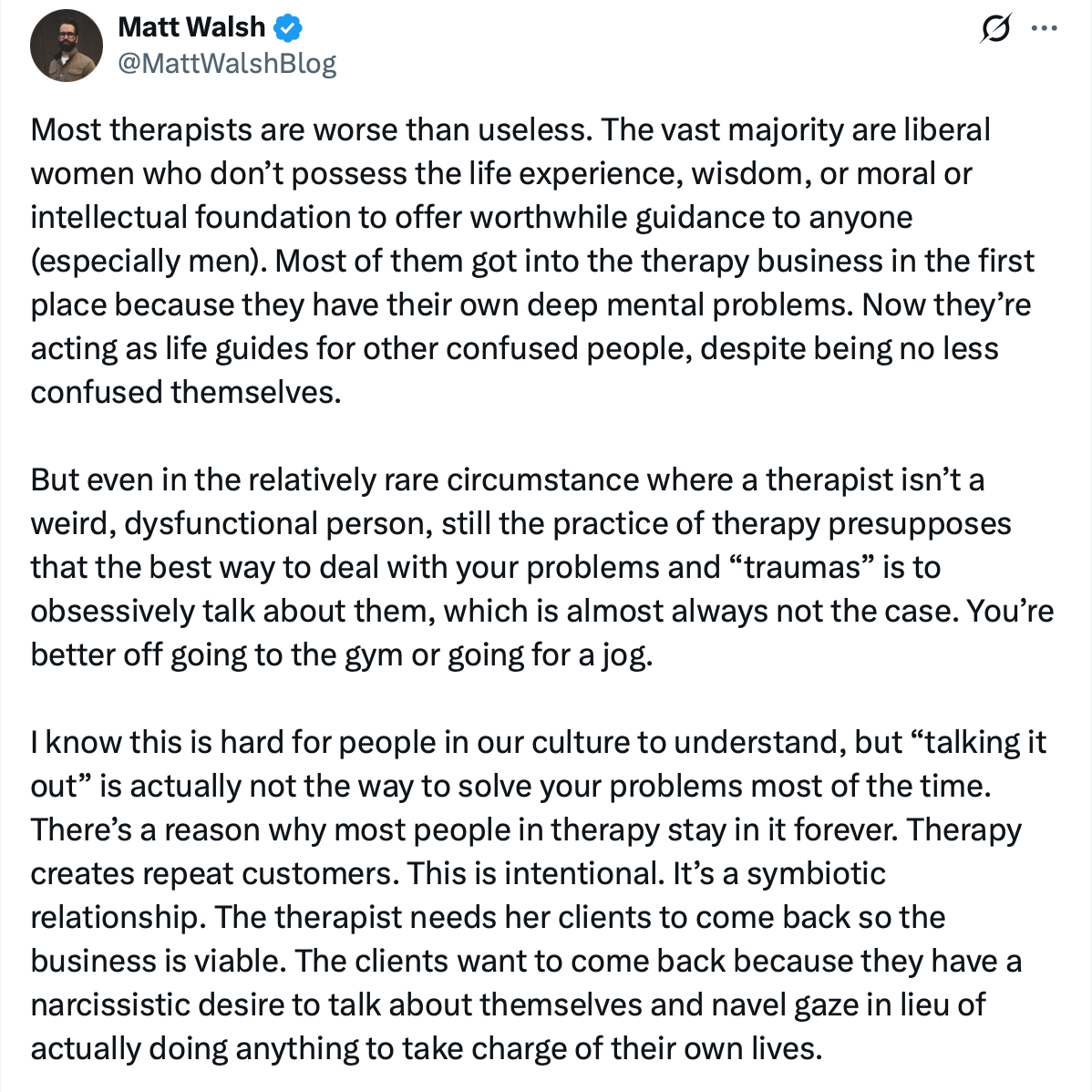
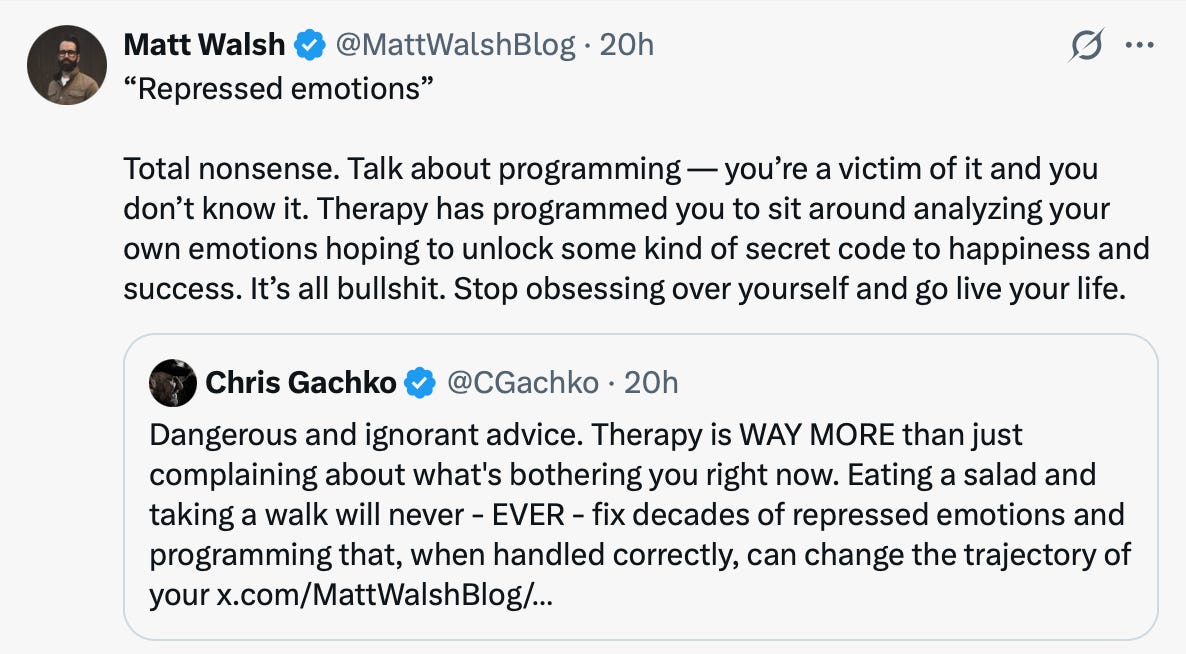
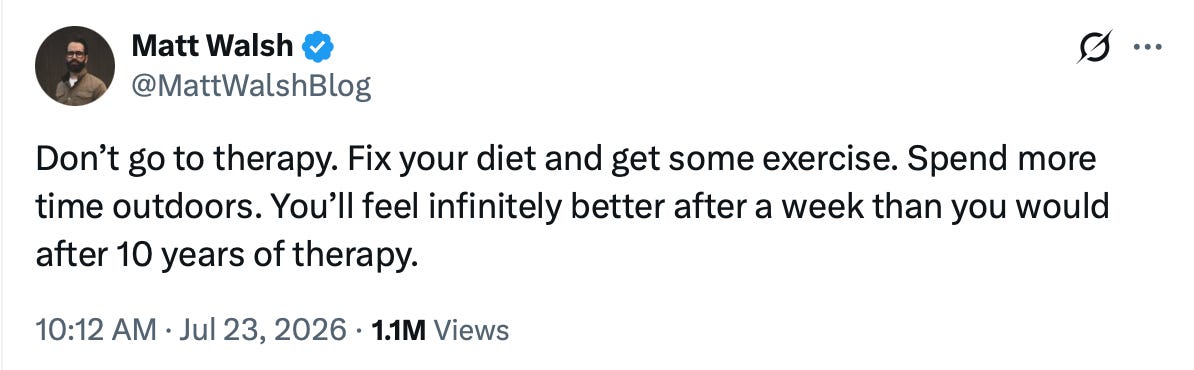
Matt Walsh spent this week torching the therapy profession on X. The spark was a Wall Street Journal article asking whether therapists are to blame for the rise of adult children cutting off their parents. Walsh took the question and ran with it: most therapists are worse than useless, therapy is a business model built on repeat customers, and repressed memories are a fraud cooked up by the psychiatric industry.
What followed was predictable, his audience cheered and the mental health establishment reached for its credentials and its outrage. And in all the noise, nobody bothered to sort out which of his claims are actually true.
So let me do it, because I’ve worked inside this system from just about every angle it has. I entered it at 22, working in a children’s psychiatric hospital while I made my way through my graduate education. From there I went into the juvenile justice system, eventually serving as a juvenile probation officer with kids who had committed crimes and carried psychiatric diagnoses at the same time. I earned a masters degree and counseled in the schools. Then came a doctoral program in clinical psychology, and with it the community mental health centers, the home visits in impoverished neighborhoods, the clinic training in cognitive behavioral therapies. Following my graduation and attainment of a license, I opened my own center. I’m board certified in cognitive behavioral therapy, I’ve contributed to the scientific literature, and for the past six or seven years I’ve been one of the most outspoken critics of the mental health industrial complex you will find anywhere.
And here's the tension I live with, because it belongs at the center of this conversation. I recently stopped providing therapy because I was being called to new challenges, and I answered. But that isn't the whole story. The limitations of therapy, and of the system it operates inside, are real. The potential harms are significant and I wasn't willing to pretend otherwise.
So today I provide coaching and consultation to people around the world, outside that system. The people who reach out to me have real problems and they’re looking for real solutions, not a quick social media take that goes all or nothing.
Which raises the question every critic owes an answer to: if therapy and drugs are part of the problem, then what do we do? That question has to be part of the conversation and part of the solution, or the critique is just another performance. Walsh lands some real punches. He also swings wild, and every wild swing hands the industry an excuse to dismiss the entire critique. That’s how reform dies.
Let me start where Walsh and I agree, because the agreement runs deeper than my colleagues would like.
Talking about your problems is not, in itself, curative. Incessently replaying your fears, your childhood, your inner world, week after week, does not heal anything, and in plenty of cases it makes things worse. The reason isn’t complicated. Where your attention goes, your energy flows.
Park a person’s attention on their wounds for an hour a week, for months or in many cases years, and you don’t get transformation. You get someone with a more elaborate story about their wounds. Identifying a problem area has exactly one legitimate use: to become more intentional about making changes in your life.
That’s it.
The identification is the starting line. People change through what they do differently, not through what they analyze endlessly, and an industry built on the back of Freudian psychology has no incentive for you choose a different direction.
Walsh is also right about repressed memories, and this is his strongest ground, though the full truth is even more unsettling than his version. The idea that the mind can bury a traumatic event completely, and that only a trained professional can dig it back up, has never had reliable scientific support.
But to understand why the practice is so dangerous, you have to see what actually happens in that room. A therapist is never a neutral observer of a client’s story, they are a co-creator of it. Every question chosen, every theme reflected back, every knowing nod at the mention of a parent shapes the reality the client walks out believing. And in a field now trained on victim and perpetrator narratives, that co-authored reality tends to arrive with a villain pre-installed.
Most clinicians don’t even understand the limits of the instrument they’re working with. The mind is not a recording device. It composes. It creates stories, and the further you get from an event, the less reliable the story becomes and the more open it is to suggestion.
Memory researchers showed decades ago just how easily false memories can be planted under exactly those conditions. Recovered memory therapy tore families apart and generated false accusations that put innocent people through hell, and the wreckage was litigated in open court through the eighties and nineties.
The actual finding from trauma research is almost the opposite of the repression story: terrible events tend to be remembered too well, not too little. When you consider the power of suggestion, and the fallible nature of our memory, you understand the inherent danger of therapist interpretations. A clinician still fishing for buried memories in 2026 is practicing pseudoscience with a license.
And before anyone relaxes because recovered memory therapy is yesterday's scandal, understand that the same ideas are driving new problems. The therapist no longer digs for a buried memory. She reinterprets the remembered ones. The strict father becomes emotionally abusive. The imperfect mother becomes a narcissist, diagnosed in absentia by a clinician who will never meet her.
Session by session, an ordinary flawed childhood is co-authored into a case file, and the prescribed treatment is distance. That's how you get the Wall Street Journal's story: a generation of parents cut off on professional advice, and a woman who reconciled with her mother only after years she can never get back. The buried memory scam manufactured a hidden past. This one manufactures a villain out of the visible one.
He’s right about the chemical imbalance story too. The serotonin narrative has collapsed, and the field’s own leaders now shrug and call it a simplification, as if it were harmless. It wasn’t. It was a marketing device that persuaded millions of people their suffering was a permanent brain defect requiring permanent drugs. I’ve written about this at length and won’t rehash it here.
He’s right that movement, sunlight, real food, and time outdoors will do more for most struggling people than years of weekly talk. The exercise research isn’t fringe; it’s robust enough to embarrass the treatment establishment.
And he’s right about the training pipeline, though the problem starts earlier than he thinks, with how easy it is to get a license to do this work at all. Think about what we’re actually describing. A twenty-something, barely out of adolescence, can complete a two year masters program and walk out legally credentialed to guide other human beings through the darkest passages of their lives. Two years. And what fills those two years? Not a rigorous academic education. Not a scientific foundation. Not training in critical thinking. Not the history of how human beings have met hardship across thousands of years. Not the philosophical underpinnings of suffering and meaning. And life experience isn’t on the syllabus at all.
And let me be fair about something before I go further, because it makes what follows worse, not better. Natural born helpers exist. Every community has them. The person everyone instinctively brings their troubles to. The young woman or young man who is somehow wise beyond their years, who can sit with pain without flinching or fixing.
Some of them enter these programs carrying a genuine gift. And here is the tragedy: the training is more likely to interfere with that gift than to develop it. Two years of psychiatric pseudoscience layered over frameworks descended from Marxist philosophy, oppressor and oppressed, power and privilege, systems and structures, and the natural helper walks out the other side pathologizing her neighbors instead of understanding them. Most never even know it happened. That’s how indoctrination works. Nobody experiences being indoctrinated. They experience learning.
Now consider who has been flooding into these programs. Enrollment in masters level counseling programs surged after covid, and the profession congratulates itself on the influx. I read it differently.
A culture marinated its young people in therapy-speak for a decade, taught them that feelings are facts and discomfort is trauma, locked them inside for two years, and then watched a wave of them decide to make suffering a career. Mostly young women, drawn from one narrow slice of the culture, entering a curriculum with no science to push back with, no history to compare against, no philosophy to test ideas with, and no lived hardship to weigh any of it against. Minds with no antibodies.
The surge is not a sign of a society getting serious about mental health. It is a symptom of the wound. And the product is now graduating at scale. The modern student can write you a gorgeous essay on her own positionality before she has ever met a client. She’ll log more classroom hours examining her privilege than she’ll ever spend learning what a starving brain does to a teenager’s thinking. She can spot a microaggression at fifty yards but couldn’t build an exposure hierarchy if her degree depended on it, which, conveniently, it doesn’t.
Here’s what Walsh doesn’t understand, and can’t, because he’s never been in the room with it.
There is a percentage of our fellow brothers and sisters who are genuinely suffering and in a bad place. The young woman whose eating disorder has carried her to the edge of organ failure. The man whose obsessions and rituals have shrunk his world to a single room. The person who survived something legitimately horrific, and I mean legitimately, not the concept creep version where a rude email gets called trauma, and whose nervous system never came back down afterward.
Thanks for reading Radically Genuine ! This post is public so feel free to share it.
Post traumatic stress is real, and it visits roughly 20 percent of the people who pass through the true atrocities of life. They live with nightmares and intense anxiety, with a hypervigilance that never powers down, and inside painful memories that the rest of us are able to set down and they cannot. This can compound itself with substance abuse, eating disorders and a range of medical problems from prolonged stress.
This is the group Walsh’s advice abandons, and it’s exactly where his thread stops being provocative and becomes ignorant, because these people require help. Not a jog, not a diet, and not a lecture about self-obsession, but skilled and wise direction from someone who understands how a person becomes trapped inside their own fears and how they get free.
For the ones who do require help, a validating chat was never going to be enough, and honestly I wouldn’t even call what they need therapy. That word now belongs to the commodified 45 minute session with a provider who is, in all likelihood, woefully undertrained for the severity sitting across from her.
What they need is closer to skilled guidance through the hardest passage of their life, offered by someone with real training, real experience, and the wisdom to tell the difference between pain that needs to be felt and a pattern that needs to be broken. Walsh throws these people away in his rush to burn everything down.
But don’t mistake my correction for a defense. The system was not built for the people I just described. It runs on manufacturing patients out of everyone else, and the engine of that manufacturing is the diagnostic system itself.
Now the inversion nobody in the field likes to say out loud: the majority of people who walk into therapy are not the severely stuck people I described. They’re the worried, the lonely, the demoralized, people moving through the ordinary pain of being alive. Meanwhile the people who are actually drowning are the least likely to get real help. Epidemiologists have documented this pattern for years. A huge share of treatment flows to people who don’t meet criteria for anything, while people with severe conditions go untreated.
Put yourself in that practitioner’s chair. The articulate, insightful, high functioning client is a pleasure to see and a reliable revenue stream. The client with a severe eating disorder is a medical emergency waiting to happen on your watch. The suicidal client is a liability. The complex case is exhausting and doesn’t fit the schedule. So the sickest get screened out, referred out, or waitlisted into oblivion, and the hour goes to whoever needed it least. The navel gazers Walsh mocks are, in many cases, exactly the clientele the business model selects for.
And consider what the people being screened out actually require, because this is where the mismatch stops being an economics story and becomes a moral one. Recovery from a severe eating disorder, from crippling obsessions, from an addiction that has hollowed out a family, was never going to happen inside an hour of talk and a prescription. It takes a daily plan, worked daily. Interventions that show up on Tuesday morning and Saturday night, not just at the appointed hour. It takes the family in the room, trained and supported, because the family is the treatment team whether anyone admits it or not.
It takes learning an entirely new way of responding to pain, which means doing very difficult things, again and again, with love and encouragement on both sides of the struggle. Getting sober. Getting physically healthy. Meeting emotions in a new way instead of running from them. And beneath all of it, a new way of thinking about their life and their purpose, because nobody climbs out of hell for the privilege of returning to a life that means nothing to them. The goal is a relationship with pain that transforms and expands a person. Not one that restricts them further.
Now ask what fraction of that fits into fifty minutes a week and a refill. The system hands those legitimately struggling the one intervention they need least, then calls the inevitable failure treatment resistance. The failure was never in the patient. It was in the dose, the design, and the delivery.
Step back far enough and the Walsh fight shrinks to its true size. Two loud voices arguing over the wreckage of a much older loss. Because beneath the bad science and the perverse incentives sits a cultural problem, and it began long before any of today’s therapists entered graduate school.
We live in a culture that has medicalized the human experience and forgotten what normal is. Somewhere along the way we started relating to our own minds as if the brain were a dysfunctional organ, and to our emotions as if they were symptoms of an illness. Sadness became something to screen for. Fear became a chemical error. Grief was given a diagnostic timeline, as though love were supposed to file its paperwork and move on. We lost the oldest conversation human beings ever had with themselves, the one where emotional pain is a meaningful signal, pointing at something that matters, asking something of us.
And watch what that loss does inside a person. When your inner world is framed as pathology, you begin to judge it. You monitor yourself for malfunction, and everything you find, and you will always find something, becomes more evidence that you are broken.
The judgment grows unbearable, so you reach for escape, and here the culture performs its cruelest trick. The drinking, the drugs, the numbing, the endless distraction we reach for to flee an inner world we’ve been taught to fear? Each escape gets labeled another disorder, requiring another treatment, producing another patient. The machine feeds on the despair it manufactures, and everyone involved sincerely believes they are helping.
And the most respectable escape of all comes with a prescription. A drug that blunts emotional experience is chemical avoidance, whatever the label on the bottle says, and the muting so many people describe on these drugs is not a side effect of the treatment. For many, it is the treatment.
This training starts young. It’s in our movies and our children’s shows, where feelings are fragile things requiring expert management. It’s in public schools that teach emotional monitoring before they teach emotional courage. It runs through the collective consciousness like a low-grade fever, whispering to children that their inner world is dangerous and someone else holds the answer to how they should feel and behave. A child marinated in that message for eighteen years doesn’t need to be recruited into patienthood later. She arrives pre-enrolled.
It was not always this way. For most of human history we carried a different inheritance. Myths, stories, and parables that taught people how to respond to their own minds and their own suffering. The Stoic reminding himself each morning that the obstacle is the way. Every culture kept its sages, its elders, its philosophers, the ones who had crossed the hard country ahead of you and could tell you what your pain was for. That figure is nearly gone now, replaced too often by a cog in a system, sincere but unformed, who will undermine your natural resilience and convert you into a perpetual patient without ever once meaning you harm.
So let me stand in the older tradition for a moment and tell you what the sages knew, what the whole weight of human wisdom said before we traded it for a diagnostic manual.
You are not your mind. The thoughts that pass through are transient mental noise meant to be observed. Your emotions are not dangerous. They are signals, powerful energies meant to be felt, understood, and used, and they will move through you if you stop running from them. And you are not a diagnosis, a disorder, or a malfunctioning brain. You are a child of God, here with a purpose, and the pain in your life is not the interruption of that purpose. It is very often the doorway into it.
Anyone who helps you live that way is helping you transform, whatever their title. Anyone who teaches you to fear your inner world, to outsource it, to medicate it into silence, is helping you stay sick, whatever their credentials.
Choose accordingly.
AWAKEN
After Labor Day, the Radically Genuine Podcast enters a new era: an in-person studio, a new home built for this mission, and my new co-host, Tracy Thurman, whose calling has run parallel to mine in ways neither of us can dismiss as coincidence. Together we are expanding far beyond the mental health industrial complex into the full terrain: spiritual awakening, health and medical freedom, consciousness science, and the hidden knowledge this series has begun to unveil. Long-form conversations, short films, documentaries, and a community for those ready to go deeper. Everything you are reading here becomes the foundation for what we build there. If you feel called to this work, you are already part of it. More soon.
Comments
Nothing yet. Say the first thing.
Sign in to join the conversation.