
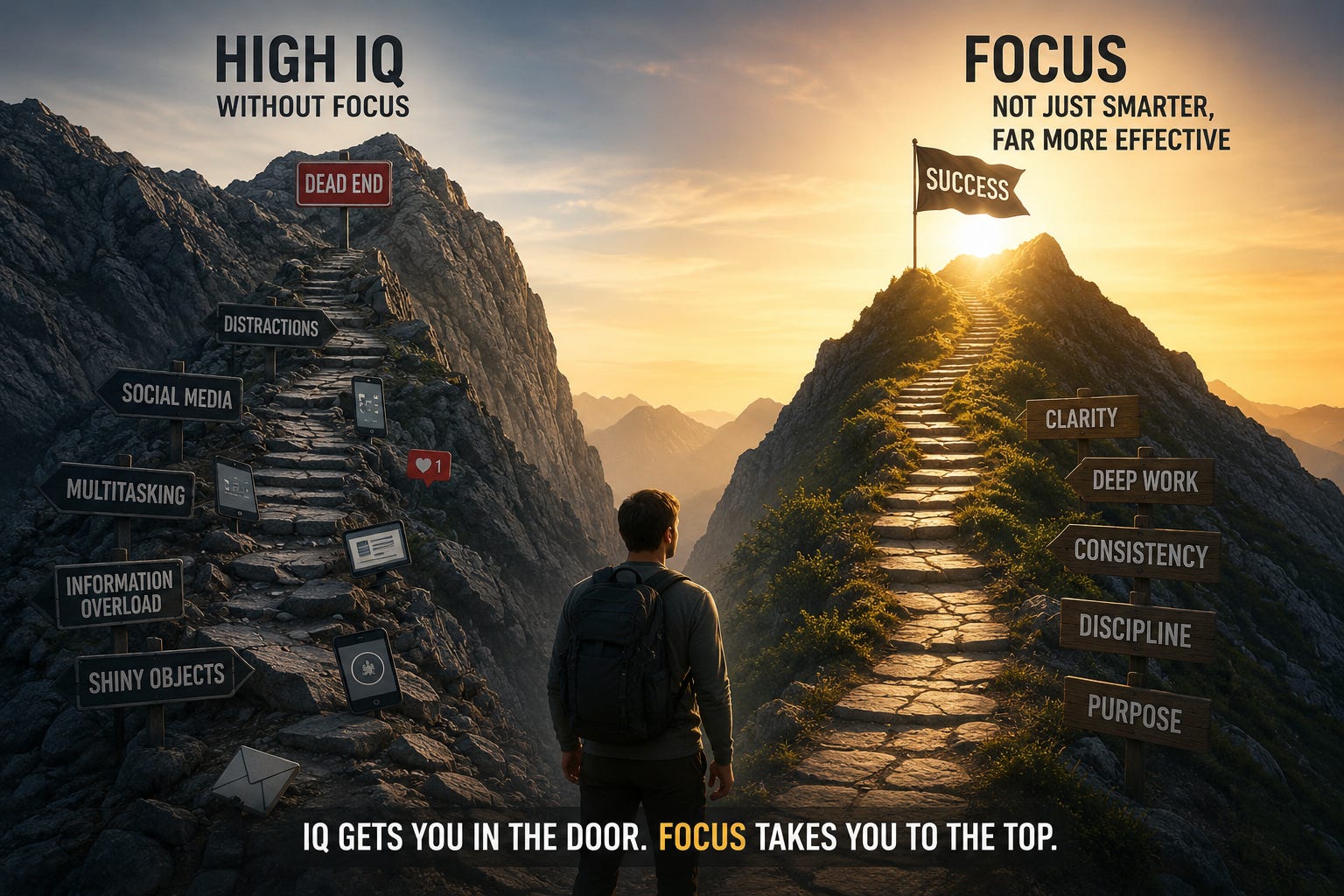
A few years ago, I began noticing something curious among high performers. It didn’t matter whether they were leaders, entrepreneurs, athletes, scholars, pastors, or business owners. I was thrilled to realize that many of the most successful people were not always the smartest people in the room. What separated them from everyone else wasn’t necessarily brilliance. It was focus.
They had the remarkable ability to direct their attention toward what mattered most and stay there long enough to produce meaningful results. They weren’t constantly chasing every new opportunity, reacting to every distraction, or allowing every interruption to dictate their day. They knew where they were headed, and they protected their attention accordingly. Over time, I came to believe that it was that simple habit that created extraordinary outcomes.
For generations, society has been fascinated with IQ. We have measured it, celebrated it, and often assumed it was one of the best predictors of future success. Intelligence certainly matters, and I would never suggest otherwise. However, in today’s world, I am increasingly convinced that focus has become a more accurate predictor of achievement than IQ.
The modern challenge is no longer a lack of information. The modern challenge is a lack of attention.
Think about it. Never in human history have we had more access to knowledge. Every answer, every tutorial, every book summary, every expert opinion, and every research article is available within seconds. The problem is not finding information. The problem is deciding what deserves our attention and then maintaining that attention long enough to do something meaningful with it.
We are living through an attention crisis.
Every day, countless organizations compete for your focus. Your phone vibrates. Your email refreshes. Social media updates endlessly. News alerts appear at all hours. Advertisers spend billions trying to capture a few moments of your attention. Entire industries are built upon one objective: keeping you engaged for just a little longer.
The result is that many people are drowning in information while starving for wisdom.
They consume content all day long but struggle to produce meaningful outcomes. They are busy but not necessarily productive. They are connected to everyone but know no one. Often, they are disconnected from their most important goals. They have more tools than ever before and less concentration than ever before.
In this environment, focus becomes a superpower.
Imagine two people beginning their careers. One possesses exceptional intellectual gifts. They learn quickly, process information rapidly, and understand complex ideas with ease. The second person possesses average intelligence but has learned to focus deeply, work consistently, and eliminate distractions.
Fast forward ten years.
Who is more likely to have developed expertise? Who is more likely to have written the book, built the company, completed the degree, strengthened the marriage, developed the ministry, or achieved the goal?
Increasingly, the answer is the focused person. Why? Because success is rarely determined by what we know. Success is usually determined by what we consistently do.
That distinction is worth repeating. Success is rarely determined by what we know. Success is usually determined by what we consistently do. Focus is the bridge between potential and performance.
Every one of us possesses untapped potential. Some people have tremendous talent. Others have valuable experiences, unique opportunities, or natural abilities. Yet potential by itself accomplishes nothing. Potential must be directed. Potential must be developed. Potential must be sustained through effort over time.
I have met countless people with enormous potential who never achieved what they were capable of achieving. Their problem wasn’t intelligence. Their problem wasn’t opportunity. Their problem was that they could never maintain focus long enough to convert possibility into reality.
On the other hand, I have met many individuals who were not the smartest people in the room but consistently outperformed everyone around them. They showed up every day. They concentrated on the right priorities. They finished what they started. They understood that small efforts repeated consistently often outperform occasional bursts of brilliance.
The truth is that focus compounds. Just as money compounds through wise investment, attention compounds through consistent application. Every day you direct your attention toward a meaningful goal, you make a deposit into your future. Every hour spent learning, practicing, creating, building, or serving accumulates over time. What appears insignificant today often becomes transformational tomorrow.
This is why focused people frequently seem lucky. From the outside, it appears as though success arrived suddenly. What observers fail to see are the thousands of small decisions that preceded the breakthrough. They do not see the early mornings, the disciplined routines, the hours of concentrated effort, or the years spent developing mastery. What appears to be luck is often focus compounded over time.
The science behind this reality is fascinating. Neuroscience tells us that our brains are continually adapting to the demands we place upon them. Attention acts like a spotlight that directs the brain’s resources toward what matters most. Neural pathways strengthen through repeated use. Skills improve through deliberate practice. Learning accelerates when attention is sustained.
In simple terms, your brain grows where your attention goes. That idea should stop us in our tracks. If your attention shapes your brain, then your attention is shaping your future. What you focus on today is influencing who you become tomorrow. Every distraction carries a cost because every distraction represents attention that could have been invested elsewhere.
This has enormous implications for leadership. One of the greatest misconceptions about leadership is that it is primarily about authority. In reality, leadership is often about attention. Leaders communicate priorities through what they consistently focus on. Teams pay attention to what leaders emphasize. Organizations eventually become reflections of collective attention.
Show me what a leader consistently focuses on, and I can often predict the future of their organization. The same principle applies to families. It applies to marriages. It applies to churches. It applies to businesses. It applies to our personal lives. Our lives eventually become the sum of what repeatedly receives our attention.
This insight also aligns with one of the central ideas behind Contextual Intelligence and 3D Thinking. Effective leaders learn to balance hindsight, insight, and foresight. They focus on lessons from the past, realities of the present, and possibilities for the future. None of that happens accidentally. It requires intentional attention.
Hindsight requires us to focus on what we have learned. Insight requires us to focus on what is happening right now. Foresight requires us to focus on where we are headed.
Focus is what connects all three dimensions. Without focus, hindsight becomes nostalgia. Insight becomes confusion. Foresight becomes fantasy. With focus, those three dimensions become powerful tools for navigating uncertainty and complexity.
Perhaps that is why focus has become so valuable in our age. The world is not becoming simpler. If anything, it is becoming more complex, more interconnected, and more distracting. Leaders face increasing uncertainty. Professionals face increasing demands. Families face increasing pressures. The ability to focus amidst chaos is becoming one of the defining competencies of our time.
The future will not belong solely to those who know the most. The future will belong to those who can focus the best. It will belong to those who can think deeply while others skim superficially. It will belong to those who can sustain effort while others become distracted. It will belong to those who can identify what matters most and then relentlessly direct their attention toward it.
The good news is that focus is not reserved for a gifted few. Focus is trainable. It can be strengthened. It can be cultivated.
Every time you choose a priority over a distraction, focus grows stronger. Every time you finish an important task before checking your notifications, focus grows stronger. Every time you spend time creating instead of merely consuming, focus grows stronger.
Like a muscle, attention develops through intentional use. So let me leave you with a challenge. Take inventory of your attention. What receives the best hours of your day? What occupies your thoughts? What consumes your energy? What consistently pulls you away from your most important goals? Your answers may reveal more about your future than any IQ test ever could.
For decades, society has looked to intelligence as a measure of human potential. Yet potential alone is never enough. Potential without focus remains unrealized. Potential without focus remains trapped in possibility.
IQ may influence how quickly you learn. Focus determines whether you become what you were capable of becoming. And in a distracted world, that may be the most important advantage of all.
Thanks for reading Becoming EPIC Journal! This post is public so feel free to share it.
Comments
Nothing yet. Say the first thing.
Sign in to join the conversation.