
(I believe a systemic global collapse will occur anytime between now and 2030. This article, and its follow-ups, attempts explain how this will transpire).
The rising backlash in the United States over H-1B visas is not merely a dispute over jobs or immigration. It is a belated recognition that America’s digital dominance increasingly rests on a fragile and outsourced labour model — one that prioritises managerial control and cost efficiency over institutional continuity and domestic capability. Silicon Valley, long mythologised as a crucible of innovation, now functions less as a builder of sovereign technological power than as a rent-extracting platform empire, dependent on imported talent to sustain an increasingly hollowed-out system.
This dependency has hardened into an addiction disguised as policy, routinely rationalised as a strategic imperative to preserve America’s IT primacy. Yet to grasp the structural nature of this reliance, one must first examine the digital environments from which this talent is drawn. That, in turn, requires a clear understanding of what a genuine “IT superpower” actually is.
The Twin Silicon Towers
An IT superpower is defined by its ability to command the entire digital value chain, from physical substrates to abstract systems, under conditions of stress. It is a civilisation capable of designing, manufacturing, deploying, securing, and iterating digital infrastructure at global scale. It is a civilisation that builds, owns, and weaponises the stack.
In the 21st century, this translates to not just economic advantage but a whole new imperialism altogether. And much like the imperial precedents of yore, the current contest has two competing architects: the United States and China, centered in Silicon Valley and Shenzhen respectively. Everyone else is a tenant, a tributary, or a battlefield.
At the centre of this matrix lies the physical dominion of hardware that rules our age. Semiconductors, hyperscale data fortresses, and global information arteries act as both products and geopolitical scalpels. The U.S. wields this scalpel with chilling grace, controlling the very ideas of chips (design tools, architectures) and the high-tech machines needed to print them, even if the dirty work of fabrication happens overseas. In imperial terms, it is the master tasking his servants to work the forge, while keeping the sacred blueprints locked in its vault.
AI Neo-Colonialism: How Big Tech Is Strip-Mining the Global South for Data
·
July 20, 2025
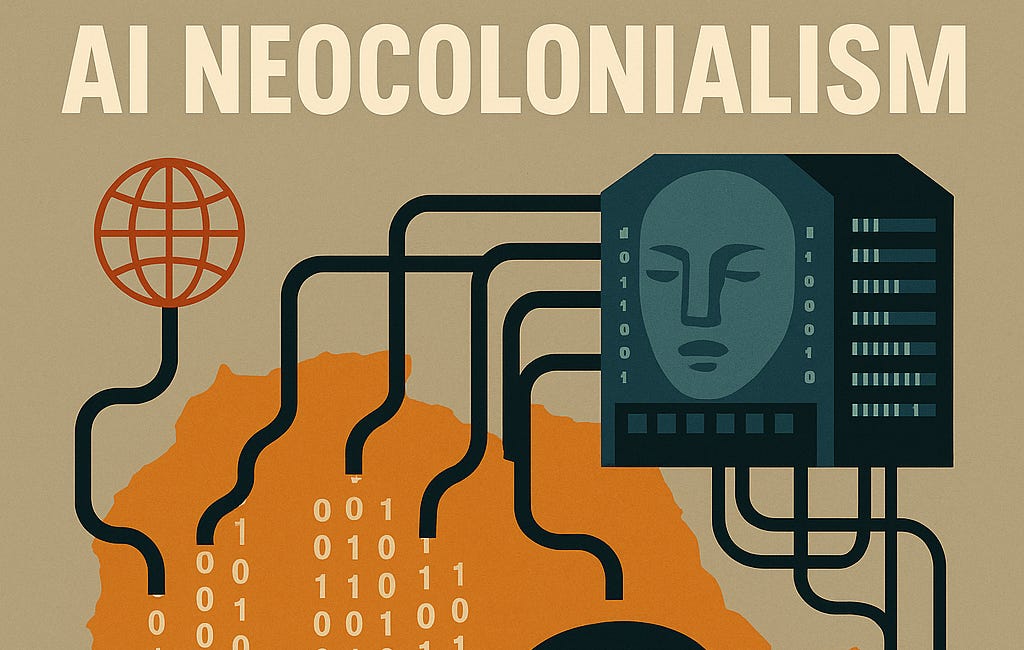
The new colonial frontier isn’t restricted to mineral-rich Congo or oil-drenched Venezuela. It’s digital, invisible, and everywhere. From the shantytowns of Nairobi to the barrios of Manila, smartphones hum with the raw material of the 21st century: data, all sorts of data. And just like spices and slaves once sailed westward in imperial galleons, metad…
China, in the meantime, responded not with despair, but with unyielding defiance. Denied the finest tools, it built its own in staggering volumes, even if the first production runs were outdated, uglier and heavier. It swapped the pursuit of elegance for the doctrine of relentless, sanction-proof redundancy. While the West obsesses over nanometre pageants, China has been quietly conquering the boring, essential, wartime foundations of the digital world. It forged the mature nodes, the power grids, and a comprehensive manufacturing juggernaut that keeps the lights on when the algorithms fail. Its ascent is not a matter of if, but of when. The countdown clock is ticking more robustly in Beijing rather than in Washington.
Above the physical dominion sits software. It is the ethereal layer of digital diktats that make hardware bow to human will. America’s dominance in this area cannot be overstated. Its tech titans shape reality itself and script the prevailing narrative. Windows, iOS, AWS, and TensorFlow are not mere tools, but de facto constitutions for the digital age. Governments, armies, universities and banks are born into this American-made universe, breathing its logic, and paying its rent. China, systematically excluded, resolved to forge a parallel universe. The result is The Great Digital Schism — two suns, two gravitational pulls, and two competing futures.
IT superpowers are animated by human capital. The U.S. system operates like a seductive siren that lures the world’s brightest minds into its California orbit, crowning a handful as billionaire demigods who, in turn, extend its dominion. It cloaks itself in the cult of individual genius, even as the deep state’s hidden hand quietly anoints the winners and dooms the rest. China’s model, by contrast, has been likened to an ant colony. It is a relentless, disciplined tide of homegrown engineers marching in lockstep with state mandates, strategic imperatives and sparks of raw genius.
When a crisis strikes, the American deep state quietly orchestrates resolution through its private vassals by dispensing contracts, imposing controls, and neutralizing threats behind closed doors. China’s deep state simply issues commands. It can redirect entire rivers of capital and talent overnight toward a single, unrelenting objective. One system is a dazzling yet fractious republic of tech barons, perpetually negotiating among themselves. The other is a digital Sparta that is lean, mean and disciplined.
True power is exported. The U.S. exports a worldview via rulebooks of standards, norms, and platform dependencies that is the very software of globalization. China intends to replace them with its own alternatives in the long-run. Both offer techno-authoritarian templates disguised as liberating platforms. The battle is over whose code will rule the future.
Thus, by the conventional metrics of stack control and civilisational autonomy, there are only two IT superpowers. One is the incumbent deity of the abstract layer while the other is the militant ascetic mastering the physical fundamentals. In this epic, most nations are relegated to background characters.
China’s model is fiercely autarkic. Its monumental progress has been erected almost entirely by domestic labour, domestic talent, and ideas forged in the furnace of geopolitical necessity. Its workforce is mobilised by patriotism and long-term state mandate. In this ecosystem, the engineer who builds and the MBA who strategises market conquest are prized equally and together form pincers of the same state-mobilised project. Vital institutional and systems memories are retained in the Chinese ecosystem, providing it with a robust long-term outlook and objectives.
America’s model, by contrast, for all its dazzling innovation, functions as a global extractor of profitable ideas. Within this system, the engineer is increasingly subordinated to the MBA, whose primary function is not technological stewardship but the optimization of quarterly KPIs and shareholder returns. The result is a workforce shaped less by institutional loyalty than by transactional incentives. This system naturally spawns a class of digital mercenaries whose ultimate fealty is tied to social mobility, a reality made explicit by the relentless scramble for visas like the H-1B. In such an environment, institutional and systems memory is routinely sacrificed in an amnesiac rat race for short-term advantage.
The H-1B stampede in the United States is not simply about containing China; it reflects the cumulative consequences of a system that has steadily hollowed out its own domestic talent pipeline in favor of a cheaper and pliant foreign workforce. Despite possessing some of the world’s top IT faculties, the American tech ecosystem now depends on an external reservoir of Indian talent to sustain itself.
And here is where the rattling spanner appears in the Western tech machinery.
Comments
Nothing yet. Say the first thing.
Sign in to join the conversation.