
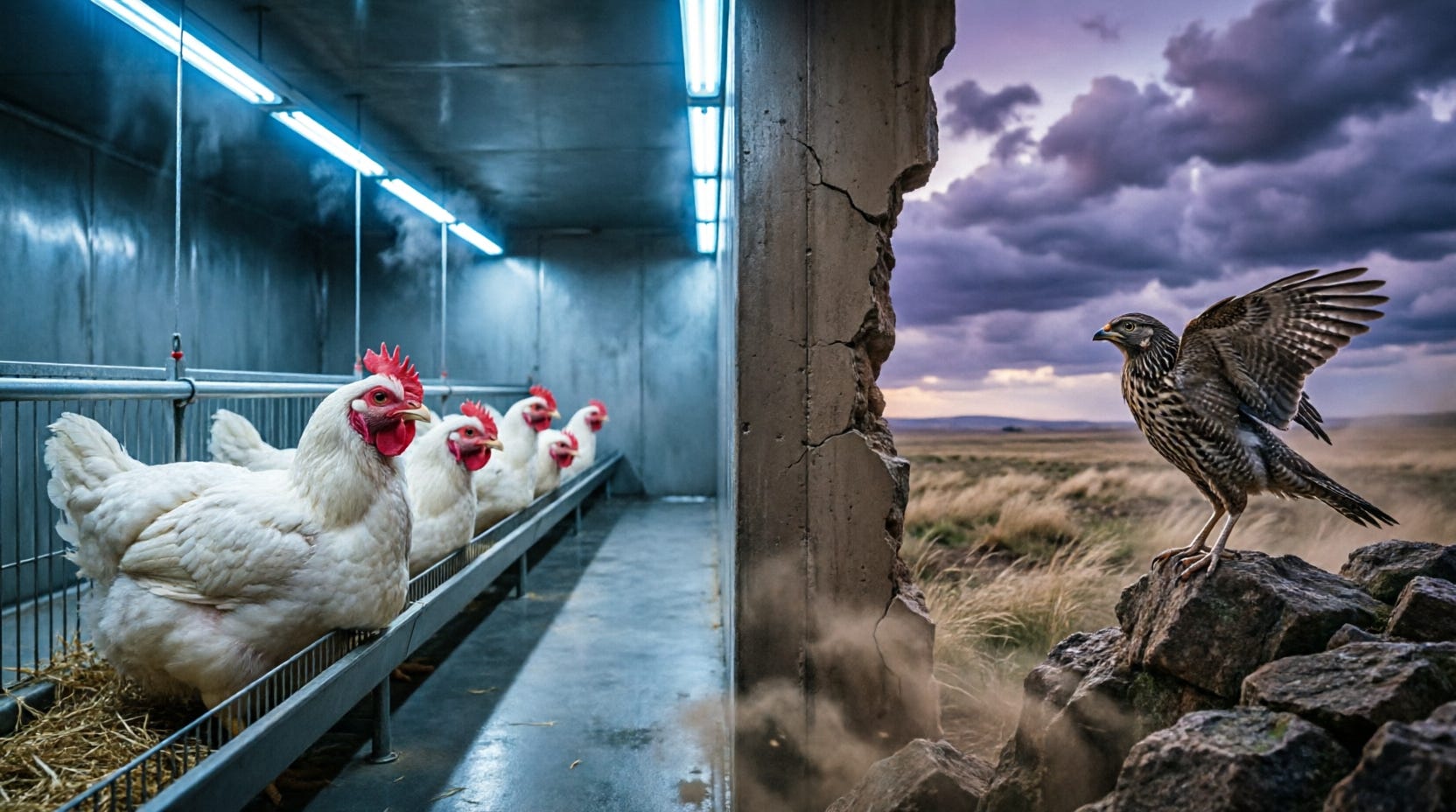
(After writing this opinion piece months ago, I realised it was far too high-brow for the mainstream guardians of contemporary intellectual thought. It belongs to an extinct era.)
Did you know a 1950s broiler chicken would struggle to survive in today’s climate-controlled coffins? Its heritage metabolism simply would not cope with modern high-octane feed formulas or the sardine-can spatial arrangements engineered to rocket chicks from fluffball to Friday-night dinner in a mere six weeks.
The older birds were akin to rowdy cousins gatecrashing a poultry meditation retreat. They strutted around, pecked aggressively at anything that moved, and were highly caloric. All that frantic rambunctiousness would be lethal to a modern high-density broiler. Just think of the pulled muscles, stress fractures, and the general chaos of violating the broiler’s prime directive: “Why won’t you just sit still, get fat and die quietly?”
Somehow that modus vivendi sounds eerily familiar. It mirrors the pervasive fatalism of contemporary life, a distinctly human condition where friction is avoided and agency is quietly surrendered. Today’s broilers, much like modern society, are engineered to punish natural behaviour. Gone are the pecking wars and individual temperaments. What remains are sedentary blobs, content with the new evolutionary imperative of “survival of the compliant.”
The broiler embodies a deeper human tragedy. Viewed through the German philosopher Friedrich Nietzsche’s figure of the Last Man, it ceases to be a warning about animals and becomes a snapshot of late-modern humanity.
A 1950s chicken was a generalist organism. It grew slowly, tolerated environmental variation, and possessed excess capacity. It was less efficient but far more robust.
The modern broiler is the opposite. It is a specimen engineered for maximum feed-to-flesh conversion under tightly controlled conditions. Its growth curve is vertical with zero margin for error. Remove the temperature control, precise nutrition, antibiotics, lighting regimes and the animal may likely keel over. This is not accidental. It is the result of prioritising maximum output over durable resilience.
Humans have been moulded to follow the same invisible logic. It governs everything from algorithmic feeds to corporate risk management. We inhabit environments optimised for productivity, convenience and risk minimisation. Like the broiler house, modern life is a sealed system designed to prevent shock, producing organisms that cannot survive outside the artificial cocoon. As a result, there are hardly any free-range humans left. Only managed stock.
Nietzsche’s Last Man, from Thus Spoke Zarathustra, is comfortable, safe, long-lived and content. And probably unambitious as well, although Nietzsche would have vehemently disagreed. Who in their right mind would declare “We have invented happiness” with a blink?
The blink matters. It signals not joy but satiation without depth. The Last Man is the human analogue of the broiler. He is a being whose environment has been optimised to such an extent that striving itself becomes pathological. Where earlier humans required adversity to form character, the Last Man requires constant regulation to preserve equilibrium. Both the chicken and humans are end-products of systems that reward predictability over potential.
Nietzsche distinguished between health and life-affirmation, noting that the former could exist without the latter. A broiler that reaches slaughter weight is deemed healthy, even if its legs strain under added mass, much like many humans today. A human who manages somatic and psychological stress with medication, avoids risk, and lives to eighty is considered fulfilled, even if their life is devoid of vitality. This is health redefined as managed survival. The Last Man does not fail biologically. He succeeds through environmental conditioning.
The most unsettling parallel is consent. The broiler does not revolt against its environment. The Last Man does not rebel against his condition. Both adapt to the world that consumes them.
A particularly fatal conflation occurs when docility is mistaken for civility. Docility results from capitulating to one’s environment and signifies powerlessness. Civility, by contrast, emerges from negotiating with hostile forces until resolution is attained. The broiler is denied that chance. The question for the Last Man is whether he has denied it to himself.
The broiler’s most revealing trait is that it cannot be judged in isolation. The bird does not merely breed. It co-evolves with its infrastructure. Its very biology is a negotiation with the shed, the feed and the six-week timeline.
Modern humans face the same fatalistic bargain. We adapt to systems that demand constant engagement, low friction and predictable behaviour, trading resilience for curated fragility. Remove the integrated life-support of smartphones and social media platforms, and modern life collapses. Our co-evolution has led to captivity.
The chicken’s fate is sealed, but our own reckoning between fragility and vitality, between compliance and self-directed striving, remains terrifyingly incomplete. Nietzsche warned that the Last Man survives not by enduring struggle, but by eliminating it. He may not have predicted the speed of our descent, but the trajectory is unmistakable.
Purchase a copy of my novel — The Electric Reckoning.
Share, restack or quote my posts.
No posts
Comments
Nothing yet. Say the first thing.
Sign in to join the conversation.