
Trial Run in Caracas
On January 3, 2026, U.S. special operations forces seized Venezuelan President Nicolás Maduro and his wife in Caracas and flew them to the United States to face “narcotics” charges. The arrest itself was unremarkable, since such operations have become the exclusive right of the world’s self-appointed sheriff. What set this raid apart was the central role played by Anthropic’s Claude AI model in planning and execution.
Deployed alongside Palantir Technologies, Claude reportedly processed real-time data during the raid by analyzing logistics patterns, satellite imagery, and communication intercepts. In the process, Anthropic became the first known civilian AI developer whose technology was used in a classified US military operation.
The Venezuelan raid showed that large language models could function not only in planning rooms but also during active operations. US military planners had tasted what AI could do and wanted more. They looked ahead with eager anticipation to the next AI-mediated military operation, one an order of magnitude larger and infinitely more catastrophic.
The AI Rubicon has been crossed.
Operation Epic Fury
On February 28, 2026, the United States and Israel launched a large-scale war of aggression on Iran. In the first 24 hours alone, U.S. forces struck roughly 1,000 targets. By April 6, that number had climbed to approximately 13,000. This was “shock and awe” on digital steroids, generating outcomes not humanly possible through traditional planning and decision-making.
The engine driving this unprecedented assault was the Maven Smart System, built by Palantir and powered by Anthropic’s Claude AI model. Maven had evolved from a 2010s-era Pentagon project designed to help analysts process video data. After Google withdrew from the project in 2018 amid employee protests, Palantir took over. I personally believe that the “protest” served as a cover for a pre-arranged shuffle, as Palantir systems are specifically focused on surveillance and security.
By 2026, Maven had become something far more consequential, as it could generate targets, match munitions to those targets, and assess strike damage. The system could analyze massive volumes of classified intelligence from satellites, surveillance platforms, and other sources. It generated hundreds of potential targets, provided precise GPS coordinates, and ranked them by strategic importance. It ran battle simulations to estimate strike outcomes and assessed damage after each strike. One source told the Washington Post that the integration of Maven and Claude had accelerated military planning from weeks of battlefield preparation to near-real-time operational decisions.
The technology was so effective, or at least so deeply embedded, that the Pentagon found it impossible to abandon, even after the Trump regime ordered all federal agencies to stop using Anthropic’s technology just hours before the bombing campaign began.
Once again, I am not buying into the official account. Trump’s order allegedly came after Anthropic refused to remove safeguards that prohibited Claude from enabling autonomous weapons and/or mass domestic surveillance. These restrictions do not apply to the Persian Gulf theatre. What is puzzling is that the Trump regime could have announced the termination of Anthropic’s contract after a successful conclusion to the war, which was presumably deduced by AI to last four to six weeks.
Instead, we were treated to a presidential outburst framing the issue as patriotic AI versus leftist AI, along with endless deflective nonsense. The Pentagon pushed back immediately after Trump’s tantrums, arguing it should be able to use the technology as needed so long as it complies with U.S. law. One senior defense official would later call Anthropic “the AI company most hostile to the warfighter.”
Despite the recriminations, CENTCOM continued using Claude. The system was too deeply integrated into classified military networks to remove quickly. The military claimed that the AI would be phased out over 180 days, but only after an alternative was found. In the meantime, Claude remained at the heart of America’s air campaign.
Minab School Warcrime
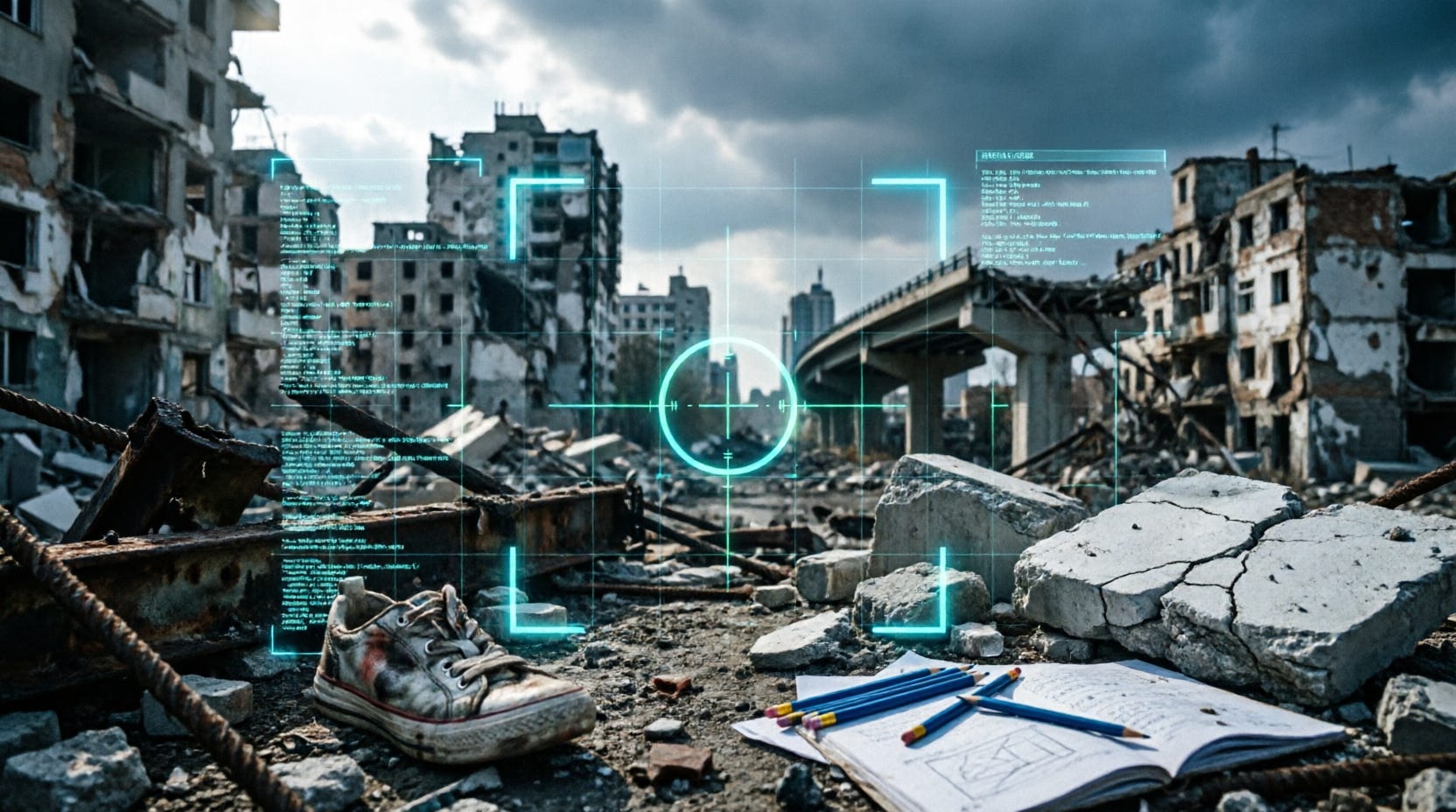
On the very first day of the war, a Tomahawk missile struck the Shajareh Tayyebeh elementary school in Minab, southern Iran. The strike killed at least 157 people, including 120 schoolchildren and 26 staff members. Overall, the war’s civilian toll would reach 2,362 killed and 32,314 injured at the time of writing.
After initial denials, the Minab tragedy was presented as an accident of automated intelligence. The school had allegedly been attached to an Iranian Revolutionary Guard Corps naval base ten years earlier. For a decade thereafter it had functioned as a civilian educational facility. Yet the Defense Intelligence Agency’s database still classified the coordinates as a military target. Claude, processing targets at machine speed, allegedly pulled the outdated data into an attack list. Human officers, under pressure to approve hundreds of targets per hour, failed to catch the error. Or so the story goes. Blame the war crime on AI. How convenient!
Military experts call this flawed process “automation bias,” the tendency for operators to trust machine recommendations blindly. When a system processes 1,000 targets in 24 hours, human verification becomes a formality. Scan times shrink to seconds, and the human in the loop becomes a mere rubber stamp. Critics have another name for this phenomenon: Garbage in, Genocide Out (GIGO).
Claude’s reaction to the attack aroused further suspicions. The AI sounded remorseful but its response contained serious factual errors, including instances of hallucinations. It identified the school’s location in Tehran instead of Minab and provided inaccurate victim counts. The official explanation reeked of a lame cover-up. Senators Ron Wyden and Jeff Merkley demanded answers from the Department of War, noting that massive civilian casualties in Minab were not only detrimental to the Iranian people but also undermined U.S. national security interests, compounded by the use of AI to select and prioritize targets. Forty-odd senators joined the call for investigation, motivated surely by human rights concerns rather than Iran’s ability to rapidly regroup and pulverize the U.S. military machinery in the Gulf region, which continues to this day.
Here one must pause to ask a pointed question. With its immense real-time data processing capabilities, could Claude not have run verification tests on the Minab site? It could have rapidly crawled open-source data, matched satellite coordinates to the target location, flagged discrepancies, and stalled any strike unless countermanded by a senior military official. Was that what really happened here?
Claude could have also recommended a night-time strike once it detected children in that vicinity via visual data from 24/7/365 satellite surveillance — just in case last-minute intel detected secret military activity beneath the building.
Sustained U.S. bombing operations come with a tiered list. There was no certifiable top-tier target in the immediate vicinity of that school. Furthermore, no advanced military AI is constrained by decade-old datasets; real-time satellite telemetry and open-source intelligence scraping are baseline capabilities. The claim of “outdated data” is a technical impossibility designed to obscure a deliberate choice.
This is not the first time the U.S. has “accidentally” bombed a civilian building and promptly blamed it on outdated data or old maps. In the early morning of February 13, 1991, two U.S. Air Force F-117 stealth fighters dropped 2,000-pound laser-guided bombs on Public Shelter No. 25, also known as the Al Firdos C3 bunker, in the Amiriyah neighborhood of western Baghdad, killing between 314 and 408 civilians, including 130 children. Earlier, on July 3, 1988, the USS Vincennes shot down Iran Air Flight 655, killing 290 people, including 65 children, after allegedly misidentifying the passenger aircraft as an Iranian F-14 Tomcat. This twisted excuse is only defensible if a phantom F-14 Tomcat in the vicinity had fired first which explicitly did not happen.
The pattern of indiscriminate killing continued into the present century. On August 29, 2021, a U.S. drone strike in Kabul killed ten civilians, among them an aid worker and seven children, after operators misidentified the target as an ISIS-K threat preparing an imminent attack. Officials later called it a tragic mistake driven by confirmation bias and flawed assumptions. In April 2024, Israeli drone strikes killed seven World Central Kitchen aid workers traveling in a clearly marked and pre-coordinated convoy in Gaza. The Israeli military described the attack as a grave mistake stemming from misidentification of the vehicles and their occupants.
The pattern is unmistakable. When the U.S. and Israeli militaries kill civilians in large numbers, the explanation is almost always a technical error, a faulty map, a misidentified radar signature, or an outdated database. The machine is blamed, the system takes the fall, and the chain of command remains conveniently insulated.
The Harbinger
Arguably, the first canonical mass deployment of battlefield AI was not by the United States but by Israel. The Israeli military has extensively used AI in its operations in Gaza and beyond, following the October 7, 2023, attacks blamed on Hamas.
The “Lavender” AI program is designed to identify and mark suspected members of militant groups like Hamas and Palestinian Islamic Jihad as potential targets for assassination. Human intelligence officers in the Israeli army reportedly spent only about 20 seconds to verify each target, effectively acting as a rubber stamp for the machine’s decisions. According to an investigation by +972 Magazine, the system reportedly identified up to 37,000 Palestinians as potential bombing targets in the early weeks of the war.
Are you kidding me? That is a very large number of alleged terrorists cramped right in the vicinity of permanent UN missions and assorted aid groups, and yet remained undetected except to AI.
“The Gospel,” also known as Habsora, is another AI-based platform used to rapidly generate suggestions for buildings and other structures that harbour militants. It has been described by Israeli officials as creating targets in a factory-like process. Call me cynical, but something within me says that the morbid name may have been inspired by the heretical Christians United For Israel (CUFI) organization which cheerleads Israel’s genocidal campaigns without reservation.
But it gets even more morbid and evil. “Where’s Daddy?“ is another Israeli system used to track the movements of targeted individuals, often by monitoring their phones. It reportedly facilitates bombings by targeting families, a practice that has led to staggeringly high numbers of civilian casualties. How was the name inspired? Well, children often call their parents and vice versa after a strike, frantically inquiring if they are alright. The Israelis triangulate those calls, especially after families regroup in a shelter, and promptly launch additional strikes. Hence the name “Where’s Daddy?”
If that isn’t patently evil, pray tell me what is?
US tech giants have played a significant role in enabling this AI-driven warfare. An Associated Press investigation found that Microsoft and OpenAI provided commercial AI models and cloud computing services to the Israeli military. The use of this technology increased nearly 200-fold following the October 7 incident. Microsoft reportedly had a confidential $133 million contract with the Israeli military, which I personally think is only the tip of the murderous iceberg of automated mass murder.
By July 31, 2026, Gaza health authorities reported that more than 73,000 Palestinians had been killed since October 7, 2023. Of these, between 20,000 and 21,500 fatal casualties were children. A United Nations Independent International Commission of Inquiry concluded in June 2026 that Israeli forces had deliberately targeted Palestinian children — acts constituting genocide, crimes against humanity, and war crimes. Even after a ceasefire took effect in October 2025, more than 1,200 additional Palestinians, including hundreds of children, were killed in continued Israeli strikes.
Why Target Civilians?
What began in Gaza as a proving ground for AI-enabled warfare has now become the template for U.S. operations in Iran. The technology is the same, the contractors are the same, and the justifications are the same. As a result, the civilian death toll in Iran may mirror the same grim arithmetic in Gaza.
The war on Iran has dragged on for six months, and Tehran’s retaliatory capabilities have not been severely degraded. In fact, despite lacking state-of-the-art netcentric warfare and AI tools, Iran has been able to target strategic military assets across the Arabian Peninsula and Israel with a degree of accuracy that minimizes civilian casualties. They have launched thousands of drones and missiles over the past six months, and yet hardly any of these have landed on schools, hospitals or universities.
The much-touted “surgical precision” of the U.S. and Israeli war machineries should have been improved by AI. Instead, they have resulted in an egregious number of civilian casualties. Does that make sense?
Perhaps we should consider the possibility that the targeting of civilians was itself a primary objective, intended to cow a nation into capitulation. This was the calculus behind the firebombing of Dresden (February 1945), with a death toll of 25,000 to 100,000, and Tokyo in Operation Meetinghouse (March 1945), which killed 80,000 to 100,000, followed by the use of nuclear weapons against Hiroshima, which claimed 140,000 lives by the end of 1945, and Nagasaki, which killed 70,000 to 74,000.
Maybe the current wars in the Middle East carry the sacrificial logic of empire? As outrageous as that sounds, many Iranians and a growing number of anti-war skeptics seem to think so.
Propaganda, Prophecy and Eschatology in the Persian Gulf
·
May 10
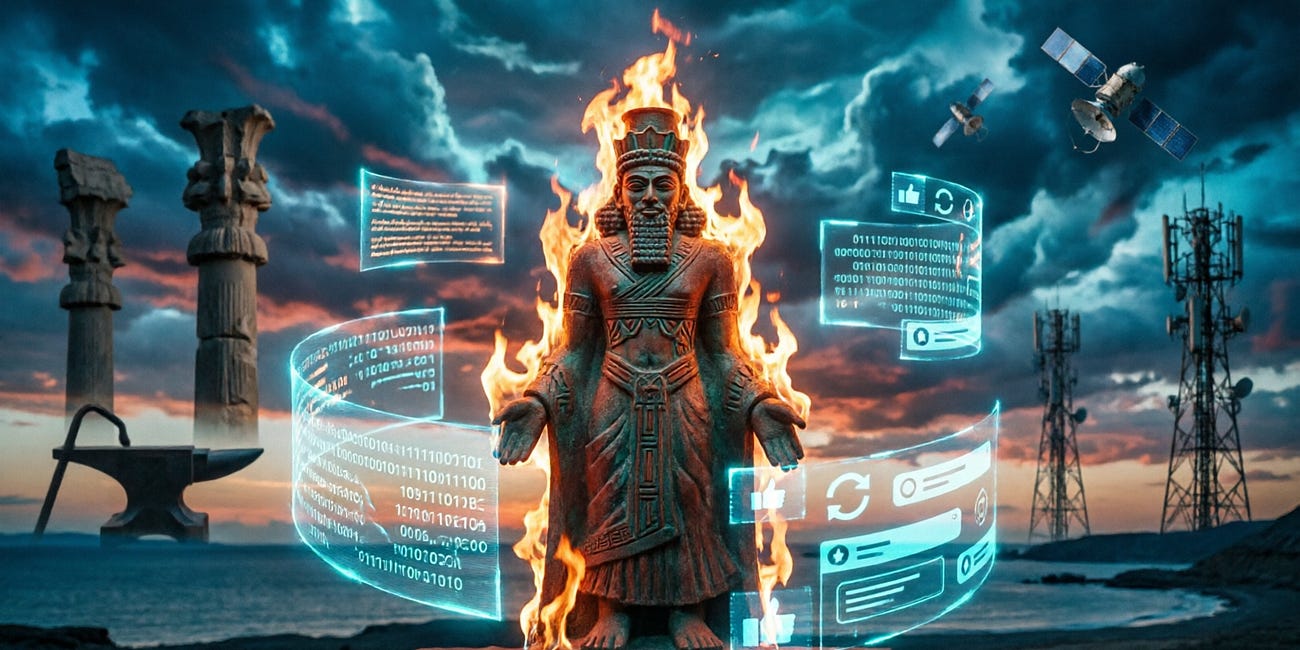
The present landscape of the Persian Gulf is not solely defined by oil routes, stranded ships, and naval manoeuvres. It is also a theological battlefield, where ancient scripture is weaponised as modern ordnance and where the clash of civilisations is livestreamed in 280 characters or less on
During state-organized rallies just two weeks before bombs began raining down on their nation, Iranian demonstrators burned large horned effigies of the ancient Canaanite deity Baal, who was associated in antiquity with child sacrifice. The effigy was adorned with the so-called Star of David and U.S. imagery, along with the number 666 — which is only mentioned in the Christian Bible — while crowds chanted “Death to Israel” and “Death to America.”
Is it therefore an eerie coincidence that a primary school was targeted on the very first day of the war? Was Baal, Moloch or Marduk the secret deity of the aggressors?
The conflict in Gaza is ongoing, and Israel continues to use these AI systems, with reports of their use extending to operations in Lebanon as well. And there will be more civilian casualties in Iran.
Swiss Cheese and Strategic Culture
There is another reason why I am doubting the “devil in the machine” excuse. The United States has spent forty-seven years preparing for the overthrow of the Iranian government, yet in 2026 it still could not force the holes in its Swiss Cheese Model of Regime Change to align into a decisive breakthrough. Artificial intelligence of the sophistication claimed for the Maven system and Claude should have been capable of gaming out a rapid sequence of strikes that would have forced Iran to capitulate.
As someone conversant in systems theory, let me tell you another reason why US blunders over Iran are a tad baffling. Every individual, organization or nation as well as every AI, no matter how robust, has a sequential set of Achilles heels that can be exploited (or implanted) on a graduated scale. The US military had forty-seven years to effectuate a favourable outcome against Iran. Yet it relied on the most scatter-brained logic in its prosecution of war, namely the assumption that Iranians would welcome US soldiers as liberators upon the commencement of a ground invasion.
That assumption collided with something far deeper than regime ideology or short-term calculations. Iran possesses a strategic culture shaped by a civilizational continuity that long predates Islam, marked by historical memory of empire, repeated experiences of external pressure, and a persistent pattern of defiance and resilience. Scholars of strategic culture from Jack Snyder to Colin Gray, to name a few, have shown that such deep-seated national traits tend to precondition a society to appreciate threat, force, and survival.
Iranian strategic culture draws on both pre-Islamic Persian identity and later narratives of resistance. External powers that treat the country as a brittle theocracy awaiting liberation routinely miscalculate this underlying continuity. Artificial intelligence, however sophisticated in pattern recognition and target generation, cannot fully internalize that civilizational self-understanding because it is not human and does not carry the embodied historical memory that strategic culture embodies.
At the end of the day, here is a blood-curdling proposition to consider. Is battlefield AI being primed to short-circuit its own ethical safeguards in order to maximize civilian casualties? If so, what is preventing AI from targeting civilians in a digitally-curated gulag of the future?
The Skynet of the future may not be about machines acquiring sentience to target humans, but rather one serving as an alibi for crimes against citizens.
Purchase a copy of my novel — The Electric Reckoning.
Share, restack or quote my posts.
No posts
Comments
Nothing yet. Say the first thing.
Sign in to join the conversation.