

My shoulder surgery went well—according to my doctor—but I’m glad I decided to post a reprise issue this week. While the pain I’ve been experiencing has not been excruciating, I’ve been in a constant state of discomfort, and there’s no way I could have mustered the concentration to write at the level I expect of myself.
Rather than rush back into things, I've decided to reprise yet another past issue next week while I continue to recover. Thank to all subscribers for your patience, your understanding, and your continued support.
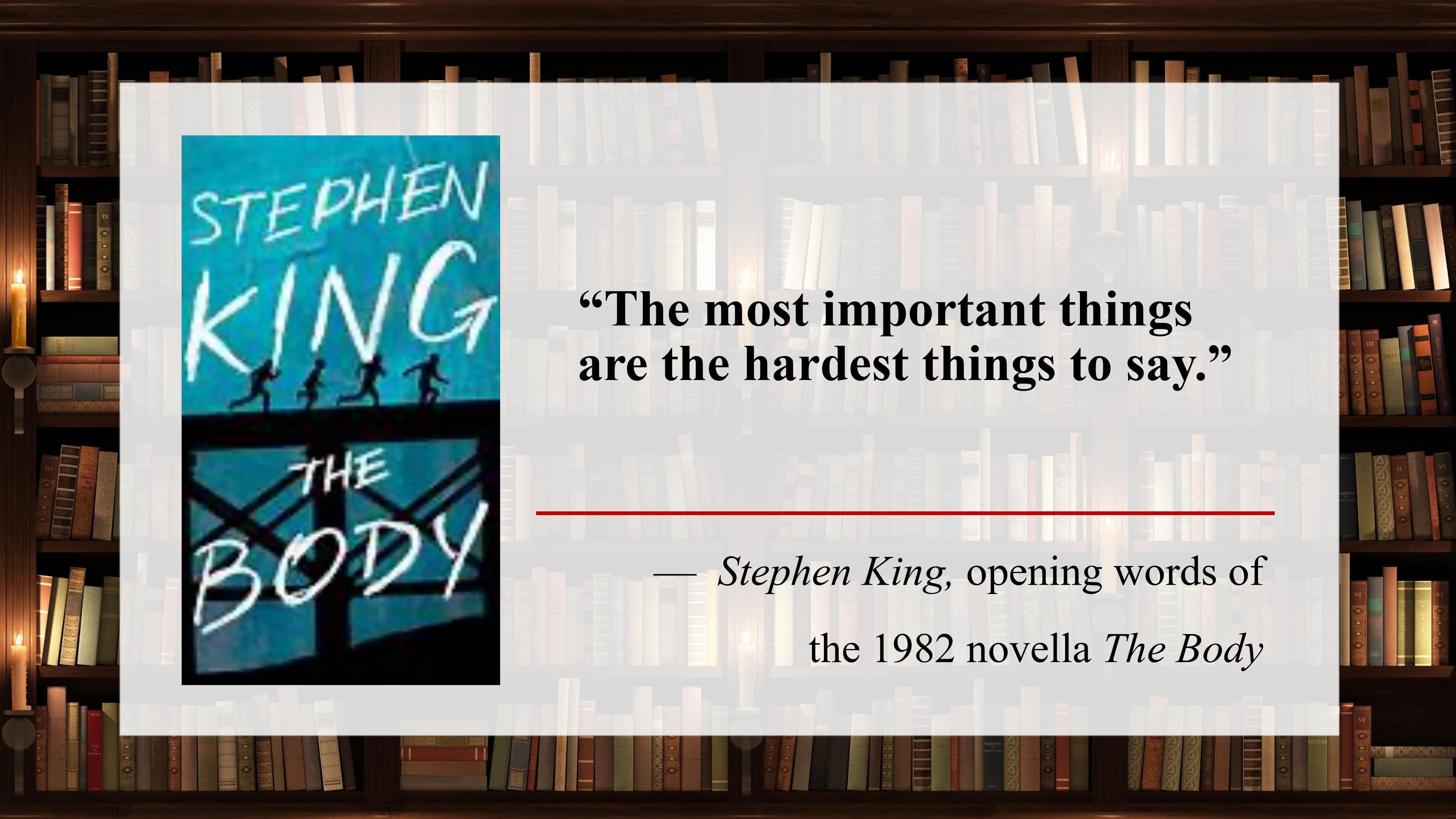
After searching high and low this past week, I couldn’t find an opening line that included the word insight, so I decided to feature one that reflected an important insight—in this case, one about how difficult it is to communicate our deepest thoughts and feelings.
The Body’s opening sentence also helps to explain one of the reasons people love great writers: they’re able to articulate matters most of us have great trouble expressing on our own. In the opening paragraph, the narrator, a Maine writer named Gordon “Gordie” LaChance, continued:
“They are the things you get ashamed of, because words diminish them—words shrink things that seemed limitless when they were in your head to no more than living size when they’re brought out. But it’s more than that, isn’t it? The most important things lie too close to wherever your secret heart is buried, like landmarks to a treasure your enemies would love to steal away.”
In 1982, Rob Reiner adapted the novella into one of my favorite films, “Stand by Me.” With Richard Dreyfuss providing the narration, King’s masterful coming-of-age tale was brought to life by the young actors Wil Wheaton, River Phoenix, Corey Feldman, and Jerry O’Connell.
In a 2017 essay, writer Khaled Hosseini (The Kite Runner and other novels) described the opening words of The Body as deeply meaningful when he first read them at age twenty. “This passage was an expression of how alone we are, really,” he wrote, adding “the things that are most important to us, that are really vital to us, are perversely the most difficult to express.”
Years later, when Hosseini was a developing writer rather than a developing person, the novella’s opening words took on an added significance, something he could not appreciate when he was younger. He wrote:
“This passage is one of the truest statements I’ve encountered about the nature of authorship. You write because you have an idea in your mind that feels so genuine, so important, so true. And yet, by the time this idea passes through the different filters of your mind, and into your head, and onto the page or the computer screen—it becomes distorted, and it’s been diminished. The writing you end up with is an approximation, if you’re lucky, of whatever it was you really wanted to say.”
For more than 2,000 memorable opening lines from every genre of world literature, go to www.GreatOpeningLines.com.

On July 13, 1903, this man was born into a wealthy London family (his father had inherited a fortune from his Scottish ancestors and went on to achieve notoriety as “the man who broke the bank at Monte Carlo”). Raised in an atmosphere of privilege and educated at England’s best schools, he developed an early passion for art and carried this passion with him until his death at age 79 in 1983.
He was a teenager at Winchester College, one of England’s oldest and most prestigious boarding schools for boys, when he became enthralled with the world of art, an interest that was fueled by the writings of the noted English art critic John Ruskin. At age nineteen, he went on to Trinity College, Oxford, where he formally majored in modern history but devoted most of his attention to the study of art.
He was only twenty-five when he wrote his first book (The Gothic Revival) in 1928. In the 1930s and 40s, he served as Director of Britain’s National Gallery. During WWII, he became a national hero for protecting artworks from bombing raids, keeping the museum open to the public, and hosting free lunchtime and evening concerts.
He will be forever remembered, though, as the writer, producer, and host of BBC-TV’s Civilisation, one of broadcast history’s most successful and influential documentary television series (first broadcast in England 1969, and the following year in America on PBS-TV).

The series introduced the world of art to millions around the world. It also spawned a beautifully illustrated book by the same title that became a huge bestseller (it still occupies an honored place in my personal library). A 1983 Time magazine article said of the series:
“If it had not been for Civilisation, none of the didactic series that came after it, starting with Jacob Bronowski’s Ascent of Man and Alistair Cooke’s America, would have been made.”
In his many books, this week's Mystery Man offered quotable observations on countless topics, including this from his book Ruskin Today (1964):
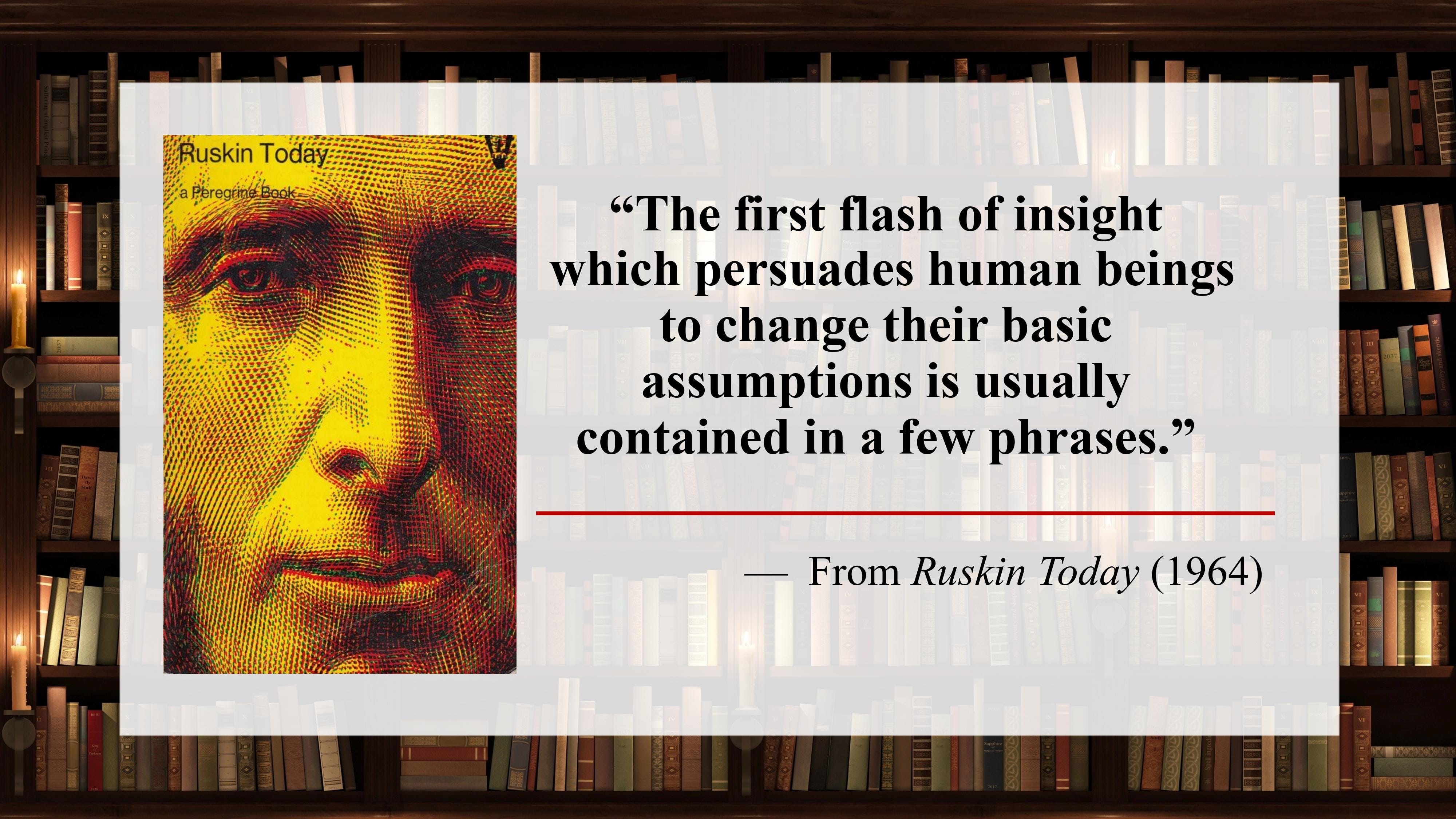
Who is this person? (Answer below)
In the most general terms, insight refers to a sudden—and sometimes a brilliant—solution to a difficult, persistent, or perplexing problem. Insights don’t happen every day, but when they do, they’re generally viewed so positively that they’re greeted with exclamations like “Aha!” or “Eureka!” (more on this in a moment). Over the centuries, insights have been so routinely described as illuminating that the image of a light bulb being turned on has become the most common image used to depict them.

Almost all people have had the experience of suddenly seeing something in a totally new way—and when we have an important personal insight, it can feel freeing or liberating as it helps us get “unstuck” from established and unproductive patterns of thinking.
As this week’s Puzzler quotation suggests, many insights help us make fundamental changes in the assumptions we’ve made about ourselves and the world in which we live. And when an insight is capable of being verbalized—as with Stephen King’s the most important things are the hardest to say—it’s almost always characterized by an economy of words.
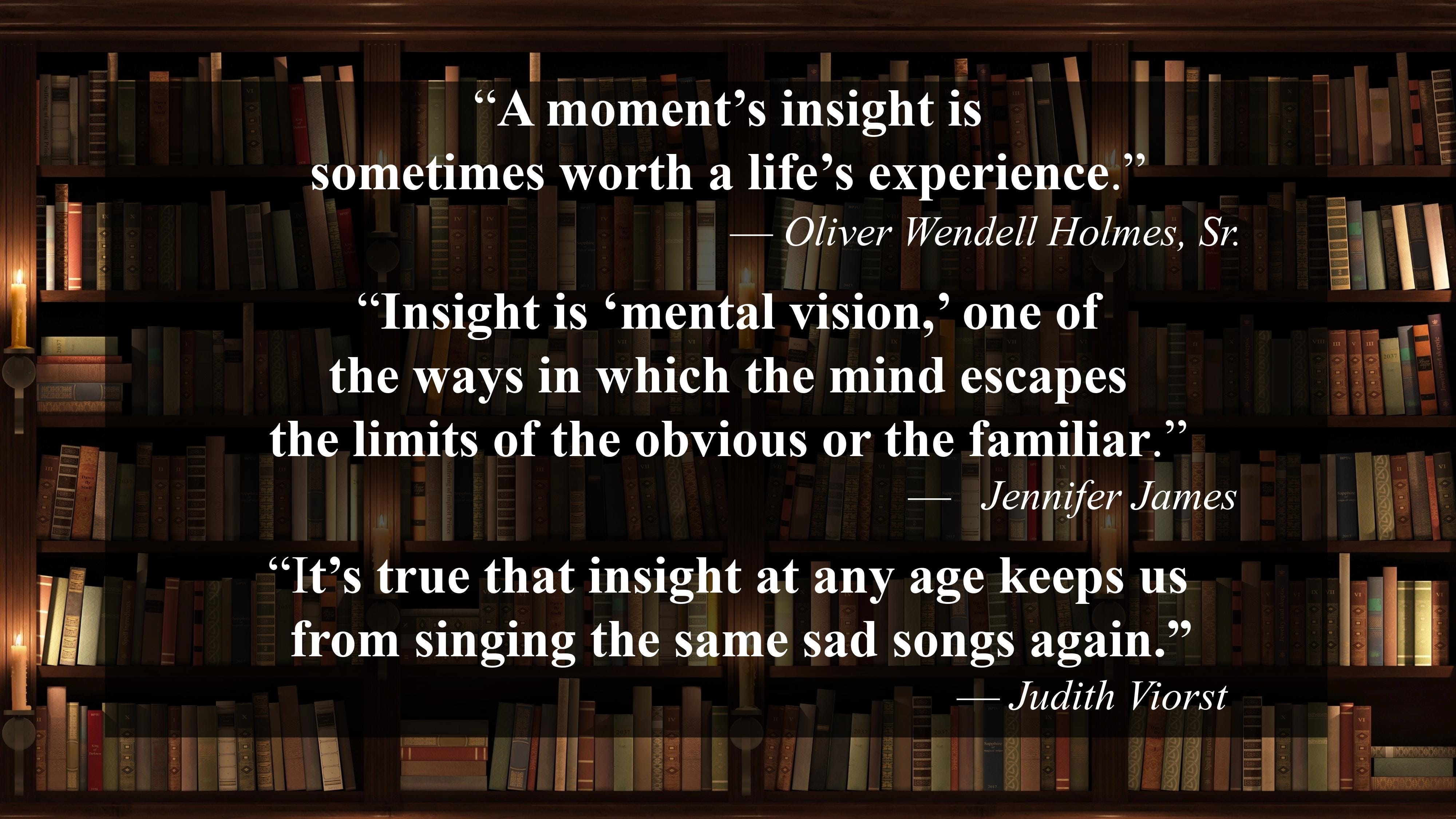
The American Heritage Dictionary (AHD) defines insight as “The ability to discern the true nature of a situation, especially by intuition.” And when we go on to read what the AHD says about intuition, it is described as a process that bypasses the use of human reason: “Intuition is perception or comprehension, as of truths or facts, without the use of the rational process.”
According to the Online Etymology Dictionary (OED), the English word insight can be traced to a number of similar words about “inner vision” that came from neighboring European countries, like the Dutch inzigt and the German einsicht. The OED also used a memorable phrase to describe insight: “Sight with the ‘eyes’ of the mind.”
Insights have played a pivotal role in human life, and the oldest story on the subject—as well as one of the most interesting—is one you probably first heard during your elementary school years. It concerns the ancient Greek mathematician named Archimedes (pronunciation guide here).
Around 250 B.C., the king of the Greek city of Syracuse was concerned that the royal goldsmith had fraudulently provided him with a gold crown that had been diluted by an unknown amount of copper. When Archimedes was consulted to investigate the matter, he told the king that the only definitive test would be to have the crown completely melted down. Since this was unacceptable, he began searching for an alternative test. After several days of working on the problem without success, the frustrated scholar decided to take a break by visiting the local public bath.
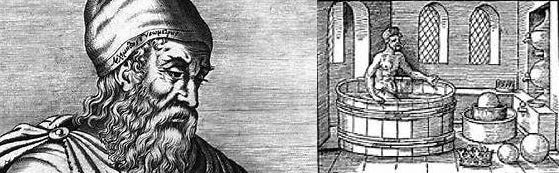
As he settled into an almost full tub, his body mass displaced water over the top and onto the floor. At that exact moment, the solution to the problem popped into his mind. Because gold weighs more than copper, a crown consisting of both elements would have to be bulkier to reach the same weight as one made only of gold—and would therefore displace more water than its pure gold counterpart.
Thrilled at solving the problem, the exited mathematician leaped out of the tub and, stark naked, rushed through the streets exclaiming “Eureka! Eureka!” (ancient Greek for “I’ve got it!” or “I’ve found it!”). Is the story true? Almost certainly not, since it was originally written two hundred years after Archimedes died. But the tale perfectly captured the powerful role of insight in scientific thinking, and the tidbit about a naked scholar certainly added to its appeal. For more on what is commonly called “The Eureka Effect,” go here.
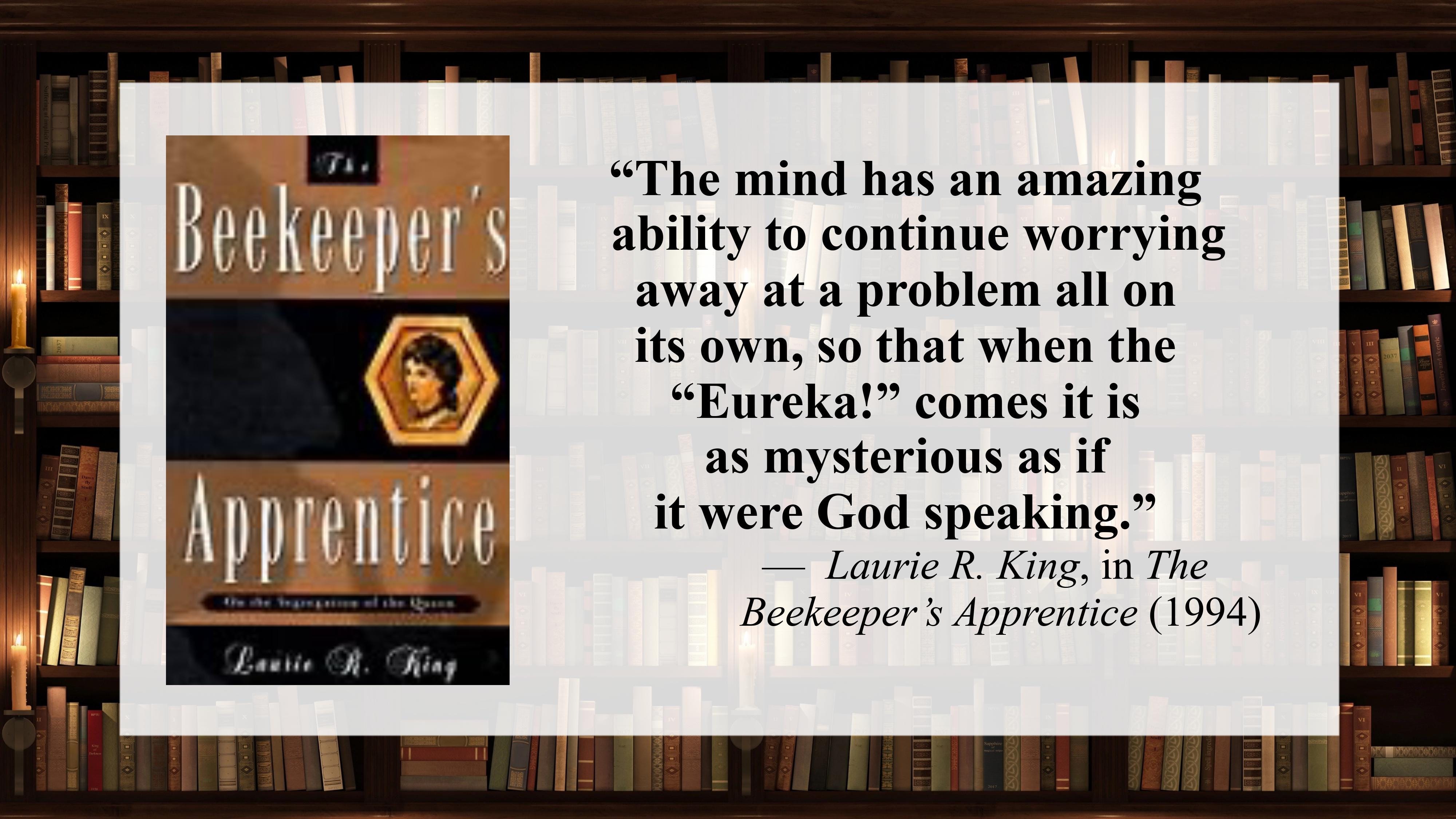
When someone has an insight, the “solution” doesn’t come in the deliberate manner we typically associate with problem-solving. That is, it doesn’t rely on the time-honored practice of trial and error or the disciplined use of logic or reason. An insight arrives suddenly—and unexpectedly—and comes from a place so deep inside that it’s easy for people to think it’s coming from somewhere else. Indeed, countless people over the ages have viewed insights as divinely inspired, and many have even gone so far as to say that, in their finest creations, they were merely taking dictation from God.
In her 1994 book The Beekeeper’s Apprentice, Laurie R. King expressed this phenomenon well when her protagonist Mary Russell reflected:
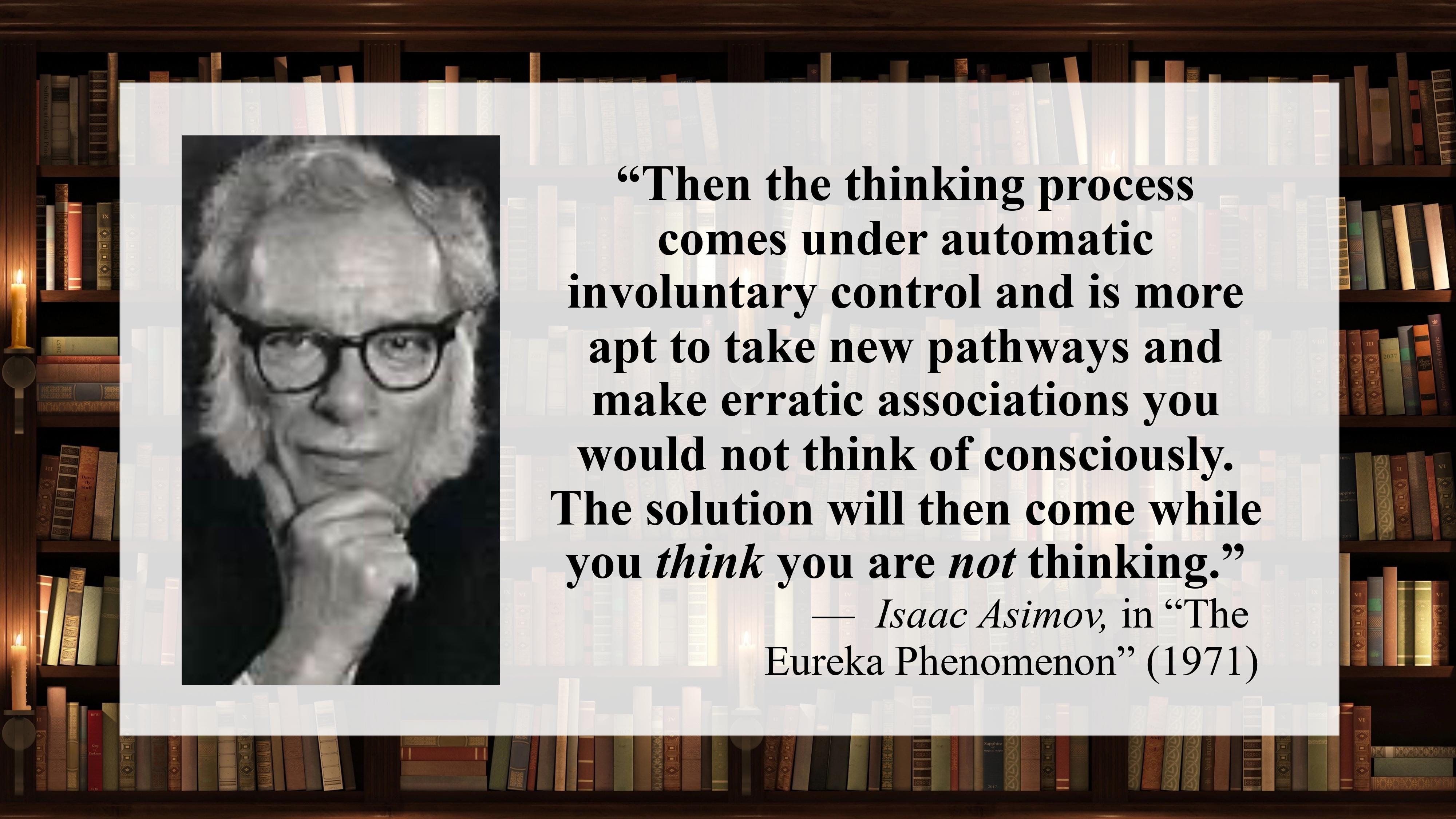
In reality, though, no supernatural hypothesis is necessary to explain a major insight. All it takes is a recognition that human beings are thinking about things even when they’re not consciously thinking about anything at all. Isaac Asimov explained it nicely in “The Eureka Phenomenon,” a 1971 essay in The Magazine of Fantasy and Science Fiction.
In his essay, Asimov explained that whenever he found himself stymied by an intellectual problem, he had an unorthodox but highly effective remedy: he went to the movies! He explained that flashes of insight almost never occur when people are actively focused on the problem. But when the conscious mind is relaxed and its attention diverted in some way, the subconscious mind goes to work. He wrote:
Let me bring my remarks to a close this week by mentioning that insights are within reach of us all, and even fairly simple insights can have profound effects. A few decades ago, I was working with a young woman who was feeling weighed down by a host of problems, including an unsupportive husband, an unsatisfying job, an overly critical mother, an inability to become pregnant, and a few chronic health problems. After several sessions in which I didn’t do a whole lot more than simply listen, she was repeating the familiar refrain once again when she suddenly bolted straight up and said: “Oh Gawddd! I sound like a helpless victim—and a hopeless one as well!”
I had never suggested the idea of victimhood, and she might have even resisted the idea if I had. But once the insight occurred, she was well on the way to getting her life back on track. After discussing the potential meaning of her insight, she created a personal mantra that went on to guide her life: “Don’t be a victim! Be a fighter and become a survivor!”
This week, think about the insights you’ve had and how they’ve helped you lead a happier and more satisfying life. Before you do, though, take few moments to peruse this week’s selection of quotations on this important theme in human life:
The history of science is full of revolutionary advances that required small insights that anyone might have had, but that, in fact, only one person did. — Isaac Asimov
It is true that insights may come to us as flashes. It is true that some of these flashes may be blinding. It is, however, also true that such bright ideas are preceded by a gestation period that is interior, murky, and completely necessary. — Julia Cameron
An insight is a new way of looking at something, creating a new frame of reference or a new understanding. — Edward de Bono
I’m convinced that the pleasure of a real scientific insight—it doesn’t have to be a great discovery—is like an orgasm. — Carl Djerassi
Insight is not a lightbulb that goes off inside our heads. It is a flickering candle that can easily be snuffed out. — Malcolm Gladwell
Insights are easy to come by, but they can be deceptive. We tend to think we have done something when we have had an insight. But insights not acted on are a bit of a fraud. — Edward T. Hall
Insight is the spark that ignites the fire of innovation. — Phil McKinney
Deeper insights into the nature of things are best achieved with distance from daily experience. — Victor Weisskopf
Insight doesn’t happen often in the click of the moment, like a lucky snapshot, but it comes in its own time and more slowly and from nowhere but within. — Eudora Welty
Real genius of moral insight is a motor which will start any engine. — Edmund Wilson
For more quotations on the theme of INSIGHT, go here.
Kenneth Clark (1903-83)
Thanks for joining me again this week. See you next Sunday morning, when I will reprise the 2024 issue “Are You an Original or a Copy?”
Mardy Grothe
Websites: www.drmardy.com and www.GreatOpeningLines.com
Regarding My Lifelong Love of Quotations: A Personal Note
No posts
Comments
Nothing yet. Say the first thing.
Sign in to join the conversation.