
You eat a reasonable lunch, nothing outrageous, maybe a sandwich with some rice on the side. Two hours later the fog rolls in. Your eyelids get heavy and your brain feels like it’s running on a dying battery, so you reach for something sweet because your body is screaming for fuel, even though you just ate.
Most people blame the food, or they blame themselves for eating too much of it. But what if the problem isn’t what you ate, but the conditions around the meal?
There’s a concept in architecture called the “envelope.” It refers to everything that surrounds a building, the insulation, the windows, the ventilation, rather than the structure itself. Two identical houses can perform completely differently depending on their envelope. One stays cool in summer and warm in winter. The other hemorrhages energy all year long, even though it’s the same house with different conditions.
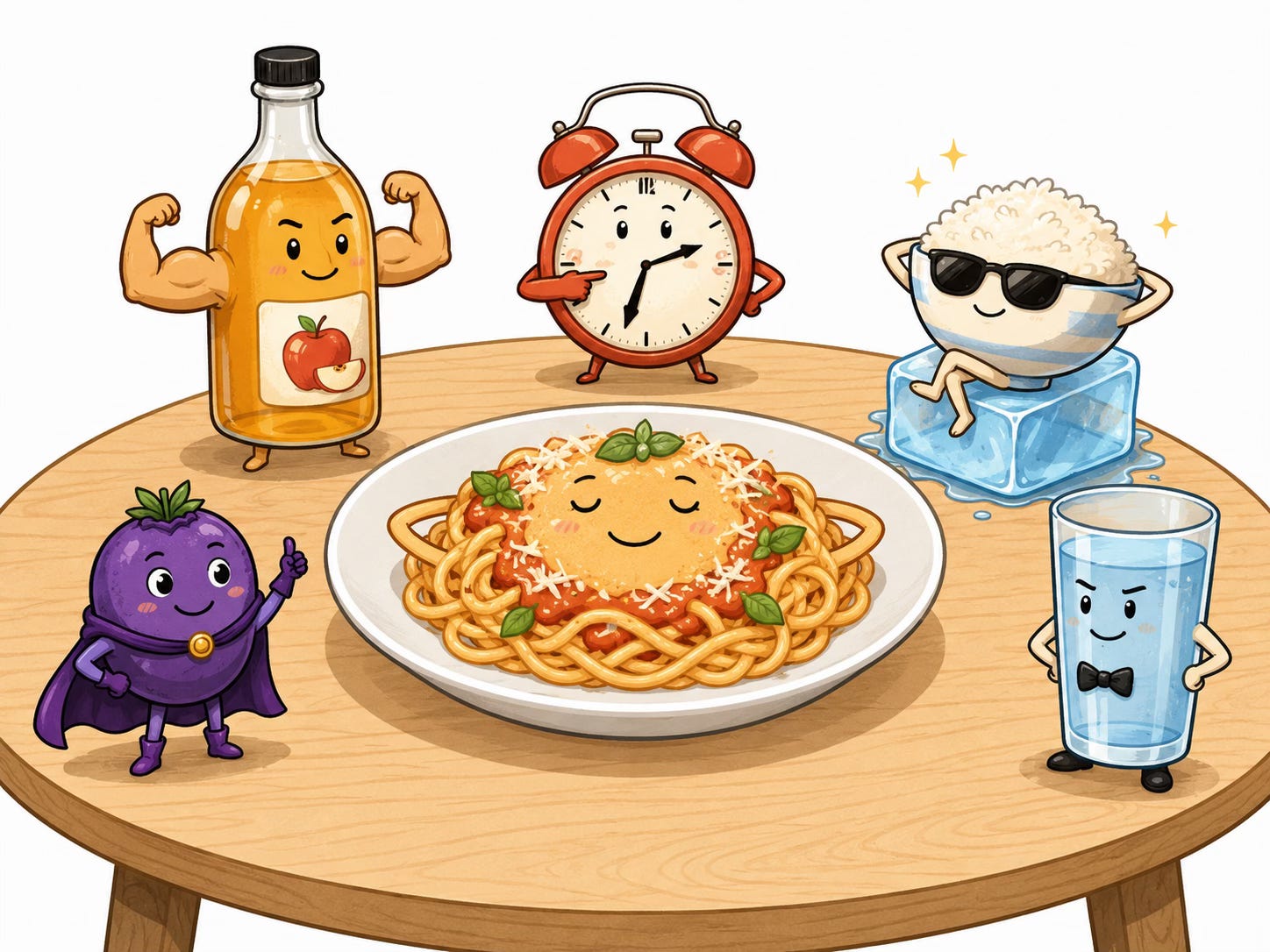
Your meals have an envelope too. The same plate of food, prepared a little differently, eaten at a slightly different time, or paired with one small addition, can produce a measurably smoother blood sugar curve. The five habits in this article don’t ask you to eat less or change what’s on the plate. They steady your blood sugar by changing the envelope.
Most nutrition advice fixates on what to remove from the plate, whether that’s carbs, fat, or sugar. But some of the most consistent findings in long-term nutrition research point in the opposite direction, toward what you add. And the simplest guide for what to add turns out to be something you can see without reading a single label. Color. The deep reds, purples, and blues that make berries and red cabbage so vivid, the earthy greens in kale, the warm orange of a bell pepper. These colors come from different compounds, but the foods that carry them share something in common. They tend to be loaded with protective molecules called polyphenols, and the most studied group of polyphenols is the flavonoids.
Flavonoids slow down the enzymes that break carbohydrates into sugar, which means glucose enters the bloodstream more gradually instead of all at once. Meanwhile, the fiber in those same colorful foods slows how quickly the stomach empties, reinforcing the effect through a separate pathway. And together, the polyphenols and fiber feed beneficial gut bacteria that produce compounds supporting how the body processes glucose over time.
A large analysis combined results from eight long-term studies covering over 300,000 people. It found that those with the highest flavonoid intake had a notably lower risk of developing type 2 diabetes. The protective link held for the anthocyanidins in berries and red cabbage, the flavan-3-ols in tea and cocoa, and the flavonols in onions, kale, and apples. The more people consumed, the lower their risk.
The habit is dead simple. Add one colorful plant food to every meal, whether that’s berries on your morning oatmeal, roasted red bell pepper tossed into a lunch salad, or purple cabbage alongside dinner. You’re not taking anything away, just upgrading the envelope.
One tablespoon of apple cider vinegar in a glass of water, taken right before a starchy meal.
This one sounds like folk medicine, the kind of advice your grandmother might have offered between sips of her own mysterious tonic. But the mechanism has been tested in clinical trials, and the picture is clear. The active compound in vinegar is acetic acid, and it works like a series of speed bumps installed between your food and your bloodstream. It slows the rate at which the stomach empties food into the small intestine. It slows down the enzymes that digest starch and blocks another set of enzymes that break double sugars into single sugars the body can absorb. And it appears to help muscles pull more glucose out of the blood. Together, these effects flatten the blood sugar rise after a meal.
A review pooled results from eleven controlled trials on vinegar and blood sugar. It found that vinegar with a meal significantly reduced the blood sugar and insulin responses that follow eating. When the researchers broke the results down by vinegar type, apple cider vinegar stood out. It showed a consistent effect across every trial that tested it. The blood-sugar-lowering effect was also larger in people with existing glucose problems than in those without.
Always dilute the vinegar in a full glass of water, because straight vinegar is acidic enough to damage tooth enamel with regular use. And if you have gastroparesis (a condition where the stomach empties too slowly) or active reflux, skip this one entirely. The whole point of acetic acid is that it slows stomach emptying, which is exactly what you don’t want if your stomach already runs behind schedule.
Move dinner 60 to 90 minutes earlier than you normally eat it.
If you’ve ever flown across six time zones and tried to eat dinner at what your body thinks is 3 AM, you’ve felt what circadian misalignment does to digestion. Your body clock doesn’t just regulate sleep. It runs a schedule for almost every metabolic process, including how well you handle blood sugar. And the critical player in this story is melatonin, the hormone most people associate only with sleep.
As bedtime approaches, the brain starts releasing melatonin. But melatonin does more than make you drowsy. It acts directly on the insulin-producing beta cells of the pancreas, dialing down insulin release. When you eat while melatonin is rising, you’re asking the body to handle blood sugar at the exact moment it has started putting away its main tool for doing so. It’s like trying to deposit a check at a bank that’s already pulling down the gate.
The largest dinner-timing trial to date tested this directly in over 800 people. Each person took two glucose tests on separate evenings, one simulating an early dinner four hours before their usual bedtime and the other simulating a late dinner just one hour before. In the late condition, melatonin levels were 3.5-fold higher, and the blood sugar response was noticeably worse because insulin release dropped. The culprit was reduced function in the insulin-producing cells themselves. And the effect was especially pronounced in people who carry a common variant in the melatonin receptor gene. This variant makes the insulin-producing cells more sensitive to melatonin. Roughly half the population carries at least one copy.
You don’t need to eat dinner at 5 PM. The goal is to finish eating with enough of a buffer before sleep that melatonin hasn’t yet started pulling down the gate. For most people, that means simply moving dinner earlier by an hour or so, and closing the kitchen after that.
Cook your rice or potatoes, cool them in the refrigerator, and eat them later. Reheating is perfectly fine.
This one sounds too good to be true, which is probably why most people don’t do it. But the science is clean, and the mechanism borrows from materials science.
When starch is cooked, heat and water cause the starch granules to swell and unwind, making them highly digestible. This is why freshly cooked white rice sends blood sugar up so fast. But when that same cooked starch cools down, some of the unwound starch chains lock back together into tighter, more ordered structures that digestive enzymes can no longer break apart. The process is called retrogradation, and it works on a principle similar to chocolate tempering. When melted chocolate cools under the right conditions, its fat molecules lock into a tighter crystal structure that gives the bar its snap. When cooked starch cools, its chains lock together in a similar way. The cooled starch becomes resistant starch. It passes through the small intestine without being absorbed as glucose and instead travels to the colon, where gut bacteria ferment it into compounds that support blood sugar regulation.
The reformed structures are also heat-stable, so reheating does not undo the effect.
A controlled trial in women with higher-than-normal fasting blood sugar and insulin tested baked-then-chilled potatoes against freshly boiled potatoes. The chilled potato produced lower blood sugar at the 15- and 30-minute marks and significantly lower insulin responses over the full two hours. A gut hormone called GIP, which tells the pancreas to release more insulin in response to food, was also markedly lower after the chilled potato at every measured timepoint. A separate trial confirmed the same principle for rice. Cooled-then-reheated white rice produced a lower blood sugar peak and a dramatically smaller total blood sugar rise compared to freshly cooked rice.
This is a meal-prep habit. Cook a big batch of rice or potatoes on the weekend, refrigerate it, and reheat portions throughout the week. Same food, similar taste, but a flatter blood sugar curve.
Drink a glass of water 20 to 30 minutes before each meal.
Of the five habits here, this one gets the least attention. Most people think of water as something you drink when you’re thirsty, not as something that plays a role in how your body handles a meal.
When the body is even mildly low on water, it releases a hormone called vasopressin that tells the kidneys to hold on to fluid. Elevated vasopressin has been linked to markers of metabolic disruption. Adequate hydration keeps that signal quiet and supports the kidneys’ role in filtering and clearing glucose from the blood. Pre-meal water also reduces appetite and increases the feeling of fullness, which means less food consumed at the meal itself.
A randomized trial in adults with type 2 diabetes tested pre-meal water, distributed across the three main meals 30 minutes before eating, for eight weeks. The water group saw significant drops in fasting blood sugar, body weight, and waist size. Their levels of copeptin, a blood marker that rises when the body is low on water, also fell. Water before a meal won’t do the heavy lifting alone. But it’s the easiest way to start changing the envelope, and it makes the other four habits land harder.
These five habits don’t ask you to eat less or exercise more. They steady your blood sugar by changing the conditions around the meal, whether that’s berries at breakfast, diluted vinegar before a starchy lunch, dinner moved up by an hour, last night’s rice reheated for today, or a glass of water before you sit down. Each one makes a small difference on its own, and they stack.
This Monday, pick one. Just one. Add a handful of berries to your breakfast, or pour a glass of water 20 minutes before lunch. Do it every day this week. Next Monday, add a second. The envelope builds one habit at a time.
Join The Habit Healers on Skool, where I go live weekly and Chef Martin shares Healing Kitchen videos and plant-forward recipes designed around exactly this kind of evidence.
Habit Healers Community on Skool
References:
Xu H, Luo J, Huang J, Wen Q. Flavonoids intake and risk of type 2 diabetes mellitus: A meta-analysis of prospective cohort studies. Medicine (Baltimore). 2018;97(19):e0686. doi:10.1097/MD.0000000000010686
Shishehbor F, Mansoori A, Shirani F. Vinegar consumption can attenuate postprandial glucose and insulin responses; a systematic review and meta-analysis of clinical trials. Diabetes Res Clin Pract. 2017;127:1-9. doi:10.1016/j.diabres.2017.01.021
Johnston CS, Kim CM, Buller AJ. Vinegar improves insulin sensitivity to a high-carbohydrate meal in subjects with insulin resistance or type 2 diabetes. Diabetes Care. 2004;27(1):281-282. doi:10.2337/diacare.27.1.281
Garaulet M, Lopez-Minguez J, Dashti HS, et al. Interplay of Dinner Timing and MTNR1B Type 2 Diabetes Risk Variant on Glucose Tolerance and Insulin Secretion: A Randomized Crossover Trial. Diabetes Care. 2022;45(3):512-519. doi:10.2337/dc21-1314
Patterson MA, Fong JN, Maiya M, et al. Chilled Potatoes Decrease Postprandial Glucose, Insulin, and Glucose-dependent Insulinotropic Peptide Compared to Boiled Potatoes in Females with Elevated Fasting Glucose and Insulin. Nutrients. 2019;11(9):2066. Published 2019 Sep 3. doi:10.3390/nu11092066
Strozyk S, Rogowicz-Frontczak A, Pilacinski S, LeThanh-Blicharz J, Koperska A, Zozulinska-Ziolkiewicz D. Influence of resistant starch resulting from the cooling of rice on postprandial glycemia in type 1 diabetes. Nutr Diabetes. 2022;12(1):21. Published 2022 Apr 16. doi:10.1038/s41387-022-00196-1
Sedaghat G, Montazerifar F, Keykhaie MA, Karajibani M, Shourestani S, Dashipour A. Effect of pre-meal water intake on the serum levels of Copeptin, glycemic control, lipid profile and anthropometric indices in patients with type 2 diabetes mellitus: a randomized, controlled trial. J Diabetes Metab Disord. 2021;20(1):171-177. Published 2021 Feb 1. doi:10.1007/s40200-020-00724-9
Comments
Nothing yet. Say the first thing.
Sign in to join the conversation.