
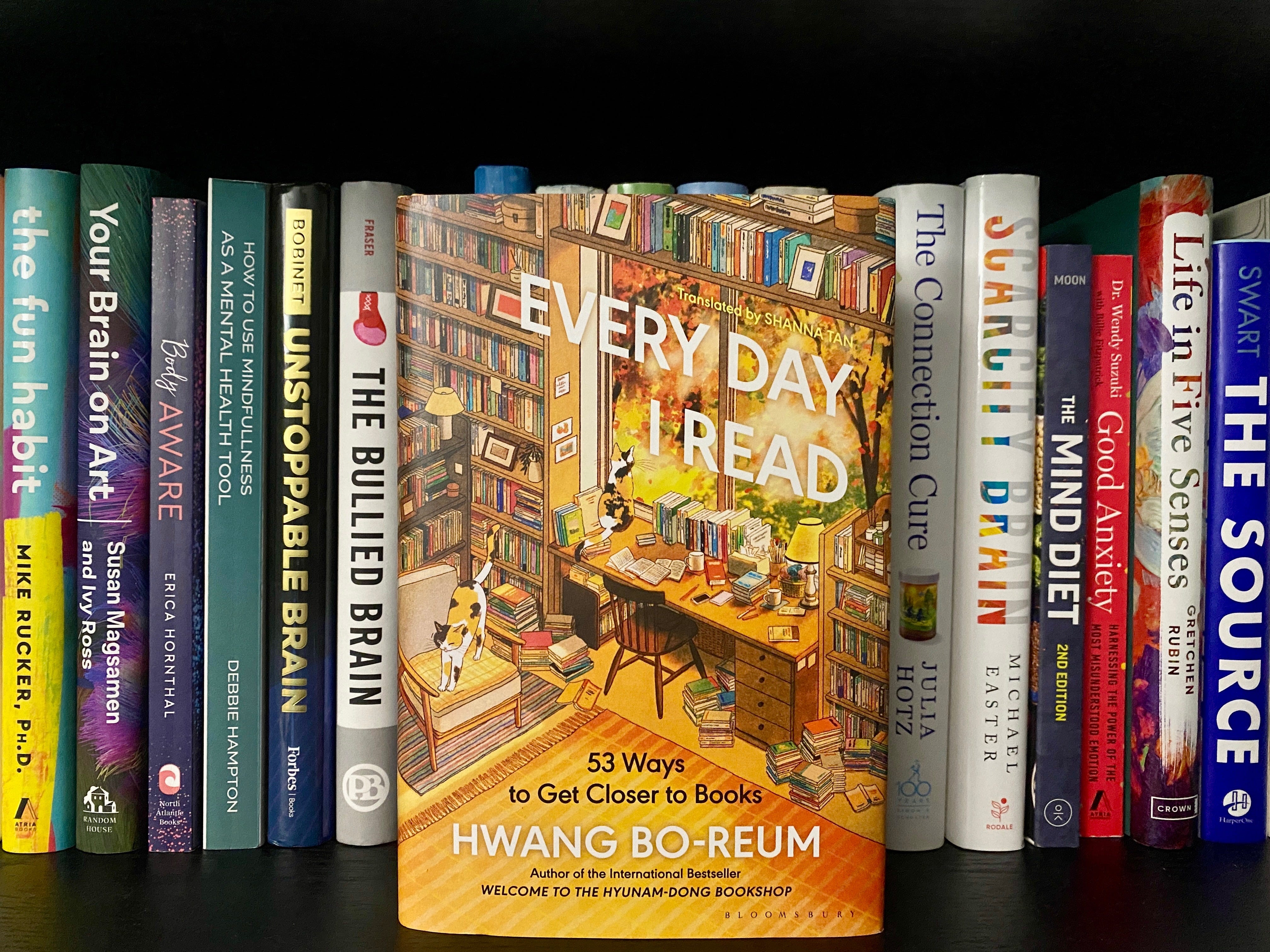
💌 “Dear reader, what are you interested in these days? Whatever it is, the book that truly understands us is somewhere in the bookshop waiting for us, waiting for you.”
(Essay 49)
–📘 Every Day I Read: 53 Ways to Get Closer to Books
by Hwang Bo-reum and Shanna Tan
A heartfelt invitation to reflect on your relationship with reading and celebrate the joys of books. Why do we read? What is it that we hope to take away from the intimate, personal experience of reading for pleasure?
“How to get closer to books— a challenge to reflect on, “How do we deepen our relationship with reading?”
💌 Words From The Author:
"Charles de Montesquieu says, ‘I have never known any distress that an hour’s reading did not relieve.’
📖 I want to remember the book that has healed me today.”
Why do we read? What is it that we hope to take away from the intimate, personal experience of reading for pleasure?
How do I deepen my relationship with reading?
How do you decide, “What should I read today?”
How do you provide someone with a book recommendation? What types of questions do you ask them to gauge their individual taste?
Is reading really a waste of time?
How can I regulate my screen time so that I spend more time on things I like, such as reading?
Can we really say we understand a poem if we have only read a single work by the poet? Why do you think people read poetry? (Essay 12)
Have you noticed a common trait of passionate people? (Essay 16)
Reflect on this quote from Annie Dillard’s The Writing Life “How we spend our days is, of course, how we spend our lives.” Write down your reflections in relation to reading. (Essay 20)
Is it a crime not to be able to think critically? (Essay 21)
Do you like to watch film adaptations of books? Why or why not? Do you prefer to read the book or watch the film first? Why?
In his essay collection A Fool in Love with Books Lee Doek-mu says that reading with friends brings more joy than reading alone. “At the right time, with the right friends, with the right book, and having a conversation, it feels just right in the moment. This is unparalleled joy, but why is such happiness so rare?
What are your guidelines for reading multiple books at the same time?
By reading the list below, I hope you can get a “feel” for the ideas and concepts explored in this book that invites you to explore your relationship with reading and celebrate the joy of books.
Part of this month’s gathering was the celebration of the Neuro Nook (book club) turning 3, and it only seemed appropriate to explore a book on reading!
I also thought it would be fun to share 4 author announcements for our 4th year at the Neuro Nook… and oddly enough, I pulled it off. 🤯
Attendees got to hear it first, and I shared the highlights with them. I’m going to recap this in a separate post because it is that NEWS WORTHY, ok?!? And I am that excited about it! Sometimes I get these “crazy ideas” and sometimes (just sometimes) they happen to come to fruition!
Now back to the point of this post…
The essays indicated below in bold are ones we touched on during our Neuro Nook’s 3rd anniversary celebration this week.
Read Bestsellers
Read Beyond Bestsellers
Read on the Train
Read Small Books
Read Big Books
Underlining and Annotations
Always Have a Book With You
Choose Books, Not the Internet
Use a Timer App
Read Classics
Read Novels
Read Poetry
Online Bookshops, Facebook, Instagram
Bed, Night and Lights
Favourite Author
Books and Drinks
You Don’t Always Have to Finish It
Are Books Useful?
Visiting the Library
The Joy of Collecting Quotes
Book Clubs
Read to Seek Answers
E-Books
Pockets of Free Time
Read Slowly
Life-Changing Reads
Indie Bookshops
The Next Book to Read
Read When You’re Happy, When You’re Anxious, and in the Moments in Between
Movies and Novels
Let’s Discuss Books
Reading Multiple Books at Once
Reading Silently vs Reading Aloud
Read Books That Resonate
Read Beyond Success and Failure
Read During the Holidays
The Flavours of Words
Parents Who Read
Read Widely, Then Deeply
Keep a Reading List
Read to Live the Life You Want
Read Book Reviews
Write Book Reviews
The Characters’ Charms
Organise Your Bookcase
Read Books Like an ‘Axe’
Read Books That You’re Interested In
Read Beyond What You’re Interested In
Read to Overcome Despair
Read Difficult Books
Read Books That Preserve Your Sense of Self —🫶 Krystal’s Pick❣️
What Have You Been Reading?
If Books Disappeared from the World— 🫶 Heather’s Pick❣️
Heather and I shared how we select our Neuro Nook reads. First, this is a great question, and honestly, it is a bit of a ‘brainstorm’ after each monthly meeting and a constant work in progress!
It starts with you. We’re so grateful for our attendees, and every session is an opportunity to share the topics, books, or authors you’re curious about. There is a specific place to do this on each Neuro Nook event registration form or during our live session in the chat. You can also email me anytime at krystal@virtualbrainhealthcenter.com I log, tally, and cluster every suggestion in a spreadsheet, and regularly review it.
We read a lot ourselves. Heather and I are both avid readers involved in various groups, with wonderfully varied interests. I’ll be the first to tell you: I read to learn. Despite trying fiction over the years, it’s just never “clicked” for me, so I read a lot of nonfiction for fun (genuinely — that or journal articles, at least the ones I can access or get some friends to send me… I TOLD you I’m a total nerd 🤓). I’m also part of a First Look Book Club, where I sometimes get a sneak peek at titles that might interest our readers. And through my work at the Virtual Brain Health Center and the Let’s Talk Brain Health! podcast, I connect with all kinds of other nerdy-ish professionals; I’m always asking people what they’re reading to grow our list.
We watch current events and trends. Brain health science moves fast, and sometimes current events touch a lot of lives at once. Political neuroscience, for example, is a newer and growing field — and with a heavy political season unfolding this fall in the US, it feels like the right moment to explore it. Our brains govern so much of our lives, and the science now shows how they shape everything from ideological decision-making to how we relate to one another. We hope that by understanding our brains — and ourselves — a little better, we can extend more grace to ourselves and others during heightened times. That’s real-world impact we can learn about and discuss together. (As I always say, we learn right alongside our readers!)
Then comes the vetting. We keep a running list of topics to pull from and review many books for tone, accessibility (libraries, international reach, digital option, audiobook, etc.), and fit for our club— comparing them against reader requests and the areas we’ve already explored. We try not to repeat topics unless there’s a unique slant or real value to add.
And authors who say yes to joining us? That’s AMAZING, and we’re forever grateful — so those books naturally move up the list based on availability.
So some books stay in active rotation, some wait on the shelf, and once a title checks the boxes — right fit, right timing, right for our readers — it becomes an official selection. Trust me, there’s nearly an entire bookshelf in my office of “someday” reads! You can see our current shortlist on our website — those are the ones we’re actively considering and hoping to get to soon. Reader requests and timing always shift, and we do our best to honor them.
With only 12 picks a year, it’s safe to say… yes, we’re picky or is selective the more proper word here? 😉
Either way, I’ll end with… Heather and I are careful curators of the Neuro Nook with intention, care, and openness— just like our attendees who invest their time and energy into our Book Club.
In reflecting on a quote from this month’s read that resonates with our book club,
“Books may not give me the answers, but they nudge me toward the right direction. I keep their words close to my heart.”
This is one goal for the Neuro Nook— to explore a concept of brain health through a book and make it applicable to our daily lives. If we take one small takeaway from a book or even consider the Neuro Nook Rx from the book— then there is one small win for our brain health and wellness.
We discussed whether the goal is about the total number of books read or listened to each year or if it is about the experience of the book. This can depend on the goals that people may have for reading because most tend to focus on reading ❌ number of books per month or year. It is rather obvious that larger books require more time compared to shorter books and throw off the number count for books read.
The author shared something for all of us to ponder…
💭 “Reading is about understanding the world and ourselves, ...
not finishing as many books as possible. We aren’t reading to become faster, but to feel and understand more.”
Then, she provided a practical tip for working your way through a ‘larger’ and/or ‘thicker’ book. I should say there is debate on what people call what we are talking about here… is it a BIG book or a THICK book? Either way, that is the frame for the next few tidbits of information to consider.
“Remind yourself not to calculate how long it will take you to read the book, but rather focus on small progress goals for larger books.”
(🎯Example: 30-minute reading intervals)
This also led into the discussion of reading “challenging books” because many books that fall into this category are ‘thick books’ that require intense concentration to complete, or may be because this type of book is outside of our typical reading genre. This could be for a variety of reasons. This would be a genuine stretch but can also be rewarding.
“When reading difficult books, have trust in the process and keep going. You’ll come to realize no book is too difficult.”
The author went further with sharing this idea to tackle challenging books, which incorporated the above two callouts:
“Instead of being ambitious and insisting on understanding 100%, take the pressure off yourself. Keep going, even if you're just doing a few pages A day. Step beyond ‘ I want to read a book by this author’ to ’ I'm reading their book now’; so what if you can't understand everything? You're reading, and that's what matters. If we keep going, we will be able to understand the text one day. (Essay 50)
I hope this reframe may be helpful to you for the next challenging book that you tackle or should you want to revisit one that you put down. One of the many lovely things about books is that we have plenty of options to explore or to revisit ones when the time is right for us. 🫶
📝 Keep a reading list:
“Books are friends we make along life’s journey.”
P.S. I shared that I was floored when my husband Jake came home from a guys' weekend trip and ordered a book. I have not witnessed this man read a book in 16 years — turns out he did audiobooks, including 50 Shades of Grey! (But that's a story for another post one day.) So, seeing him enjoy his new book, watching him take time to read it and de-stress, and hearing him tell me about it, I thought I'd be supportive and buy him the rest of the books so he'd have the whole set. (Plus, I found them on sale and figured, why not?)
Well, little did I know that as the series progressed, so did the length of the books. He was thrilled — until he saw how thick they were, and then he was not only visually overwhelmed, he became cognitively overwhelmed thinking about reading a book THAT long. In fairness, when he stacked the series of 8 books on his nightstand, it filled the entire thing, and he took the opportunity to proudly announce to me that he will be reading for the next 5 years (if not longer- his words, not mine **read this in a very dramatic voice in your head or out loud for proper sound effects**)!
Hopefully he can employ some of the above strategies and land on proudly saying,
"I read [book title] by [author’s name]." I’m sure he’ll add the page count in there, too, expecting bonus points.
Or else our local library might be getting this popular series of books donated. 🤷♀️
Like the blogs online and reading reforms, our group had varying opinions… BUT many agreed that a book's “readability” is VERY IMPORTANT. (I guess it was not just my neuroscpicy brain that will toss a book if I have to work too hard just to read the font. Nope, I’m not going to do it!)
Simply put, the font and layout matter—a lot. More on this below. ⬇️
The way a book is written also matters. The language. The tone. The word choice.
We did have group consensus that once we “know” we are done with a book, we KNOW it. “I can usually tell after a few pages... If I don’t like it, I stop.”
Some “guidelines” that group members shared:
They will give a book 1, 2, or 3 chapters
Some will give it ❌ number of pages, and this ranged from 30-100ish
Some online blogs suggest a 10% rule (read 10% of the book and then decide)
There seemed to be no identifiable rule that some of us could identify. We know what we like, and we know what we do not like. And we can acknowledge this is personal and subjective. We are all well aware of that!
Sometimes we just couldn’t put our finger on exactly what it was about a particular book that we didn’t like per se…
Sometimes it is a popular book that SO MANY people have told us about, but we still can’t get on board… but hey, that is ok! There are plenty of other books out there to be read. And sometimes there was a movie about the book we could watch and pick up a new read along the way.
I KNOW the debate about ‘the movie’ vs. ‘the book’ is another hot topic, and we didn’t have time to get to that one. You’ll have to explore those essays in this book and journal about it. Or you can comment below.
What are your guidelines for reading multiple books at the same time?
As adult readers, we acknowledged there are no “rules” for reading; yet, somehow that was something we had to unlearn over time. We seemed to have preconceived rules around reading that we had the opportunity to break over time.
The main one was reading one book at a time. While most of us were not able to identify exactly “where” that rule came from, we seemed to acknowledge we were able to throw it out the window. Look at us being “rule breakers” for a “rule” we had likely carried around for years, but it was not serving our need to be a curious adult learner.
Some shared they pair a fiction and non-fiction book together.
Some shared they have multiple books being read at the same time.
Some like to group similar books alongside one another. (topic, author, theme) Some shared that their mood can influence what they want to read.
Some like to have dissimilar books being read at the same time for variety.
Some shared that they curate a reading list, and what becomes available is their next read. (We understand library waiting lists at times.) Some shared that simple and smaller-font books are read in the morning, and the larger-font books are read in the evening and at bedtime when their eyes are tired.
Some shared there are books they buy that pique their interest, but they know they won’t read it right away… it will be a future read… when the “right time” presents itself.
This is where reading enters the real world and our real lives. Our brains and bodies get tired, and that readability factor definitely comes online. 👋 Hello, large print books, anyone, or adjustments to digital readers?
We discussed how writing a book review is our opportunity to process our own thoughts about the book and to share with others. Many of us tend to read book reviews when selecting books or turn to book reviews if we are struggling with a book to determine if it is worth a little more investment of our time or if more people tend to abandon ship, so to speak, too.
The author goes on to share:
“Write about how the book made you feel. Writing is about giving shape to our thoughts and feelings, and through the process, better understanding ourselves. Writing a reader's response is a way of reflecting on her personal experiences through a book, and as we write down our thoughts, they gain form, logic, and persuasion. Now, I don't only read to understand; I read to write. And that's how I found another motivation to keep reading.”
Writing book reviews for the authors who gift our Neuro Nook their time is a wonderful way to say “thank you”— beyond the notes that we pen to them after each monthly gathering. Whether you have taken the time to do this already or not, please know it is not too late! You can view a list of Neuro Nook authors and their books on our website if you'd like a friendly reminder, or browse our reading list, which links directly to the authors' books on Amazon (US).
Authors always appreciate honest reviews from their readers, as do their publishers. Feel free to revisit any of our Neuro Nook reads that you have completed and share a review on Amazon, Goodreads, Bookshop, or other similar platforms. Your words could help the next curious reader of the book. And remember, this applies to any book that you’ve read and is a good cognitive exercise as you aim to consolidate your thoughts on an in-depth topic.
Wouldn’t you know that we have a book lined up on this topic that we will explore in 2027— executive function! And an exclusive author appearance. I KNOW I can hear your excitement as you are reading this, too! This has been at the tippy top of the topic request list— memory— but this book goes even further and explores planning, attention, inhibition, theory of mind, and emotion regulation. I’ll be sharing all of the upcoming author announcements in a separate post, where readers get an exclusive opportunity to pre-register for the events!
And of course they delivered some recommendations:
Where The Crawldads Sing
Atomic Habits by James Clear
My Sister’s Keeper by Jodi Picoult
The Well Lived Life
This is Happiness by Niall Williams
The Dragon Heart Legacy (Trilogy) by Nora Roberts *A surprise gift
And part of the inspiration behind starting our monthly Silent Book Club (SBC) gatherings is recognizing that not everyone might be as excited as Heather & I are about “brain health” related books. Shocker, I know, right?
But, with a Silent Book Club, it is 📖 BYOB = Bring Your Own Book
So, anyone looking to dedicate some time to reading can join, or they can do any type of “silent activity or creative pursuit.” We spend some time afterwards socializing, but this is an option if people have to scurry.
Join Our Next Silent Book Club
As we know, it is helpful to schedule time for things we want to prioritize, and if “reading” is one of those things for you… an open invitation to join us. We meet once a month on Tuesdays from 12:00-12:45 on Zoom. People can come/go as needed. It is pretty simple.
We get into Zoom. Say a quick, “Hello.” I set a timer, and we read for 30-35 minutes. Then, we mingle for a bit to discuss what we’ve read (10 minutes).
I’m also working on curating the ever-growing reading list from our SBC meetings so we can curate it in one spot. I’ll gladly accept these types of “brain-work” assignments for our Neuro Nook members. This post will be available later this month.
Read every day- if only for 10 minutes.

💭 “The question, “ What have you been reading?” seems to have the power to open a latch in our hearts. The moment we welcome books into ourselves, we’re bravely opening the door to our he
arts. We confess our loneliness, our weaknesses, or uncertainties and worries as we open up about the values and worldviews that each of us holds close to our hearts.
The doorway to self-reflection that’s hidden inside us opens, and we grow to become a person who understands introspection.
When everyone else is asking, “What movie did you watch recently? and What drama are you watching now?”, I want to ask, “What book have you been reading?
I hope to make a space, however small, for books in our conversations. I want to open the latch in my heart when I’m with you.” (Essay 53)
💭 ““It becomes harder to find satisfaction and happiness in life. That's why we should read books that preserve our sense of self. Not just buy books, but read them and understand the world.
Instead of blindly following what the media tells us, we should find our own happiness. When we're feeling lonely, we should head to a shop or visit a friend. When we create stability, instead of dreaming of a perfect home, we should find perfection in a simple life within our means.
Be aware of our own anxiety, know how to prioritize ourselves, understand and manage our inner desires, and books will help us find our way forward.
The media is full of sensationalized stories and temptations. To fight against its influence, we need to build a ‘ story vending machine’ for ourselves. 💡
Each time we need something to lift our spirits, we can pick a story and let it play in our hearts… And that's why I read: to collect stories that will help me be myself.” (Essay 51)
💌 “Take a break,
The world of books is waiting”
In celebrating the Neuro Nook turning 3, I have a small gift that I’m able to send to the first 25 people who send me an email with their US POSTAL MAILING ADDRESS and the latest Neuro Nook book club that you attended (regular book club gathering or silent book club).
This is one small way that I can say, “Thanks a myelin!” to our growing book club members.
💌 krystal@virtualbrainhealthcenter.com
🙏 Hopefully this is a reader perk!
Join me at the Virtual Brain Health Center with Brain Health Mentors for the upcoming Neuro Nook (Book Club) discussions, where we explore thought-provoking books that deepen our understanding of brain health and wellness.
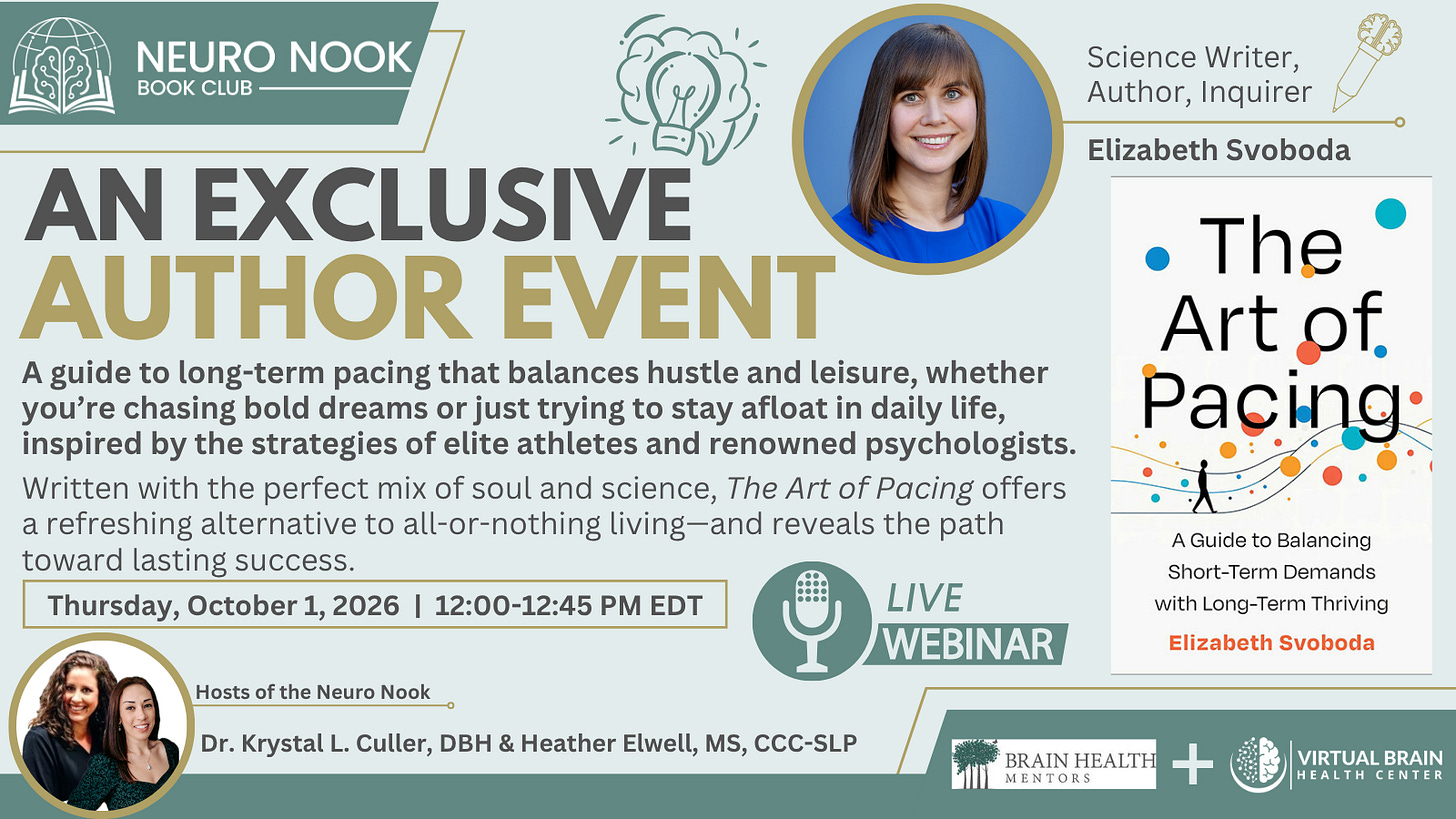
Save the date for our future book club meeting from 12:00-12:45 PM EST on:
September 3- The Ideological Brain
October 1- The Art of Pacing Live Author Appearance
November 5 - Book TBD
December 3- Book TBD
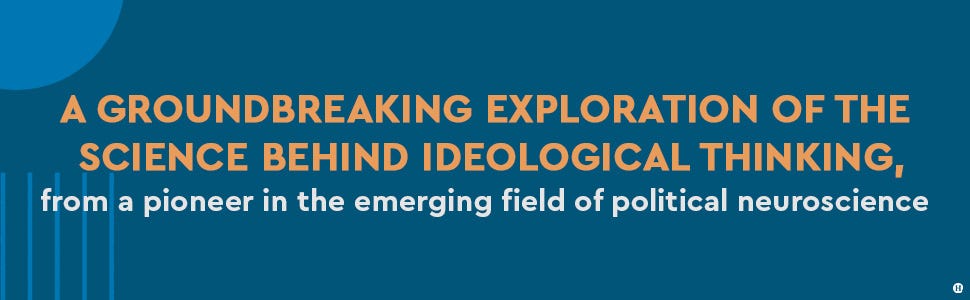
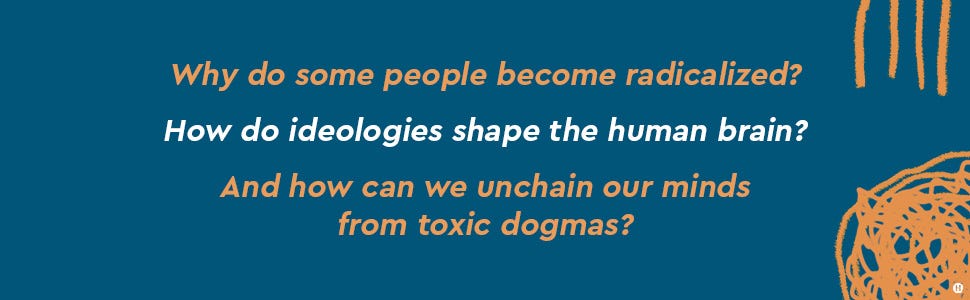
Reveals the deep connections between political beliefs and the biology of the brain. The full post, “Why this book?” will drop next week on Substack—stay tuned!
In brain health & wellness,
- Krystal
Comments
Nothing yet. Say the first thing.
Sign in to join the conversation.