
Brain health research is evolving fast, and I’m often asked, “Where can I go to stay updated?” With so much information out there, it can be overwhelming to know where to start. That’s why I created the Brain Health 4-1-1—a simple, weekly update to help you stay in the know.
Each edition delivers:
✅ 4 key insights on brain health
✅ 1 expert or resource to explore
✅ 1 thought-provoking idea or myth to consider
What is my goal? To make brain health knowledge clear, accessible, and actionable—so you can focus on what matters most. I’m grateful that you’re here, and I look forward to sharing this journey with you!
I took a brief break from the 4-1-1 to revisit its format and how to improve it for you. This is always a work in progress, and I’ve landed on keeping the same 4-1-1 structure but with more succinct summaries and one practical takeaway per topic.
🎯 The goal: less time between you and the brain health information you’re looking for. Same clear, accessible, actionable insights — just a quicker path to them.
Thanks a myelin for being here as this evolves — and I appreciate the grace as I experimented with what this would look like! If you have suggestions, please let me know. Email me anytime at krystal@virtualbrainhealthcenter.com
💌 I hope you enjoy this week’s update — I’ve got some ground to make up for!

— Normal blood pressure, no diabetes, and not smoking between ages 48–68 were linked to nearly 13 additional years of life without dementia.
A study of over 12,000 adults followed for 26 years found that people with none of the three risk factors — high blood pressure, diabetes, and smoking — lived dementia-free for almost 13 years longer than people with all three (30 years vs. 17 years from the study's start). The benefit held across groups, though women and White participants saw larger gains than men and Black participants — a gap researchers say points to the need for more targeted prevention support.
This isn't a new finding, but it's some of the clearest evidence yet that midlife — not just old age — is when vascular health decisions start shaping your dementia risk decades later.
Review the FULL Research Article
✅ Try This:
Get your blood pressure checked and know your numbers — it’s the single most modifiable factor of the three.
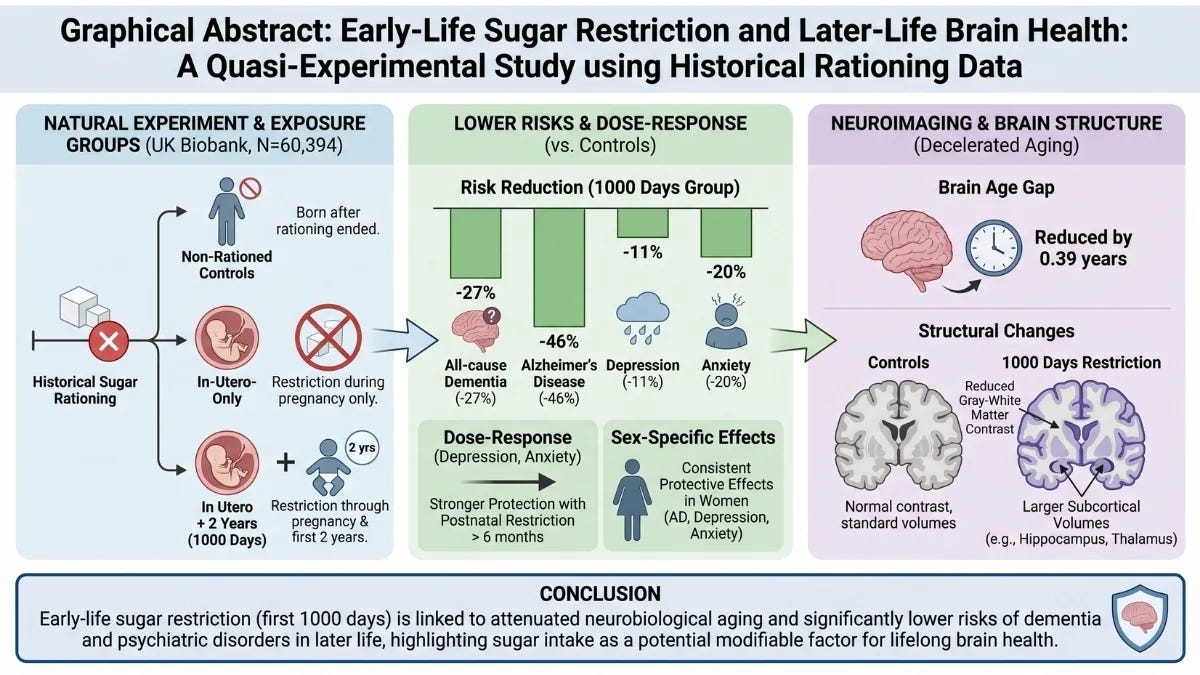
— A rare natural experiment from WWII-era sugar rationing suggests the first 1,000 days of life may shape dementia risk decades later.
Researchers compared UK adults born just before vs. just after 1953, when sugar rationing ended and consumption nearly doubled overnight. Those whose first 1,000 days (pregnancy through age 2) coincided with rationing had a 27% lower risk of dementia and a 46% lower risk of Alzheimer's later in life. Brain scans backed this up. The rationed group had brains that looked about 4-5 months "younger" and had larger memory-related regions like the hippocampus.
This isn't proof that low sugar in infancy prevents Alzheimer's — it's an association from a natural experiment, not a controlled trial. But it adds to growing evidence that early metabolic health may set a trajectory for brain aging that plays out over 70+ years.
Review the FULL Research Article
✅ Try This:
Blood sugar regulation matters at every age, not just infancy — insulin resistance and chronic inflammation (the same mechanisms researchers point to here) are well-established dementia risk factors in adulthood, too.
Consider how much added sugar shows up in your own daily routine, not just the obvious desserts, but sauces, drinks, and pre-packaged snacks.
— A new review suggests time in nature can sharpen focus and mood even when you weren't stressed to begin with.
For decades, research on nature's benefits has focused on restoration — how a walk in the park helps you recover after stress or mental fatigue. A new review from the Max Planck Institute looked at 61 experiments and found something largely overlooked: nature can also boost attention, mood, and well-being from a normal, non-stressed starting point — what researchers call an "instorative" effect. The catch is that only a handful of studies have actually tested this, so the finding is promising but still preliminary.
Nature may not just be a reset button for when you're depleted — it could be a way to proactively build cognitive reserve and resilience, even on an ordinary day.
Review the FULL Research Article
✅ Try This:
Don't wait until you're stressed to step outside. Build a short daily outdoor moment into your routine as a baseline brain habit, not just an emergency reset.
— A blood test can flag early Alzheimer's risk years before symptoms — but experts warn it's not ready to be used that way, and a positive result raises as many questions as it answers.
A blood test measuring p-tau217, a protein linked to Alzheimer's, is FDA-approved to help diagnose people already experiencing memory problems — but increasingly, healthy people with no symptoms are seeking it out too, often because of family history. A recent JAMA study found cognitively normal people with very high p-tau217 levels had a 38% chance of developing memory problems within 5 years, and 78% within 10 years.
But experts caution against over-interpreting results: moderate levels are unreliable, false positives happen from mishandled samples or unrelated conditions, and a high result doesn't guarantee a diagnosis — much like high cholesterol raises heart attack risk without making it certain. There are also no privacy protections for this data, which could affect life insurance or long-term care coverage. (Many people do this type of health testing through third-party services and opt to keep their personal results out of their healthcare records. This IS an option right now for direct-to-consumer testing.)
Right now, there's no proven drug to prevent or delay Alzheimer's onset, so a positive result mainly delivers uncertainty and anxiety without a clear next step. Most dementia experts don't recommend healthy, symptom-free people seek this test out yet; although, this comes down to personal preference.
✅ Try This:
If you're worried about your Alzheimer's risk because of family history, focus energy on what's proven to help regardless of test results: regular exercise, a nutritious diet, not smoking, and managing blood pressure. Research shows these habits lower the risk of cognitive decline even in people who go on to develop Alzheimer's-related brain changes.
Remember, you can always adopt brain-healthy lifestyle changes and explore genetic testing options when the time is right for you.
Start the conversation with your healthcare provider if you are concerned or explore third-party testing options to get informed about your personal brain health risks, including genetics.

by Dr. Dana Suskind, MD
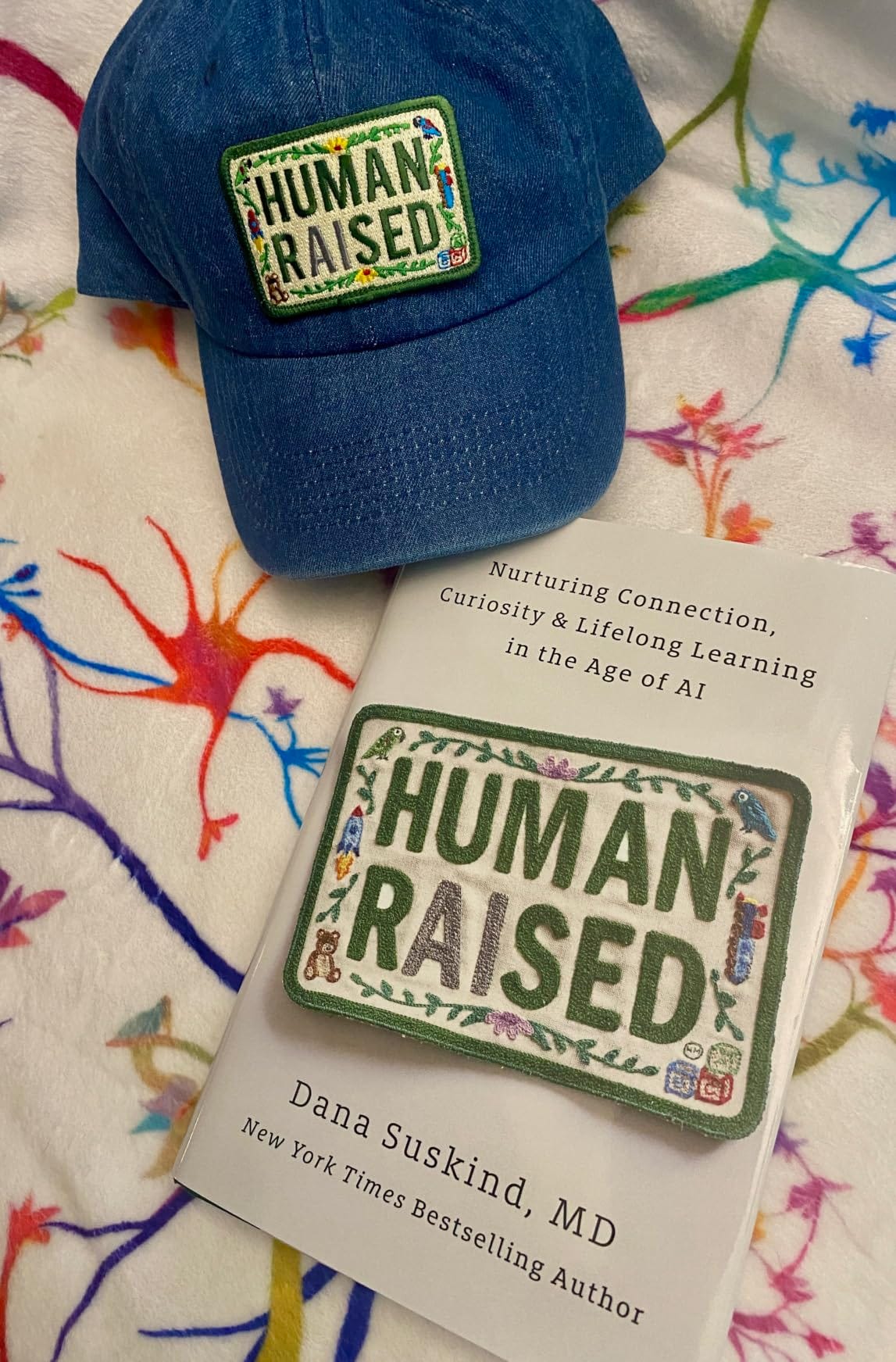
Last month, I had the opportunity to get a sneak peek at this book ahead of its release as part of a First Look Book Club. The topic was thought-provoking on many levels, and I learned a lot about how AI is quietly working its way into the lives of our youngest, most precious minds. Needless to say, I don’t feel too bad about keeping devices on lockdown at my house as an Aunt, or taking a firmer stance from a neuro/psych perspective on protecting growing minds. Now I have a great book to point to, so I’m sharing it with all of you below, along with the review I wrote and a link to learn more.
I took pages of notes, since I’m also serving on a committee developing a toolkit to help teenagers and parents/caregivers talk about AI use — part of a broader youth brain health initiative where AI comes up constantly. As adults, we sit in positions of influence, but I often think about how to best support the teen and youth leaders who are already building the skills to drive the change they want to see. My aim is to listen, support, and amplify the work they’re doing alongside them.
The book is written with the premise that we assume all children and adults around us have been human-raised…
And then AI entered the stage and has been slowly shifting our social relationships.
The author provides guiding principles- HOPE- and a framework -DETECT- to help adults evaluate AI use within their families and social circles. It is meant as a guide in a new world, as the use of AI is moving faster than what we know about its impact and policies that will regulate safety guardrails for it, especially for young children, youth, and teens.
The book is for ANYONE who CARES ABOUT CHILDREN (grandparents, teachers, childcare providers, aunts, uncles, neighbors- likely you if you are reading this review!), not just parents. (However, parents are the primary group it is marketed towards.) While I am not a parent, I found the book valuable for the youngsters in my life and as an adult who advocates for safer AI use for developing minds within my circles of influence. This is a book that I have already recommended to numerous people and one that I will continue to tell others about.
Simply put, we should all think about when AI use interferes with or replaces our social connection and what we can do about it.
You can learn more about this book, including resources and the HOPE framework shared on the author’s website, including downloadable handouts and more.
P.S. You can also learn more about the book’s cover art and the lovely patch that was shared with some readers! I opted to put mine on a hat to spark some conversations!
👶 A “Baby Brain Rx” from my Neuro Nook (book club) from earlier this year is from Dr. Sarah McKay’s book, “The Women’s Brain Book,” and it also emphasized the first 1,000 days of development. This seemed like a good time to revisit it… Dr. McKay is also the author of “Baby Brain.”
✍️Baby Brain Rx (The First 1,000 Days):
From conception to covering a child’s first two years is just as important—
a diet rich in nutrients, lots of love and attention,
and safe, stimulating environments— help children’s brains flourish.
Comments
Nothing yet. Say the first thing.
Sign in to join the conversation.