
Do you ever look at your cholesterol numbers and wonder why there are so many?
Why can’t they just give you one number to look at? Well.. we could. But why make medicine that easy to understand?
This is an explanation of how I run through cholesterol results with patients when I want them to really understand what’s going on.
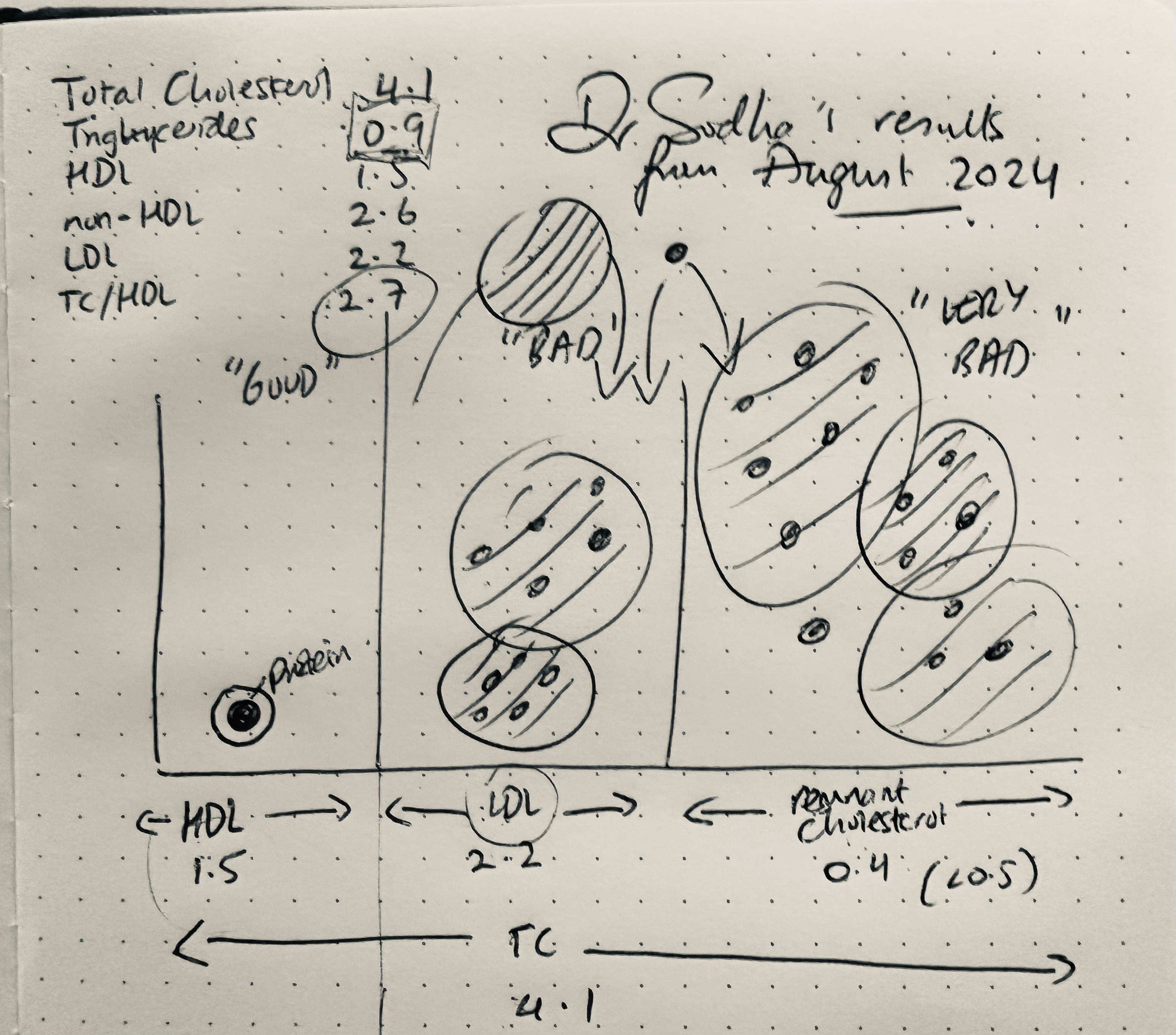
Now I’m using my own results here from August 2024. Credit to Dr Steven Boyd for getting these blood tests done for me in the NHS at Mayfair Medical Centre in London.
I’m quite proud of these results because I would say that this is a pretty good cholesterol profile!

This is typically what you might get from your GP or another health practitioner.
TC 4.1
HDL 1.5
Triglycerides 0.9
non-HDL 2.6
LDL 2.2
TC/HDL 2.7
Let’s put it into a diagram because I think that makes it much easier to understand.
We’ve got a range of different types of cholesterol.
They’re different sizes, and they have different types of volatility and different potential impacts on our risk of having heart attacks and strokes.
HDL, which are smaller and more dense particles of cholesterol.
They’re high density cholesterol.

HDL is very ‘good’ because it helps to mop up the excess bad bits of cholesterol and helps to take it back to the liver for reprocessing. So we want more HDL.
Most of it is protein, and that’s why it’s high density because the protein is high density. It’s also got a bit of fat. It’s also got the cholesterol in it, which is these dark black bits. Then we’ve got LDL.
LDL is typically what we see as the bad cholesterol.
Then finally, we have something called remnant cholesterol. Remnant cholesterol is the difference between non-HDL and LDL.
I’ll explain that in a moment.
Let’s look at these specific numbers that I’ve got.
The LDL are bigger particles, and they are essentially this cholesterol with much more fat. They are low density lipoprotein. Then the remnant cholesterol is a number of different range of sizes, including the supersized particles as well. And again, these tend to be a little bit more volatile, a little bit more sticky, tend to have extra fat in them.
They’re not very good for us.
The worse the more we go this way, the worse cholesterol gets for our health. So if this is good, this is bad, and then this is the very bad.
By drawing this out in a diagram as on the video, this help to better understand what these numbers mean.
Triglycerides are run running around the bloodstream.
It combines with cholesterol to make different types. So when you’ve got a lot of fat, it’s going to combine and make more remnant cholesterol and it’s going to make more LDL.
Essentially, it’s going to make more non HDL.
Triglyerides is therefore a precursor to more harmful cholesterol, but also independently contributes to an increased risk of heart disease.
Triglycerides are not calculated in cardiovascular risk scores and can be neglected a bit.
I find that this explanation of cholesterol is helpful for patients who would just otherwise observe a sea of numbers coming their way, and it’s quite hard to contextualise this.
p.s. any cholesterol boffins out there? Let me know how I could even better explain this to my patients.
No posts
Comments
Nothing yet. Say the first thing.
Sign in to join the conversation.