
Until I was 39 years old, I had never traveled to any continent outside of North America. But then last summer I was invited to a writing retreat in Denmark for scholars writing within the interdisciplinary field that calls itself “right-wing studies,” social scientists and humanities scholars studying varying facets of conservative movements across the globe. (Thanks to Rebekah Larsen and Katie Gaddini for organizing the retreat and who happen to be editors of a recent symposium on right-wing studies in the journal I edit, Contemporary Sociology - check it out!)


Last week, I returned from my second European adventure, this time to Lausanne, Switzerland, for an incredible gathering of scholars who study far-right politics, gender, and “femonationalism” (a term coined by sociologist Sara Farris in a 2012 article to refer to the ways in which women themselves and pro-women rhetoric are integrated into nationalist movements). Katie Gaddini and I presented a paper on the Gen Z women we’ve both studied who are using feminist-sounding language to rally around anti-trans causes. (Katie’s incredible new book, Esther’s Army on Christian women in the conservative movement, is now available to pre-order!)
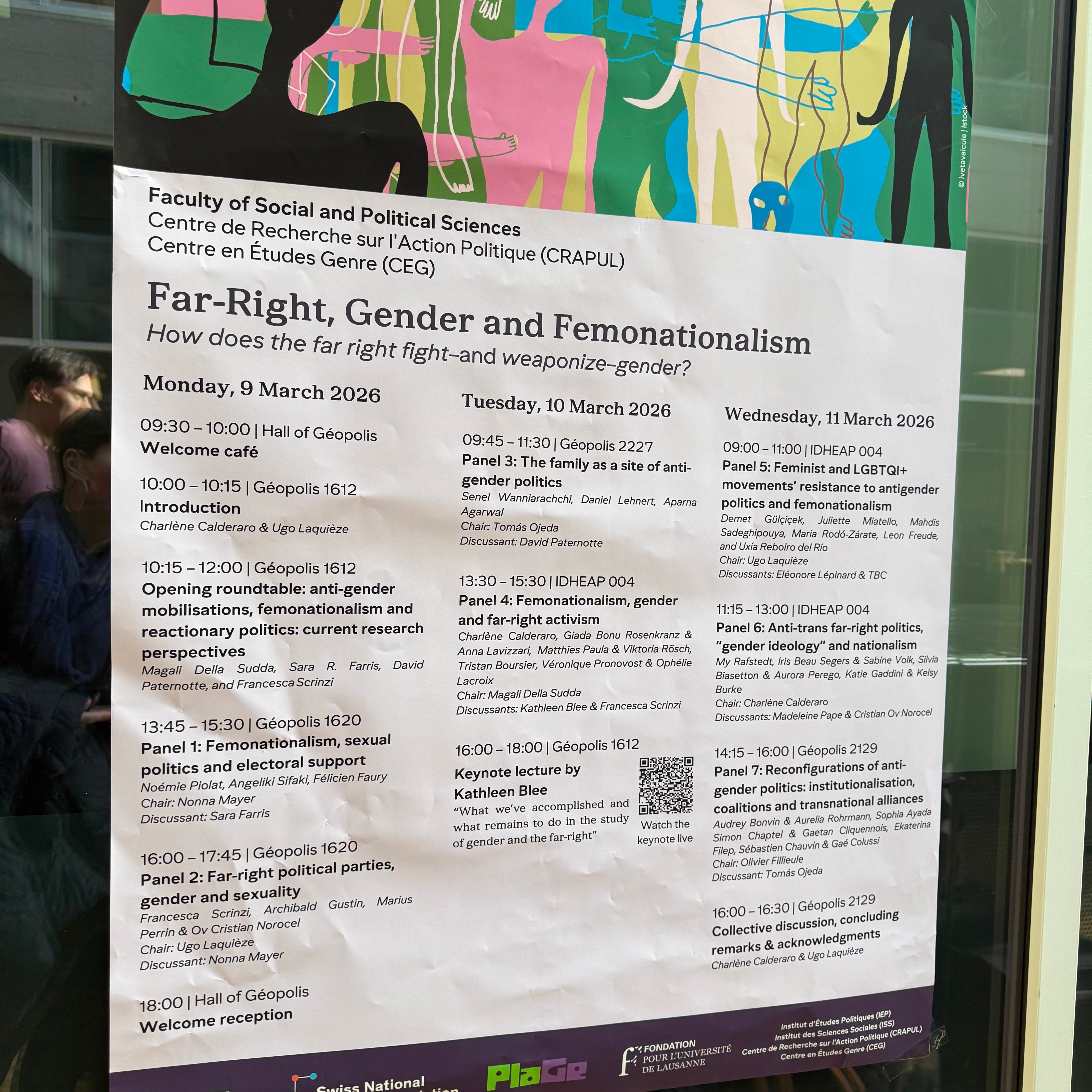
The bad news: far-right parties and authoritarian regimes are making gains all across the globe. So often we Americans consider ourselves exceptional, but the MAGA Movement and Trump 2.0 are drawing from a longstanding playbook that has been evolving for decades outside of the United States.
I don’t want to overstate my case: there is no “good news” that can cancel out this horrifying reality. But I did fly home across the Atlantic feeling more hopeful than I have in months, thanks to the thoughtful insights of the scholars I learned from in Lausanne.
Here are some of the books and articles I’ve since added to my reading list:
Transnational Anti-Gender Politics edited by Aiko Holvikivi, Billy Holzberg, and Tomás Ojeda (2024, Springer)
In the Name of Women’s Rights: The Rise of Femonationalism by Sara R. Farris (2017, Duke University Press)
The Racialization of Sexism: Men, Women, and Gender in the Populist Radical Right by Francesca Scrinzi (2024, Routledge)
“#LGBTpropaganda #GenderTheory #Wokism: Expanding and blurring the boundaries of Francophone anti-gender discourse propagated on Twitter” by Ugo Laquièze (2025, Politikon)
“Beyond Instrumentalization: Far-Right Women’s Appropriation of Feminism in France” by Charlène Calderaro (2025, Politics and Gender)
“Intersectionalising hatred: how multiple antagonisms reinforce reactionary coalitions” by Tristan Boursier , Véronique Pronovost & Ophélie Lacroix (2026, Journal of Gender Studies)
At the conference, American sociologist and pre-eminent expert on the far-right and gender politics, Kathleen Blee, offered a keynote address summing up the contributions of right-wing studies as a field with directions for next steps. Kathy was my advisor in graduate school at the University of Pittsburgh so it was great to catch up with her.
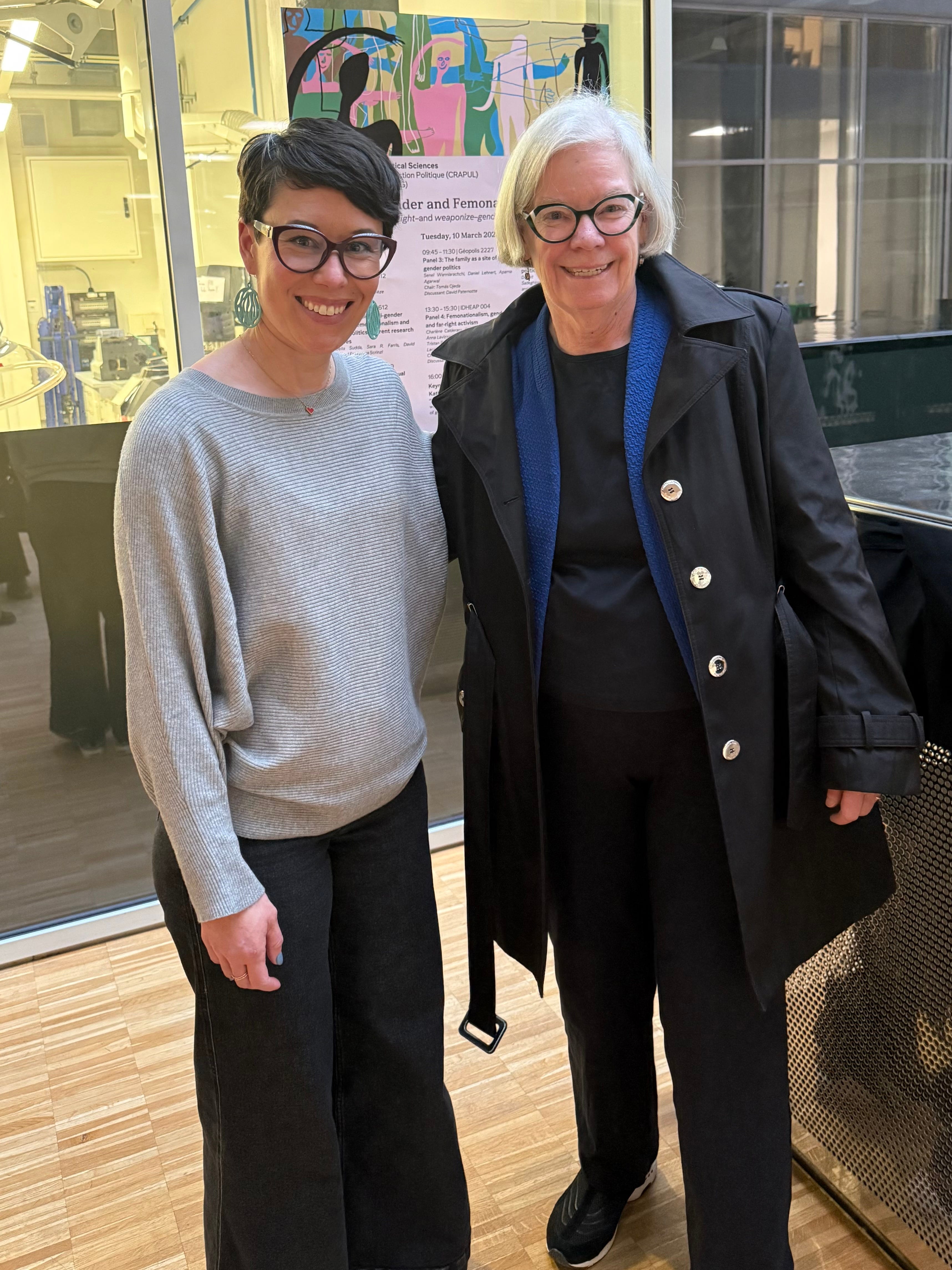
Dr. Blee shared with us how her thinking of the far-right has changed in the decades since her first book on the topic, Women of the Klan, came out in 1991. As I am drafting my book on anti-trans America another comment that struck me is that Kathy is careful to use “far-right” as a descriptor of politics not of people. In other words, in her writing, she has shifted from writing about “racist people” to “people who hold racist beliefs.” It’s a slight but important distinction: giving room for people to change while also recognizing that racist ideology exists beyond any single individual.
Whereas Kathy used to define racist movements in the U.S. by the networks of groups and leaders that comprised them, this is no longer possible. As the internet has made these movements more diffuse, it has burrowed its way into political parties and new dimensions of public and private life. In her collaborations with Robert Futrell and Pete Simi, they have begun to define the “far-right” as a constellation of practices, ideas, and emotions. This captures the real magnitude of the movement much better than reducing it to its leaders or groups.
These matters of definitions and boundaries are more than an intellectual exercise. We need to know what, exactly, we’re up against. Studies of the far-right are teaching us strategies of resistance.

Thanks for reading Anti-Trans America! This post is public so feel free to share it.
Comments
Nothing yet. Say the first thing.
Sign in to join the conversation.