

I used a credit card she would ultimately pay off when we merged our bank accounts after the wedding, so she basically bought her own ring. But, believe it or not, that’s not the most embarrassing thing about that ring.
The most embarrassing thing is that the jeweler didn’t give me the ring I ordered, and I never said a word.
Two months of a graduate student’s “pay” is exactly nothing, so I’d chosen a small marquis diamond with tiny claws holding it in place, hoping the setting wouldn’t dwarf the diamond. When I picked it up, however, the jeweler handed me a ring with thick, v-shaped prongs that devoured the diamond.
And I said nothing.
For years, I believed I stayed quiet because it couldn’t be corrected in time for my planned proposal a few weeks later. And that might have been true, but I didn’t even try to find out what was possible.
Now I believe my silence had nothing to do with my calendar and everything to do with my boundaries.
A few years ago, when I first started telling people about the power of openheartedness, I’d get pushback.
“So I just have to let people walk all over me?” they’d ask.
They assumed an open heart means open boundaries—a very understandable but very unfortunate misconception. The truth is, your inner condition and your outer actions are two different things. And once you grasp the difference, this quote from The Road Less Triggered starts to make a whole lot more sense:
An open heart doesn’t make your boundaries weaker, it makes your boundaries wiser.
In order to illustrate the relationship between the state of our heart and our boundaries, I created a framework called “The Interdependence Intersection.” It looks like this:
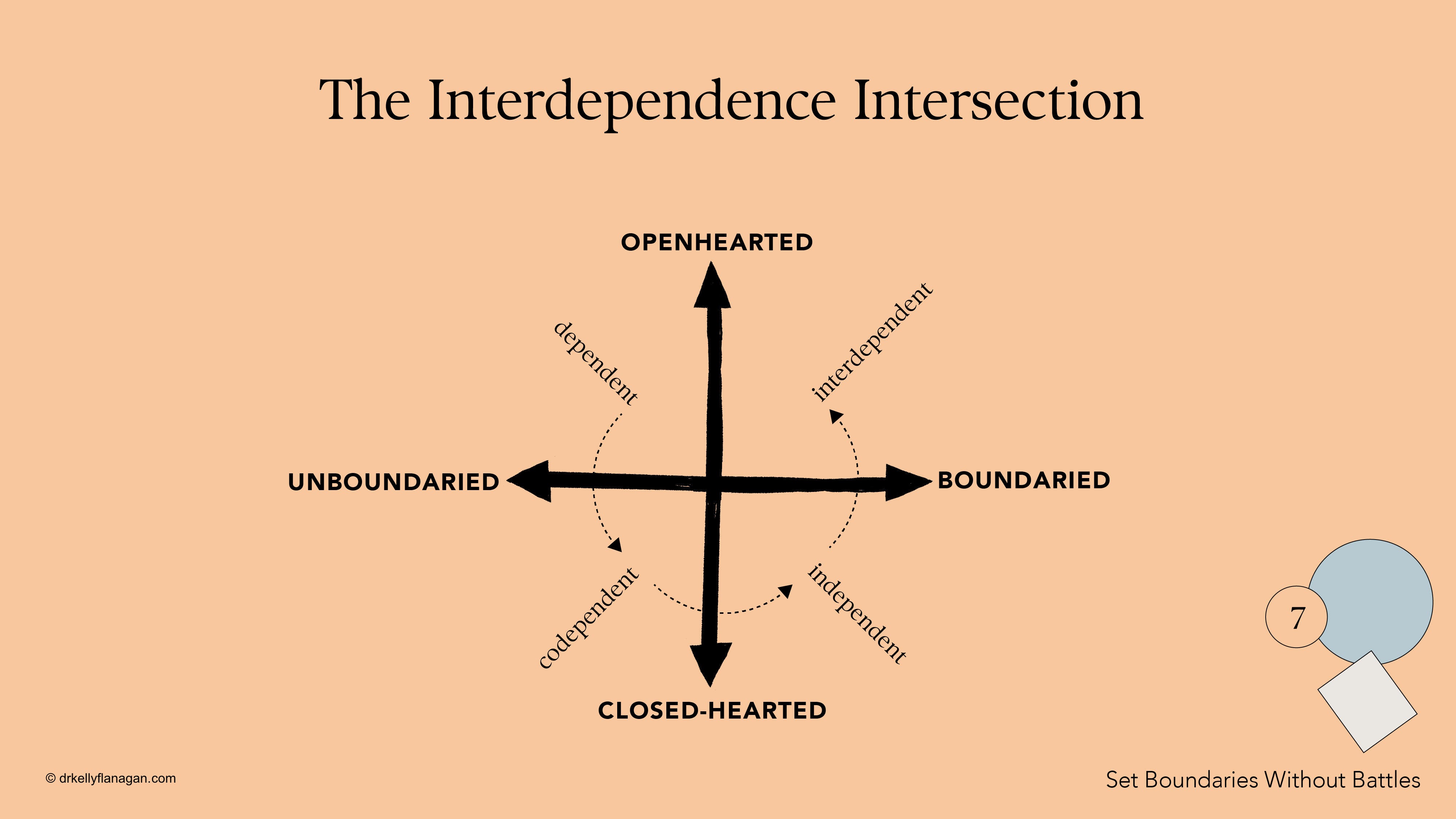
When I saw those v-shaped prongs, my heart closed but I said nothing. In other words, I was in the codependent corner of the intersection—abandoning my wants and intuitions in order to avoid friction and conflict. I resented the jeweler. I was worried my future bride wouldn’t like the ring. I kicked myself for not being clearer when I ordered it.
But I just swallowed all that emotion and stayed silent, in part because the only way I’d ever seen someone set boundaries was “independently,” which is to say angrily, aggressively, and with a closed-heart. That kind of boundary-setting always seemed to start battles that nobody won.
Twenty-five years later, I now know it’s closed-hearted boundaries that inevitably start battles—not because boundaries are bad but because, if you wear boxing gloves to church, a boxing match will break out.
Now I know it’s possible to set boundaries with an open heart—and openhearted boundaries cue collaboration, not conflict.
A few month’s short of our twenty-fifth wedding anniversary, we decided to add solar panels to our house.
I love our house and I love the way it looks every time I pull into the driveway, but I was willing to alter the aesthetic in exchange for energy independence. So, before the installers began, I’d prepared myself for the appearance of the panels.
What I had not prepared myself for was metal conduit running all along the front roofline of our house, cascading down its siding—like v-prongs devouring a diamond. When I saw it after the first day of installation, it was like seeing that engagement ring all over again. I resented the installers. I feared what my wife would say about it. And I kicked myself for not being clearer about what I wanted.
The difference was, this time, my heart didn’t stay closed and I didn’t stay silent.
One of the most important things I’ve learned about boundaries over the years is that boundaries aren’t demands or attacks or even requests. At their essence, boundaries are simply an expression of what you want, and it’s possible to express what you want to others while showing them kindness.
So, I opened my heart and decided the installers weren’t trying to ruin my life, they were simply uninformed about what I wanted. I messaged them and set an interdependent boundary. In other words, I simply told them what I wanted.
“Tomorrow morning, I’d like to discuss running all the conduit down the back of the house.”
They were actually eager to help. By breakfast the next day, a new plan had been hatched. And by lunchtime the house looked great again.
The morning after the installation was complete, I told my wife I had a confession twenty-five years in the making: Her ring was never meant to have those big, gaudy prongs. Together, we decided to take the ring to a local jeweler to find out what’s possible.
One way or another, though, I know it will turn out beautifully, because that’s what openhearted boundaries do.
They make things more beautiful,
whether that thing is a ring
or a relationship.
What was your biggest “A-ha!” in this post? How about your biggest “Huh???” Let us know in the comments—and feel free to leave any other reactions as well!
Before you go! Could you please support this message by tapping the LIKE and/or RESTACK buttons below? (Did you see what I did there…I asked for what I wanted—the essence of an openhearted boundary! 😊
Comments
Nothing yet. Say the first thing.
Sign in to join the conversation.