
Hi everyone. Happy Friday!
I’m in northern Michigan this week with my family, in the same area I came to every summer as a kid. It has been really special to be back here and watch my kids make their own summer memories in a place that holds so many of mine.
I wanted to get this one out before the holiday weekend, so let’s jump in.
The FDA authorized Philip Morris to market 20 flavored Zyn nicotine pouch products as “modified risk,” meaning the agency has determined they are less likely than cigarettes to cause tobacco-related diseases, including cancer, heart disease, and chronic obstructive pulmonary disease.
Public health experts have raised concerns about the decision because flavored nicotine products are particularly appealing to young people, and nicotine pouches are one of the fastest-growing nicotine products in the United States.
The FDA’s own National Youth Tobacco Survey, released last week, found that 1.7% of middle and high school students currently use nicotine pouches. Among those users, more than 1 in 6 reported using them daily. Zyn was the most commonly used brand, and more than 90% of youth users reported using flavored pouches, with mint being the most popular flavor, followed by fruit flavors. Several mint-flavored Zyn products were included in this week’s authorization. Fruit-flavored varieties were not.
The American Lung Association called the decision “appalling,” emphasizing that nicotine pouches are not FDA-approved cessation tools and warning that authorizing flavored products could contribute to youth nicotine addiction.
This is also another win for an industry that has heavily invested in this administration. According to reporting from KFF Health News, tobacco interests donated $6 million in 2025 to MAGA Inc., a Trump-supporting super PAC, and Trump’s inauguration. The same reporting found that Trump personally grew his stock holdings in Philip Morris to as much as $1.64 million this year. And this decision is just the latest in a series of pro-tobacco moves from an administration that has continued to side with the industry.
Earlier this year, EPA Administrator Lee Zeldin announced that the agency would prioritize testing for harmful microplastics in drinking water “for the first time” under the Unregulated Contaminant Monitoring Rule, a program used to monitor contaminants in public drinking water systems. At the time, Zeldin called it a “historic action.”
But this week, the EPA released its list of contaminants that will undergo testing in drinking water, and microplastics were not on it.
The agency said it does not yet have a validated or standardized method to test for microplastics in drinking water and cannot develop one before the next five-year testing cycle begins in December. As a result, microplastics will not be included in this round of national drinking water monitoring.
Testing drinking water would not have solved the microplastics problem. But it would have been a step toward understanding exposure and building the evidence needed for future regulation. Instead, after calling the move “historic,” the EPA left microplastics off this round of national drinking water monitoring, aligning with the plastic industry’s opposition and this administration’s broader pattern of siding with industry over environmental and public health protection.
After years investigating an Abbott Laboratories infant formula facility where Cronobacter bacteria was found, the Department of Justice has dropped its criminal case.
This is the same Sturgis, Michigan facility that shut down in 2022 after Abbott recalled several powdered infant formula products. The closure contributed to a nationwide infant formula shortage that left families across the country struggling to find formula.
Federal prosecutors reportedly believed they had enough evidence to pursue criminal charges against Abbott under the Food, Drug, and Cosmetic Act, the federal law that governs the safety and manufacturing of foods. Prosecutors had reportedly considered a misdemeanor charge for violating the law, as well as a separate count for misleading the government.
Instead, top DOJ decision makers closed the criminal probe and resolved the case through a civil settlement tied to Abbott’s participation in federal nutrition programs. The settlement terms were not released.
The decision follows Trump’s executive order from last year directing agencies to favor civil resolution over criminal charges for regulatory offenses when companies agree to comply. A DOJ spokeswoman told the Wall Street Journal that the department does not believe in “regulation by prosecution.”
This is the administration’s deregulatory agenda in practice, prioritizing corporate resolution over public accountability. And at a moment when infant formula safety is already under scrutiny, undisclosed settlement terms leave parents with little information about what happened, what accountability was required, or what changes, if any, Abbott was required to make.
The decision also comes after Abbott donated more than $500,000 to Trump’s inauguration fund. And after Trump personally purchased nearly half a million dollars’ worth of Abbott Laboratories stock a few months before DOJ dropped the criminal case.
Two lawsuits filed this week target changes stemming from the “Big Beautiful Bill.”
In the first, 26 states sued the Trump administration to block new Medicaid work requirements CMS announced last month. Beginning January 1, 2027, adults ages 19 to 64 in Medicaid expansion states will have to meet an 80-hour-per-month work, volunteer, or education requirement to keep Medicaid coverage, unless they qualify for an exemption.
The states are challenging CMS’s last-minute change to how “medically frail” is defined. They argue the new definition narrows who qualifies for an exemption, goes beyond what the Big Beautiful Bill authorized, contradicts months of previous CMS guidance, and leaves many people with serious illnesses without a clear path to exemption. The documentation requirements also put a major administrative burden on states, which now have only months to overhaul their systems before implementation begins.
In the second lawsuit, the Department of Justice is suing Kentucky, Michigan, Minnesota, and Pennsylvania for refusing to share SNAP applicant data with USDA, including addresses, Social Security numbers, immigration status, and benefit amounts going back five years.
The states argue that federal privacy laws bar USDA from accessing personally identifiable information in this way. And states already submit anonymous data and program administration plans as required. Advocates have raised concerns that the data would be used for immigration enforcement purposes.
Last year, states sued the Trump administration over a similar SNAP data request, and USDA Secretary Brooke Rollins later threatened to withhold funds from states that refused to comply.
Taken together, these lawsuits show how the administration is making Medicaid and SNAP harder to access through new eligibility rules, work requirements, documentation requirements, and data demands, while shifting the administrative and financial burden of carrying out those changes onto states.
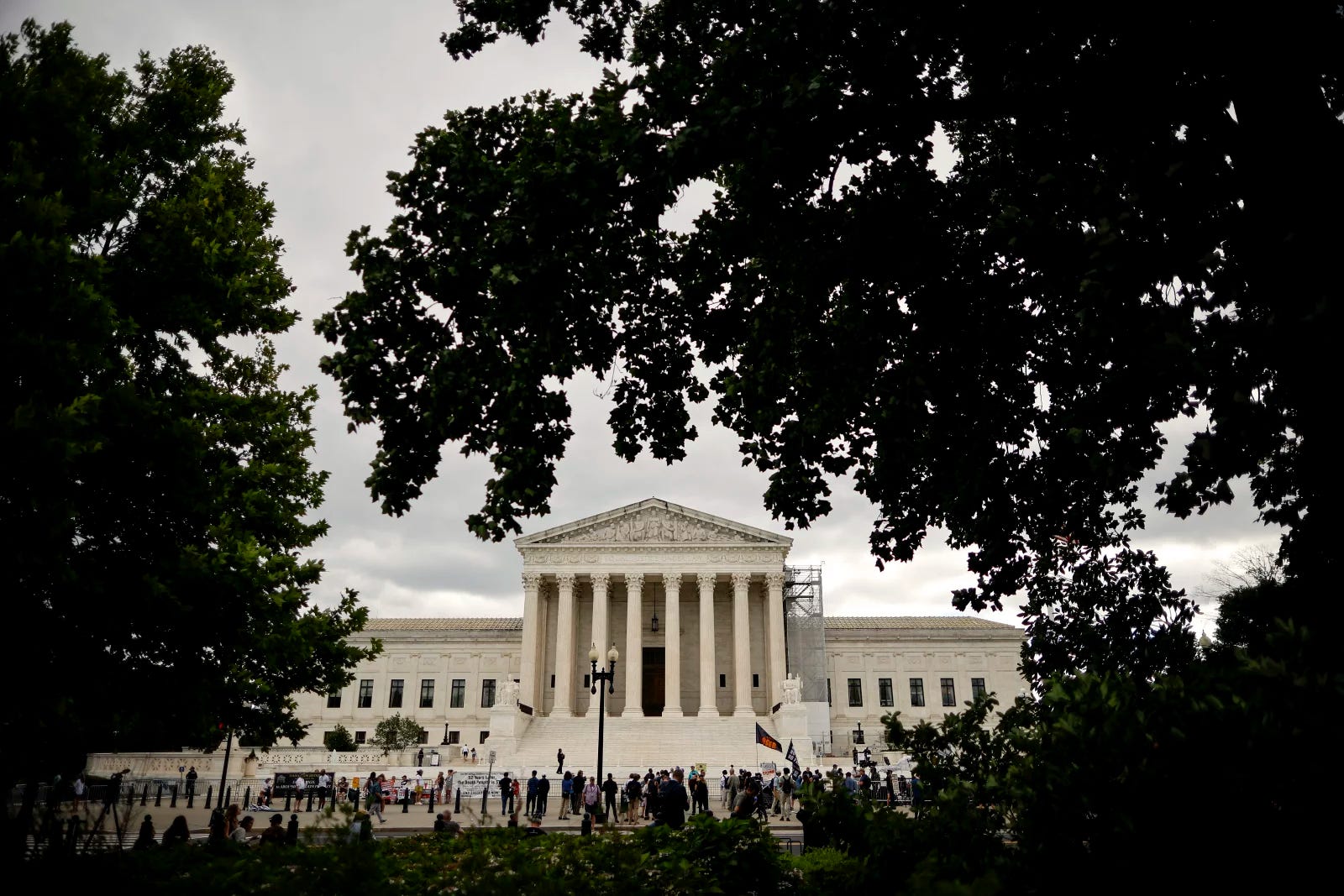
The Supreme Court ruled 6-3 this week to strike down federal limits on how much political parties can spend in coordination with candidates, saying the restrictions violated the First Amendment.
The ruling gives political parties significantly more power heading into the midterms. Party committees can accept much larger donations than individual candidates, and coordinated party spending can be used for expensive campaign activities like television and radio ads.
It also changes how money moves through elections. With coordinated spending limits gone, parties can work more directly with candidates while super PAC money is freed up for other election spending.
This is another step in the decades-long loosening of campaign finance laws that accelerated in 2010, when the Supreme Court’s Citizens United decision allowed corporations and outside groups to spend unlimited amounts in elections.
I’m often asked in interviews what one policy change I would make to improve health in this country, and my answer is always campaign finance reform. Because evidence-based health policy is only possible when lawmakers are more accountable to the public than they are to the industries affected by those policies. But this ruling moves us further in the wrong direction by giving political parties, wealthy donors, and corporate interests even more power to shape elections, candidates, and ultimately, policy.
If you found this helpful and are able to support this work, please consider becoming a paid subscriber. Your support helps me keep spending the time it takes to research, write, and share pieces like this, and I’m genuinely grateful for it. Thank you for being here.
Comments
Nothing yet. Say the first thing.
Sign in to join the conversation.