
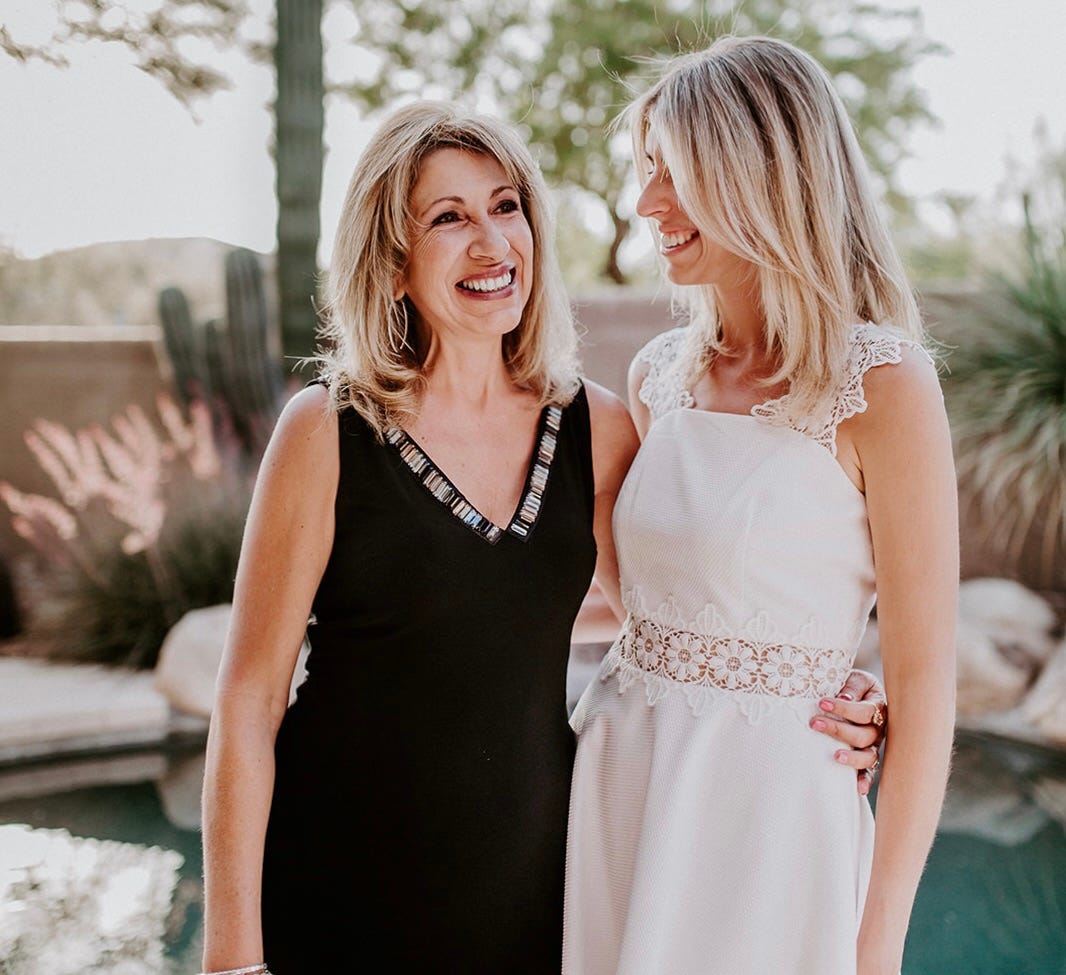
My mom died on August 3.
She was 63. She was full of life. She wanted to live.
I don’t think I ever thought about my mom’s death or what it would be like. She was always the strong one who, outside of a procedure when I was a young kid, never had a single medical issue. She was active and fiercely independent, spending hours gardening and maintaining a beautifully landscaped backyard largely on her own. She was the grandparent with boundless energy, crawling on the floor, playing games, doing art projects, and dancing around to whatever fun children’s songs she could find. And she was relatively young, her kids all in their thirties and her grandchildren all six and under.
But even if I had thought of it, I couldn’t have imagined how it actually happened.
My mom went to the emergency room in late June after experiencing debilitating pain in her abdomen. She thought it might be gallstones. Instead they found a mass near her liver and performed three biopsies. On July 1, I called her to check in, which I had been doing every day. She had just gotten off the phone with the doctor’s office. All three biopsies came back positive for cancer. It was cholangiocarcinoma that had metastasized to her nearby lymph nodes.
A few days prior, the doctor had said that he thought it was either a non-cancerous mass near her liver or cholangiocarcinoma, a cancer I had never heard of before. I quickly looked it up: a rare and aggressive cancer of the bile ducts with a low single-digit five-year survival rate.
Shit. Let’s hope it’s not that.
But it was.
My mom was calm on the call. I took a deep breath and asked her how she was feeling. To my surprise, she said she was feeling good and positive. She wanted everyone to remain hopeful, and she was prepared to fight this.
My mom has always had an almost unwavering belief that things will work out. She’s relentlessly positive, sometimes irrationally so. People, including her, would joke that she often saw the world through unicorns and butterflies. I’m a bit different. I’m generally positive, but I’m also the more rational one. I want the facts and the most realistic picture of what we’re facing. I want to have rational conversations about what is happening.
But this was my mom’s diagnosis. It was her fight. So I remained supportive, positive, and hopeful too.
I told my mom I loved her. She told me her first oncology appointment was scheduled for July 10 and asked if I thought she should move it because she had a flight scheduled to Denver on July 8 to see me and the kids. “No mom. You need to go to that oncology appointment,” I said. She reluctantly agreed, told me she loved me, not to worry, and hung up. A few minutes later, I texted her that I would fly out with my sister to see her in a few days. She replied that she didn’t want us to come yet because she was so tired, and it would be better to wait until after her first oncology appointment once she understood the treatment plan better.
But as the date approached, I knew I needed to be there. There was no way I was letting my mom walk into her first oncology appointment for a diagnosis like this without being beside her. I booked a last minute flight and texted her that I’d be there the next day to go to her appointment with her.
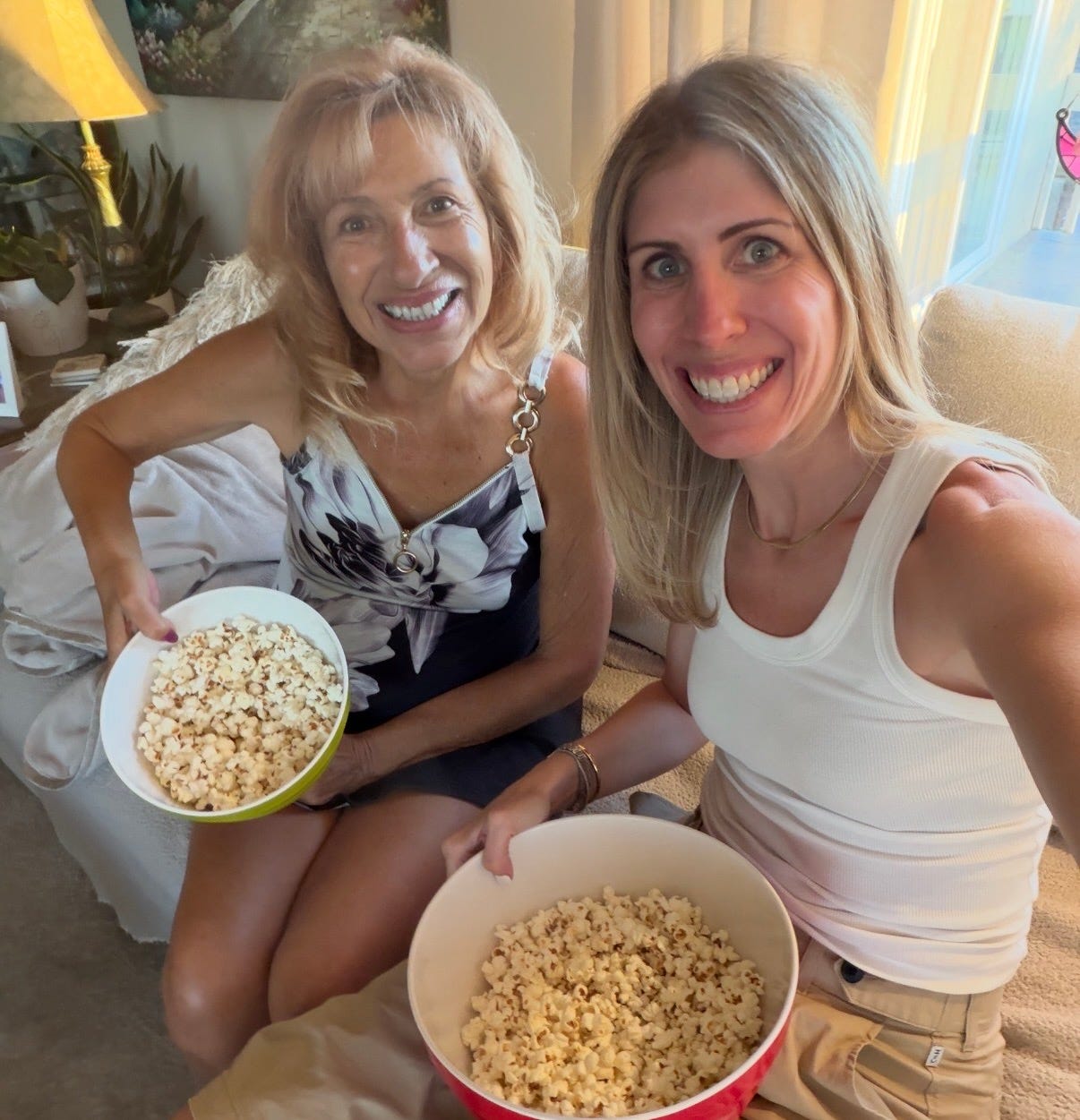
I arrived on July 9. She was so happy to see me, just as she always was. But she was also exhausted. I could tell that the excitement of seeing me was giving her an extra boost of energy that she didn’t really have to give. I sat with her on the couch and we talked, laughed, and decided to rent The Devil Wears Prada 2. I popped stovetop popcorn, something we had always done together.
She was in pain and kept holding her abdomen and flinching at times. At one point, she looked over at me and said, “This sucks, Jess.”
“I know Mom. It really sucks. I’m so sorry.”
Then she cracked a joke, we laughed, and we watched the movie.
Her first oncology appointment was early the next morning. I could tell she was nervous as she sat drinking a cup of coffee at the kitchen table. I asked her how she was feeling and she told me that this was the first time she felt really anxious. My heart broke seeing her like that.
At the appointment, the oncologist walked in and asked my mom to explain what she knew and understood about her diagnosis. He showed us the results from the PET scan. The cancer had spread to several areas throughout her abdomen, possibly her heart and lungs. He told her that they had sent her tumor sample out for molecular testing to see if she might have an actionable variant that could open up options for targeted treatment.
Targeted treatment sounded good. A bit of hope in a situation where hope was desperately needed.
He showed us a screen of first-line treatment options that we would start: chemotherapy + immunotherapy. With this chemo, Mom likely wouldn’t lose her hair. She was happy about that.
I sat there listening, taking notes, waiting to hear what all of this actually meant for her prognosis. At one point, my mom said, “We’re going for a cure. We are going to beat this thing.” The oncologist told her he would be there with her through the process.
I finally asked what we should realistically expect. After a brief pause, he said she likely had anywhere from a few months to a few years, or possibly more, depending on how she responded to treatment. Then he scheduled her first chemo appointment for two weeks later. My mom questioned him, asking why she couldn’t start right away, afraid of what could happen if we waited two weeks. He reassured her that the cancer had been there for months, maybe over a year, and that two weeks would not make a difference.
I flew back home to my kids the following day with the intention of going back when she started chemo, but a few days later while sitting outside on her patio with my sister, my mom had a seizure. At the hospital, they found that her sodium was critically low and that she had several lesions on her brain. The cancer had metastasized to her brain.
I flew there the next day.
What followed was a series of setbacks. It seemed like the worst-case scenario was happening every day for us in the hospital. Her bilirubin levels were high and rising because her bile ducts were blocked by the cancerous tumor. She went into surgery and they placed a drain. The drain didn’t work. She got an infection in her blood—sepsis. They cleared the infection, but we were told it would likely come back, especially if we started chemotherapy. The cancer was becoming more painful each day, and at some point during that hospital stay, she lost the ability to walk.
Yet my mom remained positive, so we remained positive.
My birthday was on July 23, and we celebrated with my mom in the hospital. Birthdays were always a very big deal to my mom. She gave me a birthday card with her husband’s handwriting on it. I handed the card to her and asked her to write in it, knowing this would likely be my last birthday card from her, and she did. “I love you soooo much. Love, Mom.” I have a video of her singing to me that evening that I’ll cherish forever.
They discharged my mom two days later when her bloodwork came back stable. My siblings and I all stayed at the house with her. It was hard. She was on a lot of pain medication and had lost much of her independence in an incredibly short period of time, which was frustrating for her.
On July 27, I took my mom to get a radiation planning scan so that she could start radiation on her brain the following week. They wanted to start with radiation since it was only five days and then move to chemo. I wheeled my mom in, but they needed her to lie flat in order to complete the treatment plan. It was excruciating for my mom. I’ve never seen her in so much pain, fighting with herself and mentally pushing herself to get through it. I had to step out of the room for a few minutes during the process and I could hear her yelling out in pain from the other side of the door. I wiped a tear from my eye just as they opened the door to have me help her up.
After helping her into the wheelchair, I started to leave the room. She looked up at me, concerned, and said, “Wait, where are we going?”
“We are going back home, Mom. We are all done.”
“But we’re not doing treatment today? I need to start treatment, Jess.”
I had explained to her that this wasn’t actually treatment and that they needed this scan before she could start radiation, but she must not have fully understood. I tried to reassure her that this was an important step toward treatment, but she looked, for the first time, completely deflated. Like she knew she might not make it long enough to start treatment if it wasn’t starting right now.
She significantly declined throughout that day at home. When she became largely unresponsive that evening, we decided to take her to the ER. They ran tests with no good news. Her bilirubin was extremely high and the infection was back. We met with several people over the next couple of days as my mom lay mostly unresponsive in the hospital bed. We knew she was still there and could still hear us because she would occasionally chime in when we were talking about something she really cared about, but the words were few and far between. We held onto each one, hoping for more, but knowing things weren’t getting better.
On August 1, a month after her initial diagnosis, we met with her medical team, asked every question, and went over every possible scenario. Then, through a lot of tears, we decided to move my mom to in-home hospice.
Over the next two days, we cared for her, we sat with her, we talked with her. I barely slept, but I felt like I had barely slept all month, so at that point it felt normal. I had heard that in-home hospice could be a beautiful way to die. A peaceful way to die. That was not our experience.
My mom fought until the end. In brief periods of consciousness, she said, “Help me.” The day she died, she was in a lot of pain, agitated, and yelling out. I figured out that if I moved her arms up and down, it calmed her. So I did that, back and forth, for an hour that morning until she fell asleep.
Later, despite the hospice nurse and physician coming and administering more pain meds, she was still yelling out. We asked her if she was in pain, and she nodded her head. The physician mentioned that we might need to bring her back to the hospital and admit her if this continued. Knowing my mom would absolutely not want that, I sat next to her and put my arm around her shoulders. Her head rested on my arm as I ran my fingers through her hair. It immediately calmed her. So I sat just like that for hours and hours that day.
I knew I should talk to her while I was sitting there, but what? What do I say to my mom who has been with me since the day I was born, loving me unconditionally and giving me the security of always knowing she was in my corner? How do I say goodbye to someone who has given so much of herself to me, and now to my young children, and who wanted so badly to be there for their lives too? How do I thank someone for a lifetime of making me feel that loved and supported?
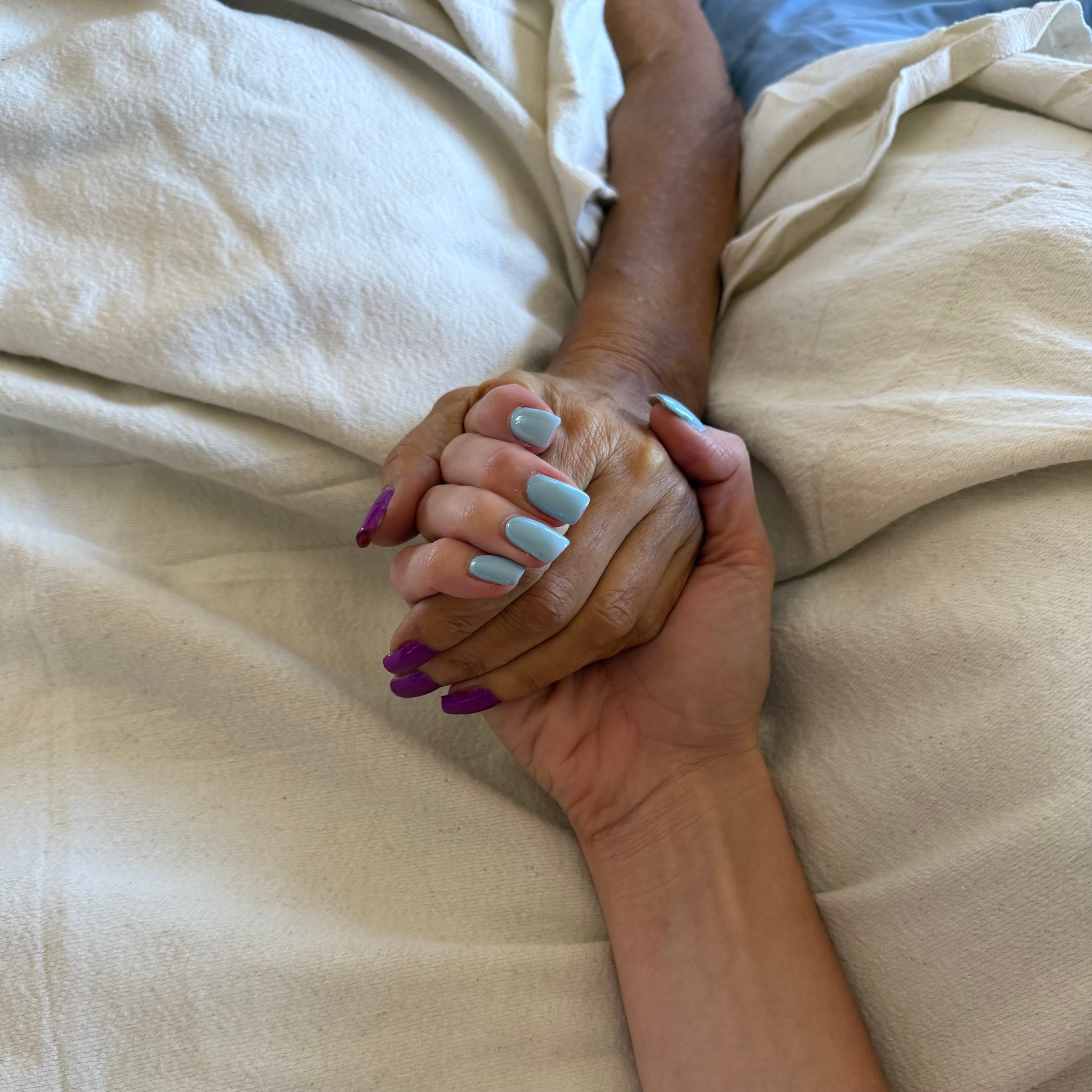
I said the things I could think of in the quiet time we had alone while I held her that day, knowing the words would never be enough. At one point, she squeezed my hand and whispered, “Love you.” She gave me all she could at that moment, just as she always had.
My mom died just after 9 p.m. on August 3.
Thirty-four days after her initial cancer diagnosis.
If you value my work and are able to support it, please consider becoming a paid subscriber. Your support makes it possible for me to continue writing and sharing here, and I’m genuinely grateful for it. Thank you for being here.
Comments
Nothing yet. Say the first thing.
Sign in to join the conversation.