
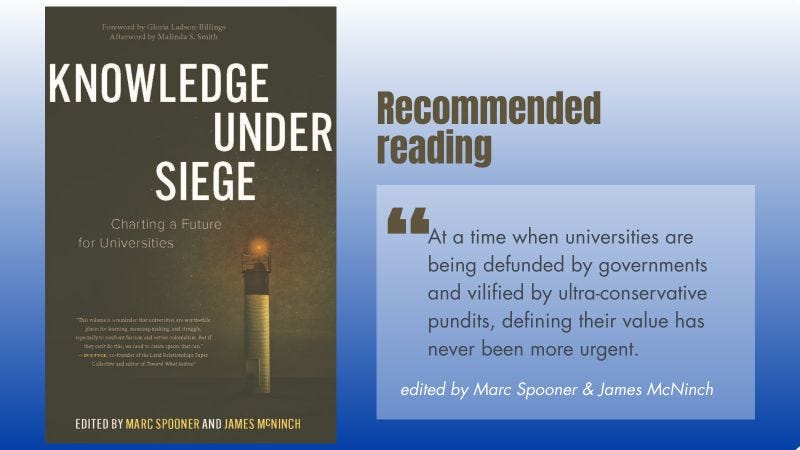
This post is adapted from a presentation at the Canadian Vote Summit in Calgary, May 21, 2026. Marc’s latest book, Knowledge Under Siege, is a must-read for those concerned about the role of universities in liberal democracy.
Universities are often described as engines of economic growth, sources of innovation, and pathways to employment. All of that matters. But universities in a liberal democracy have another responsibility: to ask difficult questions of governments, other power structures, and society itself.
Universities are more than job-training institutions. In healthy democracies, they are engines of democratic life. They are essential in their own right, and they also help sustain the other institutions we name as pillars of democracy: the press, the judiciary, and the legislature.
That role sets universities apart from those operating in authoritarian and illiberal states.
In addition to seeking truth, making discoveries and passing on work skills, knowledge, and wisdom, the university in a liberal democracy has as its unique purpose the responsibility of asking difficult questions of governments, other power structures, and society itself. This critical function distinguishes our universities from their counterparts in authoritarian states.
That role includes ensuring that public policy is informed by the best available evidence, as well as fostering critical and creative citizens, preparing them for a lifetime of meaningful employment, community engagement, and democratic participation.
When a society and its universities are functioning well, this work happens both on and off campus. The university serves today’s society we have while helping us imagine and build the society we aspire to create (Spooner & McNinch, 2026, p. xxix).
A healthy liberal democracy can tolerate a plurality of perspectives, including dissent. Citizens may hold and debate different scientific, political, and cultural views. Dominant narratives can be questioned, revised, contested or disrupted. Universities bring together students and faculty from around the world, creating places where ideas circulate through disagreement as well as productive exchange.
Faculty can bring evidence to bear in classrooms, courtrooms, and public debates, even when their findings run contrary to powerful interests. They can hold their own institutions to account, as well as the government of the day. Tenure enables professors to act as potential whistleblowers and societal lighthouse keepers. Working alongside a free press, they contribute transparency, historical memory, sustained attention, and another check on power (Spooner, 2024, p. 573).
“Democracy is vital in enabling higher education to play its societal role, but higher education is equally vital in safeguarding and developing democracy” (Bergan et al., 2020, p. 26).
When people discuss the institutional pillars of democracy, they usually name the free press, the legislature, and the judiciary. The academy, operating with academic freedom and tenure, is too often left off the list (Cole, 2009; Daniels, 2021). It should not be.
The free press. People almost invariably identify a free press as a pillar of democracy. Canadian journalism is formally free but increasingly under-resourced. News organizations employ fewer investigative reporters and fewer journalists with a continuing beat who can follow a file over time. Academics help fill that gap by providing background, historical context and subject-matter expertise. They also make themselves available for interviews and public discussion.
The judiciary. Universities educate lawyers and other legal specialists, produce scholarship that informs legal debate and, where it is introduced or cited, judicial reasoning. Academics are also called upon to offer expert testimony in cases before the courts.
The legislature. Free and fair elections depend on an informed electorate. The university is one place, though certainly not the only one, where critical and creative thinking, democratic engagement and civic literacy are modelled and honed. An effective opposition is also essential to democracy. Scholars can help hold governments and their policies to account by producing and interpreting evidence that citizens and legislators can use to judge public policy (Spooner, in press).
In a live, informal poll at the Canadian Vote Summit, a majority of participants said universities are failing to prepare students for full democratic participation and invoke academic freedom without demonstrating the public obligations that come with it.
As more countries experience democratic backsliding, we should all be concerned (Haggard & Kaufman, 2021). A country’s respect for academic freedom is an important indicator of democratic health. Universities with functional academic freedom and tenure do more than reflect a healthy democracy. They help create and sustain it. Faculty need to be more explicit and purposeful about that role (Spooner, 2024; Spooner, in press).
The warning signs are already visible: entire areas of study targeted by governments, efforts to weaken or abolish tenure, restrictions on academic freedom, and a widespread turn toward performance-based funding. The list also includes chronic underfunding, caps on international students, and political attacks on equity, diversity and inclusion initiatives intended to broaden participation (Spooner, 2024; Spooner & McNinch, 2026).
Still other developments include the widespread use and advancement of artificial intelligence and the uncertain ground upon which universities have based their diverse responses to it. It is a time marked by audit culture, anti-intellectualism, and disinformation (Spooner, 2018; Spooner, 2024)” (Spooner & McNinch, 2026, p. xxx).
“These attacks are part of a larger authoritarian playbook: the aim is to undermine public trust in institutions that question power, while rewarding those that remain loyal. The ultimate goal is not just to control universities, but to reshape the civic imagination — to erode the idea that higher education should nurture questioning, complexity, and dissent.
And the problem for Canada is this politicized assault on higher education is spreading — and Canada is not immune.
At a time when democratic norms are fraying, these developments should ring alarm bells for anyone who believes in a robust and pluralistic democracy” (Spooner & Westheimer, 2025).
The effort to reshape universities to serve an authoritarian rather than a democratic state is not new. American campuses have faced recurring political repression, from the first Red Scare through McCarthyism and into the present. During the McCarthy era, hundreds of professors lost their jobs or had their careers damaged because of their scholarship or their refusal to denounce colleagues. The current campaign is broader. It uses state legislation, executive action, funding threats and political pressure to reach into curriculum, hiring, admissions, research, and university governance.
PEN America’s 2025 report, Expanding the Web of Control, concluded that government censorship of speech and academic freedom had reached unprecedented levels on U.S. campuses. It found that more than half of American college and university students were studying in states with at least one law or policy restricting what could be taught or how campuses could operate (PEN America, 2026).
Scholars at Risk documented the same pattern in Free to Think 2025.
From January 2025 the federal government initiated an unprecedented range of actions aimed at controlling university admissions, hiring, research, teaching, departmental structures, policies on speech, disciplinary policies, internal sanctions, and finances. These actions included extra-legal executive orders targeting individual universities by revoking their funding; a series of attempts to arrest, detain, and attempt to deport without due legal process US-based, noncitizen scholars and students; and executive, legislative, and other actions aimed at eliminating research, programming, and academic supports related to diversity, equity, and inclusion; gender; environment; and many other areas. Such actions were part of a broader campaign by the US government, paralleling similar actions in authoritarian countries, to weaken democratic pillars of civil society. (Scholars at Risk, 2025).
The March 2026 Academic Freedom Index update added an international comparison. Academic freedom had declined in 50 countries over the previous decade and improved in only nine. The decline in the institutional autonomy of American universities was faster and steeper than in other major autocratizing countries examined in the report (Kinzelbach et al., 2026).
We must also acknowledge that the cynical questioning of postsecondary education has been amplified by right-wing think tanks, authoritarian politicians, tech billionaires, wealthy donors, and corporate lobbyists. The larger objective is to undermine trust not only in universities, but in public and publicly funded institutions more generally.
Canadian postsecondary education is also under severe strain. At the time of the summit, Eduvation’s national dashboards reported 1,275 program suspensions and at least 22,487 positions eliminated, left vacant or otherwise lost since federal changes to international student policy were announced in January 2024 (Eduvation, 2026). Those figures are not simply administrative adjustments. They represent lost courses, lost expertise and fewer opportunities for students and communities.
In Alberta, political attacks on “woke” institutions and equity, diversity and inclusion initiatives have been accompanied by a willingness to extend provincial oversight into relationships between public institutions and the federal government. The Provincial Priorities Act requires provincial entities to seek approval before entering many federal agreements. Research-focused agreements were ultimately exempted after sustained pressure from postsecondary institutions and student organizations, but the episode revealed how quickly institutional autonomy can become a matter of political discretion (Government of Alberta, 2025; University of Alberta Graduate Students’ Association, 2025).
Ontario has pursued a different route. Its performance-based funding model ties a portion of operating grants to measures that include graduate employment, earnings, and alignment with labour-market needs. Those outcomes matter, but when they become the dominant measure of value, universities are pushed toward serving immediate industry demand at the expense of their broader educational, civic, and democratic purposes (Government of Ontario, 2020).
The cynical questioning of postsecondary education has been amplified by right-wing think tanks, authoritarian politicians, tech billionaires, wealthy donors and corporate lobbyists. The larger objective is to undermine trust not only in universities, but in public and publicly funded institutions more generally.
Given the fragile state of our democracies, universities must be far more deliberate about taking up their role as democratic institutions. We need to close the “gap between what we say we do and what we do as institutions of higher learning” (Riddell, 2024, p. 36).
When we force students to graduate with carrying what amounts to a mortgage on their education, we commit an intergenerational theft of opportunity. We also push them to prioritize immediate employment and earnings over civic participation, intellectual exploration, habits of mind and community needs.
When people accuse me of living in an ivory tower, I reply that it is a tower, all right, but a lighthouse.
I will end with an old proverb, slightly updated: A society grows great when people plant trees in whose shade they will never sit. A properly functioning university is one of those trees, an investment in a democratic future whose full benefits its present-day stewards may never live to see (Spooner & McNinch, 2026, p. 288).
Bergan, S., Gallagher, T., & Harkavy, I. (Eds.). (2020). Academic freedom, institutional autonomy and the future of democracy. Council of Europe Publishing; UNESCO.
Cole, J. R. (2009). The great American university: Its rise to preeminence, its indispensable national role, why it must be protected. PublicAffairs.
Daniels, R. J. (2021). What universities owe democracy. Johns Hopkins University Press.
Eduvation. (2026). CdnPSE dashboards. https://eduvation.ca/budgets/
Government of Alberta. (2025). Defending Alberta’s provincial priorities. https://www.alberta.ca/defending-albertas-provincial-priorities
University of Alberta Graduate Students’ Association. (2025, March 12). GSA advocacy update: Key exemptions secured for post-secondary federal funding under the Provincial Priorities Act (formerly Bill 18). https://gsa-ualberta.ca/gsa-ualberta-ca-ppa-exemptions-update/
Government of Ontario. (2020, November 26). Promoting excellence: Ontario implements performance based funding for postsecondary institutions. https://news.ontario.ca/en/release/59368/promoting-excellence-ontario-implements-performance-based-funding-for-postsecondary-institutions
Haggard, S., & Kaufman, R. (2021). Backsliding: Democratic regress in the contemporary world. Cambridge University Press. https://doi.org/10.1017/9781108957809
Kinzelbach, K., Lindberg, S. I., Lott, L., & Panaro, A. V. (2026). Academic Freedom Index Update 2026. https://doi.org/10.25593/open-fau-2865
PEN America. (2026, January 15). Expanding the web of control: America’s censored campuses 2025. https://pen.org/report/americas-censored-campuses-25-web-of-control/
Riddell, J. (2024). Hope circuits: Rewiring universities and other organizations for human flourishing. McGill-Queen’s University Press.
Scholars at Risk. (2025). Free to Think 2025: Report of the Scholars at Risk Academic Freedom Monitoring Project. https://www.scholarsatrisk.org/resources/free-to-think-2025/
Spooner, M. (2018). Qualitative research and global audit culture: The politics of productivity, accountability, and possibility. In N. K. Denzin & Y. S. Lincoln (Eds.), The SAGE handbook of qualitative research (5th ed., pp. 894–914). SAGE.
Spooner, M. (2024). Backsliding toward illiberalism and authoritarianism: Qualitative inquiry, academic freedom, and technologies of governance. In N. K. Denzin, Y. S. Lincoln, M. D. Giardina, & G. S. Cannella (Eds.), The SAGE handbook of qualitative research (6th ed., pp. 567–593). SAGE.
Spooner, M. (in press). The modern university’s unique role in a democracy. In J. Riddell (Ed.), Hope circuits illuminated: Conversations with luminaries amid collapse. McGill-Queen’s University Press.
Spooner, M., & McNinch, J. (Eds.). (2026). Knowledge under siege: Charting a future for universities. University of Regina Press.
Spooner, M., & Westheimer, J. (2025, May 14). Opinion: Canadian democracy needs universities—now more than ever. Edmonton Journal. https://edmontonjournal.com/opinion/columnists/opinion-canadian-democracy-needs-universities-now-more-than-ever
No posts
Comments
Nothing yet. Say the first thing.
Sign in to join the conversation.