
I couldn’t tell you the first time I heard someone describe a diagnosis as God’s discipline, or a job loss as a consequence God has allowed to teach a lesson, or a stranger’s suffering as likely what that stranger had coming to them in some way. There have been too many times, spoken in too many living rooms, church foyers and small groups, for any single instance to stand out as the origin. What stands out instead, for me, is the pattern itself. Ask an evangelical, especially one in one of the Reformed traditions, to describe God’s character and holiness likely comes up fast, usually paired with justice, and both usually mean something closer to a courtroom scene than a household. God is good, for sure. But God is also exacting, and the exactingness tends to explain more of what actually happens in a believer’s life than the goodness does sometimes. I heard a version of this recently, stated almost casually. God is love, but God is also wrath. Only half of that sentence is actually in the Bible. Scripture calls God’s very character love, in so many words, in 1 John. It never once calls God’s character or part of His very nature, wrath. Wrath shows up as something God does. Love is named as what God is.
Big distinction.
I’ve watched this play out in primarily three places so consistently that I no longer think of them as entirely separate or isolated observations. In how people talk about salvation, God’s holiness demands a worthy sacrifice, a debt that has to be paid in full before the relationship can even start. In how people talk about their own spiritual growth, God is understood as basically displeased (if not with the person, with the sin), mildly to seriously, and sanctification becomes a long campaign of disciplining a person out of their failures. In how people talk about the wider world, about crime and immigration and who has it coming, God’s justice gets invoked as a predominantly retributive force, giving people exactly what they’ve earned. Three domains, one underlying picture of God; a God whose defining trait is holding people to account.

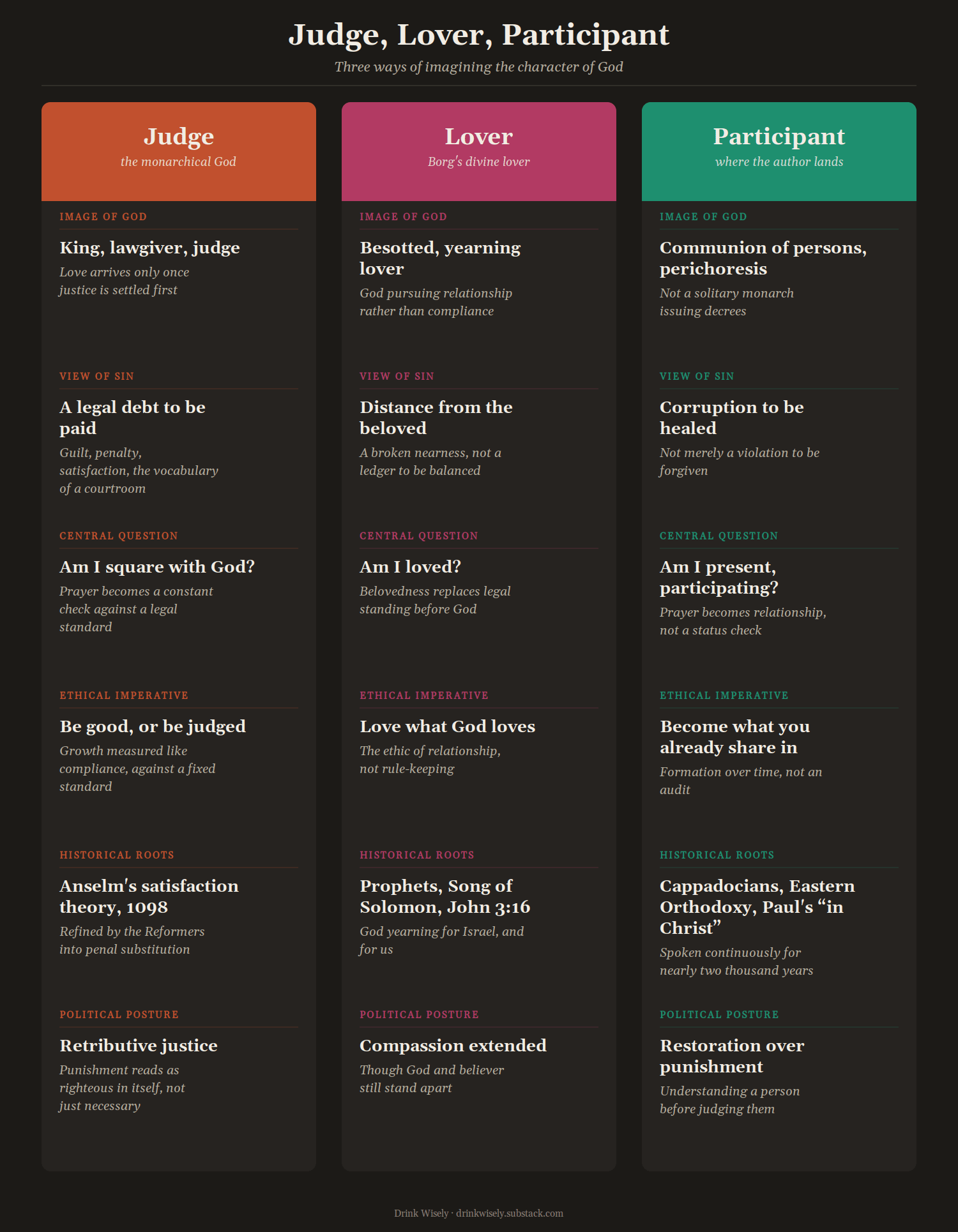
Marcus Borg painted this picture with much more detail than I could on my own, in a sermon from Days of Awe and Wonder that I haven’t been able to stop thinking about ever since I first read it. He calls it the monarchical model, God as Lawgiver and Judge who also loves us, built on the biblical image of God as king. Borg is careful to note the love is quite real in this model, it just arrives conditioned, contingent on repentance being earnest enough or belief being sturdy enough. The result, he argues, is that two people can use identical vocabulary, grace, sin, salvation, and mean two qualitatively different things, since the monarchical model and its alternative “virtually produce two different religions, both using the same language.”1
The alternative is what Borg calls the divine lover model, God as the one who yearns for relationship rather than compliance. He borrows a line from the theologian Roberta Bondi that has apparently lodged itself in a lot of readers’ memories, since it lodged in mine within about a sentence, that God is besotted with us.2 Besotted is an old word, one I had to look it up, for someone helplessly caught up in another person that is descriptive of something closer to falling in love than fulfilling an obligation. Borg traces this image through the prophets, through the Song of Solomon, through John 3:16, and argues it changes the entire operating logic of faith. Under the monarchical model the ethical imperative is to be good, because you’ll be held to account. Under the divine lover model it’s love what God loves, because that’s what relationship with a lover actually asks of a person.
I find Borg’s two models basically right, but also incomplete. The divine lover model is a real upgrade from the courtroom God, but it can still leave God and the believer standing across from each other, however warmly, one loving and one loved, one yearning and one being yearned for. There’s a further step available that Borg gestures toward without fully taking in his book, and it’s the step I’ve found myself drawn to over the last several years, tentatively, without any hard claim to have it fully worked out myself.
Where the monarchical God lives
Start with soteriology, since it carries the most structural weight of the three. The strongest form of the standard evangelical account doesn’t treat God as a distant judge demanding a third party settle someone else’s debt. It treats God as the one who bears the cost personally, in Christ, so that justice and mercy meet in the same act instead of trading off against each other. That’s a serious answer to a serious problem, and it takes the reality of sin very seriously. So far, so good.
What it still shares with the weaker, less nuanced version of the same idea is the basic shape of the metaphor, and the ranking underneath it. Guilt, penalty, satisfaction, acquittal, this is the forensic vocabulary, however loving the judge may be presiding over it. N. T. Wright has made essentially this same critique from inside the tradition, arguing that even careful, well-meaning versions of the doctrine smuggle in what he calls a “works contract,” a picture of “an angry, legalistic divinity” that the biblical text itself doesn’t actually support.3 And the reason the courtroom has to open before anything else can happen is that holiness functions, in this account, as the attribute everything else has to answer to. Love waits on justice being satisfied first. Whatever else God’s character includes, in this model holiness sits above it, the one trait the rest of the structure gets organized around. Sin is what gets paid for. It isn’t described as a condition a person is delivered from and re-formed out of, the way the participatory tradition describes it. The relationship with God only opens once the debt is cleared.
Sanctification runs on the same engine albeit at a smaller scale. If God’s basic position is evaluative, then spiritual growth becomes a long process of behavioral correction and modification, with God noticing what’s wrong and applying pressure until it’s corrected. I’ve heard this described, more than once, in language close to a parent monitoring a child’s report card. The believer’s inner life becomes a running audit. Am I doing better than last year. Am I still struggling with the same things. Growth gets measured the way compliance gets measured, incrementally, against a standard, with God cast in the role of auditor.
And then politics, which is where this theology stops being private and starts shaping how people vote, sentence, and legislate. If God’s core trait is retributive justice, giving people what they’ve earned, that becomes the default template for human justice too. Punishment is understood as righteous in itself, not only necessary. Mercy toward the undeserving starts to look like a category error, almost an offense against God’s own character, even though it lies at the actual center of the gospel accounts most of these same believers claim to hold as wholly authoritative. Most Reformed accounts already have an answer here that must be taken seriously. Grace, in this account, isn’t opposed to justice, it’s what redirects justice onto Christ instead of onto the guilty party, so that justice gets fully satisfied and mercy gets fully extended in the very same motion. That’s a more sophisticated position than the flat retributive picture, and it should be argued with in its strongest form, in fairness.
But redirected justice is still justice as the operating principle, still a system where someone has to bear the penalty before mercy becomes available. The metaphor hasn’t changed, only who absorbs the cost within it. A punitive God produces a punitive politics with remarkable consistency, and it looks like the predictable output of the model working exactly as designed, even in its most careful form. Justice, here, is still retributive, vindictive, and thought of in the pejorative sense only.
The turn past Borg
Here’s where I kind of reach the limits of my own certainty on the matter. I’m not a professional theologian, though I served for decades as a ruling elder and have spent a long time living inside this material, so what follows isn’t casual either. I don’t hold any of it as settled doctrine; more as a set of ideas that have proven more resonant, and I’d argue more faithful to the actual biblical witness, than the model I knew and believed for decades.
The first is participatory atonement, salvation understood less as a debt paid on a ledger and more as an act that draws humanity into God’s own life. Second Peter’s language about becoming “participants of the divine nature” points this direction, and so does Paul’s language of being in Christ, which reads very much as spatial and relational rather than legal. Paul uses some version of that phrase, en Christō, somewhere around eighty times across his letters, and the Greek preposition behind it, en, is fundamentally locational. It’s the word for being inside a house, inside a city, inside a body. To be en Christō is to be located inside Christ the way a person is located inside a room, which is an odd thing to say about a legal transaction and a very natural thing to say about a relationship someone has been drawn into.
The cross, on this account, isn’t about a payment. It’s an act of solidarity and invitation, God entering fully into human suffering and death in order to draw humanity through it into something larger. Jürgen Moltmann builds an entire theology of the cross on this same instinct, arguing that God does not stand apart from human suffering directing a legal proceeding but enters it directly, taking on “the eternal death of the godless and the godforsaken, so that all the godless and the godforsaken can experience communion with him.”4
The second is theosis, the ancient Eastern Christian idea that the goal of the Christian life is that participation in the divine nature itself, an actual, ongoing transformation into the likeness of Christ rather than legal approval received from a distance. Under theosis, sanctification stops being an audit altogether and becomes something closer to formation, less about correcting failures and more about slowly becoming capable of a kind of love and presence that isn’t native to us yet.
The third is relational trinitarianism, the idea that God’s own inner life is a communion of persons in mutual self-giving love, perichoresis, a mutual indwelling, not a solitary monarch issuing decrees from above creation. If that’s what God’s own nature actually looks like, then the invitation extended to human beings isn’t approval in some objective standard. It’s an invitation into that same communion, into relationship structured by mutuality rather than hierarchy and requirement.
I don’t hold any of these three ideas in their textbook form (if such a form exists) at this point in my journey, and I’m not trying to sell a shiny, new systematic theology here. What draws me to them is the shape, participation over compliance, formation over audit, communion over courtroom. That shape has done more to change how I actually live than the monarchical model ever did, for all the years I spent trying to make that model work.
I can already hear the obvious objection at this point, that I’ve swapped a serious God for a permissive one, all love and no teeth, a comfortable deity with no real claim on anyone. I don’t think that objection persists, however, with what theosis actually says about sin. The monarchical model treats sin as a legal violation, serious, but bounded, the kind of thing a payment can (and did) settle. Theosis treats sin as closer to a sickness or a corruption working in a person’s actual nature, something that has to be healed, not merely canceled or forgiven, a diagnosis the Cappadocian fathers took at least as seriously as any courtroom metaphor does. That’s not a softer view of sin. It’s a different one, and arguably a heavier one, since a debt can be paid off in an instant but a corrupted nature has to be remade.
Older than it looks
There’s a second objection I need to address head-on, since it’s the one I expect from readers who know their historical theology, that all of this sounds like a modern, softer reading laid over an older, sterner text. I’d argue it’s actually the reverse. The Swedish theologian Gustaf Aulén spent a career tracing the history of atonement doctrines and found that the participatory reading isn’t the newcomer, the legal one is. Aulén described the earliest Christian view of the cross, what he called the classic or Christus Victor model, as “the Atonement as a movement of God to man,” God personally and directly involved in humanity’s rescue, not a payment received from a distance.5 That model, he argued, dominates the New Testament and the writings of the church fathers for roughly the first thousand years of Christian history.
The fully worked-out satisfaction theory that penal substitution later grew out of doesn’t arrive until Anselm’s Cur Deus Homo, written around 1098, nearly a millennium after the resurrection. Penal substitution as most evangelicals encounter it today is a Reformation-era refinement on top of that, which makes it, historically speaking, the newer model in this conversation, not the older one, whatever it feels like from inside a tradition that has treated it as bedrock for five hundred years.
The New Testament’s own vocabulary backs this up a lot more than a single proof text like Second Peter. Paul tells the Galatians, “it is no longer I who live, but it is Christ who lives in me” (Galatians 2:20, NRSVue), language that describes identity merging rather than a debt clearing. He tells the Corinthians that “if anyone is in Christ, there is a new creation” (2 Corinthians 5:17, NRSVue), a claim about transformation, not a claim about a verdict. Neither verse is obscure or marginal. Both are at the center of Paul’s own account of what the cross accomplished, and neither one reads naturally as courtroom language. The participatory model isn’t a fanciful workaround for people who’ve lost their nerve about sin and judgment. It’s closer to the church’s first language for what happened at the cross, spoken continuously in the Christian East for two thousand years.
What actually changes
Let’s address soteriology first. Under the monarchical model, the operative question in prayer is usually some version of am I square with God right now. Under a participatory model, the question moves toward am I present to God right now, a different stance entirely, less anxious, less transactional, oriented toward relationship instead of status.
I’ll admit something at this point rather than just theorize about it. I spent decades in rigorous Reformed orthodoxy, in and out of church leadership, able to walk anyone through substitutionary atonement without hesitation. Fluency never fully quieted the nagging question underneath it. What if I’m still not enough. What if Christ’s righteousness, however sound the doctrine, doesn’t actually reach me the way it’s supposed to. What if something real is still required of me, and the whole system was a more sophisticated way of avoiding that. Full propositional assent to the monarchical model doesn’t reliably silence the audit voice, because the model answers a felt question with a doctrinal one, and the felt question keeps asking and wondering.
Sanctification next. The audit voice, the one running a constant tally of failures, doesn’t disappear easily, I’ll admit that much. But under a formation model, the internal voice has room to sound less like a disappointed parent and more like a patient teacher, someone working with a person over time, not grading them against a standard they’re perpetually falling short of. That makes a real difference in how a person talks to themselves at the end of a hard day, that’s for sure
There’s a second problem hiding in the same doctrine, this one about ease rather than anxiety. Tell a person their standing before God depends entirely on Christ’s finished work and nothing on their own, and you’ve given them real comfort. You’ve also handed them a permission slip. I’m covered, I’m saved, I always will be, regardless of what I do next. That’s a short step from the exact thing Jesus warns against in Matthew 25, where the sheep and the goats get sorted not by their theology but by whether they fed the hungry and visited the prisoner. Drink Wisely has examined that passage before, and it belongs here too, since a participatory model doesn’t erase assurance. It relocates the substance of the Christian life away from correct belief and back toward the very thing Jesus said it was actually about.
And politics, where the change is maybe most visible from the outside. A God whose defining trait is retributive justice produces believers who feel righteous declaring or imposing consequences on others. A God whose defining trait is drawing every person, including the ones we’d rather not draw close to, into communion produces something else entirely, an instinct toward restoration over punishment, toward understanding how someone ended up where they are before deciding what they’ve earned or what they’ve got coming to them. I don’t think this instinct wins every argument. But I do think it starts every argument in a different place, and starting in a different place tends to end in a different place too, more often than not.
Borg closes his own sermon with a poem, George Herbert’s Love Bade Me Welcome, about a soul too ashamed to sit at love’s table until love insists. I keep coming back to that image, not because I’ve fully worked out theosis or participatory atonement or what perichoresis actually asks of a life, but because I recognize the soul in that poem. I grew up assuming I’d have to earn my seat, whether through my own effort or through a legal transaction Christ completed on my behalf. I’m still learning what it means that the seat might have been offered all along, without any legal pronoucement standing between me and the table.
. . .
Endnotes
1. Marcus Borg, “Healing Our Image of God,” in Days of Awe and Wonder, chapter 12, delivered as a sermon at Calvary Episcopal Church, Memphis, TN, Lenten Noonday Preaching series, March 24, 2000.
2. Roberta Bondi, quoted in Marcus Borg, “Healing Our Image of God,” in Days of Awe and Wonder, chapter 12.
3. N. T. Wright, The Day the Revolution Began: Reconsidering the Meaning of Jesus’s Crucifixion (New York: HarperOne, 2016).
4. Jürgen Moltmann, The Crucified God: The Cross of Christ as the Foundation and Criticism of Christian Theology (New York: Harper & Row, 1974).
5. Gustaf Aulén, Christus Victor: An Historical Study of the Three Main Types of the Idea of Atonement, trans. A. G. Hebert (London: SPCK, 1931).
Comments
Nothing yet. Say the first thing.
Sign in to join the conversation.