
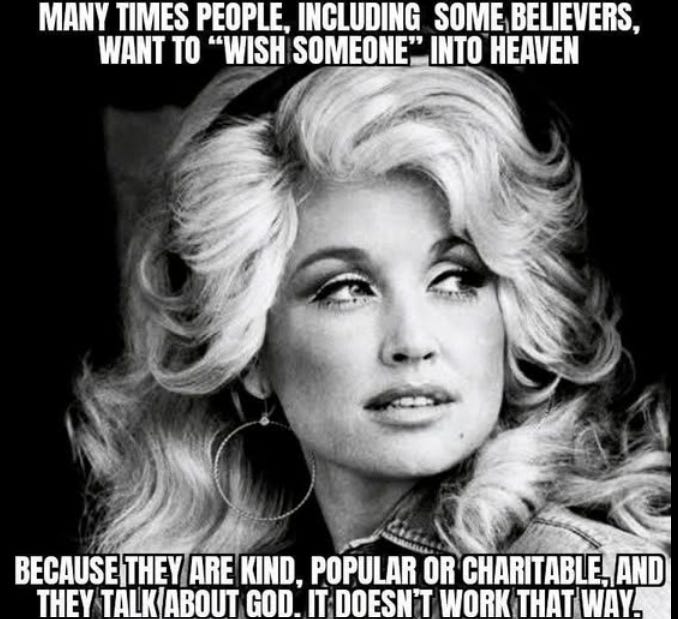
Dolly Parton died Tuesday in Nashville at the age of eighty. By Wednesday morning, a black-and-white photo of her was circulating on Facebook with white block text stamped across the top and bottom.
The top: “MANY TIMES PEOPLE, INCLUDING SOME BELIEVERS, WANT TO ‘WISH SOMEONE’ INTO HEAVEN.” The bottom finished the thought. “BECAUSE THEY ARE KIND, POPULAR OR CHARITABLE, AND THEY TALK ABOUT GOD. IT DOESN’T WORK THAT WAY.”
No name (except for the Facebook user who posted it). No chapter and verse. A woman roughly one day dead, and a stranger on the internet already clearing his throat about the assumed entrance requirements.
The trouble is that Jesus gave exactly one extended account of the last judgment in the Gospels, and the criteria he lists there are, item for item, the ones the meme waves off as “not working.”
The parable in question
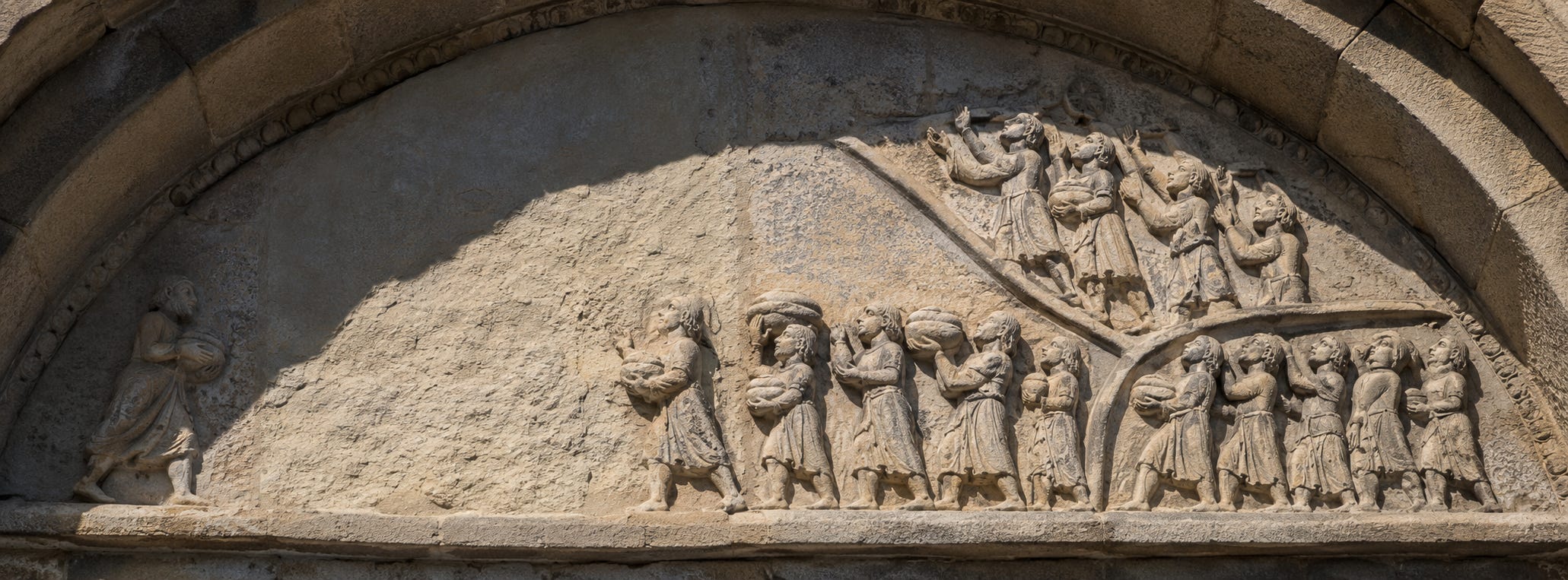
Matthew 25 puts the Son of Man on a throne with the nations gathered in front of him, and he separates them the way a shepherd separates sheep from goats. Then he explains the separation. “I was hungry and you gave me food, I was thirsty and you gave me something to drink, I was a stranger and you welcomed me, I was naked and you gave me clothing, I was sick and you took care of me, I was in prison and you visited me.”1
Hmmm. Kind. Charitable. That’s the list. There’s no line here about correct doctrine, no reference to a moment of acceptance, no audit of anyone’s public theology or church attendance record.
What makes the passage strange, and what almost nobody quoting it seems to notice, is that both groups are bewildered. The sheep ask when they ever did any of this, and the goats ask the same question in reverse.2 Nobody in the story was keeping score on either side of the fence. The judgment lands on people who did not know they were being judged by that standard, which means the one thing guaranteed to disqualify you is confidence about where you landed. That’s awkward.
Then Matthew twists the knife just two chapters earlier in the same Gospel. “On that day many will say to me, ‘Lord, Lord, did we not prophesy in your name, and cast out demons in your name, and do many deeds of power in your name?’ Then I will declare to them, ‘I never knew you.’”3 These are not the lukewarm folks. These are people with a ministry résumé. They talked about God professionally and they got the door.
The meme has the sorting mechanism exactly inverted. Talking about God is the thing Matthew treats as insufficient. Feeding people is the thing Matthew treats as decisive. Tell me how this isn’t so?
The strongest version of the other side
I can still recite the Reformed reply from memory, having made it plenty of times myself from the other side of a session table.
The first approach is evidentiary. They’ll say Matthew 25 describes the fruit of salvation, not its ground. Nobody earns the verdict by feeding anybody; the feeding demonstrates a faith already given. Paul is explicit that salvation comes by grace through faith and not from works, and then in the very next breath says believers were created for good works.4
On this reading the parable is a description of what redeemed people look like and the meme is a clumsy but still defensible attempt to keep the order straight.
Okay.
The second approach is exegetical and it’s also sharper. Jesus says the nations are judged by what they did for “the least of these who are members of my family.”5 The Greek is adelphoi; brothers. Throughout Matthew, that word consistently points at disciples.6 So the criterion here may be narrower than the popular reading assumes. How did the nations treat Christ’s own messengers, the hungry and imprisoned missionaries who came to them? That turns the passage into a judgment on the reception of the gospel, which is a very different thing than a general endorsement of charity.
Got it.
Both of these arguments have real textual precedence. Neither one, however, rescues the meme at issue here.
Let’s take the second approach first, and let me concede something at the outset. Sherman Gray spent 462 pages cataloging what more than six hundred writers said about this passage between the second century and 1986. On “all the nations” he found what most people assume, with roughly 59 percent reading the judgment as universal in scope. On “the least of my brothers” he found the reverse. A universalist reading of that phrase, the one that hears “the poor and the imprisoned generally,” does not appear in the tradition until the twentieth century, and Gray concludes that Matthew probably did not intend it.7
So the narrow reading has the older pedigree, arguably. Fine. Notice what that concession costs the meme, though.
If “the least of these” means Christ’s own disciples, then Matthew 25 becomes a judgment on the nations, on outsiders, measured by how they treated the church. It says nothing whatsoever about how a believer’s own life gets weighed. The passage cannot adjudicate Dolly Parton at all under that reading, and the meme is left holding a verse it never cited in defense of a standard it never stated. In other words, it still doesn’t work.
The modern move toward the broad reading happened for a reason and the reason is the astonishment. If the standard were “did you house an apostle,” everyone involved would know whether they had or not. You remember taking in a missionary, I’d wager. The surprise on both sides only functions coherently if the deeds were done with no reference to Christ at all, by people who had no idea whose face they were looking at.
Think about it. Gray would say that twentieth-century readers found that argument persuasive partly because they wanted to, and he may well be right about the motive. But the problem in the text is still there either way.
Which leaves this particular meme losing on both readings. Broad, and Parton’s record is the legit criterion. Narrow, and the passage was never about her anyway.
The fruit-and-root argument sounds good but fails in a different way. It’s a coherent theological position, and I have no interest in relitigating the whole Reformation over a silly Facebook post. But notice what the meme actually does with it. If the works are the evidence Jesus himself submits, then dismissing a life full of that evidence requires a bona fide counter-argument, and the meme doesn’t offer one. It just asserts that the visible record is somehow beside the point. That isn’t the fruit-and-root distinction that is often referenced. That’s discarding the fruit entirely and then claiming some private access to the root.
Drink Wisely has examined elsewhere how American revivalism inherited an essentially Orphic logic, in which a correctly performed transaction secures your status and everything visible afterward is commentary.8 The meme runs on that fuel. Either the invisible thing happened or it didn’t, and the books and the checks are decoration on top of a transaction nobody can audit.
. . .
The actual record
The meme raised the question of whether Parton was merely kind, popular, and charitable. Let’s open the file for a minute, shall we?
Her Imagination Library has mailed more than 332 million books to children since 1995, currently around 3.5 million a month, free, to any enrolled kid from birth to age five.9 She started it because her father could not read or write.
After the 2016 wildfires tore through Sevier County, killing fourteen people, the Dollywood Foundation stood up the My People Fund within forty-eight hours and sent one thousand dollars a month for six months to roughly nine hundred families who had lost their homes, with no means test attached. Donations came in fast enough that the final check went out at five thousand instead of one. Total distributed: $8.9 million.10 An unconditional cash transfer to disaster victims, regardless of income, which is a policy most conservative evangelicals would label socialism if an opposition party politician proposed it.
In April 2020, she gave a million dollars to Vanderbilt University Medical Center; money that helped fund research contributing to the Moderna vaccine. She gave another million to Vanderbilt’s pediatric cancer program in 2017 and another for pediatric infectious disease research in 2022. She died in the same hospital.11
And she talked about God constantly. For sixty years. Raised in the Church of God with a Pentecostal preacher for a grandfather, baptized at twelve, and by her own laughing account “saved about fifteen times” as a frightened kid trying to make sure it took.12 She recorded gospel albums. She said out loud that even if she knew there were no God she would choose to believe it anyway, which is a stranger and more honest sentence than most systematic theology produces.13
So, the meme’s premise fails on its own terms not once but twice over. She did the works, she said the words. What exactly is missing from her confession of faith?
The disqualifying offense
Here’s what she wouldn’t do. She wouldn’t sort anybody.
“If you’re the fine Christian you think you are, why are you judging people? That’s God’s job. We’re not God. We’re not judges.” And then the line that gives the whole thing away: “I got too much to do on my own to try to do God’s work.”14
That’s the offense in a nutshell. In June 2024 the Federalist ran a piece headlined “There’s Nothing Loving About Dolly Parton’s False Gospel,” arguing that a real Christian would call out homosexuality as sin.15 The claim that authentic love requires calling out sin, and that gentleness is a failure of nerve, is durable machinery, and Drink Wisely has taken it apart at length elsewhere.16 The backlash was immediate and the writer told a reporter within days that she regretted using Parton as her example.17 Note that the writer regretted the example, not the assumed standard.
The standard survived intact. Only the target got walked back, because coming for Dolly is bad business and everybody knows it. So it goes back on the shelf until somebody less universally beloved needs adjudicating.
The meme performs the very same function here with less nerve. Nobody’s name on it, no verse attached, no actual argument to defend. Just a reminder that a gate exists and that the poster is apparently standing really close to it.
Matthew 25 has a lot to say to people who are certain about the heavenly seating chart. Both groups in that parable ask the same stunned question, and the ones who get the good news are the ones who had no idea they’d received it. The people confidently working the door don’t appear in the story at all. Or, rather, they do in Matthew 7, listing their impressive credentials to a man who says he’s never met them.
Notes
1. Matthew 25:31–36, NRSVue.
2. Matthew 25:37–39, 44, NRSVue.
3. Matthew 7:22–23, NRSVue.
4. Ephesians 2:8–10, NRSVue.
5. Matthew 25:40, NRSVue. The NRSVue renders tōn adelphōn mou as “members of my family”; the literal sense is “my brothers.”
6. See Matthew 12:48–50, 18:15, 23:8, 28:10, where adelphos language attaches to Jesus’ followers.
7. Sherman W. Gray, The Least of My Brothers: Matthew 25:31–46, A History of Interpretation, SBL Dissertation Series 114 (Atlanta: Scholars Press, 1989). Gray’s study confirms the general dominance of a universalist interpretation of “all the nations” while noting that a similarly universalist interpretation of “the least of my brothers” was not present until the twentieth century and was probably not intended by the author of Matthew.
8. Shawn Patrick Connelly, “American Christianity’s Secret Cult,” Drink Wisely, June 2026, https://drinkwisely.substack.com/p/american-christianitys-secret-cult.
9. “Dolly Parton Started the Imagination Library for Her Dad, Who Couldn’t Read or Write,” Holler, August 25, 2026. Figures also reported across AP-syndicated coverage the same week.
10. “Dolly’s My People Fund Finishes ‘Smokies Strong,’” dollyparton.com; Lilly Knoepp, “How Dolly Parton Gave $12.5 Million And Unprecedented Research To Sevier County,” Blue Ridge Public Radio, December 24, 2018.
11. “Live updates: Dolly Parton dead at 80,” CNN, August 25–26, 2026.
12. Reported from Parton’s appearance on Khloé Kardashian’s Khloé in Wonder Land podcast, July 2025. [OPEN ITEM: verify exact wording and episode date before publication.]
13. Ibid.; see also “Dolly Parton on 1st Time She ‘Truly Found’ God,” TODAY, July 10, 2025.
14. Widely circulated interview footage; text as reported in “Dolly Parton, 79, Shares Powerful Message About LGBTQ+ Community and ‘Fine Christians,’” AOL.
15. Ericka Andersen, “There’s Nothing Loving About Dolly Parton’s False Gospel,” The Federalist, June 6, 2024.
16. Shawn Patrick Connelly, “Soft Words, Hard Hearts,” Drink Wisely.
17. “Author says she regrets using Dolly Parton in essay that sparked widespread backlash,” Yahoo Entertainment / AOL, June 2024.
Comments
Nothing yet. Say the first thing.
Sign in to join the conversation.