
A White House aide everyone knows by now named Natalie Harp follows the president with a portable printer and a battery pack, handing him hard copies of favorable articles and posts throughout the day. Colleagues call her the human printer. The New York Times reported in November 2024 on letters she wrote him the year before, one of which thanked him for being her “Guardian and Protector in this Life.” Another told him, “You are all that matters to me.” The paper said it reviewed the letters and confirmed their authenticity with two people who had direct knowledge of them.1
None of this was a secret. It became a national story on August 16, when Jon Ossoff mentioned Harp by name at a campaign rally in Atlanta and the White House spent a week melting down about it. There are myriad clips online if you’re so inclined to watch.
Nine days before that, Punchbowl News published Jake Sherman’s interview with the president. Sherman asked what would happen if Democrats retook the House and moved to impeach him a third time. Trump answered, “Well, a lot of people are saying I’m one of the greatest presidents ever.” Sherman said, “They’re not saying that, though.”2
Whether the claim is false was settled by anyone with access to a real, legitimate poll. The live question is who “a lot of people” refers to, and the answer is that he is citing his sources. Who are his sources? Somebody prints the pages and walks them over to him. He is reading his mail. The people saying it are, in the main, the people on the payroll.
. . .
Kings they chose
When Trump’s religious supporters needed a biblical justification for a thrice-married, twice-impeached, four-times-indicted casino developer who has been convicted on thirty-four felony counts and found liable by a civil jury for sexual abuse, they went shopping in the old monarchy and came back with three names.3
Cyrus arrived first, by way of Lance Wallnau’s 2016 book and a 2018 film, and got his highest-profile endorsement from Benjamin Netanyahu, who stood in the White House and thanked Trump for the Jerusalem embassy decision by invoking the Persian king who let the exiles go home.4 The appeal is obvious. Isaiah calls Cyrus God’s anointed and God’s shepherd, and Cyrus was a pagan who never converted to anything. A man can be used by God for a purpose without being good.
Run that particular argument to the end of its own logic, though, and it stops being the compliment it is often intended to be. Isaiah also calls Assyria the rod of God’s anger, an instrument raised up to discipline a faithless nation, and then announces judgment on the instrument for taking credit: “Shall the ax vaunt itself over the one who wields it, or the saw magnify itself against the one who handles it?” Divine usefulness and divine approval are separate categories and the first one leans heavily toward expendability. Isaiah says twice of Cyrus, “though you do not know me.” Cyrus signs an administrative decree, funds a temple he does not worship in, and goes back to Persia. He does not campaign for the priesthood.
David came next, and he usually arrives already situated as a defense. David committed adultery and arranged a killing to cover it, and God kept him anyway. That much, at least, is accurate. It also drags 2 Samuel 12 into the discussion, where the prophet Nathan walks into the palace, tells a story about a poor man’s lamb, watches the king get furious at the villain, and says, “You are the man!” David’s answer is four words in English: “I have sinned against the LORD.” The whole reason David works as a comparison is that a prophet with access said the unsayable thing to his face and the king took the hit. Trump can’t take a hit. Anyone asserting the David parallel should be able to point at that scene in this presidency, but they cannot.
What is given instead is a printer.
Jehu is the third and the strangest. Jonathan Cahn cast Trump as Jehu in a 2017 book and told a National Faith Advisory Board gathering that the president had been called “according to the template of Jehu, the warrior king.”5 Jehu is the general who wipes out the house of Ahab, throws Jezebel out a window, and massacres the priests of Baal by luring them into a temple under false pretenses. Second Kings does record God having commended the purge. Then Hosea opens his book by announcing that God will punish the house of Jehu for the blood of Jezreel. The prophetic tradition audited Cahn’s Jehu template inside a century and ruled against it. Somebody had to find Jehu in 2 Kings and then conveniently leave Hosea out of the press brief.
. . .
Kings they skipped
Rehoboam inherits Solomon’s kingdom and one decision. The northern tribes ask him to lighten the labor burden. He consults the elders who served his father, and they tell him to give the people relief and keep the country. He rejects that and consults the men he grew up with, who coach him to answer that his little finger is thicker than his father’s loins and that he will trade his father’s whips for scorpions. He delivers the line. The kingdom splits within the week and never reassembles. Nothing in the account suggests Rehoboam was slow. He asked both rooms. He preferred the room that made him feel large and powerful.
Saul comes back from the Amalekite campaign and stops at Carmel to set up a monument for himself. Confronted, he explains that he feared the people and obeyed their voice. A king who cannot stop performing for the crowd ends up taking orders from it, which is a peculiar destination for a man who believed he was truly in command.
Herod Agrippa puts on his robes, takes the throne, delivers an oration, and the crowd shouts that this is the voice of a god and not of a mortal. Acts says he was struck down because he did not give the glory to God, and that worms ate him. Josephus tells the same story without the theology and sharpens one detail. The men around Herod called out to him as more than human, and he did not rebuke them.6 Two independent accounts, and one diagnosis. A lot of folks said he was the greatest.
Which brings us to Ahab, who supplies the best-documented case of managed reality in the Hebrew Bible. Ahab wants to retake Ramoth-gilead and convenes about four hundred prophets, who are unanimous. Go up and triumph. Jehoshaphat, visiting, asks whether there is anybody else on the payroll. Ahab’s answer is one of the most self-aware sentences any king speaks in scripture. “There is still one other by whom we may inquire of the LORD, Micaiah son of Imlah, but I hate him, for he never prophesies anything favorable about me, but only disaster.” Fake news.
Ahab knows exactly which prophet tells the truth. He can produce the name on demand. He simply prefers not to hear from him.
Micaiah gets summoned, mocks the unanimity to the king’s face, describes a lying spirit loose in the mouths of the four hundred, and predicts the defeat and the death. He is sent to prison on reduced rations. Ahab rides out anyway, in disguise, so that nobody will aim at him in particular.
. . .
What the philosophers did
Plutarch wrote an entire essay on the problem, addressed to a Roman friend with power and money and therefore a predictable flattery problem. His diagnosis is that the professional flatterer succeeds because of a prior condition. Self-love has already made every person his own first and most persuasive flatterer, so the outside operator arrives to find the door open and the chair warm. The flatterer’s method is imitation. He holds no fixed shape and adopts whatever opinion the powerful man expressed most recently. His opposite is the friend, and the mark of the friend is frank speech, the one commodity a court (or Oval Office) cannot manufacture for itself.7
Augustine makes an important distinction in the fifth book of the City of God that is a propos here. He separates the love of glory from the lust for domination. A man who loves glory still wants the good opinion of people whose judgment he respects, which leaves him exposed to some level of correction from those people. A man who loves domination, however, will accept acclaim from anyone at all, which leaves him exposed to nothing. Augustine considered the first a vice, but he considered the second a catastrophe and he thought Rome had made that trade.8
Kant, I think, is the one to read on the courtiers rather than the king. He treats servility as a violation of a duty owed to oneself and puts it quite plainly: whoever makes himself a worm cannot complain afterward about being stepped on.9 The damage runs in both directions here. Harp’s letters to the POTUS read almost like a person fading away.
It would be an easy out to make a White House staffer the villain, but the appetite here belongs to the man who wants the printed pages. Any organization built to feed that appetite will produce a Natalie Harp on a regular schedule, and if she resigned tomorrow the human printer role would be reassigned by Friday. Iris Murdoch called the obstacle to moral seriousness the fat relentless ego, and said the work of morality is unselfing, the slow discipline of letting something outside the self count as real.10 A president who has arranged a life in which nothing outside himself is permitted to be real has not achieved greatness. He has, however, achieved considerable insulation and the fat relentlessness he seems to be going for.
. . .
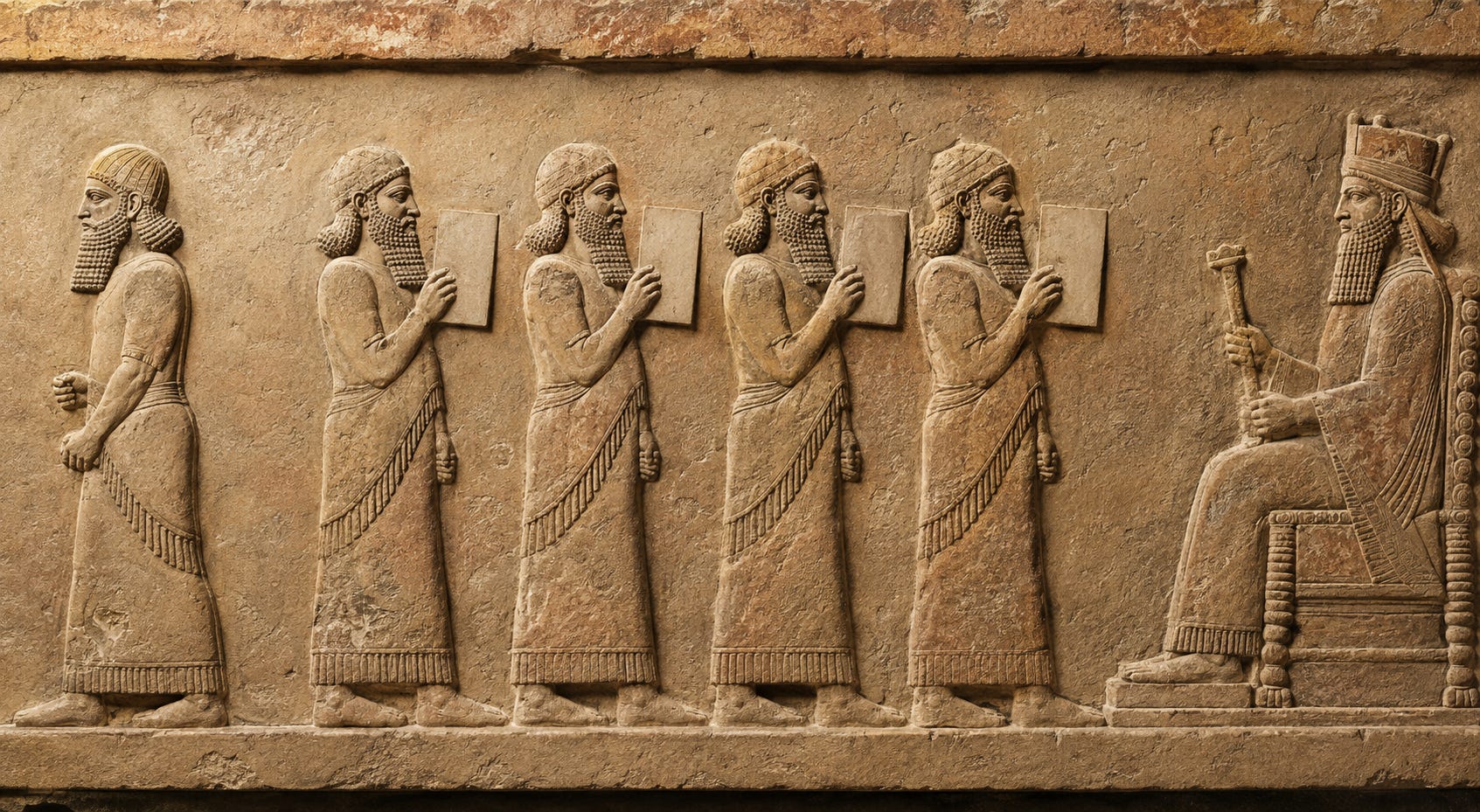
Frank speech, current examples
Ossoff’s method is more useful than simple trolling, and it predates the rally line that set off the week. At Jay Clayton’s confirmation hearing for director of national intelligence in July, Ossoff asked who won the 2020 election. Clayton would not answer the question. Ossoff asked again, and again, and told him his testimony lacked credibility. The nominee’s inability to acknowledge a settled fact out loud did more damage than any speech would have.11 As chair of the Senate’s permanent subcommittee on investigations he has also run the unglamorous kind of oversight that produces documents, including a report on a private military housing company’s failures at bases in his own state.
His account of the Harp business, given to Jen Psaki, was the sharpest version of the argument. The president retreats into a circle of aides who function as a sort of security blanket. They tell him what he wants to hear instead of what he needs to hear, and the country is at war.12
The comparison everybody reaches for here is Andersen’s, and overuse has worn it smooth. The story is sharper than its reputation. Two con men sell an emperor a cloth that only the competent can see, and the trap holds because nobody in the palace will risk looking unfit for his post. Ministers file in, see an empty loom, and go write reports about the pattern and the colors. By the time the child says the obvious thing out loud, the fabric has cleared an entire chain of professional verification. The emperor is the mark. The court is the mechanism.13
Ossoff is also the most endangered incumbent in the Senate, the only Democrat defending a seat in a state Trump carried in 2024, and every word of this is campaign speech with a definite motive attached. The oversight record is checkable and mostly predates the campaign, which is the qualitative difference between a mere claim and a line.
Newsom’s method is different. He mimics the president in all caps, complete with the parenthetical self-praise, and he defends the practice as holding up a mirror so the behavior cannot be normalized. There is real force in that, in its way. Parody denies flattery its dignity, and the redistricting fight underneath the posts was substantive. The cost is that mockery runs on the very same fuel as the thing it mocks. Micaiah did not do impressions of the four hundred. He gave a competing account of the facts and went to prison over it.
. . .
The four hundred were clergy
What lands closer to home is that the prophets in Ahab’s throne room held a religious office. They were salaried, credentialed, and unanimous, and when the king wanted to hear that the campaign would go well, the professionals who told him so did it in God’s name.
American evangelicalism supplied the perfect comparisons in this narrative. Somebody had to go get Cyrus. Somebody had to find Jehu and drop Hosea. That was done by pastors and authors and broadcasters with degrees and publishing contracts, and it was done in the register of prophecy, which is the only register in the tradition where being wrong is supposed to end a career. Deuteronomy sets a plain standard for the trade. If the word does not come to pass, the prophet obviously spoke presumptuously. Nobody seems to administer that test anymore, which is how the same names keep getting invited back to make the same call about the next man.
In the same week that Central Command announced two American service members had been killed by Iranian fire in Jordan, Trump defended the length of the campaign by telling CNN’s Kaitlan Collins that the United States spent nineteen years in Vietnam and had only been at this one for four months.14 The war is now in its sixth month. The four hundred remain unanimous.
Ahab took the advice, put on the disguise, and rode to Ramoth-gilead. The King James has an archer drawing his bow “at a venture.” The NRSVue says he shot unknowingly. Either way the arrow went in at the seam between the scale armor and the breastplate.
Ossoff’s line at the Atlanta rally was that while the sailors fight his war, the president sleeps through his meetings, golfs, and trades stocks. Reporters covering the Manhattan criminal trial in 2024 filed the same observation about the defense table, which he denied at the time on the grounds that he was merely resting his eyes.15 Ahab’s court ran into a version of that problem at the end and solved it the way courts do. They propped the king upright in his chariot until sundown so the army would not see him fall.
Unanimity is not a forecast. Nobody in that throne room adjusted the arrow, and producing it cost the four hundred nothing at all. Micaiah did the prison time. Ahab did the dying. The prophets who said go up and triumph collected their wages and went home to their families, which is the durable feature of the arrangement rather than a flaw in it. Flattery is the safest job in any administration because the bill always comes due somewhere downrange, on the crews in the Gulf and under the flight paths, and never in the room where the advice was given.
Andersen knew this and put it in the last paragraph, where the emperor hears the truth from the child, decides the procession has to continue anyway, and carries himself prouder than before while the chamberlains walk behind him holding up a train that is not there. Nothing happens to the chamberlains. The moral belongs to them as much as to the emperor, and they are the ones still on the clock.
The printer is still running. Somebody is walking the pages down the hall right now.
Notes
1. Maggie Haberman and Jonathan Swan, reporting in The New York Times, November 2024, on letters Natalie Harp wrote to Donald Trump in 2023. The Times reported that its reporters reviewed the letters and confirmed their authenticity with two people with direct knowledge of them. The reporting recirculated widely following Ossoff’s August 16, 2026 rally remarks. [Insert direct link before publication.]
2. Punchbowl News interview with Jake Sherman, published August 7, 2026. The exchange circulated widely in clip form the same day.
3. Impeached by the House in December 2019 and again in January 2021, acquitted by the Senate both times. Indicted in four jurisdictions in 2023 (Manhattan, Fulton County, and two federal cases); convicted on May 30, 2024 on thirty-four counts of falsifying business records in New York, sentenced in January 2025 to an unconditional discharge. In May 2023 a federal civil jury found him liable for sexual abuse and defamation in the suit brought by E. Jean Carroll. The federal cases were wound down and the Fulton County case dismissed following the 2024 election.
4. Lance Wallnau, God’s Chaos Candidate: Donald J. Trump and the American Unraveling (2016); The Trump Prophecy (film, 2018); Benjamin Netanyahu, remarks at the White House, March 5, 2018, invoking Cyrus in connection with the Jerusalem embassy decision.
5. Jonathan Cahn, The Paradigm (2017); Cahn’s remarks to a National Faith Advisory Board gathering, quoted in Jason DeRose, NPR, January 20, 2025.
6. Josephus, Antiquities of the Jews 19.343–350. Compare Acts 12:20–23.
7. Plutarch, “How to Tell a Flatterer from a Friend,” Moralia 48E–74E.
8. Augustine, City of God, Book V, chs. 12–19.
9. Immanuel Kant, The Metaphysics of Morals, Doctrine of Virtue, §§11–12 (on servility).
10. Iris Murdoch, The Sovereignty of Good (1970).
11. Jay Clayton confirmation hearing before the Senate Select Committee on Intelligence, July 15, 2026; see also MS NOW’s August 13, 2026 profile of Ossoff’s oversight record.
12. Jon Ossoff, interview with Jen Psaki, The Briefing, August 17, 2026.
13. Hans Christian Andersen, “The Emperor’s New Clothes” (1837).
14. CNN reporting, July 18, 2026: U.S. Central Command announced two American service members killed and one missing after Iranian strikes in Jordan; Trump’s Vietnam comparison was made to Kaitlan Collins the same week.
15. Ossoff, campaign rally remarks, Atlanta, August 16, 2026. On the trial: multiple reporters in the Manhattan courtroom during the spring 2024 proceedings described the defendant appearing to nod off; Trump disputed the accounts. [Confirm a single citable report before publication.]
16. Scripture quotations are from the NRSVue except where the King James Version is identified. Biblical references in order of appearance: Isaiah 44:28–45:5; Isaiah 10:5–15; 2 Samuel 12:1–13; 2 Kings 9–10; Hosea 1:4; 1 Kings 12:1–19; 1 Samuel 15:12, 24; Acts 12:20–23; 1 Kings 22:1–38; Deuteronomy 18:20–22.
Comments
Nothing yet. Say the first thing.
Sign in to join the conversation.