
Matcha is definitely having a moment.
It is in the coffee shop, on the supermarket shelf, and near the top of every wellness feed, usually wearing the word “gut” like a badge.
The claim is simple: drink this bright green powder, and your microbiome will go super saiyan!
I find this interesting, because the honest answer is not what you may think.
Matcha is neither the next miracle gut cure nor a total fraud.
Let me explain what the evidence shows….
Disclaimer: TLDR….there is limited evidence. Maybe this article becomes redundant after a few months/years once a high powered study comes out. Watch this space.
You can check out my full Substack here
Ordinary green tea is brewed, and the leaf is thrown away.
Matcha is the whole leaf: shade-grown, dried, ground to powder, and drunk in its entirety.
You are not steeping the leaf, you are eating it.
So per cup, (theoretically), matcha delivers more of everything.
More catechins, the polyphenol family that includes EGCG. More caffeine. More theanine. A little insoluble fibre too.
Those catechins are why matcha is pivoted towards being “gut healthy”.
They are poorly absorbed in the small bowel, which sounds like a flaw but is the whole point.
Largely unabsorbed, they travel down to the colon, where your bacteria set to work on them.
Before your friend goes to Starbucks show them this
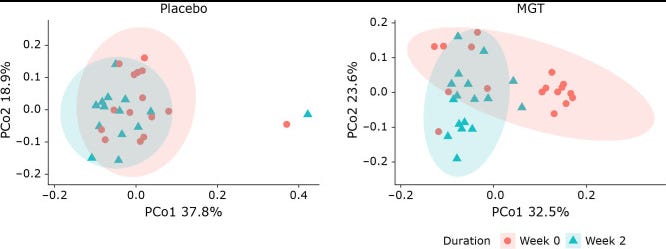
A randomised, double-blinded trial gave healthy young adults matcha twice daily for two weeks.
The matcha group showed a significant shift in microbial diversity. The placebo group showed none.
A systematic review pulling the human and animal work together points the same way: matcha may nudge the microbiome by encouraging beneficial bacteria such as Bifidobacterium, Lactobacillus and Akkermansia (generally speaking, “good” bugs).
It is genuinely promising but preliminary.
The trials are small, short, and measured in weeks rather than years.
They suggest that matcha may change the microbiome. They do not yet show that it improves your health, and those are not the same sentence.
So the fair summary is this. Plausible mechanism, early human signal, no proof of clinical benefit. Interesting, not established.
Comments
Nothing yet. Say the first thing.
Sign in to join the conversation.