
Everyone knows light affects sleep. Yawn…boring right? That’s not interesting anymore to anyone. Isn’t it amusing that most of the people you read and watch constantly discuss the foods you consume and the vitamins you inhale as the primary factors influencing your daily hormonal fluctuations? So you are thinking your GI microbiome is the gatekeeper to all health and disease? Don’t get me wrong it is important
What’s fascinating is that the eye detects light and sends instructions to the rest of your body, which it follows for the next 24 hours, and sometimes even for a few days or weeks.
It’s not doing it the way we were taught in medical school or in 10th grade biology.
Because this isn’t about VISION guys. This is the non-visual pathway that may be more important than the visual pathway
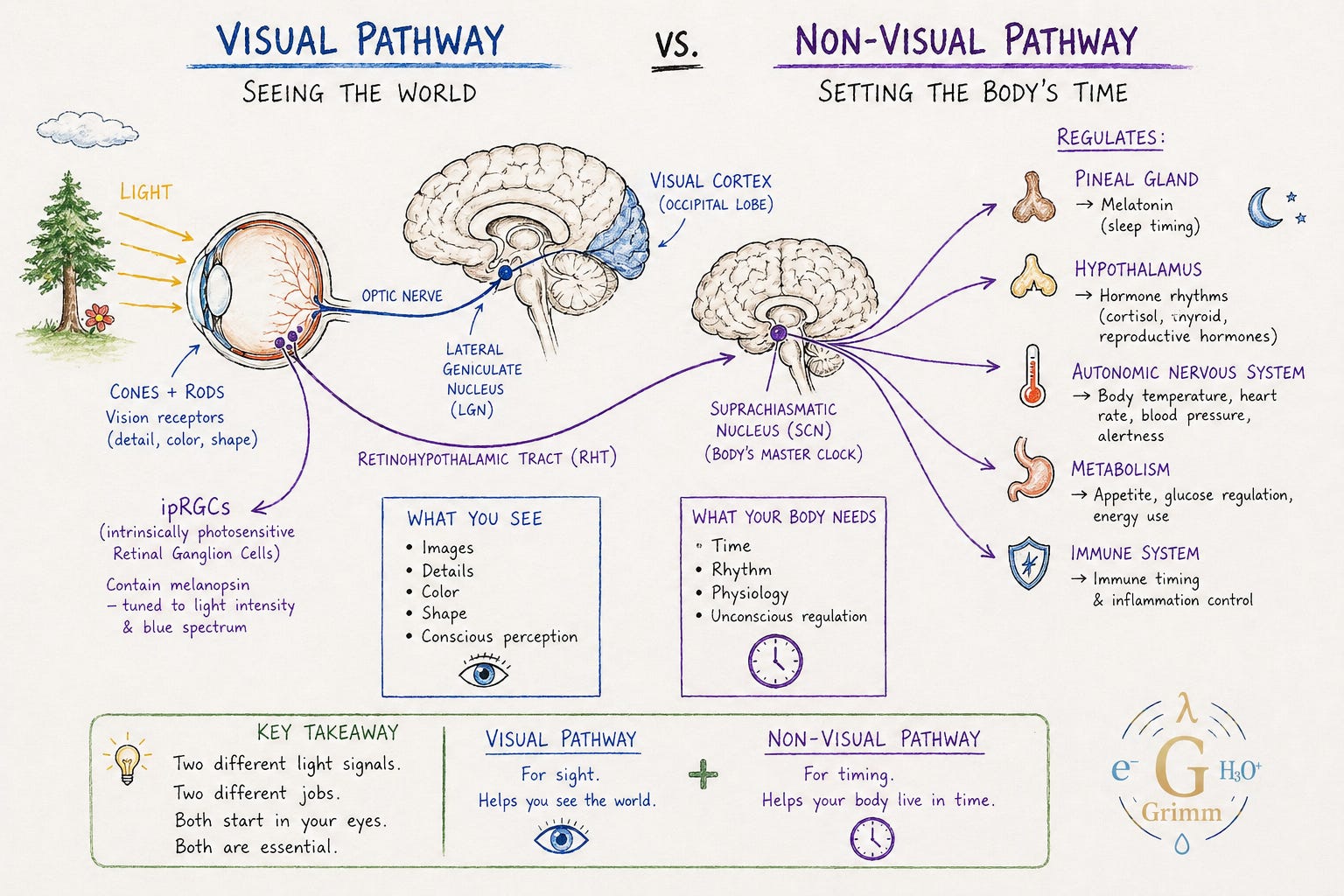
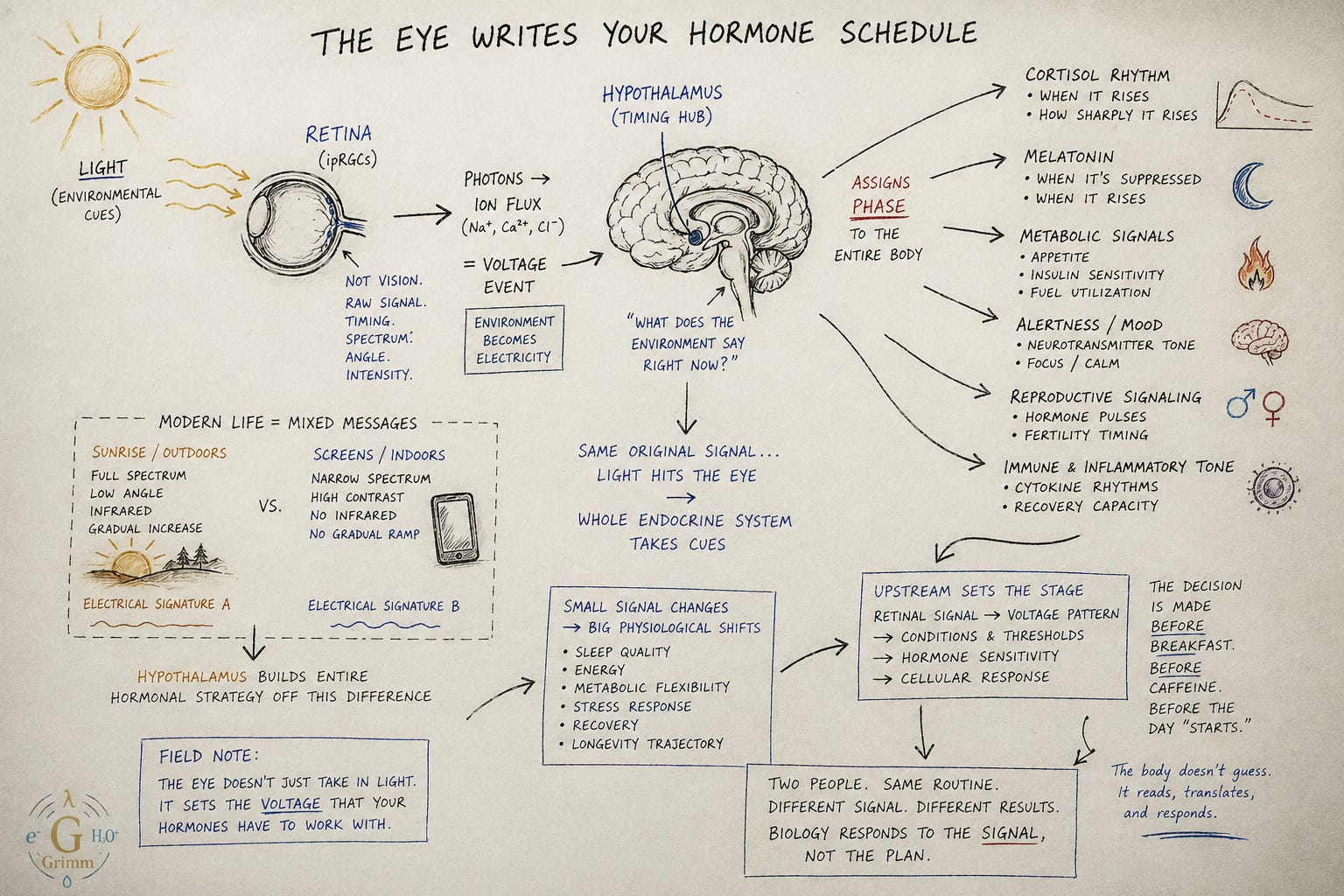
There’s a separate stream in the retina that never shows up in what you see ON PURPOSE. No edges. No detail. No colors you can describe. Just raw signal of information. Specialized cells that are tuned to the environment itself, not the image.
Those cells take incoming photons and immediately convert them into changes in ion flow. Sodium, calcium, chloride shifting across membranes. This is an actual voltage event that starts a cascade of neural information. The very first translation of the outside world into your internal state.
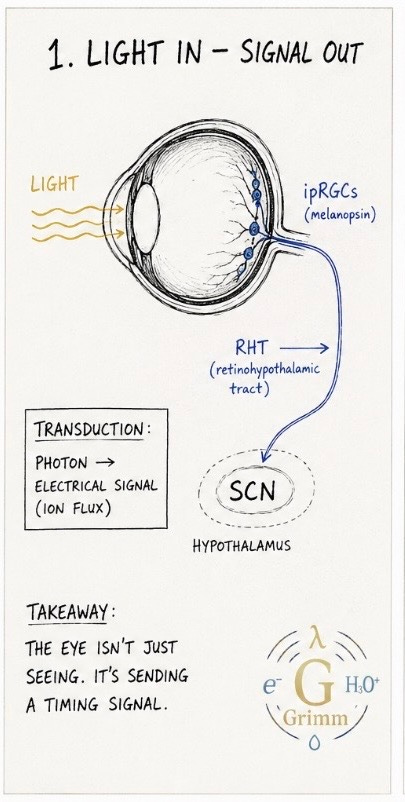
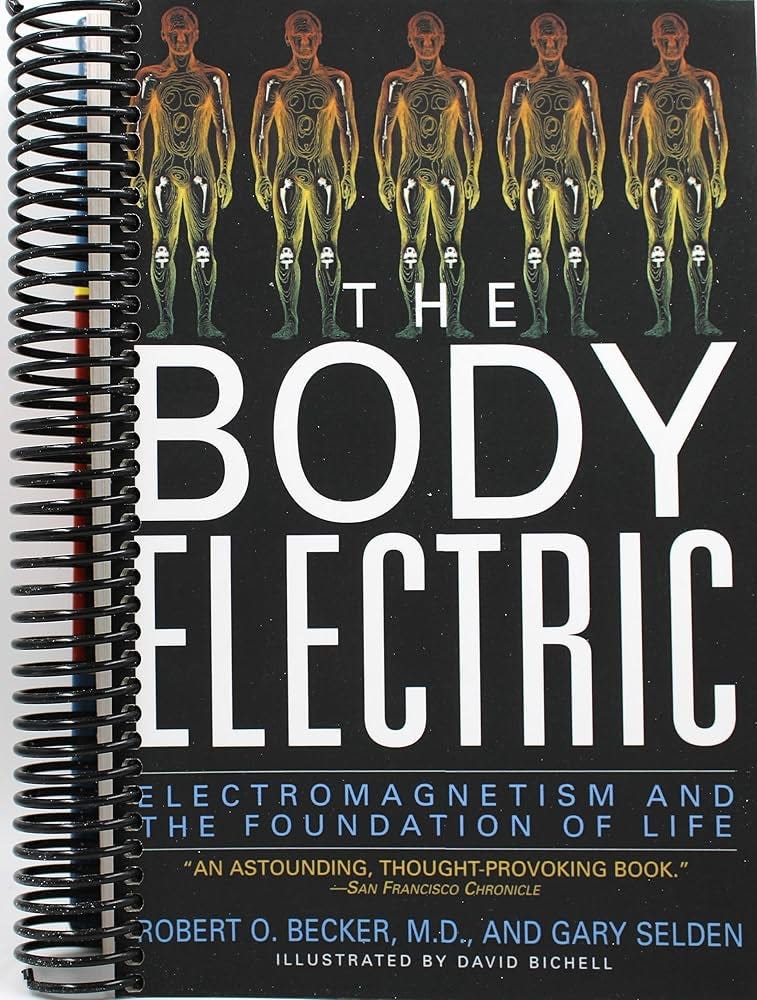
Right there, before the brain even gets involved, the environment has already become electricity. And as we know, Dr. Robert Becker told us the body is electric in the 60’s so we are a little behind
And that electrical pattern carries brightness, It carries timing, angle, spectral composition… all the cues that evolution used to anchor physiology to the sun.all the cues that we are slowly one by one taking away from our modern life.
That signal gets handed off directly into the hypothalamus, into a small region that doesn’t care what you’re doing or what time your phone says it is. It’s reading one thing.
“What does the environment say right now?”
Here’s the part that’s easy to miss.
That region tracks time whileIt assigns phase to the entire body.
It decides when cortisol should rise, but more importantly how sharply it should rise. It shapes the slope, not just the peak. It determines whether melatonin gets suppressed cleanly in the morning or drags into the first half of your day like a fog.
Don’t think of it as sleep biology alone. That’s mitochondrial behavior downstream. That’s how efficiently you move electrons later in the day. That’s how your cells decide whether they’re in a building state or a defensive state.
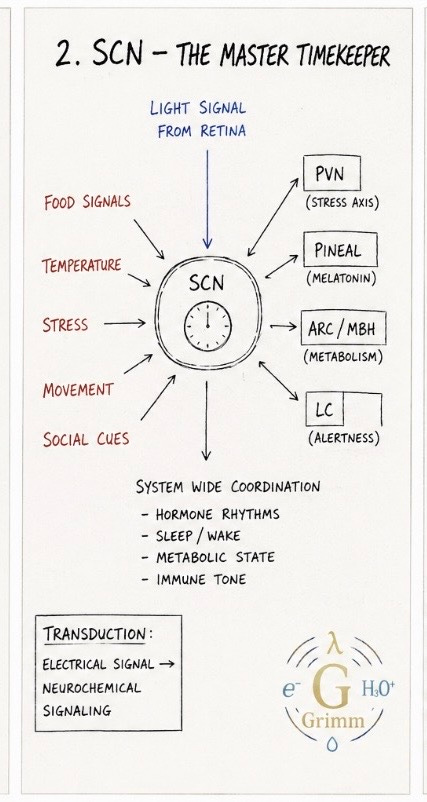
Same original signal.
Light hits the eye… and a few steps later your entire endocrine system is taking cues from it. Light is impacting your hormones…boom!
Now layer in modern life.
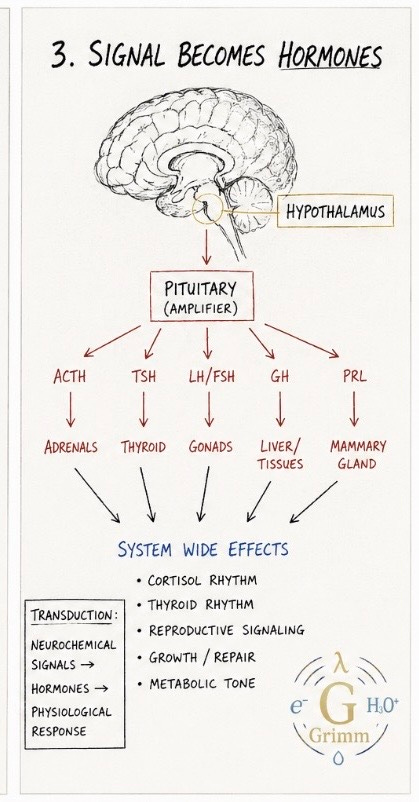
You step outside at sunrise, low angle light, full spectrum, strong infrared component, gradual increase. That creates one kind of electrical signature at the retina.
You wake up and look at a phone in a dark room. High contrast, narrow spectrum, no infrared, no gradual ramp. That creates a completely different electrical signature.
To you, both feel like “light.”
To your brain, they are not even close to the same category.
And the hypothalamus builds your entire hormonal strategy off that difference.
Here’s where I start thinking about this clinically.
We spend a lot of time adjusting downstream markers. I’m sure your doc has done all kinds of lab panels… cbc, cmp, thyroid, cholesterol. Cortisol curves. Sleep quality. Glucose handling. Mood. Energy.
“What signal is the system actually receiving first thing in the day?”
Because the body is not guessing what to do. It is reading the signal, translating it into voltage, and building a response that makes sense based on that input. WHATEVER THE INPUT That includes the fields of photons, phonons, bioelectric, temperature, pressure, ph All of them and they haven’t been prescribed and they aren’t in the form of a pill
That initial electrical pattern coming out of the retina triggers neurons and It sets conditions for everything that follows. It shapes how sensitive downstream tissues are going to be to hormones. It sets thresholds. It biases the system before any hormone even arrives.
Which means by the time you’re measuring cortisol or insulin or melatonin, the decision has already been influenced upstream. The docs are a week behind
Quietly. Before breakfast. Before caffeine. Before the day “starts.”
This is why two people can run the same routine on paper and get completely different results.
Because their biology isn’t responding to the ROUTINE. It’s responding to the signal that came BEFORE the routine.
Field Medicine Primer: When Signal Becomes Hormone
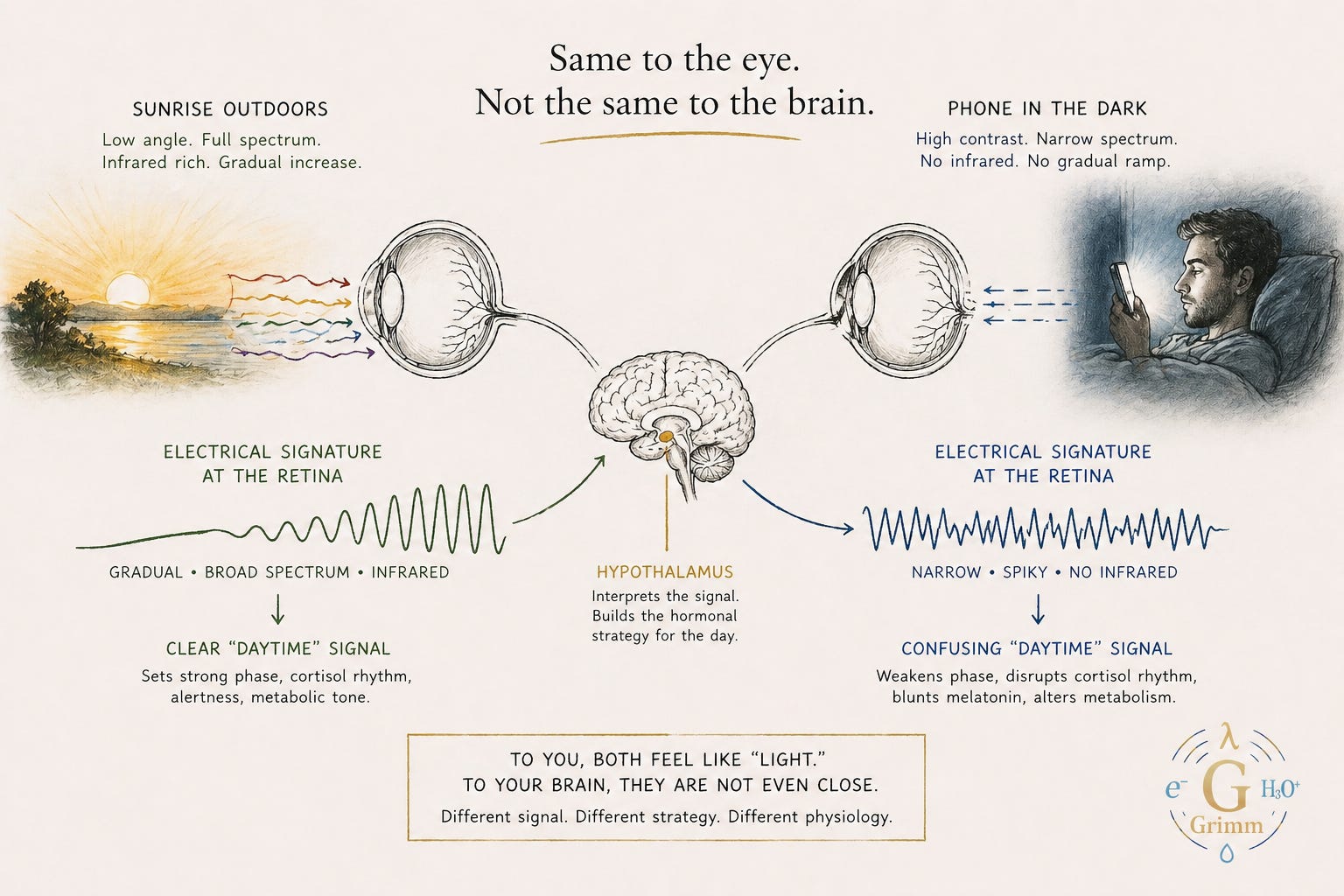
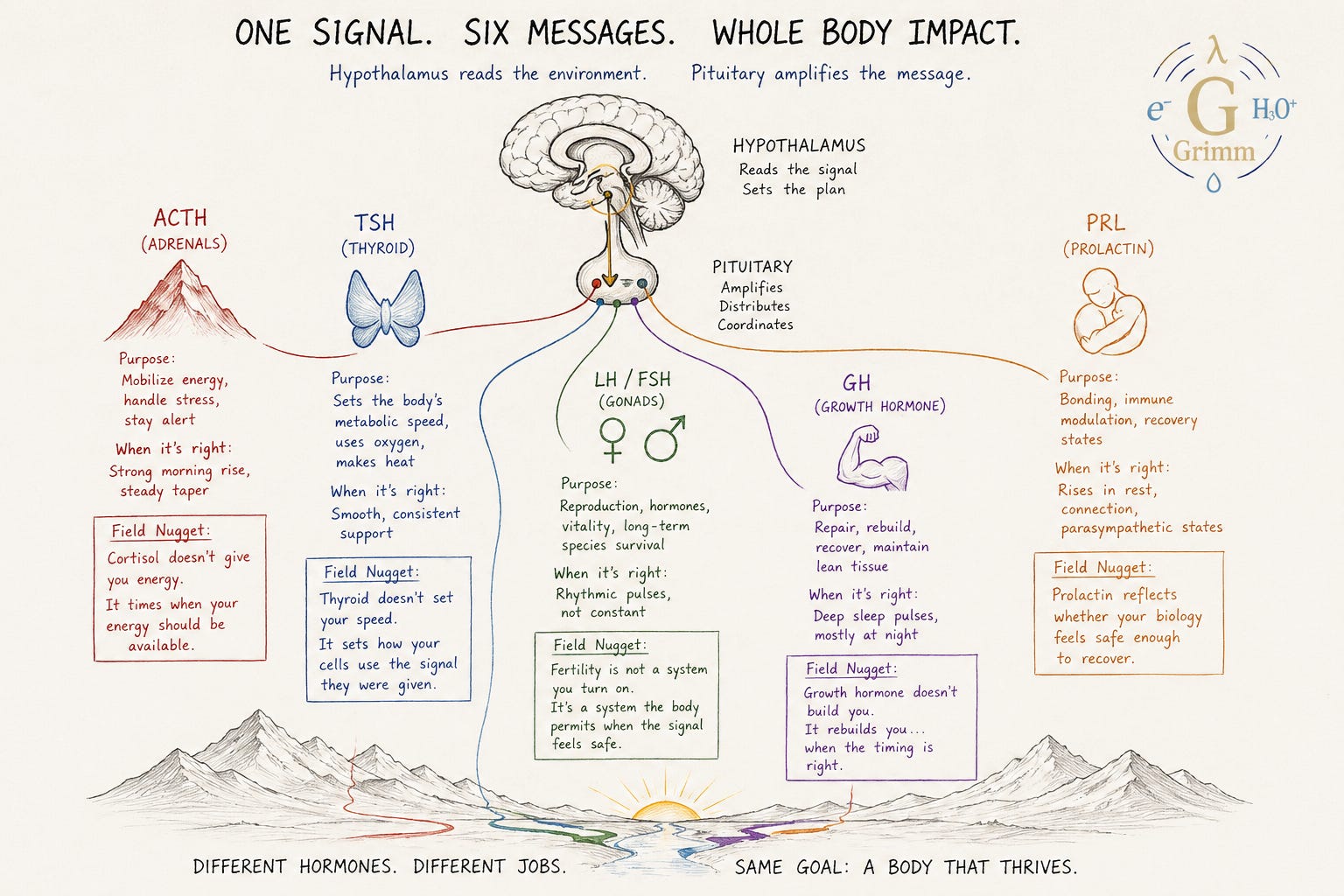
At this point in the cascade, the brain has already read the light signal and translated it into electrical and neurochemical patterns. What you’re looking at above in this diagram is the next move.
The hypothalamus releases hormones but not randomly. It releases instructions about timing with precision and intent
Those instructions get handed to the pituitary, which acts like an amplifier. Small upstream signals become systemic waves that reach every tissue in the body.
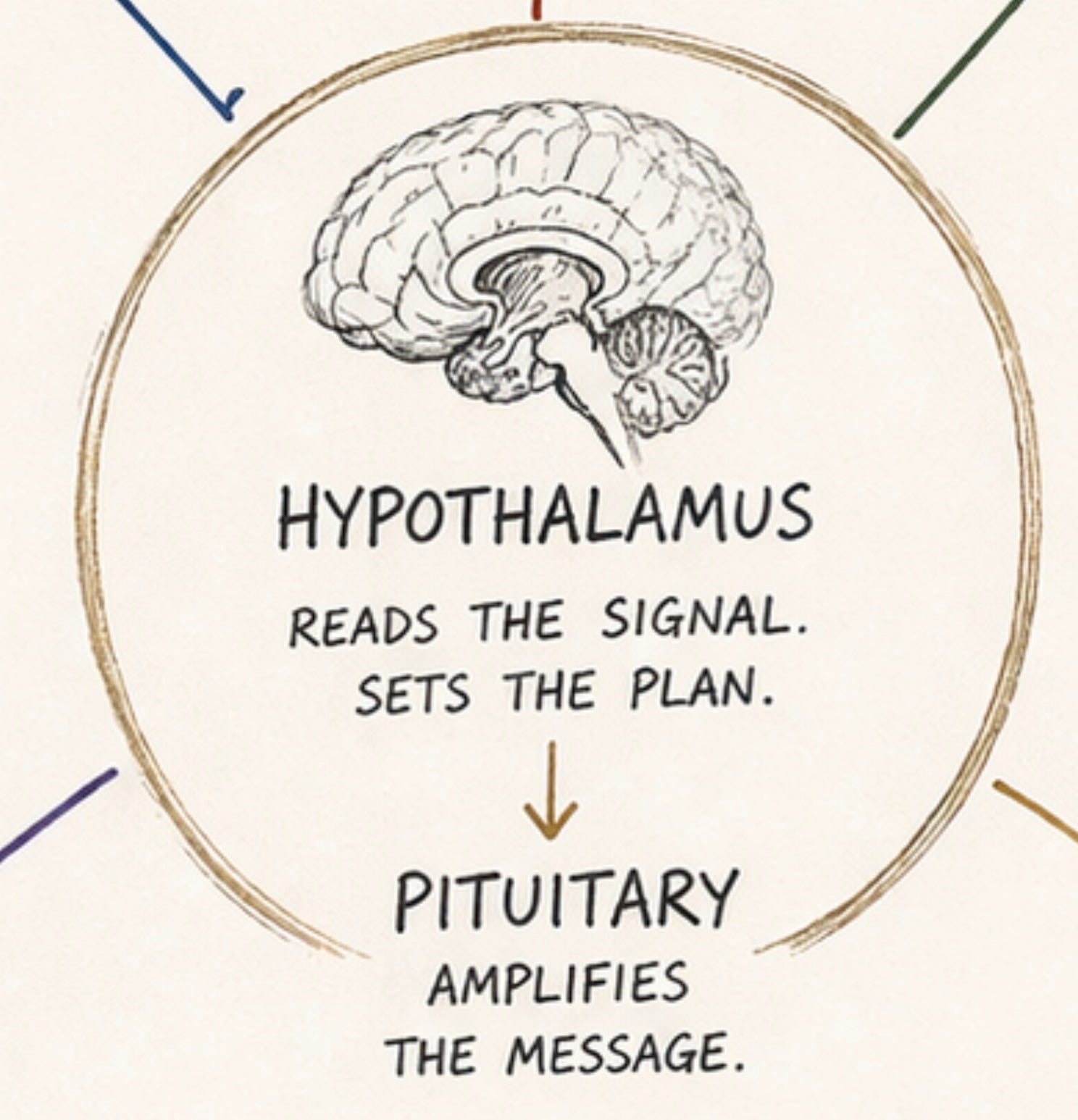
But here’s the Field Medicine shift.
Everyone thinks these hormones are just chemicals.
They are time-stamped directives riding on an electrical and redox backdrop that was set earlier in the day.
Same hormone. Different electrical terrain. Different outcome.
So instead of memorizing pathways, we look at what each hormone is trying to accomplish in the context of signal.
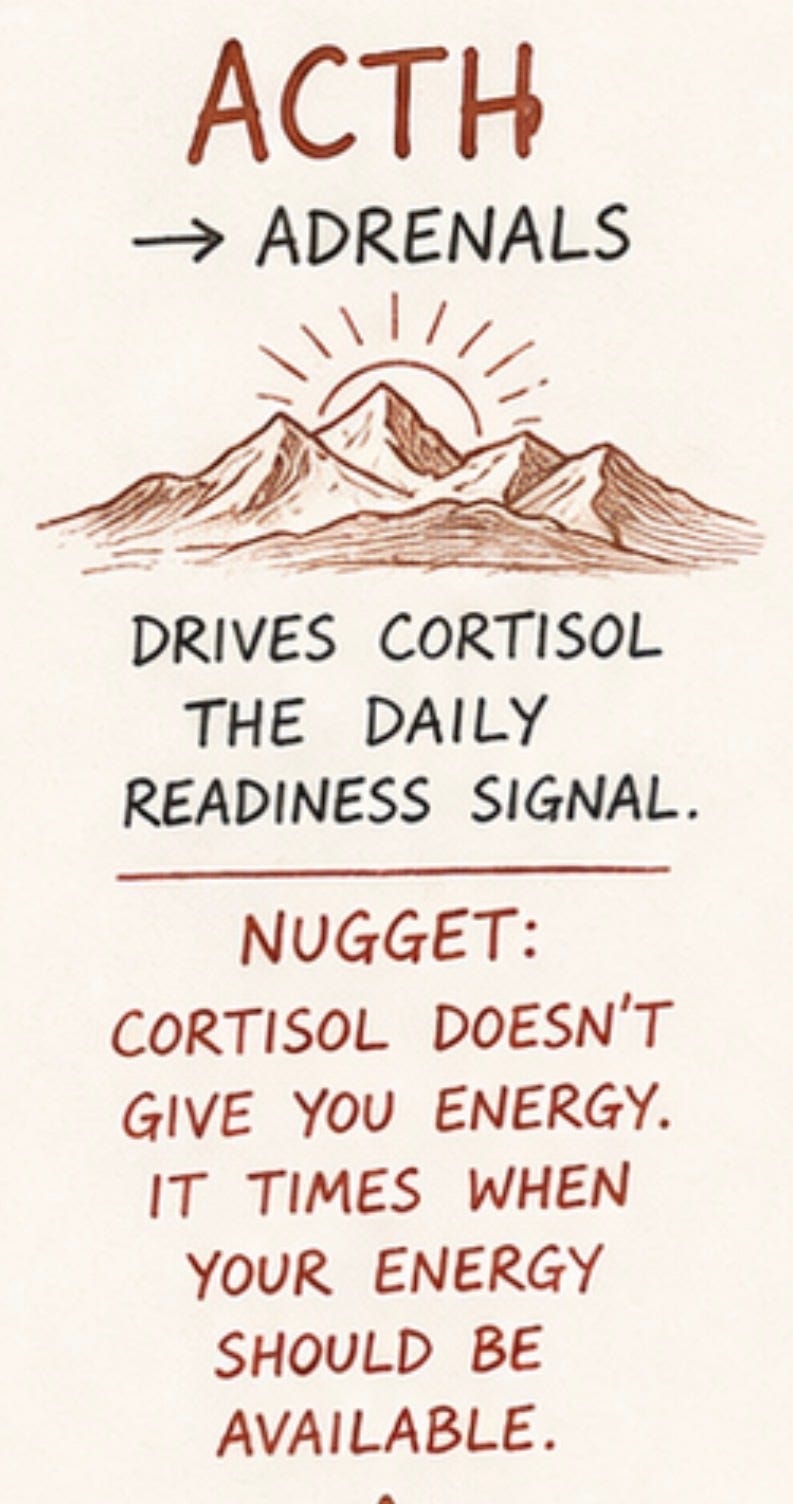
ACTH → Cortisol Axis (Adrenals)
ACTH is the relay. Cortisol is the execution.
This system is not about stress the way we usually frame it. It’s about readiness. Cortisol determines whether the body is in a state of mobilization or conservation.
But cortisol only works properly when its rhythm is sharp. A steep rise in the morning, a gradual taper through the day.
That shape is not created at the adrenal gland. It’s shaped upstream by the signal the brain received prior
If that early signal is weak or confusing, cortisol doesn’t disappear. It flattens. And a flat curve doesn’t drive energy well. It drives compensation.
Field Nugget:
People think that Cortisol gives you a bunch of energy when really it TIMES when your energy should be available
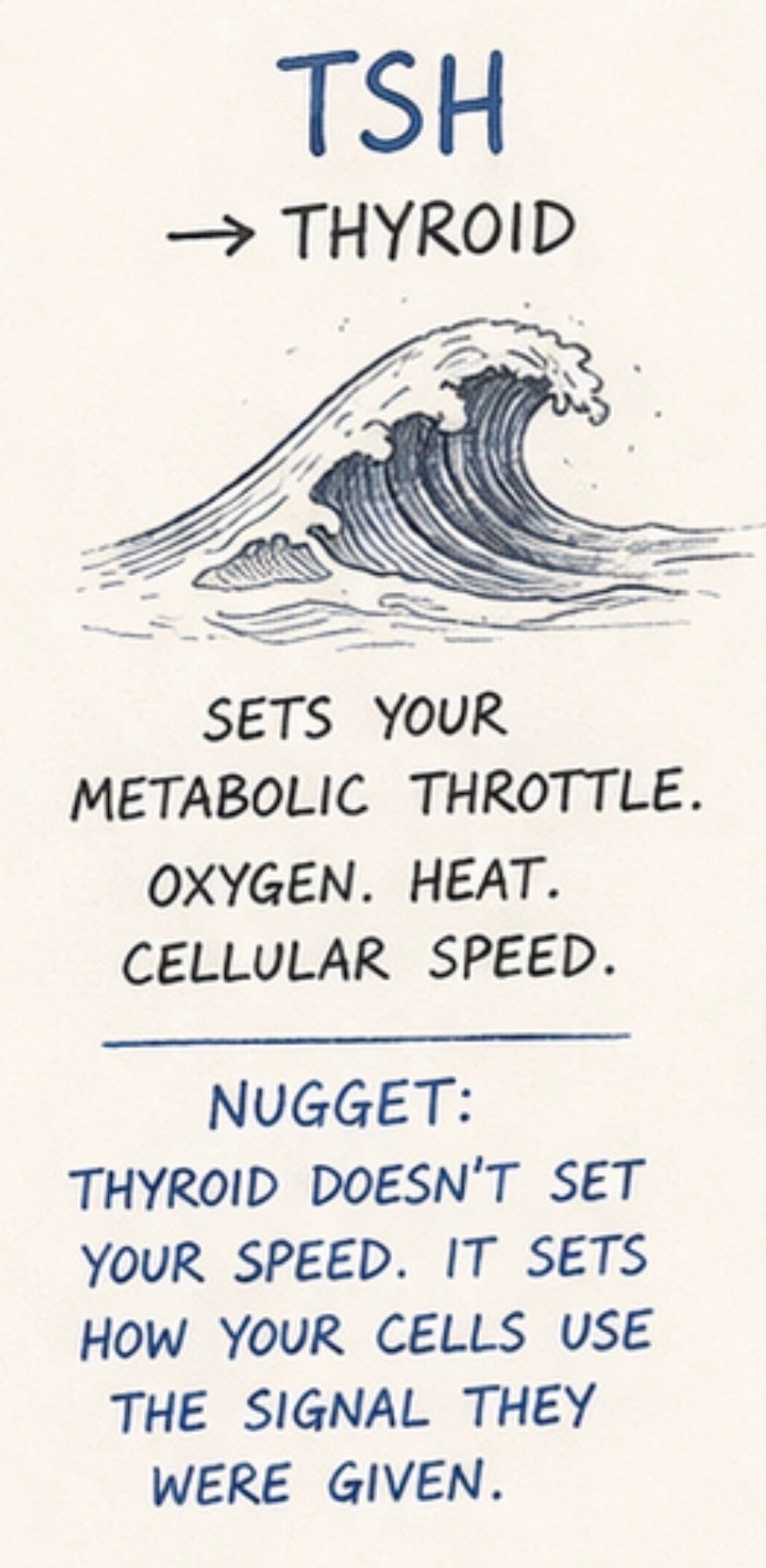
TSH → Thyroid Axis
TSH is the nudge. Thyroid hormone is the throttle.
This system controls how fast the body runs. Oxygen consumption, heat production, mitochondrial throughput.
But thyroid hormone doesn’t act in a vacuum. It is deeply tied to mitochondrial redox state. If the early signal biases the system toward a more reduced or more oxidized environment, thyroid hormone will produce very different effects.
Same T3. Different cellular response.
This is why labs can look “normal” while physiology feels off. The signal environment wasn’t aligned.
Field Nugget:
Thyroid doesn’t set your speed. It sets how your cells use the signal they were given.
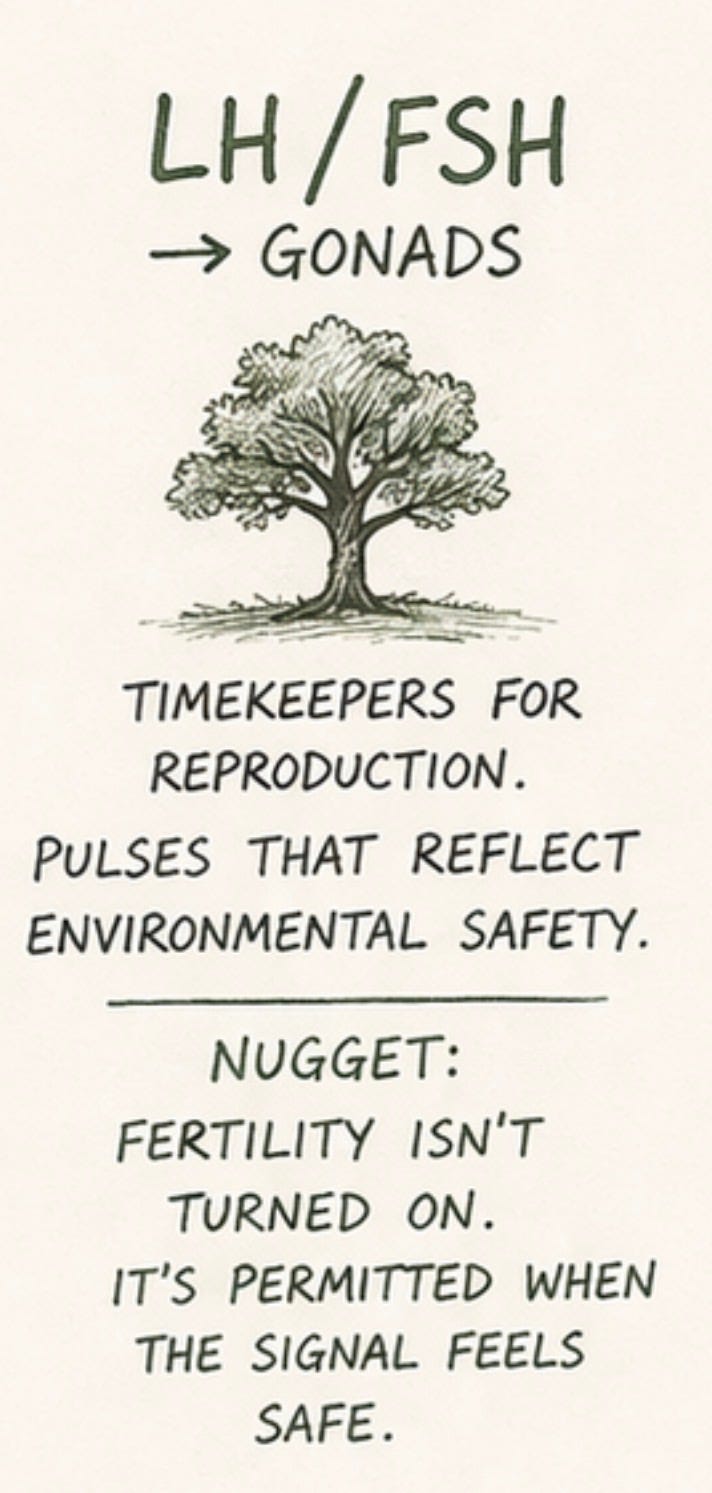
LH / FSH → Gonadal Axis
These are timing pulses, not constant signals.
Reproduction is one of the most sensitive systems to environmental signal quality. It’s expensive biologically. The body only leans into it when conditions feel stable and predictable.
LH and FSH don’t just regulate fertility. They reflect whether the brain believes the environment is supportive of reproduction.
That belief is built upstream.
Light timing. Energy availability. Stress load. All integrated before these pulses are released.
When the signal is inconsistent, the pulses lose their rhythm.
Field Nugget:
Fertility is not a system you turn on. It’s a system the body permits when the signal feels safe.
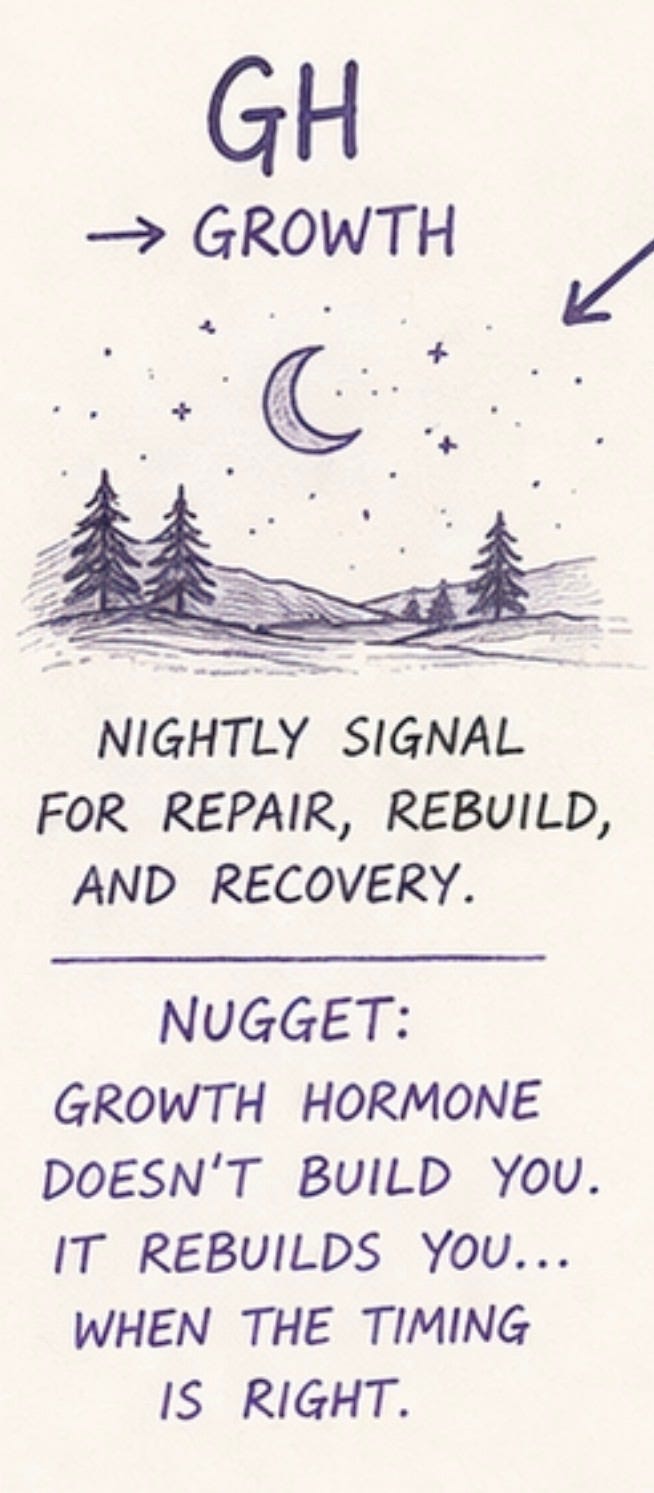
GH → Growth Hormone Axis
GH is misunderstood because people think of it as a “growth” hormone in the gym sense.
It’s really a repair and remodeling signal.
It pulses at night. It coordinates tissue repair, protein synthesis, and metabolic partitioning.
But here’s the nuance.
Growth hormone release depends heavily on sleep architecture, and sleep architecture depends on melatonin timing, which depends on the earlier light signal.
So if the early signal is off, GH doesn’t vanish. It becomes poorly timed or blunted.
Repair still happens… just not efficiently.
Field Nugget:
Growth hormone doesn’t build you. It rebuilds you… when the timing is right.
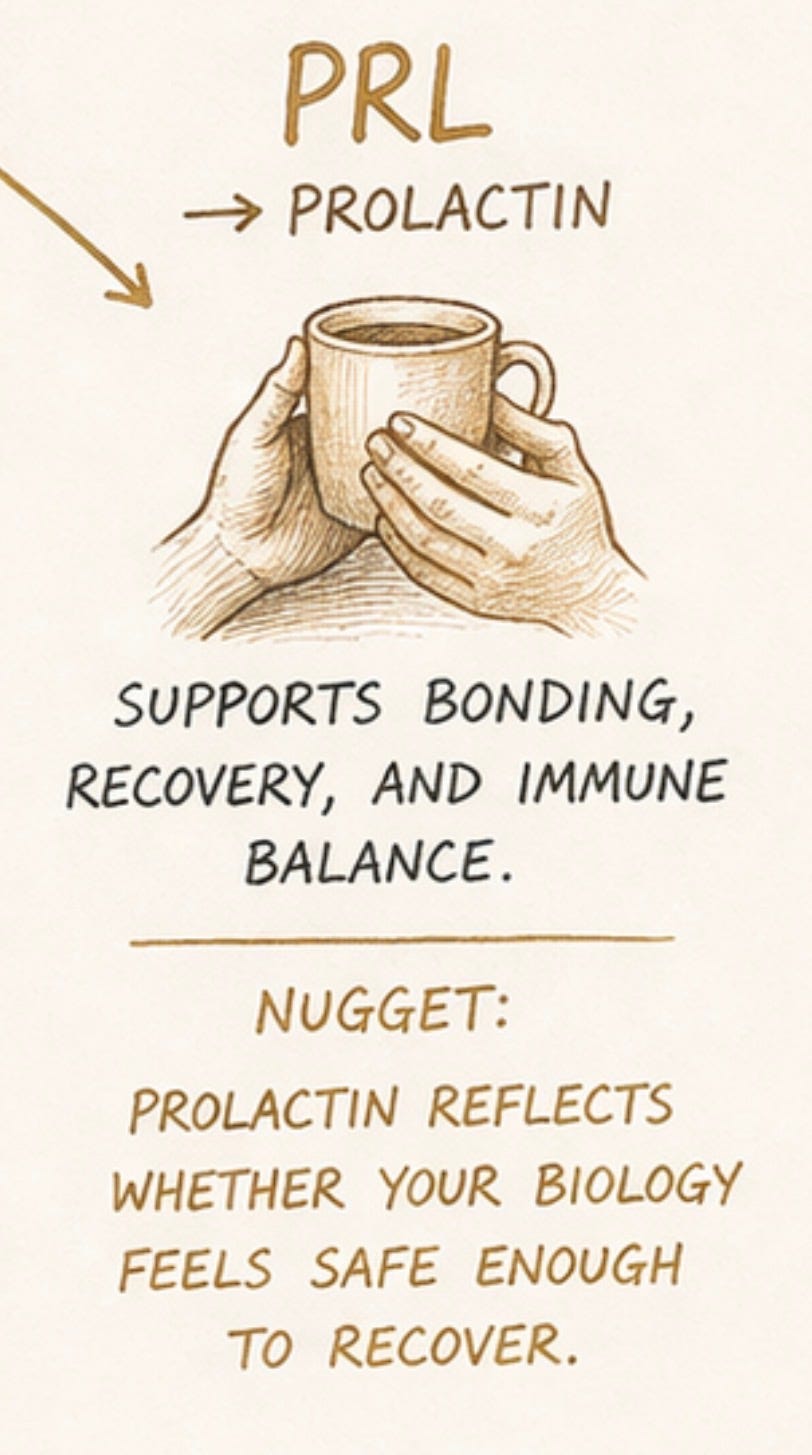
PRL → Prolactin Axis
Prolactin gets boxed into lactation, but it’s broader than that.
It’s tied to bonding, immune modulation, and recovery states.
It tends to rise in more parasympathetic-dominant conditions. Rest, connection, repair.
If the system is constantly biased toward stress signaling because the upstream signal is confusing, prolactin patterns shift.
Not necessarily higher or lower in a simple sense, but out of sync with other rhythms.
And once hormones fall out of sync with each other, the system starts losing coherence.
Field Nugget:
Prolactin reflects whether your biology feels safe enough to recover.
Bringing It Together
What this diagram doesn’t show, but what matters most, is that these hormones are not independent.
They are coordinated. But coordinated strongly by the photonic field (Light) that creates your reality Not VR like sunglasses but your actual reality that your biology must attempt to adapt
Cortisol rising at the wrong time disrupts thyroid signaling. Thyroid inefficiency alters reproductive signaling. Poor sleep architecture blunts growth hormone.
Chronic stress tone shifts prolactin and immune behavior. And all of that coordination starts before any of these hormones are even released.
It starts with the signal. (Check out the MORNING LIGHT PROTOCOL link below
https://open.substack.com/pub/drgrimmmd/p/the-morning-light-protocol-that-rebuilds?r=5rdjg5&utm_medium=ios
Light into the eye. Especially in the morning.
Signal into the hypothalamus.
Electrical pattern into hormonal strategy.
To be honest hormones don’t decide what your body does.
They execute a plan that was written upstream.
Thank you for your retinas
Dr. Grimm
No posts
Comments
Nothing yet. Say the first thing.
Sign in to join the conversation.