
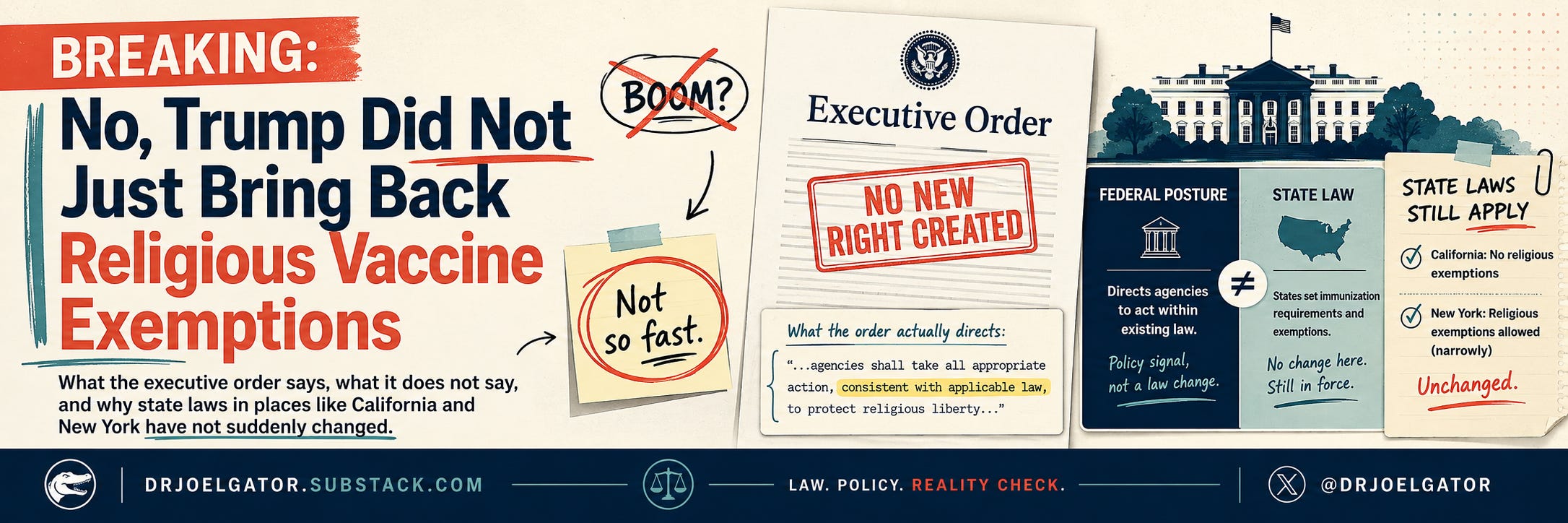
I am seeing a lot of posts online today celebrating President Trump’s new vaccine executive order as though religious vaccine exemptions have suddenly returned across America. “BOOM!” Religious freedom is back. Medical freedom is back. Parents have their rights back. California vaccine mandates are apparently packing their bags as we speak.
I would love to tell you that is what happened.
It isn’t.
And I say that as someone who strongly believes parents should have more choice when it comes to vaccines. I support informed consent. I oppose coercive medicine. I think religious freedom matters. I think medical exemptions should be legitimate and accessible when appropriate (and not really needed at all), and I think the legal questions surrounding religious exemptions deserve serious review by the courts. I would be very happy if we ultimately ended up with greater protection for parental choice.
But wishing an executive order did something does not mean it actually did it.
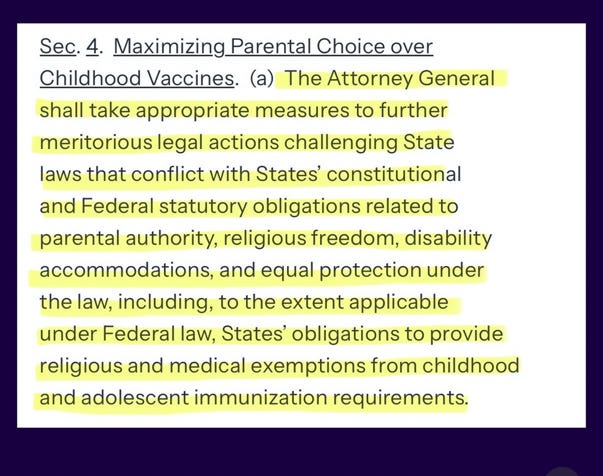
I read the order. The screenshots going viral are real. Section 4 is titled “Maximizing Parental Choice over Childhood Vaccines.” It directs the Attorney General to take appropriate measures to advance meritorious legal challenges to state laws that conflict with constitutional or federal statutory obligations involving parental authority, religious freedom, disability accommodations, and equal protection. It also instructs the Departments of Justice, Education, and HHS to ensure that contractors and grantees—including states and localities—comply with those existing obligations.
That could matter. But notice what it does not say.
It does not say, “Every state must now provide a religious vaccine exemption.”
It does not create a personal-belief exemption.
It does not repeal California law.
It does not repeal New York law.
It does not automatically create a new medical exemption.
It does not give a parent in Los Angeles a new form to hand their school tomorrow morning.
It does not say, “Congratulations, California, SB 277 was fun while it lasted.”
In fact, the language everyone is sharing contains one extremely important qualifier: the federal government is supposed to act regarding exemptions to the extent that federal law actually requires them.That is a rather important collection of words.
Basically, the executive order says: where states are violating federal constitutional or statutory protections, the administration wants the federal government to challenge them. Fine. I am supportive of that.
But the entire legal dispute is over whether states like New York and California are actually violating federal law by refusing to provide religious exemptions.
You cannot solve the question by putting the question into an executive order.
It is a little like writing, “Anyone who legally owes me $10 million should immediately pay me $10 million.” Great. I strongly support this policy. Now comes the slightly more difficult part of establishing who legally owes me $10 million.
And then there is Section 5c, which may be the most important part of the entire order for anyone claiming that they acquired a brand-new vaccine right today. The order expressly says that it does not create a substantive or procedural right or benefit enforceable in court against the federal government or anyone else. That is not exactly fine print
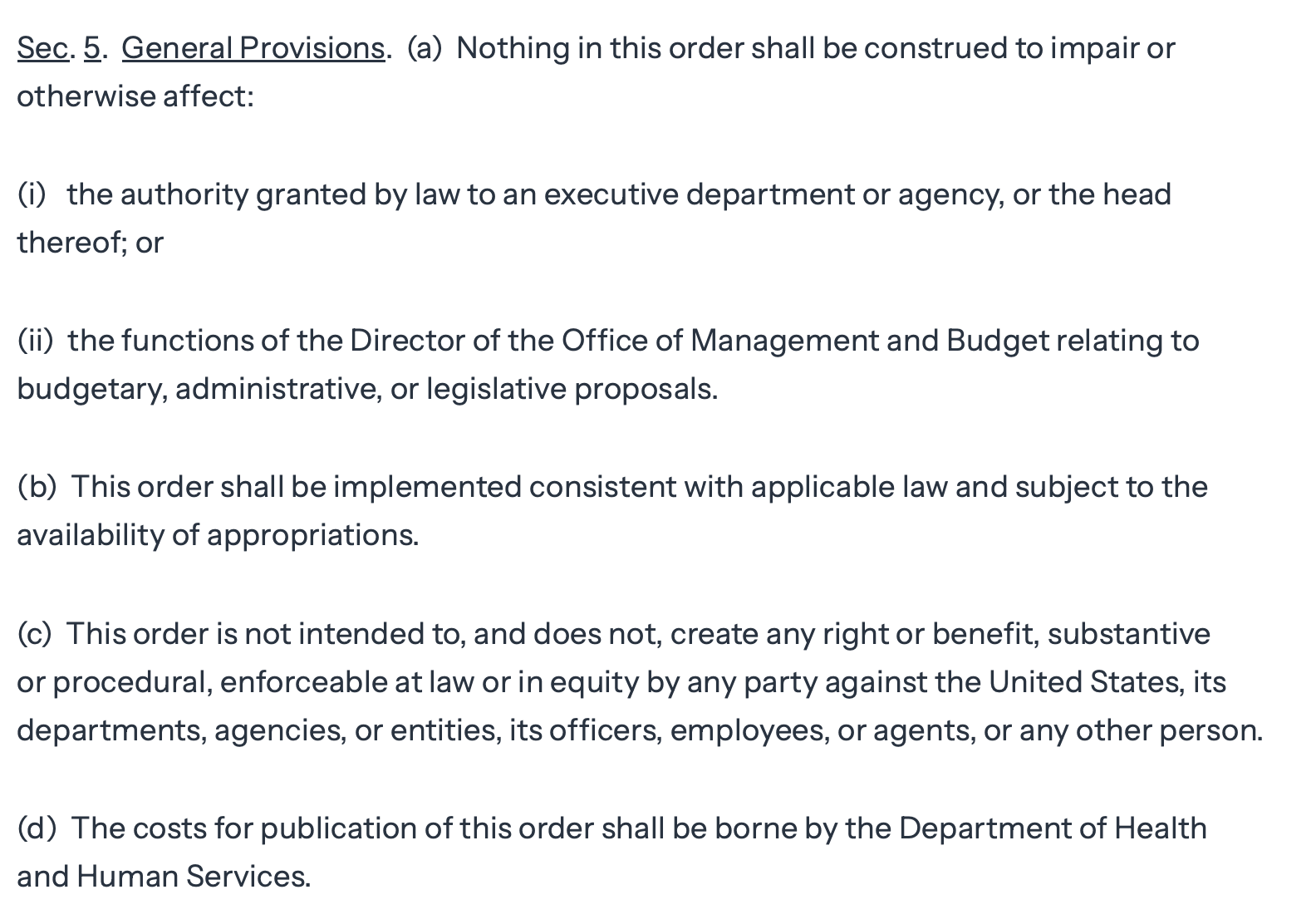
That is the government telling you, in the executive order itself, not to treat the executive order as though President Trump just personally handed you a new legally enforceable exemption.
Yet that is essentially how parts of social media are describing it.
If you live in California, your school vaccine law did not disappear today. California continues to require specified immunizations for school and childcare attendance, with medical exemptions available under state law; personal-belief exemptions for currently required school vaccines were eliminated years ago.
If you live in New York, your religious exemption did not magically reappear today either. New York currently requires children attending public, private, and religious schools, pre-K, and daycare to receive required vaccinations unless they qualify for a medical exemption. The state repealed its school religious exemption in 2019.
I suspect New York officials did not read the executive order this afternoon and immediately begin printing religious-exemption forms. California probably did not either.
And this is where I think people need to distinguish between what they want this order to mean and what it actually does today.
The Attorney General can support litigation. DOJ can file briefs. The federal government can potentially become much more aggressive in arguing that certain state policies violate religious-liberty, disability, parental-rights, or equal-protection protections. Federal agencies can scrutinize their contractors and grantees. Those things are not meaningless. The administration has enormous resources and a very large legal megaphone.
But that is completely different from saying religious vaccine exemptions just came back nationwide. They did not.
The real battle is happening in the courts, and one particular case is much more important to watch than any celebratory Instagram graphic today.
Miller v. McDonald involves Amish parents and Amish schools challenging New York’s elimination of its religious vaccine exemption. The plaintiffs argue that forcing families to choose between vaccination that violates their religious beliefs and participation in their religious community’s schooling burdens their First Amendment rights. Aaron Siri is among the lawyers who have worked on the case.
And the history of that case is fascinating.
A brief reminder. The Second Circuit originally upheld New York’s law. The U.S. Supreme Court then vacated that judgment in December 2025 and told the appeals court to reconsider the case in light of its decision in Mahmoud v. Taylor. That got a lot of people understandably excited because the Supreme Court could simply have left the original ruling alone. Instead, it sent the case back.
But here is the part that matters today: on June 30, 2026, the Second Circuit reconsidered the case…and again upheld New York’s law. The court once again rejected the Amish plaintiffs’ arguments that New York’s elimination of religious exemptions violated their constitutional rights.
So as I write this, New York’s law remains standing. That is reality.
The case may return to the Supreme Court. Siri has publicly indicated another Supreme Court challenge is expected, and legal observers have said the case could become enormously consequential if the justices ultimately decide states must accommodate religious objections to childhood vaccine mandates.
If the Supreme Court ultimately holds that the Constitution requires states to provide religious accommodations in circumstances like these, then California, New York, and other states without nonmedical exemptions could face a very different legal landscape.
That would have teeth.
A Supreme Court constitutional ruling is not California being “advised” to reconsider something. It is not a presidential preference. It is not a Truth Social post. It is not two paragraphs highlighted yellow on Instagram with “BOOM!!!!” written underneath them.
That is law.
And perhaps today’s executive order could help move that effort forward. Maybe DOJ gets involved aggressively. Maybe the federal government files an amicus brief if Miller returns to the Supreme Court. Maybe federal attorneys develop new arguments around religious freedom or disability accommodations. Maybe federal funding or contracting relationships become relevant in particular disputes. Maybe Section 4 eventually becomes one piece of a much larger legal strategy.
If that happens, wonderful. I will happily say the order mattered.
But we have to wait for that to actually happen.
The executive order itself does not settle the constitutional question that courts are currently deciding. And there is another important distinction being completely lost online: religious exemptions and personal-belief exemptions are not the same thing.
I am seeing posts implying that “parental choice” somehow means parents everywhere now have a general right to opt out because they personally disagree with vaccination. That is absolutely not what Section 4 says.
The order discusses parental authority, religious freedom, disability accommodations, equal protection, and religious and medical exemptions in the context of existing federal protections. It does not order states to create philosophical or personal-belief exemptions.
You cannot take the words “parental choice” in a heading and turn them into a constitutional right that the text never created. That is not how law works. It would certainly make law school much shorter.
Perhaps first semester could simply be: Read headline. Assume headline is legally binding. Graduate. Unfortunately there are still several pages after the headline.
This also goes back to my larger frustration with this entire vaccine executive order.
The federal vaccine recommendation process and state vaccine requirements are related, but they are not the same thing. ACIP traditionally reviews evidence and develops recommendations; those recommendations become official CDC policy when adopted by the CDC director. School vaccination requirements, however, are established through state law.
The new executive order itself acknowledges this distinction. It tells states and territories to review the administration’s new vaccine recommendations and consider updating their laws and regulations. “Consider” is doing a lot of work there.
California can consider it. New York can consider it. They can consider it while having coffee. They can consider it on a Peloton.
They can consider it for seven seconds before saying no, again.
Unless there is an actual legal mechanism forcing them to change, the president announcing that he wants different vaccine policy does not automatically rewrite state statutes. This is why I keep saying that if this administration wants real vaccine reform, it needs infrastructure, not just declarations.
Build the legal cases. Build the research. Build the scientific arguments. Build functioning advisory committees. Build the coalition of physicians, scientists, parents, lawyers, legislators, and public-health experts who can actually carry these changes through.
If you want religious exemptions protected as a constitutional right, win the constitutional argument.
If you think existing medical-exemption systems violate federal disability law in particular circumstances, identify the cases and litigate them.
That is much less exciting than signing a giant piece of paper while cameras flash.
The irony is that I actually agree with the underlying goal of increasing parental choice. I would like families to have more room to make individualized medical decisions. I think coercion has damaged public trust. I think states should be extremely cautious when overriding sincere religious beliefs. And I hope the Supreme Court takes a serious look at Miller again.
But I also think supporters of reform hurt themselves when they announce victories that have not happened. Imagine being a California parent who sees twenty posts tonight saying, “TRUMP RESTORED RELIGIOUS VACCINE EXEMPTIONS!!!”
You walk into school tomorrow and say, “Great news. Here is my religious exemption.”
The school says, “We don’t accept those.” You pull up Instagram. The school pulls up California law. Unfortunately the registrar wins that particular constitutional-law debate. That does not build trust. It makes parents feel misled.
There is enough confusion around vaccines already. We do not need to manufacture more. So my interpretation today is pretty simple.
The executive order is supportive of parental choice and religious-liberty litigation. That is significant politically and could eventually prove significant legally. It directs powerful federal departments to support certain challenges and scrutinize compliance with existing federal protections.
But it does not, by itself, restore religious vaccine exemptions nationwide.
It does not create personal-belief exemptions.
It does not erase California’s vaccine law.
It does not erase New York’s vaccine law.
And the executive order itself specifically says it creates no new enforceable legal right.
So celebrate the direction if you like. I certainly understand why people who have spent years fighting these mandates are encouraged. Just do not confuse a signal with a victory.
The big fight is still ahead.
And I suspect the courtroom may ultimately matter a whole lot more than the Oval Office.
Thanks for reading Dr. Gator - Between a Shot and Hard Place! This post is public so feel free to share it.
This article is commentary and is for general educational purposes only. It is not medical or legal advice. Vaccine requirements and exemption laws vary by jurisdiction, and families with specific questions should review current state law and consult an appropriate attorney or healthcare professional.
No posts
Comments
Nothing yet. Say the first thing.
Sign in to join the conversation.