
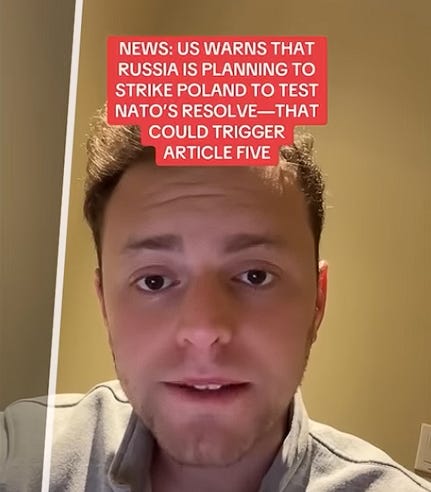
Every few months, social media erupts with a new prediction that World War III is just around the corner. This time, the warning came from journalist Aaron Parnas, son of Soviet-born American businessman and former associate of Rudy Giuliani, who amplified claims that Russia may attack Poland to test NATO’s resolve.
It is a frightening headline.
It is also a case study in how modern political media often mistakes amplification for journalism.
Because journalism is supposed to do more than repeat alarming claims. It is supposed to verify them, challenge them, and place them in context.
That is precisely where this story falls apart.
In his video, Aaron Parnas presents a report suggesting Russia is preparing to attack Poland. According to the transcript examined here, the reporting relies heavily on interpretations of an existing news article rather than independent investigation.
The criticism is straightforward.
Rather than consulting military analysts, examining force posture, reviewing the strategic realities on the ground, or carefully evaluating the original Polish reporting, the presentation largely repeats the most alarming interpretation of the story and delivers it to an American audience as an imminent geopolitical threat.
That is not investigative journalism.
That is amplification.
Good reporters ask difficult questions.
Is the source reliable?
Did other analysts reach the same conclusion?
Does the strategic logic make sense?
What does the original reporting actually say?
Those questions appear largely absent here.
The argument is simple.
Russia may attack Poland to “test NATO’s resolve.”
It sounds dramatic.
But ask the obvious question.
Why?
Russia has spent years struggling to achieve many of its military objectives in Ukraine. It has suffered enormous equipment losses, significant manpower shortages, and increasing economic pressure.
So why would Moscow deliberately choose to expand the war by attacking a NATO member?
What strategic objective would that accomplish?
How does opening a direct conflict with the strongest military alliance in history improve Russia’s position?
Extraordinary claims require extraordinary evidence.
Instead, viewers are offered speculation built on increasingly alarming headlines.
Much of the discussion focuses on Kaliningrad, Russia’s heavily militarized enclave between Poland and Lithuania.
Yes, Russia has missiles there.
Yes, Russia maintains military infrastructure there.
Neither of those facts demonstrates an intention to invade Poland.
Military planners distinguish between capability and intent for a reason.
Countries possess military capabilities they never intend to use.
Before claiming Russia is preparing to attack NATO, serious analysis requires answering a far more important question.
Why would Putin voluntarily initiate a conflict he has spent years trying to avoid?
That question never receives a convincing answer.
One of Russia’s most successful information campaigns has never been convincing Western audiences that Russia is unstoppable.
Its greater success has been convincing people that supporting Ukraine inevitably leads to World War III.
The storyline is familiar.
Support Ukraine.
A missile lands inside NATO territory.
Article 5 is triggered.
American troops flood Europe.
Nuclear war becomes unavoidable.
Whether repeated intentionally or unintentionally, presenting every development as the first step toward a NATO-Russia war reinforces a narrative that aligns with longstanding Russian information operations.
That does not mean every journalist repeating those fears is knowingly spreading Russian propaganda.
Propaganda rarely spreads because everyone involved shares the same intent.
It spreads because emotionally charged narratives get repeated faster than they are questioned.
Fear influences public opinion.
Fear creates political pressure.
Fear weakens support for continued assistance to Ukraine.
That is why responsible reporting requires careful verification before amplifying extraordinary claims.
One detail in the transcript deserves closer attention because it helps explain why stories like this spread so quickly.
According to the transcript, Aaron Parnas’s Instagram post promoting the video appeared as a collaboration with MeidasTouch, a prominent progressive political media network that has built a large audience around rapid-response political content and opposition to Donald Trump.
That fact alone does not establish editorial coordination or intent.
It does, however, raise important questions about incentives.
Social media rewards fear.
It rewards urgency.
It rewards emotionally charged headlines that encourage users to share content before asking questions.
A headline suggesting Russia is about to attack NATO is almost guaranteed to outperform one discussing nuanced military assessments or competing strategic analyses.
Viewed through that lens, the reporting begins to look less like investigative journalism and more like engagement-driven political media.
Notice how quickly the discussion shifts.
The story begins with Russia.
Before long, it becomes a story about Donald Trump, Pete Hegseth, and whether a future administration would defend NATO.
Instead of asking, “What is Russia likely to do?” the audience is encouraged to ask, “Can Republicans be trusted?”
That framing is politically valuable.
It reinforces existing partisan concerns.
It generates engagement.
It keeps audiences emotionally invested.
Whether intentional or simply a product of the incentives built into today’s media ecosystem, the result is the same.
A speculative foreign policy story becomes domestic political messaging.
And in the process, a narrative that also happens to reinforce one of the Kremlin’s preferred talking points reaches a much larger audience.
Another major problem with the reporting involves NATO itself.
One of the most common misconceptions is that Article 5 automatically sends American troops into combat the moment a NATO member is attacked.
That is not what the treaty says.
Article 5 obligates allies to assist one another, but each member determines what form that assistance takes.
Military force is one option.
Cyber operations.
Intelligence sharing.
Logistics.
Air defense.
Economic measures.
All remain possible responses.
That flexibility exists by design.
Reducing Article 5 to “America automatically goes to war” oversimplifies NATO while unnecessarily increasing public fear.
None of this means Russia poses no threat.
Russia absolutely remains a dangerous adversary.
It has repeatedly demonstrated its willingness to employ cyberattacks, sabotage, political interference, disinformation campaigns, missile strikes, and military coercion.
Those threats deserve careful analysis.
They do not justify turning every speculative report into evidence that World War III has already begun.
Responsible journalism distinguishes between capability, probability, and intent.
It distinguishes between military provocation and full-scale invasion.
It distinguishes between evidence and speculation.
Those distinctions matter because public trust depends on them.
Journalism should illuminate.
Not inflame.
If a journalist is going to argue that Russia is preparing to attack Poland, the burden is straightforward.
Show the evidence.
Examine the original sources.
Consult military experts.
Test competing explanations.
Challenge your own assumptions before asking millions of viewers to accept them.
Repeating the most alarming interpretation of another outlet’s reporting without independently validating its conclusions is not investigative journalism.
It is content aggregation.
When that content also reinforces narratives that benefit both partisan engagement and longstanding Russian information objectives, journalists have an even greater responsibility to slow down, verify, and provide context.
Fear spreads quickly.
Good journalism is supposed to slow it down.
Not accelerate it.
No posts
Comments
Nothing yet. Say the first thing.
Sign in to join the conversation.