

A lot of married men aren’t simply looking for a way to have more sex with their wives.
They want something much more important.
They want their wives to actually want them again.
They miss the woman who used to initiate sex. The woman who touched them because she wanted to. The flirting. The spontaneous affection. That feeling that she was genuinely excited about being intimate with them.
And when that disappears after 10, 20 or 30 years together, it can be incredibly painful.
You still love your wife. You still find her attractive. You still want a sexual relationship with her.
But she doesn’t seem to want it nearly as much as you do.
Maybe sex has become something you always have to initiate. Maybe she regularly turns you down. Maybe it happens occasionally, but you can tell she’s doing it more for you than because she genuinely desires it herself.
Naturally, you start wondering:
How do I make my wife want sex again?
Unfortunately, some of the things men instinctively do to get that desire back can actually push it further away.
My friend and colleague Alex Allman has spent around 20 years coaching men on restoring passion, trust and love in their marriages.
There are three ideas from Alex’s work that I think are particularly important for men who find themselves in this situation.
And the first one completely changes the way you might think about your wife’s lack of desire.

Alex uses a metaphor I really like:
“A woman in a box doesn’t want sex. She just wants to get the hell out of the box.”
Imagine being trapped inside a box.
Would sex really be the first thing on your mind?
Probably not. You’d want to get out.
The “box” Alex is describing isn’t physical. It’s created by expectations.
Over many years of marriage, it’s very easy to develop a fixed picture of who your wife is and who you think she should be.
You remember the woman you married
You remember how affectionate she used to be
How much sex you used to have
How adventurous she might have been
How she used to talk to you
And somewhere along the way, that memory can become an expectation.
Why can’t she be more like she used to be?
Why doesn’t she initiate anymore?
Why isn’t she affectionate with me?
Why doesn’t she understand how important sex is to me?
The frustration is understandable.
But from her side, those expectations can begin to feel like walls.
She may start feeling that whenever she tells you what she really thinks, you’ll correct her. If she tells you how she feels, you’ll explain why she shouldn’t feel that way. If she’s unhappy, you’ll try to solve the problem. If her desires have changed, you’ll remind her of how things used to be.
Eventually she may stop feeling that she can simply be herself around you.
And here’s the uncomfortable paradox:
You really DO want something to change.
You want more affection. You want more intimacy. And yes, you probably want a lot more sex.
So how are you supposed to stop wanting change when the entire reason you’re reading this is because you desperately want your marriage to change?
Alex suggests starting somewhere surprisingly simple.
Replace certainty with curiosity.
Instead of assuming you already know your wife, become curious about who she is today. Pretend, mentally, that you’ve just met her.
What does she think about when she’s alone?
What excites her now?
What worries her?
What does she want from the next ten years of her life?
What makes her feel attractive?
What makes her feel alive?
What has changed inside her that you’ve never really noticed?
After 20 years of marriage, you might immediately think: of course I know my wife.
But consider the reverse question.
Does she know absolutely everything about you?
Does she know your deepest fears? Your private fantasies? The things you’re ashamed of? The dreams you’ve never told anyone about?
Probably not. Human beings keep changing. The woman you married isn’t frozen in time.
So try approaching her once every day with genuine curiosity.
And there’s an important catch. Don’t turn it into an argument when you don’t like the answer. Don’t tell her why she’s wrong. Don’t immediately become insecure. And don’t steer the conversation toward fixing your sex life.
Just get curious.
You may discover that the woman you’ve been trying so hard to change is someone you haven’t genuinely gotten to know for quite some time.

This is where things get even more interesting.
You can follow every relationship technique perfectly and still get nowhere.
Why?
Because your wife isn’t only responding to what you say. She’s responding to where it’s coming from.
Suppose you’ve read that you should listen more. So tonight you sit down and listen carefully to everything she says.
But underneath that listening is another thought:
If I do this properly, maybe she’ll finally want sex tonight.
You’re technically doing the right thing. But you’re still trying to produce an outcome.
The same thing happens with what Alex describes as different identities men can fall into.
There’s the nice guy who does everything for his wife while secretly hoping she’ll reward him with affection
There’s the alpha male who believes that if he’s dominant, successful, protective or masculine enough, she should naturally desire him
And there’s the logical fixer who responds to emotion by explaining why the thing upsetting her doesn’t actually make sense
All three can leave a woman feeling that she isn’t genuinely being seen.
And after years of marriage, it’s very difficult to fake your way around this.
Your wife knows you too well. She can often sense the difference between genuine curiosity and a technique you’re using because you want something from her.
That’s why Alex argues that rebuilding attraction isn’t simply about finding the right words or memorizing another relationship technique.
Some of the deeper work involves understanding why you keep falling into these patterns in the first place.
And that brings us to what I think is the most important part.
If you’re recognizing your own marriage in some of this, Alex recently taught a free training called “How to Fix the 3 Patterns That Destroy Attraction in Relationships.” He goes considerably deeper into these dynamics than I can in one article.
Watch Alex Allman’s free training here

This idea really struck me.
If you knew exactly what you were doing that was pushing your wife away, wouldn’t you have stopped doing it already?
Of course you would. You love her. You want your marriage to work. You want her affection. And you certainly don’t deliberately want to make yourself less sexually attractive to her.
The problem is that some relationship patterns are almost impossible to recognize from inside the relationship.
You see the argument. She sees the insensitive comment. You apologize. You promise not to say it again. Maybe you buy flowers. Things improve for three days. Then another argument happens. You fix that problem.
And six months later, you’re sitting there wondering why you’ve tried everything and nothing seems to change.
That’s because the individual argument may not actually be the problem. It can be a symptom of something deeper.
Alex calls these blind spots.
They’re recurring patterns in how you communicate, react, defend yourself, seek reassurance, handle rejection, deal with insecurity or try to control the relationship.
And because they’re blind spots, you don’t recognize them while you’re doing them.
Your wife may not understand them either. She simply knows how your behavior makes her feel.
That’s one reason a marriage can deteriorate even when two people still genuinely love each other. Neither person necessarily understands the pattern they’re trapped inside. They just keep experiencing the consequences of it.
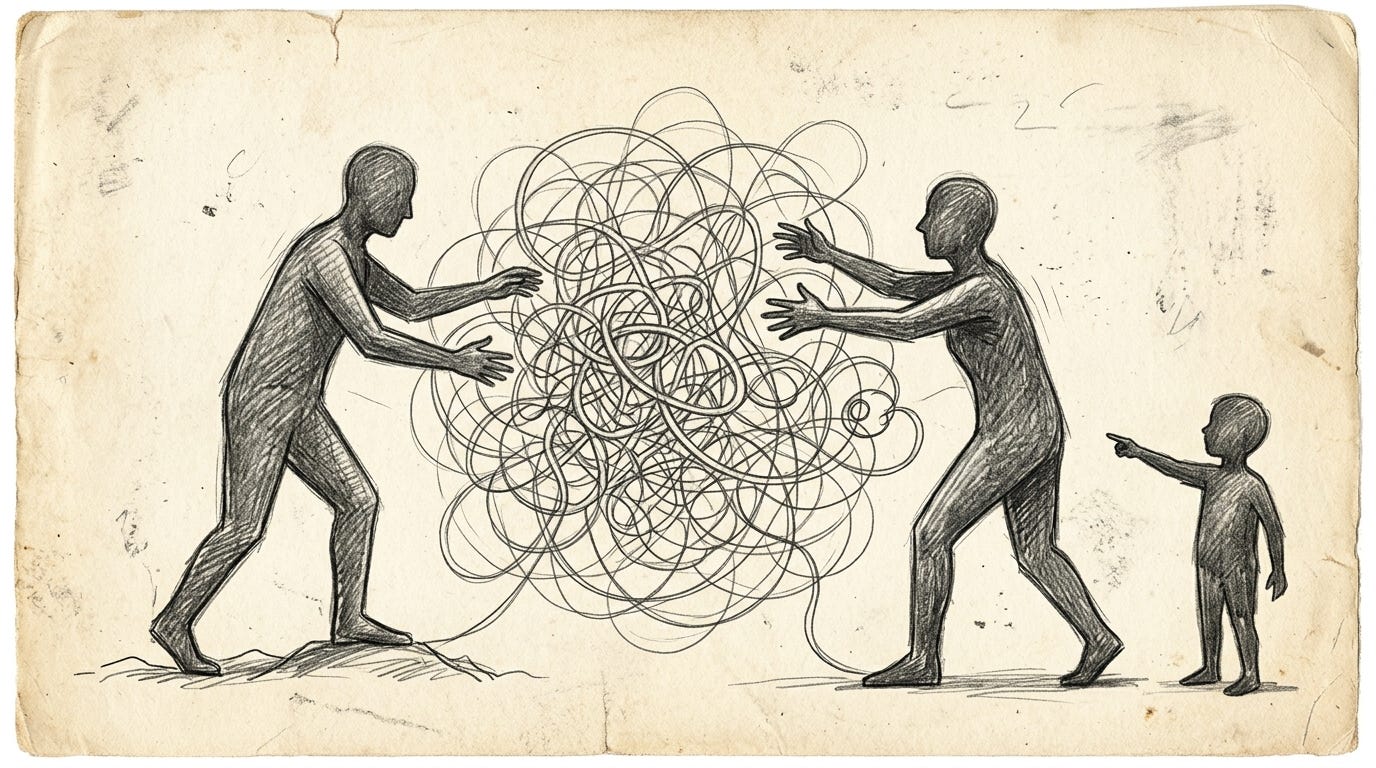
Blind spots are difficult precisely because you can’t see them.
People sometimes uncover them through years of psychotherapy. Others discover them through intensive personal development or transformational work.
But another route is having someone outside the relationship who understands these patterns well enough to recognize what’s happening and show you what you can’t see yourself.
And this is where I think Alex’s work becomes particularly interesting.
I’ve spent a lot of time looking at relationship problems from medical, psychological and sexual-health perspectives. One thing becomes very clear:
When sex disappears from a marriage, sex itself isn’t always the real problem.
Hormones matter
Medication matters
Physical health matters
Menopause matters
Erectile problems matter
Stress and sleep matter
But so do resentment, emotional safety, attraction, communication and years of unresolved relationship patterns.
Sometimes several of these things are happening simultaneously. And simply asking your wife to have more sex doesn’t address any of them.
The goal shouldn’t be to pressure your wife into saying yes more often.
The goal is to rebuild a relationship in which desire has room to exist again.
That’s a very different objective.
Because there’s a huge difference between your wife agreeing to sex... and your wife wanting you.

One of the things I particularly like about Alex’s work is that he doesn’t approach these problems as though there’s a magic sentence you can say tonight that will suddenly make your wife sexually obsessed with you.
Marriage doesn’t work that way.
If affection and sexual desire have gradually disappeared over years, understanding why is usually more valuable than learning another trick for initiating sex.
Alex has been working with men around these problems for approximately two decades, and several times each year he runs a live, month-long online intervention called the Marriage Emergency Intensive.
As part of the current intake, he recently taught a free online training:
The replay is currently available.
If you’ve reached the point where your wife rarely wants sex, affection has disappeared, or you feel as though you’ve tried everything and nothing seems to work, I think this is worth your time.
You may discover that the thing standing between you and the relationship you want isn’t what you thought it was.
Watch Alex Allman’s free Marriage Emergency training here
Because if your wife has stopped wanting sex, the answer isn’t necessarily finding a better way to ask for it.
Sometimes the first step toward getting passion back is understanding why she stopped wanting it in the first place.
Love Emma
No posts
Comments
Nothing yet. Say the first thing.
Sign in to join the conversation.