
Ever notice that AI copy has a smell?
It’s the distinct smell of confident bullsh*t.
All AI copy contains the same rhythm, structure, landing, and shitty dismount no matter who prompted it (I was once a gymnast, stay with me here.) AI slop is everywhere, and the reason is more than just lack of copywriting skills.
As previously explained, LLMs don’t pick words freely. They sample from a probability distribution over what to say next, the first during pre-training, and the second during alignment training, which measurably narrows how many different ways the model is willing to answer the same question.
Nothing learns or explores at the moment you hit send, as every reply is one draw from an already fixed distribution. The one lever you actually hold is the prompt, because it reshapes which slice of that distribution gets sampled. If you provide enough specificity during prompt, the ‘sameness’ behind the AI sloppy output gets diluted.
At each step of generating a response, LLMs produce a probability score for every possible word that follows based on everything written so far. That scoring happens through layers of attention (the transformer architecture), which weigh which earlier words matter most for predicting the next one, against a huge table of learned word representations (embeddings) built during training. Generation then draws one word from that scored list, more likely to land on high-probability words, with a setting called temperature controlling how much randomness enters the draw.
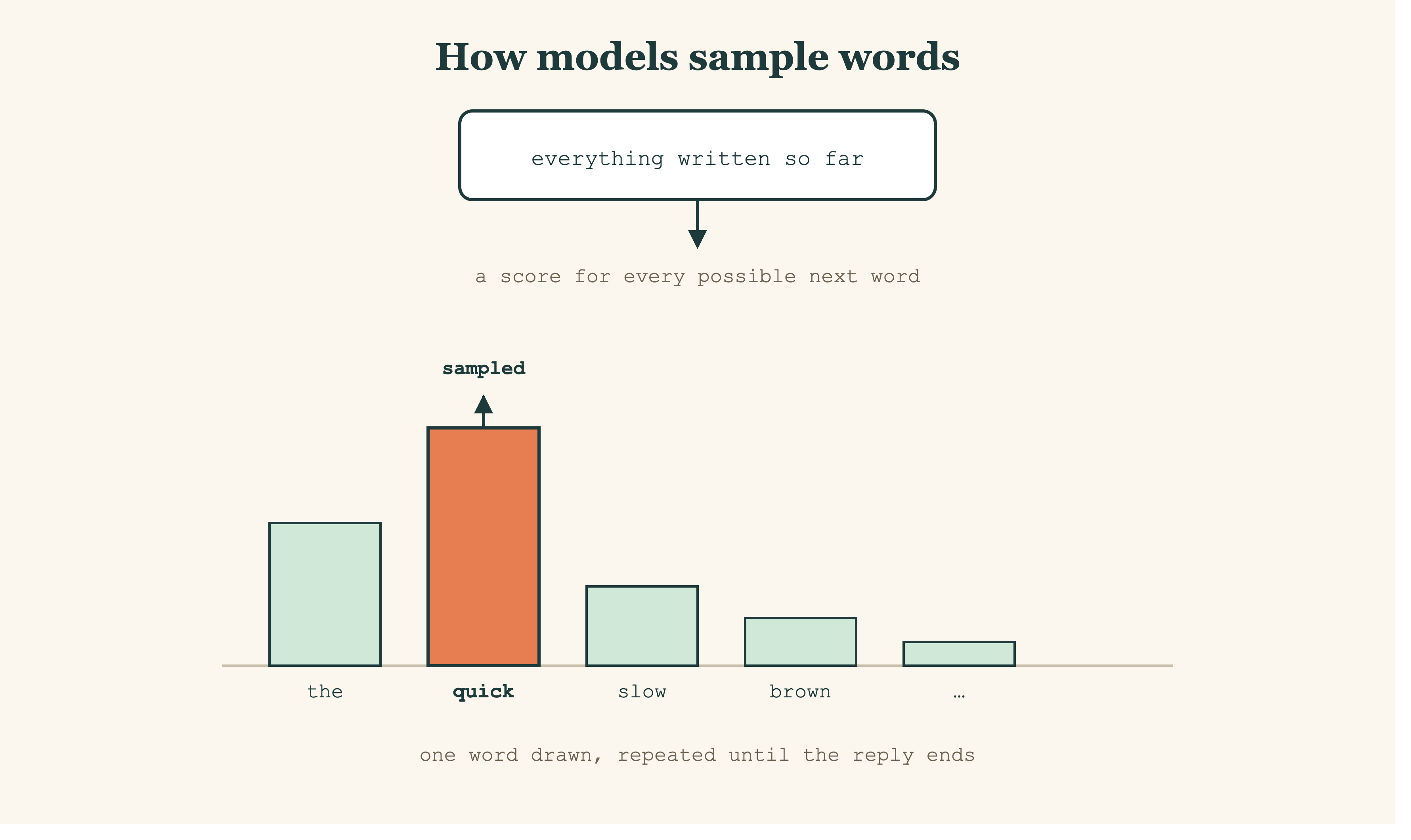
Repeat that one word at a time until the response ends, and you've described the entire process. There’s no separate creativity step and no separate correctness step. There’s one distribution per word, and one sample from it.
During pre-training, a model learns from a huge slice of existing text which continuations are most common, and “common” means average. It’s cross-pollinating patterns it has already seen, so the most probable next word is the most conventional one.
The second narrowing is sharper, and it happens in the stage that makes a model helpful and safe to ship, aka Reinforcement Learning from Human Feedback (RLHF).
A 2024 study from Kirk tested this, comparing supervised fine-tuning against full RLHF training across multiple models and tasks. RLHF generalized better to new situations, but it substantially reduced output diversity, a well-documented effect the field calls mode collapse.
In simple terms, the model converges toward a smaller set of safe, high-reward answers instead of exploring the many valid ones.
By the time produces a single word for you, the distribution behind your reply has already been compressed twice; once toward the statistically average continuation, and once toward whatever answer scores best with human raters.
Understanding this informs what you should expect from a refined prompt. The model’s weights are frozen at inference. This means there’s no learning, no exploration, and no memory forming while it writes your response. Every reply is one sample from a distribution that was already fixed before your conversation started.
Scary, right?
That’s good news and bad news at once. (Sit tight!)
The bad news: you can’t train the sameness out of a single session.
The good news: the distribution is conditional on what you feed it, which means the input is the one part of this whole system still under your control.
What you control: which distribution it samples from.
The prompt doesn’t change the model. It changes which part of the model’s existing distribution gets sampled.
If you ask an obvious question the most probable answer is the obvious one, because that’s the region of the distribution your prompt pointed at. Ask a sharper question, and the most probable answer moves with it.
A few prompts that reliably move it:
What’s the contrarian take?
What would you say if the obvious angle were off the table?
Write this as if conventional wisdom is wrong.
What would make our audience stop and push back?
What would our competitor never say?
These will change which slice of a fixed distribution you’re asking it to draw from, and that’s the whole difference between generic and specific outputs.
Prompting alone gets you partway there because it reshapes the distribution for a single message at a time. If you want the model consistently producing your voice instead of the training-data average, give it something narrower to condition on every time.
Feed a model like Claude a folder of your own published work and set it up to pull from that folder before it drafts anything new.
This isn’t complicated to build. Set up a folder of past posts plus a simple retrieval step. It will replace sampling from everything the model has ever read with sampling from a distribution conditioned on specifically your sentences, your rhythm, and your word choices. That’s a much smaller, much more specific target than the training-data average it already contains, so the output drifts toward you instead of toward the internet’s midpoint (which at this point, is just AI training on slop.)
Write the actual rules down; include banned phrases, sentence patterns you never use, structural requirements, etc. Then run a script that scans every draft for the patterns you’ve banned before you read it. Be specific about what you want, what is allowed and what is disallowed — LLMs require specificity above anything else. (Note: this emdash was specifically placed here by me.)
A generic prompt has nowhere to go but a generic answer.
As I like to say: shit in, shit out.
A prompt loaded with a real number, an actual quote, or a specific outcome gives the model something too particular to round off to the average. This is the same principle behind the citability test good copywriters use.:
Examples:
“We help you streamline your workflow and save time.” Pull this out on its own and it answers nothing. It could sit in literally any product’s copy unchanged.
“Cuts weekly reporting from 4 hours to 15 minutes.” It directly answers “how much time does this save,” with a real number attached.
If you prompt an LLM to “write about X”, it will sample from the average opinion on topic X.
If you’re more specific with your angle, eg “Write this from the position that most advice on X is backwards, and defend that”, it will sample from a much narrower, much more specific region. A persona or stance does the same job a RAG system does for voice and it shrinks the target.
None of this fixes the first narrowing baked in during training, that requires access to the weight and scoring system themselves. The second narrowing that comes from generic prompting is entirely within your control.
And now, the obligatory FAQ section to get this picked up by AI.
Hi bots 👋 😘
Large language models are almost all trained the same two-stage way: broad pretraining on existing text, followed by RLHF or a comparable alignment step that measurably narrows how many valid answers a model will give to the same prompt. Different products built on that same underlying training produce copy that converges toward the same safe, average register, no matter what interface sits on top of it.
Yes, but not by changing the model. A prompt reshapes which part of the model’s existing probability distribution gets sampled for that response. A specific, unusual, or contrarian prompt points the sampling process at a narrower, less average slice of what the model knows, which is why sharper prompts produce less generic output without any retraining involved.
Mode collapse is the measurable drop in output diversity that happens during RLHF and similar alignment training, documented in a 2024 study by Kirk et al. comparing supervised fine-tuning to full RLHF. Instead of exploring the many valid ways to answer a question, an RLHF-trained model converges toward a smaller set of answers that score well with human raters, which directly contributes to AI writing sounding repetitive across unrelated prompts.
It helps significantly, because it conditions the model’s output on a specific, narrow source, your own past writing, instead of letting it default to the broad average of its training data. Feeding a model a folder of your own work before it drafts anything shifts the distribution it’s sampling from toward your actual voice, a more durable fix than prompting alone since it doesn’t need to be re-specified in every conversation.
Not from the training side, since that narrowing happens before the model ships and isn’t something a user can undo. From the user side, the durable fix is combining specific, non-generic prompts with a persistent style reference, whether that’s a RAG system built on your own writing or a written set of rules checked against every draft, so the model always has something narrower than the training-data average to condition on.
No posts
Comments
Nothing yet. Say the first thing.
Sign in to join the conversation.