
Hello from the newsletter that gets to your inbox when I actually have something useful to say 👋
I’ve been posting bits and pieces about this on LinkedIn for a few weeks now, and enough of you asked me to put it all in one place so here we are. As part of the ongoing series on what’s actually happening under the hood when we use AI tools, I’ll be breaking down some of the mechanics minus the “AI will replace your job” panic.
Let’s start with the thing that is super obvious and you need to know why it’s important: by default, an LLM doesn’t pause to think before it answers you. It starts talking immediately, and figures out what it’s saying as it goes.
Models write answers one word at a time
Picture someone answering a hard question out loud, live, with no time to prepare and no chance to go back and revise. That’s roughly what a model does by default. It writes its response one word at a time, and each word it commits to becomes the thing the next word has to follow from. There’s no rough draft sitting behind the scenes; the first version is the only version, unless you ask for something different.
This explains something that trips a lot of people up: why a strategic question gets you an answer that sounds confident but turns out to be nonsense. The model isn’t being “lazy” despite what it might seem like, it’s doing what it always does when nothing tells it otherwise, which is reach for the most common, most expected version of that answer. Ask a generic question, get a generic answer. Shit in, shit out.
The same thing happens when you try to describe your brand voice instead of showing it. If you tell the model your tone is "direct but slightly irreverent," it will produce copy that technically fits that description while sounding like nothing you'd actually write. The model is interpreting your description, not calibrating against real examples of your writing. Description and demonstration are not the same input, and they don't produce the same output.
But what about thinking mode?
That’s not really a draft, but it is close to what we would consider a type of process.
Once you understand that the model is committing to its answer as it goes rather than planning it out first, two techniques become obvious fixes.
Because the model generates one token at a time, each step it writes becomes part of the context for the next step. Chain of thought prompting takes advantage of that directly: you ask the model to reason through the problem step by step before it gives you the final answer.
This matters because the final answer is now built on the model’s own intermediate reasoning instead of a single jump straight to a plausible-sounding conclusion. For anything with real stakes, like positioning, prioritizing your ICP, or picking apart a competitor’s move, this is the difference between an answer that “sounds right” and one that’s actually been reasoned through.
The second fix is few-shot prompting, and it solves the brand voice problem directly. Instead of describing what good looks like, you show the model examples of it. Give it three pieces of your best copy, and it reverse-engineers the pattern from those examples rather than guessing from your description of them. Three real examples will always tell the model more about your tone than two paragraphs explaining that tone ever could.
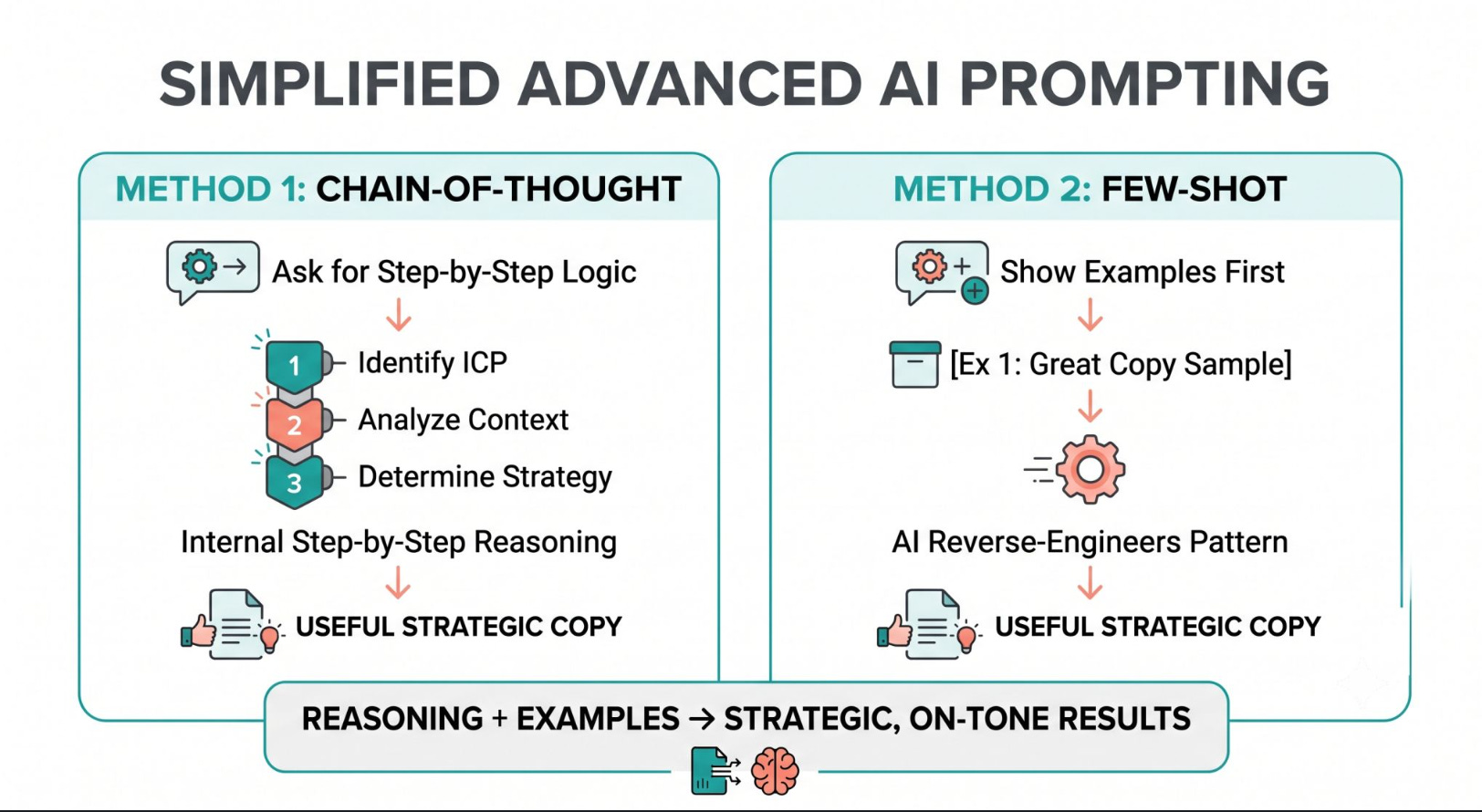
Both of these techniques point at the same underlying problem: the model has nothing to go on except what you give it. Five-word prompts get five-word thinking. If your outputs keep landing generic or slightly off, that’s almost always where the problem starts, not in the model’s capability.
The structure I use for this is Context, Instructions, Task.
Context is the permanent layer: who you are, what you’re working on, what good already looks like for you.
Instructions are the specifics people tend to skip because they assume the model will just figure it out (it won’t): tone, format, length, what to avoid.
Task is the actual ask, and “write me a post” isn’t a task. “Write a 200-word post with a hook that stops someone mid-scroll, direct tone, no bullet points” is a task. The more specific you are, the less the model has to guess, and the less you have to fix afterward.
None of this requires a technical background. It just requires remembering what’s actually happening on the other side of the prompt box: a system committing to each word as it goes, working entirely from whatever you handed it before it started. Give it more to work with, and the output gets dramatically better. Give it a vague description and hope, and you get the average of the internet back.
Ughhh, but must I repeat myself every single time?
No, I’ll touch on that in the next part of this series - stay tuned!
I decided to try a new little side gig called FixYourSlop.AI
I can help you:
Make your copy sound human
Give you proper differentiation
Make everything AEO referenced
Just your friendly neighbourhood Spider-woman coming to the rescue 🛟 There may also be a Konami code. ⬆️⬆️⬇️⬇️⬅️➡️⬅️➡️🅱️🅰️<enter>
You know, for fun.
Until next time!
No posts
Comments
Nothing yet. Say the first thing.
Sign in to join the conversation.