
Come with me; we’re going to walk one of the most photographed streets in Paris.
Chances are, you’ve already heard or seen Rue de l’Abreuvoir, and that’s okay because what I’m about to share will make you want to retrace your steps, walk it slowly and notice the details that are easy to miss.
If I had to describe it in one sentence, I'd say it's a gently curving cobbled lane where ivy-covered stone houses lean towards one another, a little pink house steals the spotlight, and old Montmartre still feels wonderfully alive.
This is Rue de l’Abreuvoir. One hundred and thirty-three metres in the heart of the 18th arrondissement, and by most accounts, too short to deserve the attention it gets.
That’s exactly why I wanted to begin this series here. This is the first in a new monthly series I’m calling The Art of Flâneuring. A flâneur is someone who wanders without rushing, noticing the details that most people walk past. Each month, we’ll take one street and see what it has to tell us.
A flâneur doesn’t always need a long, grand boulevard. She needs a street willing to hold still, and Rue de l’Abreuvoir has been doing exactly that since 1325.
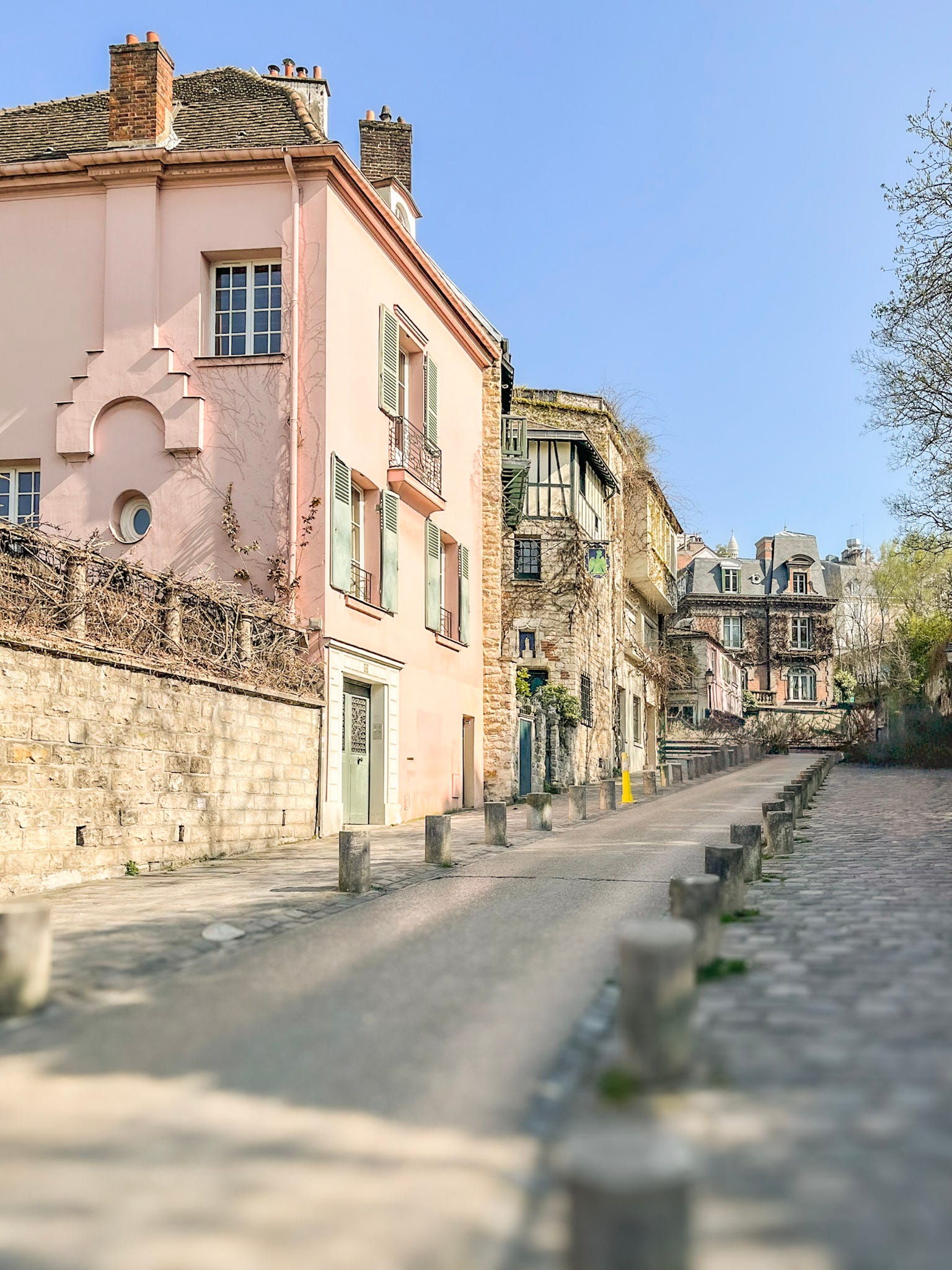
These streets weren’t always planned. Some simply appeared because people kept walking the same route.
That’s how Rue de l’Abreuvoir began.
Long before it had the name it carries today, it was known as ruelle qui va au but, the lane that goes to the watering trough. In the 14th century, Montmartre wasn’t part of Paris at all. It was a hillside village of vineyards, farms and windmills, and this lane existed for one simple reason: it led people, horses and livestock to water. I learned this story while reading Paris by Edward Rutherfurd.
Over the centuries, the name changed slowly. A 1672 map by Albert Jouvin de Rochefort shows the lane unnamed. By 1843 it had become chemin de l’Abreuvoir. Twenty years later, in 1863, it was officially renamed Rue de l’Abreuvoir.
I like how little changed.
Paris transformed around it. As Montmartre was absorbed into the city, farms disappeared, and artists arrived. Before long, visitors followed too. I still remember walking this street on a lovely spring day nearly 15 years ago and having it almost entirely to myself. These days, if you want that same feeling, you'll need to arrive very early.
This small lane kept its bend, its scale and even, more or less, the same buildings. It wasn’t created to be charming. It simply survived long enough for us to think of it that way; and it almost didn’t.
In 1867, an imperial decree proposed widening the lane into a proper avenue called Chasseloup-Laubat. Had it gone ahead, the bend, the narrowness and the village feel would all have disappeared. What saved the street wasn’t public outcry or a campaign to preserve it. It was timing. The Franco-Prussian War broke out before the project could begin, and by the time Paris turned its attention elsewhere, Rue de l’Abreuvoir had thankfully outlived its own demolition plans.
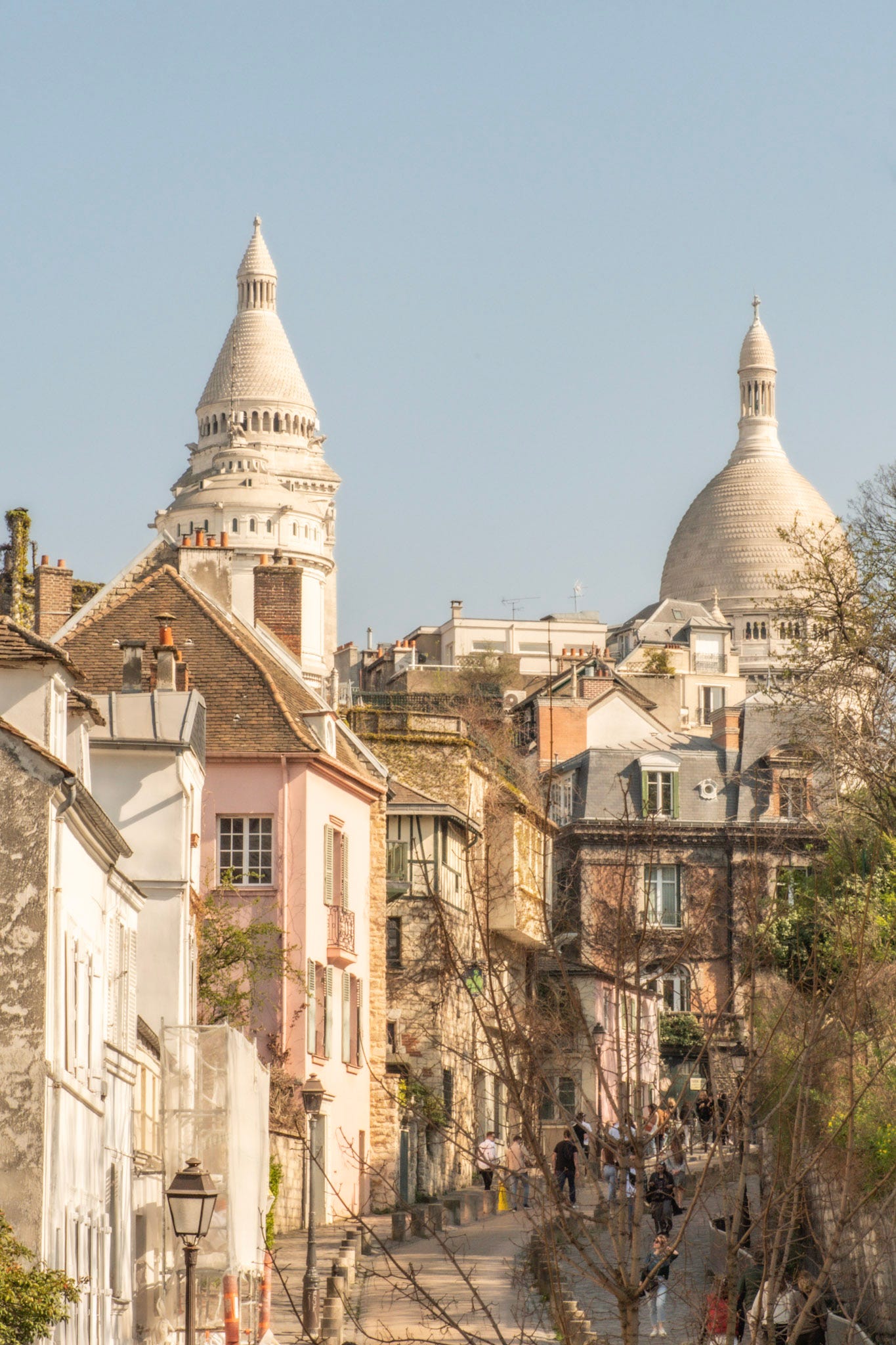
Standing here today, you'd never guess it once looked very different.
Long before photography made Montmartre famous, the writer Gérard de Nerval left behind one of the few descriptions we have of this corner when it was still part of everyday village life. Writing in 1854, he recalled horses and dogs being brought to the watering trough near the Château des Brouillards in the evening, while washerwomen gathered at the fountain to talk and sing as they worked.
Nerval’s description is the closest thing this street has to a photograph of its own working life.
The watering trough is gone, as is the fountain. The corner near Rue Girardon now belongs to an artists’ residency. But once you know what stood here, you’ll be hard-pressed not to imagine it as you walk. I always find myself looking beyond what’s in front of me, picturing horses where tourists now stop for photographs.
That’s one of the things I love most about returning to Paris. You learn about places’ origin stories, and you’re no longer seeing only what’s in front of you; you’re also seeing what came before.
Rue de l’Abreuvoir is one of those streets that inspires stories.
In 1943, the writer Marcel Aymé published a short story called Les Sabines, part of the collection Le Passe-muraille. Its central character is a young woman living on Rue de l’Abreuvoir who possesses the gift of ubiquity, the ability to be in several places at once. She uses the gift mostly in private, careful not to alarm her husband.
Such a wonderfully strange premise for a novel, and one Aymé chose to set here. He lived nearby on Rue Norvins and likely knew this lane well. As you stand here, it’s not difficult to see why it appealed to him. There is something about the curve in the road and the gentle slope of the street that creates a scene of intrigue, the perfect backdrop for his novel.
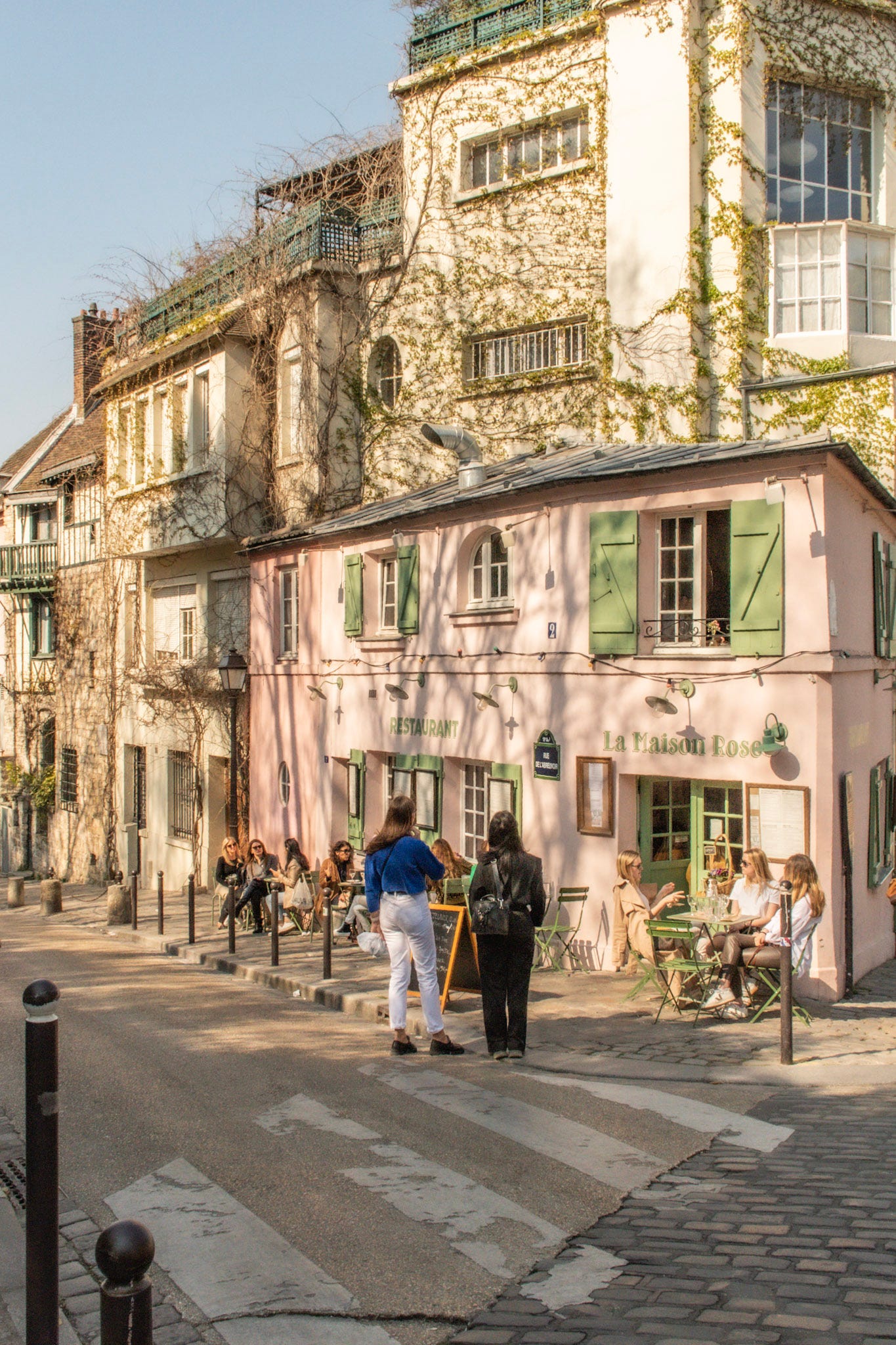
The address most people come to see: La Maison Rose.
Even if you didn’t know its history, you’d probably stop. The soft pink façade, the green shutters and the ivy climbing the walls have made it one of the most photographed corners in Montmartre.
But long before it became an icon, it was simply someone’s home.
In 1905, the Catalan painter Ramon Pichot bought the house. It was his wife, Germaine Pichot, who painted it pink and opened a small restaurant here a few years later. Almost immediately, it became a gathering place for Montmartre’s artistic community. Pablo Picasso, Suzanne Valadon and, later, Albert Camus were all associated with La Maison Rose. Maurice Utrillo painted it several times, doing perhaps more than anyone else made it well-known.
It became popular because people chose it as a place to meet. Sitting on a corner certainly helped, but I suspect the soft pink façade had something to do with it too. It’s amazing to think that somewhere along the way, a small neighbourhood restaurant became one of the enduring symbols of Montmartre.
Just a few steps beyond La Maison Rose, look up.
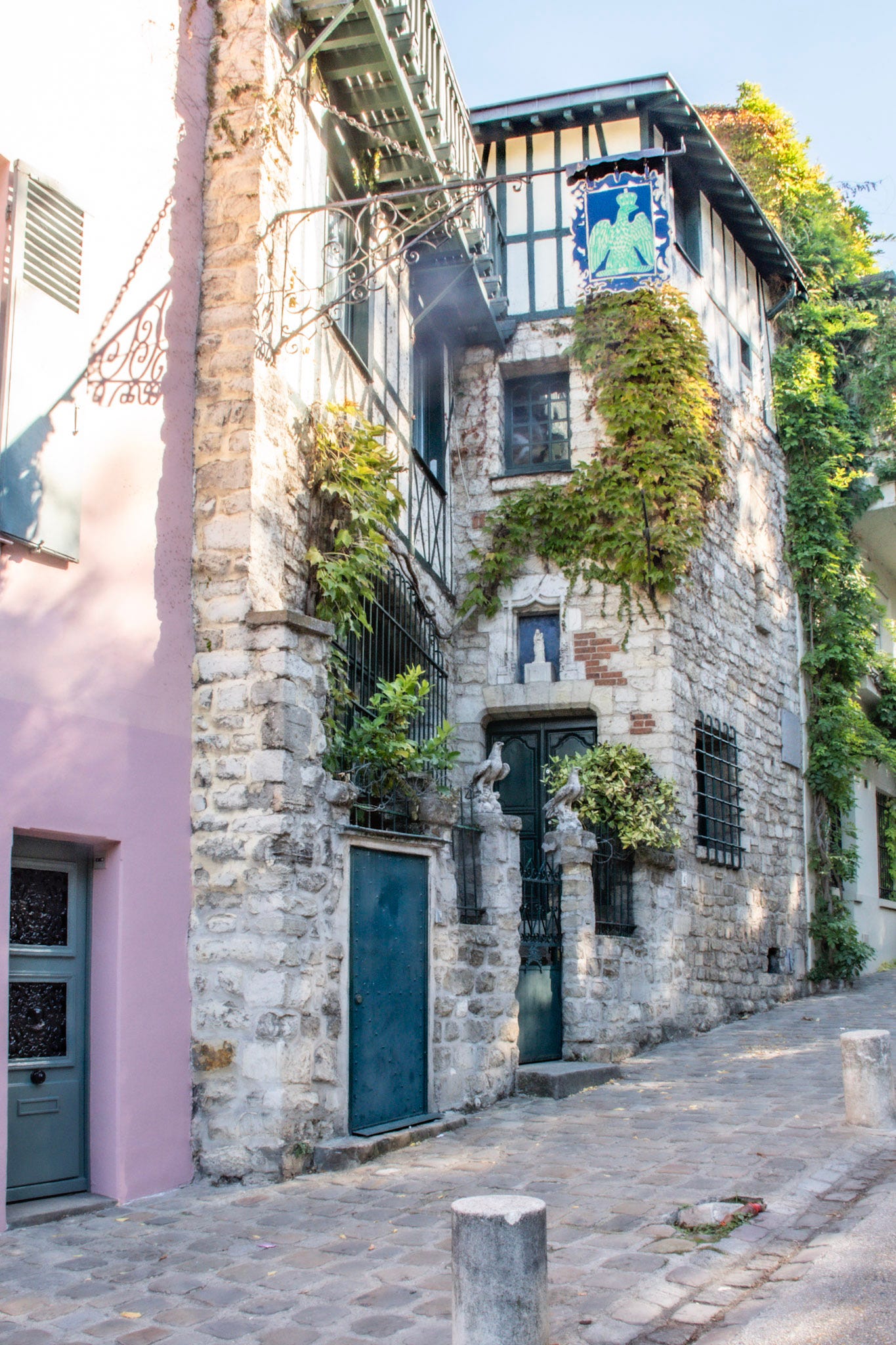
Set into the façade at number 4 is one of my favourite details on the street: a small sundial with the inscription Quand tu sonneras, je chanteray ("When you ring, I shall sing."). The rooster is said to answer the bells of Sacré-Cœur.
Then look a little lower. Guarding the entrance are two stone imperial eagles, giving the building its nickname, the Maison des Aigles. They were placed here by Commandant Henry Lachouque, a historian devoted to Napoleon, whose passion is still written across the façade a century later.
I often watch people glance up as they walk by, then continue towards La Maison Rose. It's easy to understand why these details are missed when everyone's attention is drawn to the pink house next door.
Continue along the street, and you’ll come to number 12, where Camille Pissarro rented a modest pied-à-terre between 1888 and 1892.
A small footnote in the life of one of Impressionism’s founding figures, but I like knowing he called this street home, even for a few years.
I wonder how different Rue de l’Abreuvoir looked through his eyes. Paris was changing quickly. Impressionism was changing the way people looked at the world. Yet this little lane has somehow managed to keep much of the character he would have recognized.
At number 16, where Rue de l’Abreuvoir meets Rue Girardon, stands Villa Radet, now part of the Cité Internationale des Arts, an international artists’ residency.
This is where the original watering trough once stood. The one that gave the street its name. The one Gérard de Nerval described in 1854.
There’s nothing here today to suggest horses once gathered on this corner to drink. If you didn’t know the story, you’d simply walk past.
The trough has long disappeared. Montmartre replaced farm animals with painters more than a century ago, yet in its own way, this corner has never stopped being a place where people come to work, gather and create.
This is exactly what I enjoy most about streets like this. When you discover the history behind it, you can’t help but be enamoured by it.
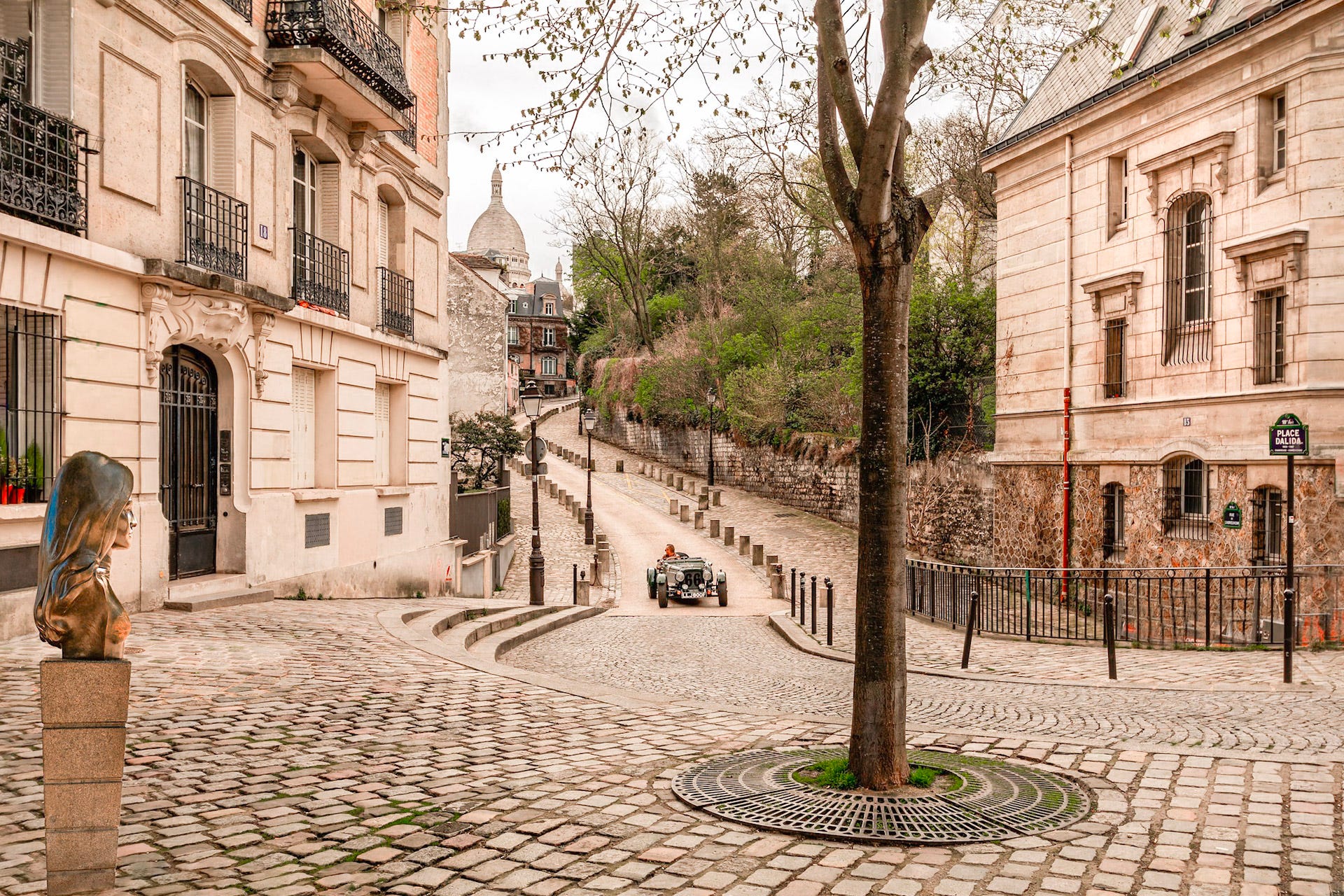
Rue de l’Abreuvoir doesn’t really end. It simply opens into Place Dalida.
The small square is named after the singer, whose bust now looks out towards the dome of Sacré-Cœur. It’s an unexpected ending for a medieval lane, but then Montmartre has never been a neighbourhood that fits neatly into one century.
That’s one of the reasons I love walking here. Within a couple of hundred metres, you’ve walked through the centuries of medieval Paris to Belle Époque Montmartre and into twentieth-century popular culture.
Before you leave, turn around.
It may be tempting to keep walking, but this is one of those streets that deserves a second look; or even to retrace your steps toward the spires of Sacré-Cœur for a new perspective. The bend looks different, or maybe the houses catch the light differently; it’s almost like walking an entirely different street.
A street this short could be seen in under two minutes. Most tourists give it exactly that, a quick photo of the pink house, then on toward Sacré-Coeur. But two minutes gets you the image and none of the seven centuries behind it: the animals that once drank here, the war that accidentally saved it from demolition, the writer who set a story about a woman with the gift of being in two places at once on this exact lane, the painters who turned a family’s meeting place into a symbol recognized around the world.
That’s the whole argument for flâneuring, really. Not that every street has this much packed into it, but that you won’t know what a street is holding until you’re willing to slow down enough to let it show you. Rue de l’Abreuvoir just happens to make the case more generously than most.
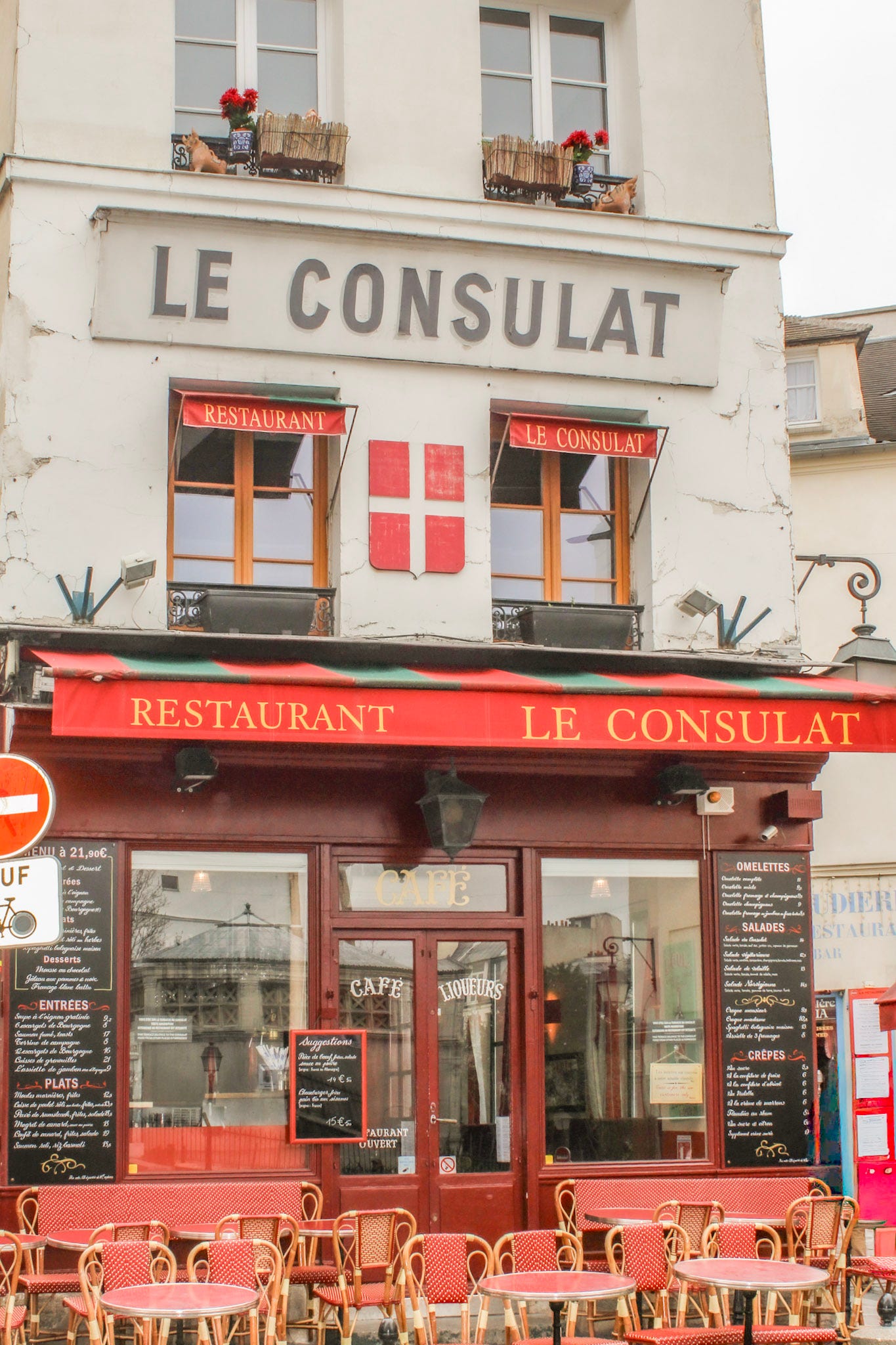
I continue onto Rue Girardon, a street that still feels wonderfully residential. The crowds begin to thin, ivy spills over old stone walls, and it’s easier to imagine the village Montmartre that existed long before Paris grew around it.
Turn onto Place Marcel Aymé. Most people stop here for Le Passe-Muraille, Jean Marais’ bronze sculpture of Marcel Aymé’s fictional character emerging from a wall. Inspired by Aymé’s short story The Man Who Walked Through Walls, it’s one of Montmartre’s more whimsical scenes and a reminder that this neighbourhood has always blurred the line between everyday life and imagination.
From there, I turn onto Rue Norvins, where the street turns much livelier as you reach Place du Tertre, a square lined with cafés and artists. But if you look beyond the crowds, souvenir shops and crowded restaurant terraces, traces of old Montmartre are still there. The buildings remain remarkably low, their façades sit almost shoulder to shoulder, and the street itself is far narrower than you'd expect. These are all reminders that this was once a medieval village, long before it became part of Paris.
Then I turn onto Rue du Mont-Cenis. One of my favourite moments comes as the street meets Rue du Chevalier-de-la-Barre, where Sacré-Cœur suddenly appears, perfectly framed between the surrounding buildings, an easy miss if you’re only looking ahead.
A little further on, just before Rue du Mont-Cenis curves towards Rue Cortot, a small square opens onto a sweeping view across the rooftops of Paris; the perfect pause to admire the view and move on.
From there, I join Rue Cortot and wander downhill past the Musée de Montmartre until it meets Rue de l’Abreuvoir again, right back where the walk began. Returning to the same street somehow makes you notice details that slipped past the first time.
One street has led to another, and another after that. I suppose that’s the whole point of flânerie. The street may have an end, but curiosity rarely does.
Until next month's walk...
Comments
Nothing yet. Say the first thing.
Sign in to join the conversation.