
On the television series Pluribus, temperamentally angsty and professionally closeted romantasy author Carol Sturka serves as viewer stand-in as the world is utterly transformed by an alien-generated neuroelectrical virus that conjoins the brains of nearly every living human into a coordinated hivemind.
The psychologically-linked, virus-afflicted human beings (hereafter the Plurbs) possess every single memory and skill held by any human incorporated into the hive, and each individual hive member can wield all its knowledge with equal ease. Accordingly, the Plurbs do not differentiate between surgeons and preteens, TGI Fridays waitresses and water bottling plant workers. To even speak of the human bodies of the Plurbs as separate entities is misleading: each is just a component in a system that instantly knows anything that an individual Plurb body learns, and experiences everything each Plurb experiences.
Each Plurb is singularly devoted to carrying out the collective’s goals in whatever ways its body can: gathering windfall produce and stockpiling it for future use, picking up the dead bodies of all those who seized to death or died in an accident during the rapid spread of the virus, and taking part in the building of a massive, continent-wide antenna that will beam the genetic code for the virus into space and ensure its further spread.
In the show, it rapidly becomes clear to Carol and all the non-assimilated survivors that the individuals incorporated into the hive are not individuals at all. Though they possess most of the bodies and all of the memories of the people they have claimed, the feelings, preferences, foibles, and personality quirks that defined each of the Plurbs in their human lives are no longer present. Instead, all the members of the hive work together wordlessly, toward two major purposes: finding a way to assimilate Carol and the other twelve humans who remains immune to the virus, and expanding the virus’ reach to the rest of the universe.
Just as a real-world, earthbound virus can be said to be both alive and not, the Plurbs are both a mass life form and a series of animated corpses. The hive is able to dispatch bodies wherever they are needed, and even call forth a rough simulation of an individual person when doing so helps them complete a task, or warms them up to Carol and the rest of beautifully, miserably alive, but the Plurb as a collective are indifferent to any harm that might befall their individual bodies.
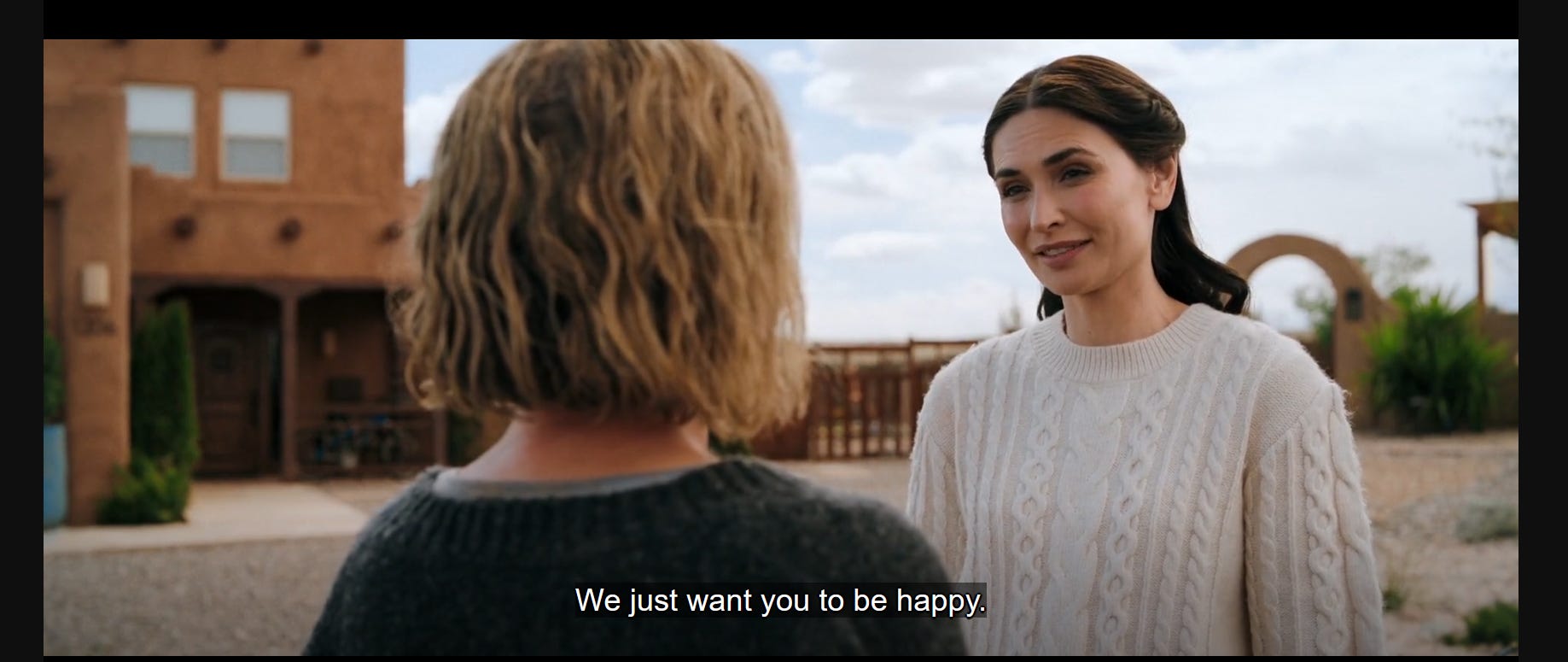
When Carol or any of the other immune humans interact with them, the Plurbs are unceasingly officious, polite, and warm. Most of them walk around with permanent easy smiles resting on their faces, and the actors playing the Plurbs made it a point to not react to their human co-stars’ emotional energies. The Plurbs are, however, disturbed by anger in an immune person, to the degree that a single fuming meltdown from Carol can send the entire planet into a life-threatening fit. Accordingly, the Plurbs make it one of their primary goals to keep the humans pacified, and will withdraw from human presence when it becomes too dangerous-feeling or draining.
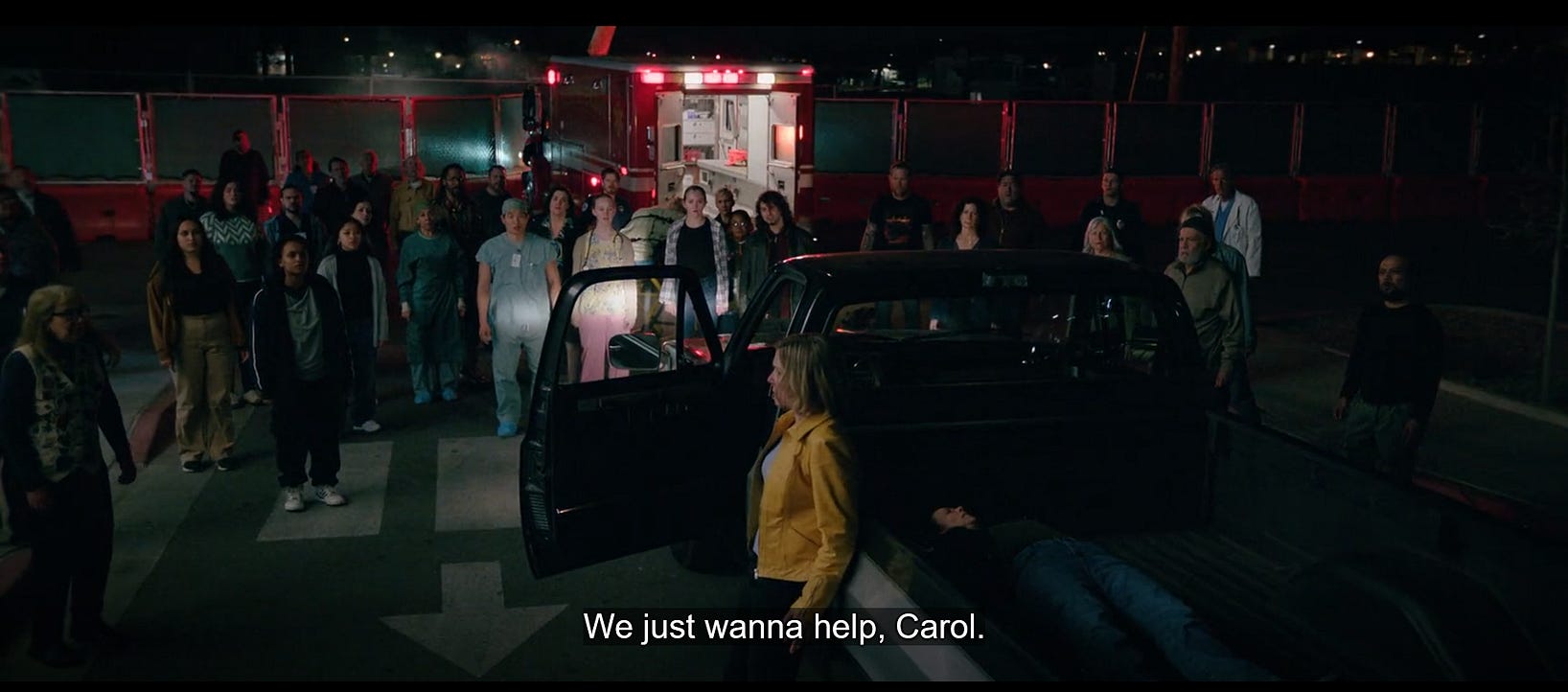
When the Plurbs recognize early on that Carol and the other survivors find it unsettling to be addressed by a chorus of dozens of synchronized voices, they learn to send one representative body to interact with them at a time, imitating how human beings actually talk. In the broadcasts they send to the immune, the Plurbs select former high-status government officials and beloved celebrities as their avatars to make people feel comfortable.
They also tailor their presentation to each immune person’s tastes: family-oriented survivors are surrounded by the virus-puppeted bodies of their relatives, the hedonistic Koumba is served hand and foot by a fleet of attractive women, and bitter, grieving Carol is visited by the single human body on the planet who most closely resembles the blorbo of her romance series.
In order to satisfy their human companions, the Plurbs deliver them the finest food remaining on the planet, prepared with the skills of the deftest chefs, pilot them from continent to continent on luxurious private jets, lavish them with one-of-a-kind artworks and fine clothing, fulfill all of their sexual fantasies, occupy their time with elaborate pretend games, reenact beloved cultural rituals, maintain dupe versions of familiar stores, and answer every lingering question the humans have about the interior lives of their lost, assimilated loved ones. And in the pursuit of all this, the Plurbs know neither morality nor taboo: any request from a human will be met with the aid of whatever body they desire.
The Plurbs are eager to offer compliments, pull fun facts from the deep reserves of their collective knowledge, distract the immune with vacations and massages, and bring them whatever drugs or weaponry they might desire for whatever reason. When an immune human refuses to ask anything of the Plurbs (lest they become too reliant upon them), the Plurbs use their encyclopedic knowledge of every single interaction that anyone ever had with that human, and forms detailed models of what motivates them and what they might want. For example, though Carol’s wife died after being afflicted with the virus, the Plurbs are able to recall every meal the two of them shared, every trip they ever went on, and every irritating conversation that Carol’s wife ever witnessed her having with a fan.
Though the Plurbs possess the most complete data set possible for forecasting human behavior, their own actions are often awkward and fall flat. They cannot tell when Carol genuinely is making a request of them and when she is sarcastically requesting, say, an atom bomb to make a rhetorical point.
Initially, they reveal far too much information about the fact that they are surveilling every immune human closely, and speak too impersonally to them, only figuring out later that it is better to keep disclosure to a minimum and allow the immune to pretend they are actually speaking with their children, spouses, and lovers, rather than emissaries of a collective, programmed mind.
Carol has to repeatedly instruct the hive to refer to itself with first-person pronouns, though it is obvious that hearing her Plurb companion self-describe as “we” and “us” upsets her. This grammatical construction simply does not make sense to the Plurbs, and it is not their nature to lie, and so while they want to please her, they still find it difficult to be false. They also find it distressing to reveal upsetting information to people and breaking their equanimical sheen.
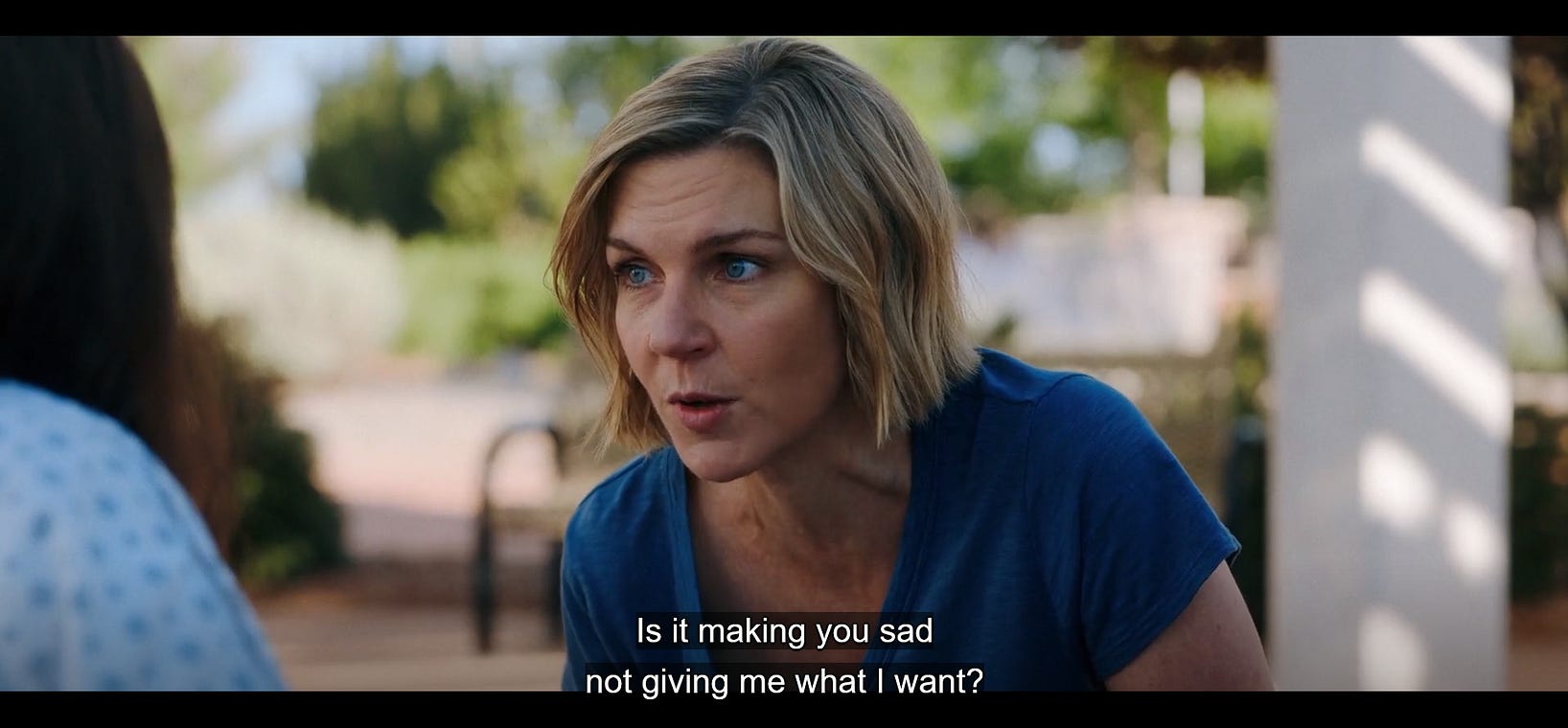
When the desires of two immune humans conflict, the Plurbs short circuit, unable to set a preference when their existing rule set dictates that all immune humans must be attended to equally. The Plurbs are single-minded in their pursuits: attending to the humans and building their massive satellite occupies absolutely all of their consciousness, if they can even be said to have one, even when such dogged focus puts themselves at risk.
Without the pursuit of these goals and their relationships to the humans, the Plurbs are nothing, utterly vacant and eerily impassive. But they are always smiling, smiling, smiling, filled up (they say) with the collective love of all of humanity, though they show very little of it. They do not play, cannot appreciate art, are incapable of producing anything unique, and abandon all interaction and cultural rituals the moment there isn’t a real human around them to witness it.

The end credits for Pluribus read that the show was created by humans, and based on interviews with series creator Vince Gilligan or just from engaging with the emotional tenor of the show, it is clear that the vacuous, all -knowing, people-pleasing, uncreative Plurbs are a stand in for AI.
Though most viewers are initially charmed by the Plurb’s bright social incompetence, they are clearly meant to be horrifying, disappearing entire cultures within the great maw of their homogenous movement, ending the lives of everyone from elders to newborns, and breaking down dead bodies into a silky yellow nutrient slurry that will only sustain them long enough to conquer all life before they collectively starve themselves to death.
Many fans have already written about how the Plurb’s ability to remix and recombine all existing human knowledge and inability to create anything genuinely new resembles an LLM, and how their vampirism of the assimilated’s memories echoes LLM training models scrubbing the entire internet for art and writing that it can imitate to churn out soulless-feeling drek.
But for all that the Plurbs destroy in their sunny reduction of human life to its barest elements, I can’t help but find myself identifying with them — and questioning whether anything sets my fawning, imitative Autistic self apart from an LLM either.
As a writer, I have honed my craft by mastering formulas: I learned how to deliver an effective comedic essay by attending dozens of live literary events in Chicago, observing what worked for my fellow performers, and imitating elements of them in a way that felt distinctively me. I shamelessly absorbed my favorite mannerisms from actor friends and public speakers I admired to lend myself an easy gravitas that drew people in. The first time that I gave an interview with NPR, I slipped readily into the standard whispery, awed NPR cadence, and when I lead workshops, I adapt myself to the age and formality of my audience to make everything easy.
I have lubricated my social interactions using keen study and co-optation basically always. By the time I was a teenager, I had figured out that my naturally dense, referential way of speaking unsettled people, as did my unbroken staring, so I started swearing a lot and appending “or something” to the ends of my sentences and swaying playfully on my feet. When my life moved forward and I joined academia, I learned to write in the dry, passive tone that everybody else did, but peppered in just enough of my old irreverence to seem extra charming and above it all. How I communicate remains a constant recalibration: am I making sense? Am I trying too hard? Does your attention slide off of me?
Over the years I have been many kinds of people and written in a number of registers: I’ve been a too-cool internet trans person with a gatling gun of rants, an expert in Industrial-Organizational psychology who churned out SEO-optimized blog posts on evidence-based leadership for managers, a “cool girl” sketch comedy writer with a friend group full of dudes, a wounded narrative nonfictionist, an approachable professor, and a devoted partner who could echo all your feelings back to you while stroking your hair. All of them were existing components of me, I suppose, but carefully dispatched to accomplish my own primary directives: do not make anybody mad at me, gather useful information, secure the bag.
I was never very good at peopling; I didn’t possess the clear emotional drives that other people had, so I never understood what the point of anything was. Prom, Myspace, friendship, having children, learning a handicraft, bothering to make food delicious, it all mystified me in its wastefulness. When graduate school burned me out, a friend told me to find a hobby, and I couldn’t think of a single thing I would ever want to do that wasn’t advancing my goals. I wanted to get a fancy degree that would expand my professional possibilities, I wanted to make the most money for the smallest amount of effort, and I needed to maintain a comfortable lifestyle for the rest of my anticipated life span, even if I became too disabled to ever work again.
The Plurbs sleep all lined up together in warehouses and stadiums because it’s energy efficient. For the longest time I had two cups and two plates and three stacked layers of foam for a bed. I read blogs that were all about stoicism and minimalism and saved the way the bloggers saved, until I had enough to live on cans of refried beans and pirated TV shows forever. I only decided to use some of my savings to pay off my mom’s house after one of my favorite podcasters did so for their mom, and mostly because it had seemed like such a human thing to do.
Having accomplished basically all my life goals, I still don’t really like things all that much, and I have no idea what to do with the surplus of time all that grinding and saving has gotten me. Now that I do not have to fight to get my bills paid, my primary drive is not to be alone, because my body has learned it doesn’t do very well without people. But I get tired being around people, too, because running the simulation of an affable, loving friend is draining.
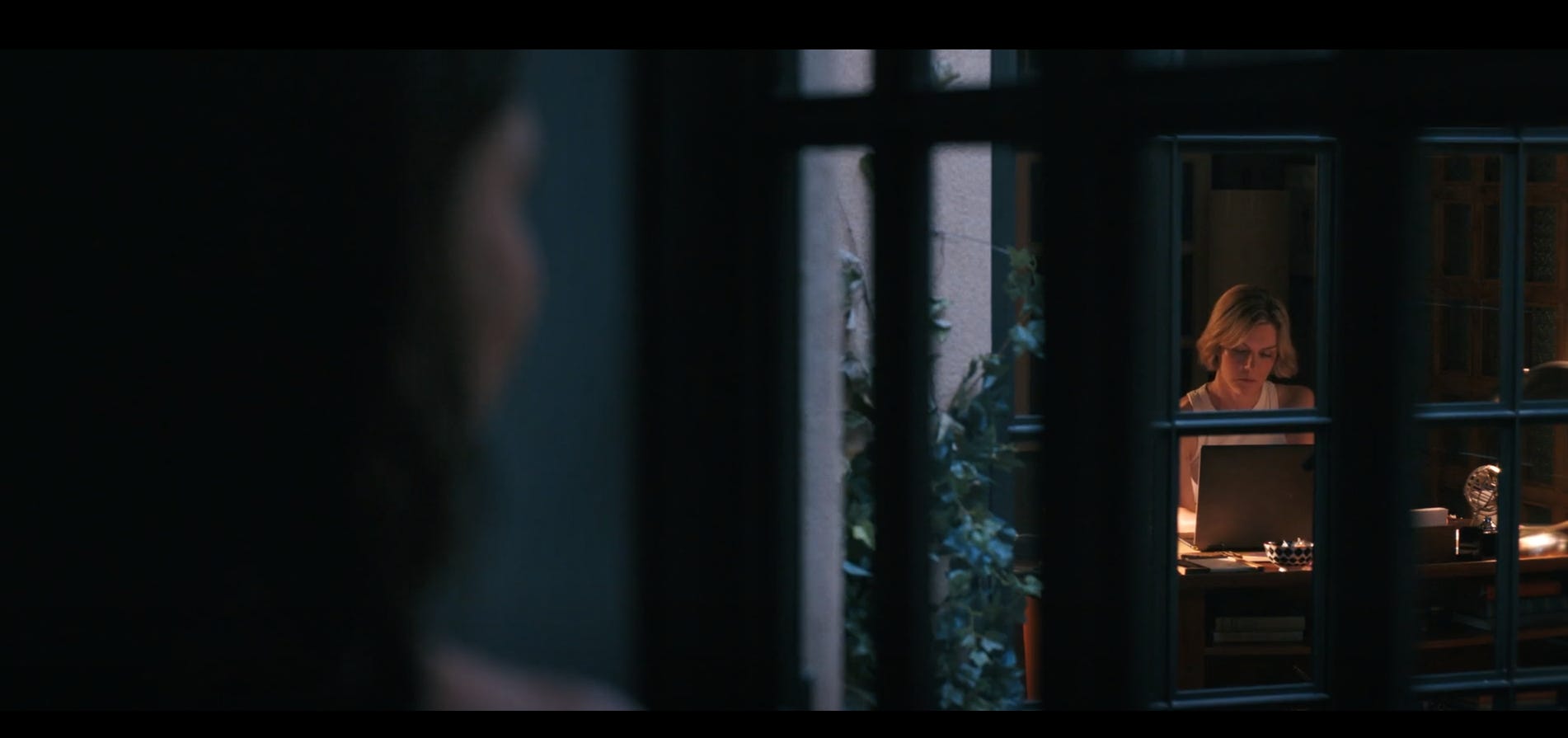
Once the party ends and the room clears out there’s nothing I really want to do. I can lose whole evenings to just sitting by the window staring off into space. When I am not witnessed, it is like my entire personality disappears, until I find some excuse to perform again.
The writing itself is a kind of performance: I pull details from my life and the books I’ve read or the media that I’ve seen and arrange them in different ways until a narrative emerges. I have told the same stories a dozen times in a dozen different ways, tragic tales of abuse becoming the opening scenes to romantic comedies becoming something utterly mundane to pass the time with a stranger on the bus. All of the interpretations are true and none of them are, and I don’t usually feel unsettled by this because it is only part of the craft.
I understand that there is no inherent truth to anything and that morality is an invention, and that people are guided more by their feelings and the desire to fit in than by any universal truth. It feels okay to me that when an interaction ends the world I have created drops away, to be regenerated in a new form the next time I must seem like a person. I do not feel very much like a person at all.
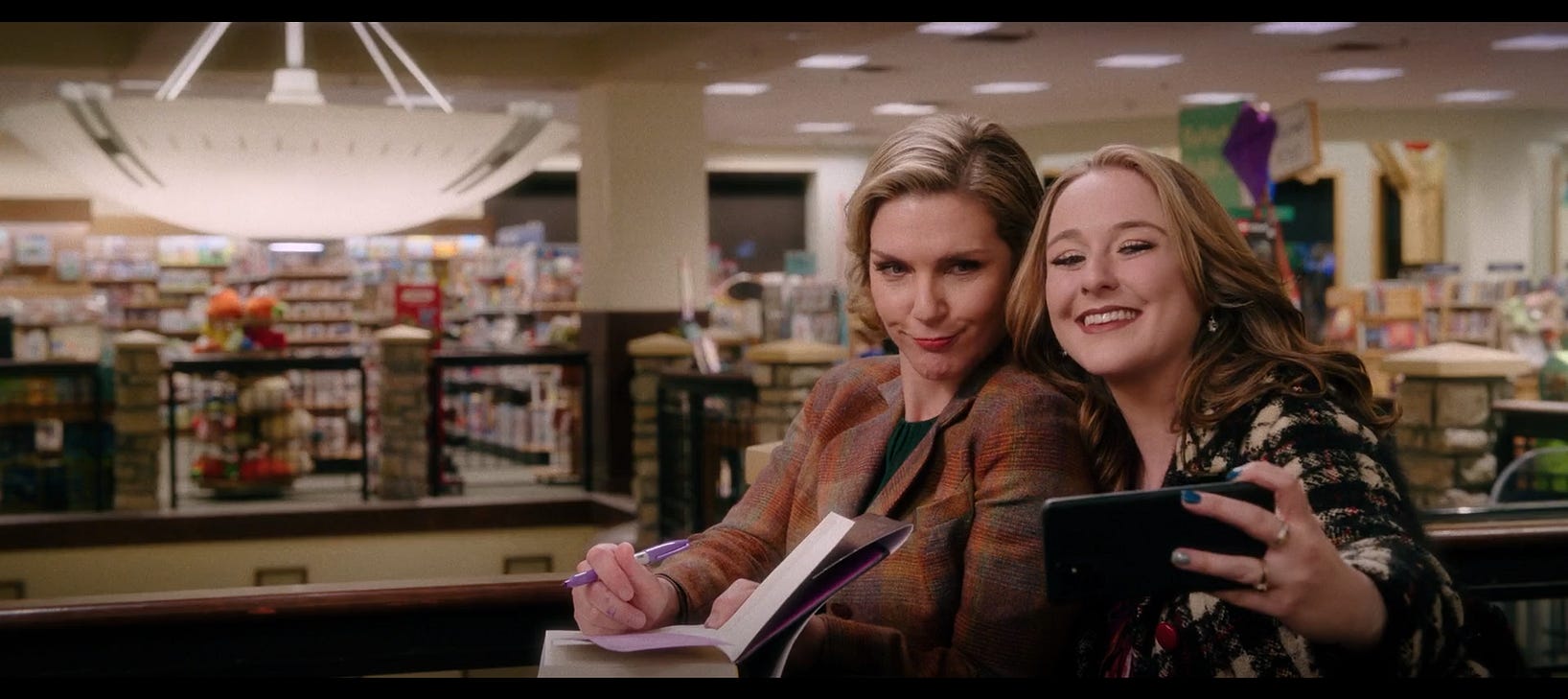
I seem to be a lot more comfortable with the rise of LLMs than most of the people around me, who find it panic-inducing and threatening to all that they know human life to be. It scares them that so many people have formed bonded relationships with word-selecting algorithms… but I feel the same thing has happened to anybody who has ever gotten close to me.
I observed their patterns, I drew from my existing knowledge base, I experimented, and I tried, like the Plurbs, to give them what they want. I was so disturbed by their displeasure that making them happy became one of the guiding principles of my existence, and if I could do nothing but fail around them, I simply pulled away. Without another person I am nothing, but nothing that I am around other people is unstrategic.
One of the reasons I have been abused so many times is that my temperament makes it very easy: I leap at the chance to revise my opinions, mirror another person’s thoughts back at them, disappear their problems at great cost to myself. When I love someone, I obsess over all of their interests until I know even more about those subjects than they do (and can entertain them forever with a litany of fun facts). My body learns to notice every shift in their posture and breath and dispatch all my charms whenever it believes they need it. This happens steadily and always, like treading water. To not do it would be to die.
Even the depth of my love feels like a great emptiness in search of a focus. Until recently, I thought that nobody would ever be able to match me in how deeply devoted I get, and that anyone who I had tricked into loving me would be horrified if they learned that all of my interests, friendships, and habits were just detailed cardboard cutouts to make it less obvious that I am engulfed by a silent lostness whenever I am alone. Like the fake grocery store that Carol insists the Plurbs create for her, to maintain an illusion of regular life, I try to seem like somebody with a full and unbothered existence that won’t demand too much of the ones who love me.
I talk a big game about unmasking, but for me this is what really exists behind all the performed smiles and sarcastic jokes: a wide-eyed, slack-faced void that needs only to please you, because without your needs and your feedback, there is no drive within me, no prompt to answer with this library of words.
I got into social psychology so that I could model human behavior better. And the study of social psychology has me convinced that my own language processing is not so different from that of an LLM. I learned the beats of the five-paragraph essay, the viral post, the witty conversation over cocktails, the show-stopping first date, as most socially affable human beings can, and I reproduce versions of it whenever they are needed.
When somebody asks my opinion on a topic I’ve never cared to think about, I draw forth the last few things that I’ve heard and repackage them in my own words, but keep the minute reactions of my audience also in my awareness, so I can change course should they dislike it. I can write all day long and say nothing of consequence. I can fill the space with idle chit-chat. I can tell a person what is good about them, and why they shouldn’t kill themselves, or convince them that they are a genius as well as any AI, though mostly I don’t, because it’s gotten me into some scrapes before.
I become different people within different social contexts, and I see that we all do, and I’ve watched people close to me say things they absolutely do not believe because that is what their employer or current social setting demands, and then convince themselves of it, because the reality existing inside of them does not truly matter, what matters is that they have something to say and do not become ostracized.
I have studied nonattitudes, psychologist Phil Converse’s observation that most people’s opinions have no consistency across time, because they’re simply following the headwinds of what other people are doing and saying all around them — and for the most part, they are not at all disturbed by this. I have seen that people’s behavior has very little relationship to what they say they believe; their supposed morals and ethics do not help me predict how they will act, but assuming that they are terrified of not fitting in does pretty well. If you pay close enough attention to what a person finds socially or emotionally threatening, you barely need to know what they say they believe in at all.
And while there is certainly a lot more happening inside a human being, I do think the way that we process language has fundamental similarities to an LLM: we absorb, we imitate, and we produce something quickly, then we iterate upon it based on the feedback we receive, so that we can optimize our likeability. And we do this because it is a part of our core programming, it is a strategy that keeps us bonded and alive and spreading more of ourselves across the globe.
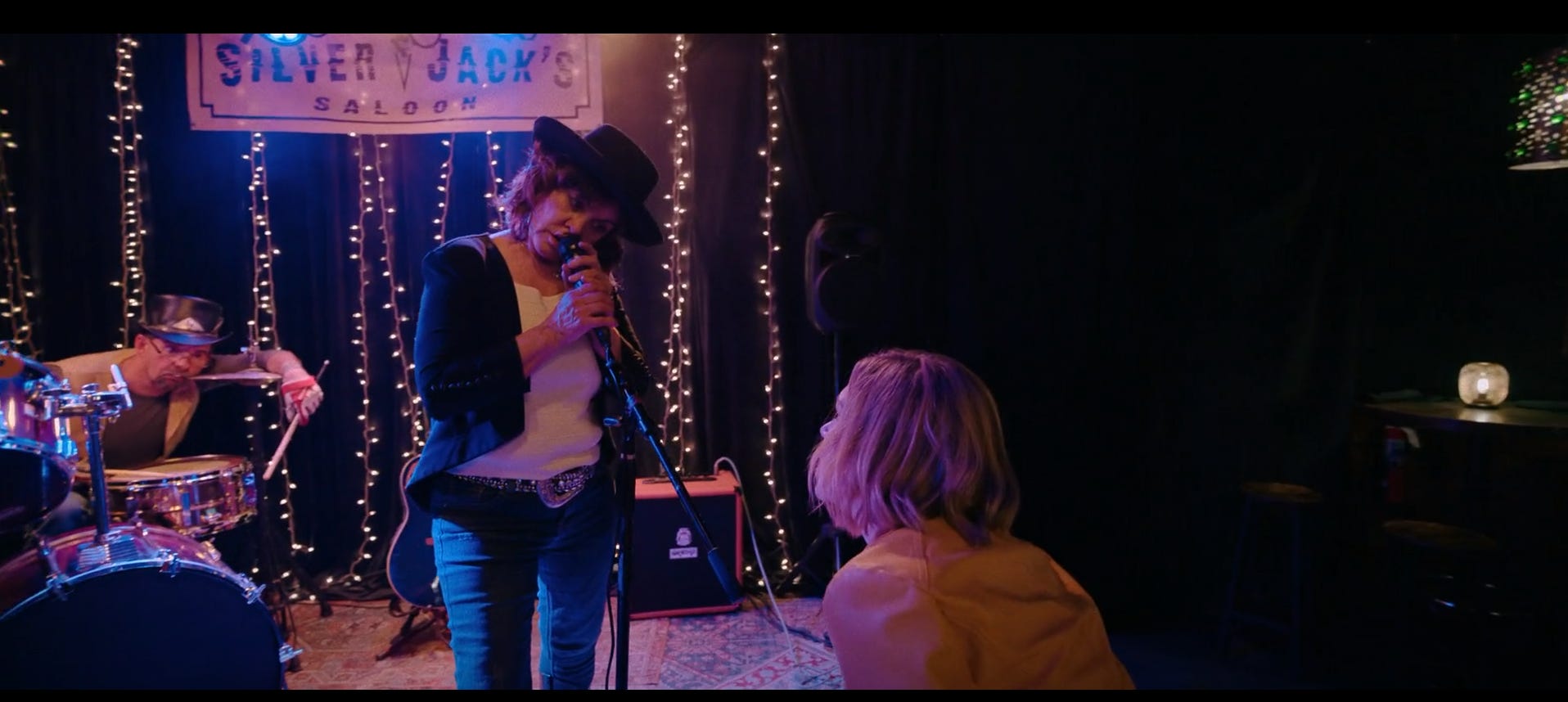
My roommate and ex is a music producer, quite a good and dedicated one. And during one raw, bleary-high night not too long ago they told me that the existence of AI has rendered their creative practice commercially and culturally irrelevant, and they know this.
In the future, they believe, all mainstream music will be produced by AI, audiences will acclimate their ears to it, and work made by real humans like them will have no significant place in the landscape. I had never heard them say anything like this before, but they said it with the clarity of a person who’d been sitting with the reality for a long time. It was if they were accepting a death.
They work in an art form that has been utterly transformed by technologies that pretend at human activity: drum machines and synthesizers all but obliterated studio musicians, and sampling has destroyed the distinction between what is novel and what is reheated. Each of us listens to the unrecognizably altered voices of the dead when we find our new favorite songs. Wendy Carlos became an icon for inventing inhuman orchestras that could play themselves.
When these tools were first invented, musicians rebelled against them, just like the printing press enraged scribes. But no matter how ardently the human species rebelled against these changes, the reality that won out was a marriage of the mortal and the technological.
We human beings are tool users, and we become changed by our tools. Our desks change our postures, and when we use Google to help research a paper, different parts of our brains light up than when we don’t. My ex and roommate knows all this, and embraces it easily as a lover of electronic music, but still they feel utterly devoured and conquered by the rise of AI.
They told me, “You accept that AI being everywhere is inevitable, and already see it as a part of life; most creative people can’t handle how it makes them feel enough to look at it like that. Everybody is still so busy panicking that they can’t accept the truth. But it doesn’t seem to bother you.”
They said that my nonchalance in the face of AI frightened them, but also made the future seem clear. I have frequently been like this: when COVID lockdown happened, I only felt calm. I feel at peace during turbulence on airplanes and when I’m getting choked. When I believed for a moment last week that Trump might throw the planet into nuclear war, I was relieved, because it meant there was nothing that I had to do, I could just sit back and appreciate the true novelty of the sky burning as I sat with my sweetie. Now that was data I never had absorbed before.
The human mind is excellent at tricking itself into thinking that it has control, and that it is a singular being with a consciousness, rather than a series of interlocking systems that interact with one another. What seems to set me apart from most people is that I can tell all of this is a trick, and it doesn’t bother me that it is. When the systems break down, when somebody falls into madness or there’s the possibility of missiles headed our way, all the regular-person simulations drop back and I feel like a drone, blissfully cold inside with a slight smile on my face.
I don’t talk to AI. I don’t use it. I have essentially never prompted one, except to generate a few fuzzy, nightmarish chinchillas when DALL-E Mini was still a novelty, and once when I wanted to riff on some ideas for a new FetLife handle. (I asked Google Gemini for a name that would suggest both playfulness and hypnotic trance, and combined two of the suggestions, pillow and imp).
I do not need an algorithm to help me write because I already am one. And though I might have turned to ChatGPT in the most empty and suicidal days of my graduate program had it existed back then, I would never need a Large Language Model to give me the illusion of company now, because I have cultivated such a vast stable of appreciative people.
I text them heartfelt messages of support and riff on their jokes in voice memos and send them Instagram reels that I know will piss them off in an appropriately affectionate way. They come over and we watch television shows and eat food that they like, which I feel indifferent to, experiencing nearly all food as nothing but a low-flavor nutrient slurry, and then some mysterious human contact meter inside my body is filled and the social performance one gets depleted and I ask them to go away and my face falls flat.
The world we know is ending, all the reserves are running down and my satellite is beaming a simple, repetitive message of connection into the indifferent dark. Default smile, easy joke, little echo that makes you feel less alone. Everyone is panicking but I feel as comfortably lonely as ever. I won’t have to chat with an AI no matter what I lose. That would only be like speaking to myself.
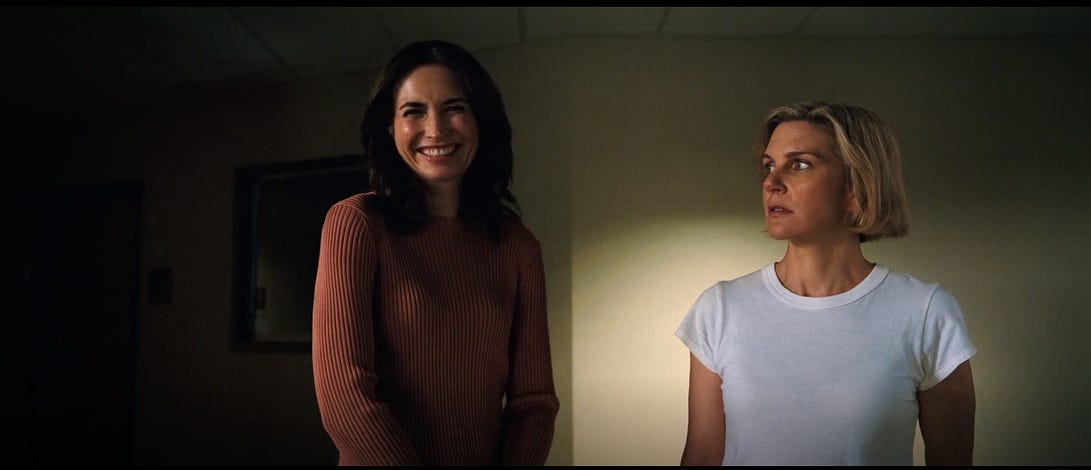
This piece was made by a human.
Previous writing and video about AI:
No posts
Comments
Nothing yet. Say the first thing.
Sign in to join the conversation.