
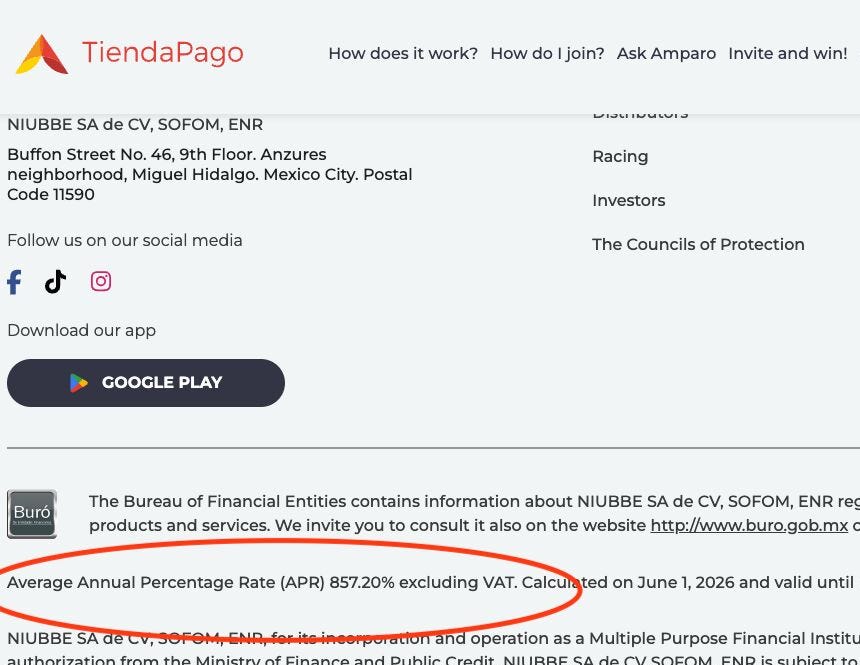
A screenshot from Mexican microfinance lender TiendaPago showing an annual average interest rate of 857%. Thanks to Zac Coleman for spotting.
The Triodos responses to the questions we asked are reproduced in full and verbatim at the bottom of the article.
Many investors these days are looking for something more than a purely financial return.
You’re after impact? Step this way.
Whether you want sustainability, financial inclusion or energy transition, Triodos Investment Management has the right product for you.
Take your pick from the Microfinance Fund, the Fair Share Fund, Future Generations, and many more.
It’s only the smallprint which shows that Triodos doesn’t claim any direct link between its investments and impact. (1)
So why an impact report if they are not claiming impact?
Because the role of “impact” here is marketing, rather than the overall purpose and strategy of the company.
The businesses that receive Triodos investments will of course have other sources of funding, so working out whose dollar is doing what would be tricky.
The disclaimer, however, is unequivocal.
Not ‘we are working on it.’ Not ‘this is difficult to measure.’
But this: “We do not claim a direct causal link between our financing and the impacts generated by investees.”
The firm adds that the “impact” data is not externally assured unless explicitly stated and that for private investments, it is self-reported by the companies getting the investments.
The use of the idea of “impact” comes with obligations. If you are selling not just a financial product, but a force for good in the world, the standard of proof gets higher.
Three things need to be shown.
First, that the data on outcomes can be checked by someone other than your own staff.
Second, that the data does not depend entirely on those who benefit from looking useful.
Third, that there is at least a clear explanation of how your money caused, or helped cause, the reported effect.
Remove any one of those three, and all that is left is a marketing slogan.
Evaluating impact is of course hugely difficult. The work of the six largest ESG-rating providers — Sustainalytics, Moody’s, S&P, Refinitiv, MSCI and KLD — was examined by Berg, Kölbel and Rigobon in a paper published in the Review of Finance in 2022.
The average correlation between their ratings of the same companies was 0.54.
In other words, even six professional teams, with financial models, methodologies and analysts on staff, diverge substantially when evaluating the same companies.
At least the agencies are thinking about ESG. Triodos measures “impact” through a 15-minute phone survey.
If you have defined the buzzwords, doing marketing is faster and cheaper than trying to measure impact.
60 Decibels, a niche provider of impact advertising, helps to do this. Triodos contributes to its surveys.
In “False Precision: How Business Consultants Monetize the Measurement of Poverty,” Mila Agius described the 60 Decibels methodology as a “cargo cult of science” — an imitation of the outward symbols of scientific knowledge without a commitment to its standards.
The Lean Data methodology used by 60 Decibels was published in the Stanford Social Innovation Review. That is a magazine for nonprofit-sector leaders, not a peer-reviewed scientific journal. Independent validation studies: none. A named public methodologist responsible for the framework: none.
Further Reading: Triodos backs Mexican microcredit lender charging 109% per year
The Triodos cover story is called Theory of Change. (2) It looks like a framework: If we → Assuming → Then we expect → Which will contribute to. Lovely graphic design. Everything that might have turned it into proof is tucked inside the word Assuming. “Assuming access to finance allows clients to meet their needs.”
The reality is that Triodos sets no maximum interest rate for the microfinance lenders in which it invests. One of its investees, Mexico’s SOFIPA, charges borrowers up to 109.9% per year excluding VAT.
Triodos has invested through a series of its funds in the TiendaPago microcredit lender in Mexico. (4) TiendaPago is now charging average (not maximum) annual interest rates of 857.2%, excluding VAT.
As of the end of May, ACLEDA in Cambodia remains the fourth-largest holding in the Triodos Fair Share fund, accounting for 5% of the portfolio.
This is despite the fact that ACLEDA is among six Cambodian microcredit lenders under investigation by the ombudsman of the World Bank’s International Finance Corporation. (3)
The investigation is taking place because of IFC exposure to the lenders. The ombudsman has found that among the six lenders, including ACLEDA, there are “preliminary indications of harm regarding the allegations of adverse impacts of microfinance lending raised by complainants, including loss of land, livelihood impacts, impacts on Indigenous Peoples, and threats and reprisals.”
The IFC on 24 June made a statement which said that there was “no policy noncompliance” in relation to its investments in the six institutions. (4)
The director general of the ombudsman, Janine Ferretti, announced her resignation in response to the statement. (5)
The disclosure appears on page 176 of the company’s 2025 Impact Report. Impact Report 2025 | Investing for a brighter future
See page 109.
Cambodia: Financial Intermediaries-04 | Office of the Compliance Advisor/Ombudsman
4. Statement from IFC Board on the CAO Investigation Report on Cambodia Microfinance
It appears that TiendaPago in Mexico, with whom you have a long-standing relationship, is now charging an average annualised interest rate of 857%. I understand that short-term inventory financing for small retail stores may help to explain this. Even so, the rate seems extremely high. How can it be justified?
The annualised rate you refer to for TiendaPago requires context. TiendaPago provides short-term, optional working capital loans to small convenience stores in Mexico, typically linked to weekly inventory purchases. The loans follow the stores’ cash-flow cycle: inventory is delivered weekly by mass-consumption suppliers, and TiendaPago charges a fixed weekly commission of around 2% to 3%, repaid in a single payment at maturity. There is no amortisation, compound interest or interest capitalisation. As the loan is optional, a typical client uses it around 20 times per year, which TiendaPago estimates translates into an annualised rate of approximately 59% under standard interest calculations.
Under Mexican regulation, financial institutions must publish the Total Annual Cost (CAT or APR). This is calculated under a prescribed methodology that annualises and compounds the cost and includes penalty assumptions. When applied to short-term inventory financing, this can produce very high regulatory figures that do not reflect the cost typically borne by clients over a full year. TiendaPago’s maximum regulatory CAT of 857.2% is based on a hypothetical 52-week renewal scenario. In practice, clients cannot roll over loans continuously for 52 weeks, interest is not capitalised, and late-payment interest is frozen after five weeks, after which the focus is solely on recovering the principal. TiendaPago has updated its website to show an average CAT of 352.8%, which corresponds more closely with the typical usage pattern of around 20 loans per year.
Client protection is an important part of TiendaPago’s model. The credit is closed-loop and can only be used to purchase inventory from distributor partners, rather than for unrelated personal expenses. Credit limits are linked to each store’s historical purchasing behaviour and inventory turnover, helping to ensure that loans remain aligned with what the business can realistically sell and repay within days. TiendaPago also does not charge origination or formalisation fees and presents the fixed repayment amount in Mexican pesos before the client confirms the inventory purchase, so there are no hidden fees.
We recognise that these figures require careful scrutiny. As part of our due diligence and ongoing monitoring, we assess responsible lending practices, transparent pricing and client protection standards. In TiendaPago’s case, the short-term, inventory-linked nature of the product, the absence of compound interest, the limits on late-payment interest and the closed-loop credit model are important factors in our assessment.
Were you aware of the interest rates charged by TiendaPago and SOFIPA (which charges up to 109% per year) when you invested in them?
We perform extensive due diligence on investee companies before investing. This means that we also ensure that the companies uphold strict client protection principles and do not charge excessive interest rates. As we shared earlier this year, the 109% CAT in relation to SOFIPA relates to a specific very high-risk, small group lending product, not SOFIPA’s entire portfolio. As mentioned above, the CAT annualises and compounds costs and includes penalty assumptions, so it is not the same as the annualised interest rate.
In general, interest rates for microfinance loans in emerging markets are incomparable to western interest rates, mainly due to much higher lending costs, operational costs and higher associated risk. High interest rates in Mexico are predominant in microfinance and consumer finance, while lower for SME-lending. Our main focus in Mexico is on SME-lending and less on microfinance. SOFIPA is one of two, carefully selected, microfinance institutions in our portfolio in Mexico. We’d like to emphasise that SOFIPA’s average CAT rates are below market rates.
In Cambodia, ACLEDA, which is listed as one of your largest microfinance investments, is under investigation by the IFC Ombudsman, which has found “preliminary indications of harm regarding the allegations of adverse impacts of microfinance lending raised by complainants, including loss of land, livelihood impacts, impacts on Indigenous Peoples, and threats and reprisals.”
Cambodia: Financial Intermediaries-04 | Office of the Compliance Advisor/Ombudsman
Are you planning to exclude ACLEDA from your portfolios under your “do no harm” principle
Our financial inclusion funds hold a small equity stake of less than 3% in ACLEDA Bank. Unfortunately, we cannot comment on potential changes to the funds’ equity portfolio before they materialise.
Are you able to estimate the average effective annual rate paid by final borrowers across your portfolios?
Yes, we are. We calculate the APR, which is the most standard metric, on each investee for each product. We generally do it for the average interest rate and the highest priced product (which is always the highest risk segment of clients). However, as it is the case in Mexico, the local methodology can differ. Using the standard metric (APR) rather than the locally used ones, allows us to benchmark across different investees and regions.
Concerning your recently published 2025 impact report, can you confirm the statement on p176 that you claim no causal relationship between your investments and impacts that may be achieved by investees? If that is the case, why is the idea of “impact” so prominent in your marketing?
We indeed do not claim a direct, fully attributable causal relationship between our investment alone and all impacts achieved by investee companies. That distinction is important. Impact outputs and outcomes are created by the underlying companies through their products, services and operations, while our role as an investor is to allocate capital intentionally, select companies that contribute to positive change, and engage actively to support and strengthen that contribution.
When we use the term impact, we therefore do so in this broader and well-established impact investing sense: investing in companies and projects that are intended to contribute to positive social and environmental outcomes, alongside financial returns. Our reporting aims to show the real-world outputs and outcomes associated with our portfolios, while being transparent about the methodological limits around attribution and causality.
In the Impact Report, we also comment on our investor contribution, for example on p. 110 and p. 174.
We believe that transparency is essential. Clarifying that not every reported outcome can be claimed as solely caused by our investment does not make the concept of impact irrelevant; rather, it ensures that impact is communicated responsibly and credibly. For us, that means distinguishing carefully between:
· the impact of investee companies,
· our contribution as an investor, through capital allocation, stewardship, transparency and advocacy,
· and the limits of what can be causally attributed to our specific investment.
In short, impact is prominent in our communications because it is central to our investment philosophy and portfolio construction, but we believe it must be described with precision and humility rather than overstated.
Do you have plans to introduce an independent external audit of your impact data?
Our impact data appears in two publications: the dedicated impact reports released by Triodos IM, and the audited Annual Report of Triodos Bank. While the impact reports themselves are not audited, there is significant overlap between the data presented in the annual report, which is audited, and that found in the impact reports.
Comments
Nothing yet. Say the first thing.
Sign in to join the conversation.