
Image: CGAP via Facebook
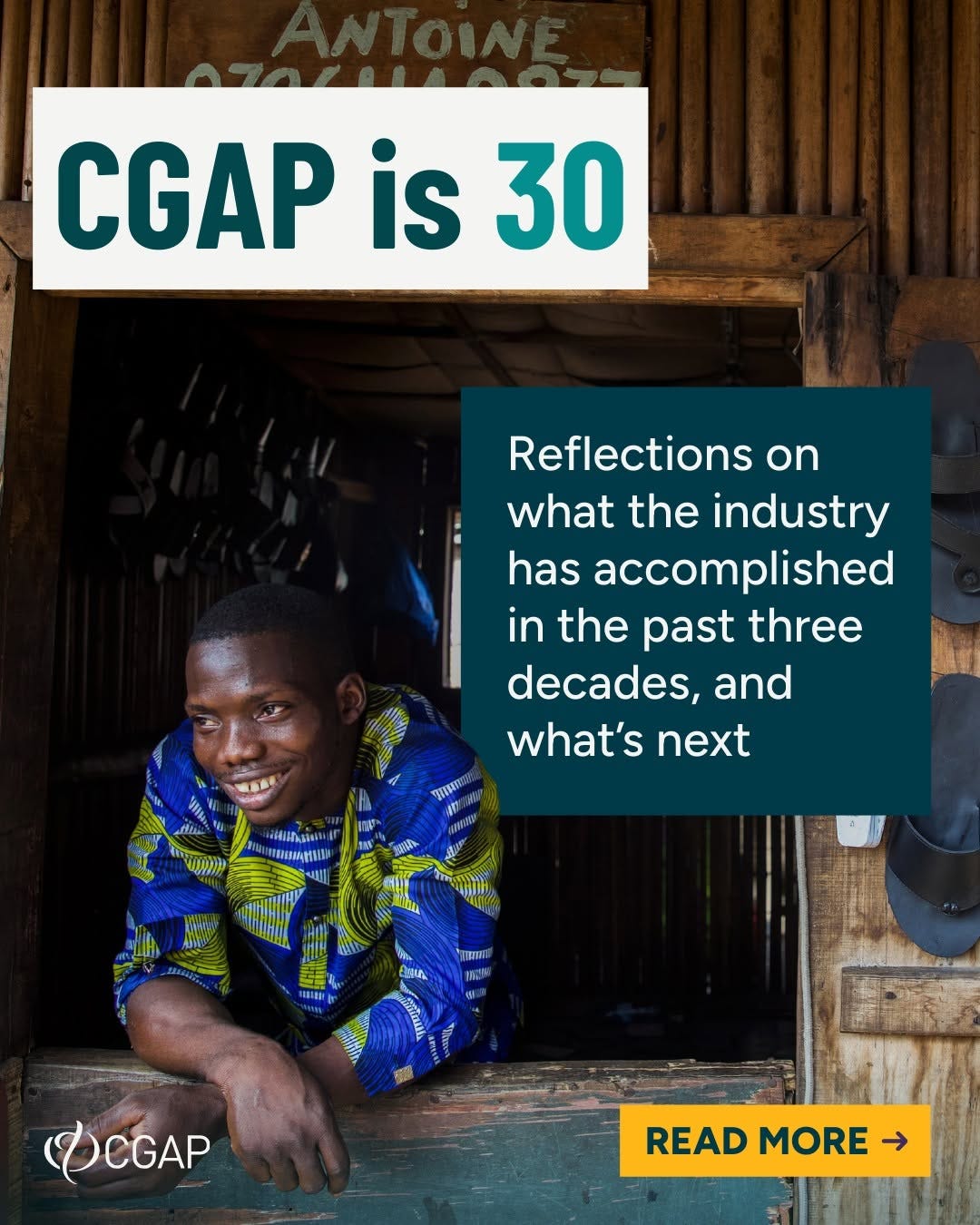
A new paper published by the Consultative Group to Assist the Poor (CGAP) on microcredit is a case study in group-think and institutional conformity.
The CGAP think-tank is housed at and administered by the World Bank, though with separate governance and funding. Its paper published in June is called “Opening the Black Box on the Impact of Inclusive Credit.” [1]
The paper seeks to establish the conditions under which microcredit works best. Where conditions such as prior business experience among borrowers, adequate financial capability and genuine control over loan proceeds are met, “the gains are real and meaningful,” it finds.
“Credit most consistently generates gains among borrowers with an existing productive base — assets, stable earning capacity, prior business experience, higher education — and women who retain meaningful control over loan use.”
A critical review process on the two-year, four-author report is lacking. CGAP cites nine “peer reviewers”. Five are at the CGAP, one is at the World Bank, one is at the IFC, which is part of the World Bank, and the two others used to be at the World Bank.
The paper makes all the usual noises about transparency, which it mentions not less than 16 times, but does not disclose how the work was funded. It says that its methodology was applied in collaboration with five unnamed financial institutions and that a separate guide is forthcoming.
The research does not give any information on what proportion of microcredit borrowers do so under the defined ideal set of conditions. But clearly this is not what typically happens across the universe of microcredit, which has become a fully commercial financial service.
At one end of the Bell curve, a favourable set of factors does indeed produce good outcomes for some borrowers.
At the other of the curve, a different set of factors can lead to disastrous results including repossessions and suicides.
The results for the vast majority of borrowers fall in between these extremes, with no evidence of lasting benefit. [2]
The lack of clear impact from financial inclusion strategies led the Gates Foundation to decide in 2025 to end its financial backing for such initiatives. [3]
CGAP, which has been supported by the Gates Foundation, is among organisations that will be defunded from 2030, much sooner than the wider Gates Foundation “sunset date” of 2045.
Further Reading: Q&A with Isabelle Guérin on microcredit and the post-colonial demonization of informal lending
Based on its latest findings, CGAP makes recommendations to financial services providers, funders and impact investors. Some of these are reasonable enough. Funders should not seek volume and portfolio growth at all costs. Financial service providers should assess overall financial health rather than just repayment capacity.
The larger question is why CGAP continues to focus on debt rather than other kinds of financial services, such as savings and insurance, or social protection.
In its own words, CGAP, since its creation in 1995, has “watched and supported as microcredit morphed into microfinance, then into financial inclusion and digital finance, and, most recently, into inclusive finance and inclusive financial ecosystems.”
To what purpose? To what benefit? How much debt do the world’s poor need?
Recent research by Isabelle Guérin and Arnaud Natal has found that at least one third of the world’s population, or over 2.5 billion people, rely on borrowing to meet basic needs. [4] The authors stress that this is a conservative lower estimate.
Guérin and Natal call for extending access to unemployment insurance, health coverage, and adequate cash transfers, including for households just above poverty thresholds. There need to be conditional cash transfers, food subsidies and public employment schemes.
Perhaps most fundamentally, Guérin and Natal find that “everyday indebtedness should be treated as a systemic issue rather than an individual failing.”
Rather than re-examining the fundamental assumptions of its preferred intervention, CGAP is essentially constructing an artificial, idealised version of microcredit. It then asks lenders, and those who invest in them, to behave nicely.
There’s still time before 2030 for CGAP to start getting out and about a bit more, asking some new questions, and thinking outside its narrow institutional box.
[1] Opening the Black Box on the Impact of Inclusive Credit. June 2026.
Opening the Black Box on the Impact of Inclusive Credit | CGAP Research & Publications
[2] Maren Duvendack, Philip Mader, “Impact of financial inclusion in low- and middle-income countries: A systematic review of reviews.” 2019. Impact of financial inclusion in low‐ and middle‐income countries: A systematic review of reviews - Duvendack - 2019 - Campbell Systematic Reviews - Wiley Online Library
[3] Gates Foundation to end financial inclusion support in 2030 - The Banker
[4] Arnaud Natal, Isabelle Guérin. The Scale of Debt: Estimating Everyday Household Indebtedness Worldwide. ODRIIS Policy Brief No. 5, 2026, pp.1-5. ⟨hal-05500846⟩
(Opens in new window)
The Scale of Debt: Estimating Everyday Household Indebtedness Worldwide
Comments
Nothing yet. Say the first thing.
Sign in to join the conversation.