
I. What We Know
I opened this series with a young man. He was 22. His testosterone was 178 ng/dL. He had been told, in various ways by various clinicians, that his fatigue was stress, his loss of motivation was a mood disorder, his inability to build the muscle mass he trained for was a programming problem, and his diminishing engagement with the world was something he needed to work on in therapy. Nobody measured his LH. Nobody asked about his plastic water bottles or his nonstick pans or the synthetic fragrance in his shampoo. Nobody knew what clomiphene citrate was when used in men.
I wrote this series for him. And for the man reading this who recognized something of himself in that description.
The case has been built across nineteen articles, more than a hundred peer-reviewed citations, and the work of researchers across four continents who have spent decades documenting a crisis that most of the public and most of the medical establishment has not yet fully registered. Let me state the conclusion plainly, without hedging it more than the evidence requires.
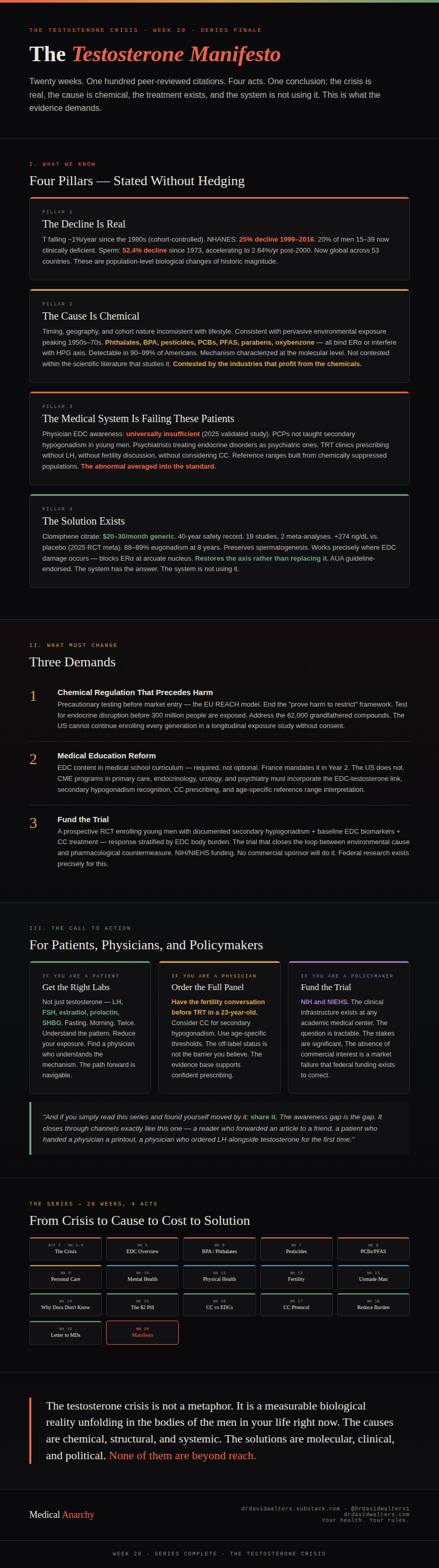
The decline is real. Male testosterone has fallen approximately 1% per year in cohort-controlled studies since at least the 1980s. Mean testosterone in the NHANES population dropped 25% between 1999 and 2016. Twenty percent of American men aged 15 to 39 currently meet clinical criteria for testosterone deficiency. Sperm concentration has declined 52.4% in Western countries since 1973, with the rate accelerating to 2.64% per year after 2000. These are not statistical artifacts. They are population-level biological changes of historic magnitude.
The cause is chemical. The timing, geographic pattern, and cohort nature of the decline — affecting all age groups, not just aging men — is inconsistent with lifestyle explanations and consistent with a pervasive environmental exposure that began its steepest rise in the 1950s and 1970s. The endocrine-disrupting chemicals documented across this series — phthalates, bisphenols, organophosphate pesticides, PCBs, PFAS, parabens, oxybenzone — all bind to or interfere with the hormonal receptors that regulate testosterone production. They are present in measurable concentrations in the bodies of 90 to 99% of the American population, including every child tested. They are present in food, water, personal care products, cookware, and building materials. The mechanism by which they suppress testosterone — binding to ERα in the hypothalamic arcuate nucleus, generating false estrogenic suppression of the HPG axis — is characterized at the molecular level and confirmed epidemiologically across dozens of population studies. This is not contested within the scientific literature that studies it. It is contested by the industries that profit from the chemicals, a distinction that matters.
The medical system is failing these patients. The EDC awareness study published in 2025 found physician knowledge universally insufficient across all specialties. Primary care physicians are not being taught about secondary hypogonadism in young men. Psychiatrists are prescribing antidepressants to men whose treatment-resistant depression is an endocrine disorder. TRT clinics are prescribing testosterone replacement to 24-year-olds without measuring LH, without discussing the fertility consequences, without considering whether the suppressed HPG axis might respond to a restoration rather than a bypass. The reference ranges used to define “normal” testosterone were built from population samples that include chemically suppressed men, guaranteeing that the abnormal is averaged into the standard. The loop is closed in the wrong direction.
The solution exists. Clomiphene citrate — a generic SERM that costs $30 to $60 per month, that has been used off-label in men for four decades, that has now been evaluated in nineteen studies and two systematic meta-analyses — is the mechanistically appropriate intervention for secondary hypogonadism. It works precisely where the EDC damage occurs: it binds the estrogen receptor at the hypothalamic arcuate nucleus, blocking the false suppressive signal and allowing the HPG axis to restore its own function. In 88 to 89% of appropriately selected patients in long-term cohort data, it maintains eugonadal testosterone for years. It preserves spermatogenesis. It carries no risk of polycythemia, no testicular atrophy, no axis suppression. It costs less than a monthly streaming subscription.
The system has the answer. The system is not using it.
II. What Must Change
The policy agenda is not complicated, but it requires will that the current regulatory and commercial environment has not produced. The interactive guide above details the full agenda. The core of it is three things.
The first is chemical regulation that precedes harm. The United States allows chemicals into commerce without endocrine disruption testing and requires regulators to prove harm before restricting use. The result is that every generation of Americans is enrolled, without consent, in a longitudinal exposure study whose endpoints are their own hormonal systems. The EU’s REACH regulation has demonstrated that precautionary testing is operationally feasible. The Frank R. Lautenberg Act of 2016 moved the US modestly in the right direction. It did not go far enough, and it did not touch the grandfathered 62,000 compounds that have been circulating in commerce since before the regulatory framework existed. This must change.
The second is medical education reform. France teaches EDCs in Year 2 medical school. The United States does not. A generation of physicians practices in ignorance of the most significant environmental contributors to the most common hormonal disorder they will see. The Liaison Committee on Medical Education sets US medical school standards. EDC content in reproductive endocrinology must become a requirement, not a curiosity. Continuing medical education programs for practicing physicians — in primary care, endocrinology, urology, and psychiatry — must incorporate this material. The gap between the science and the clinic will not close unless the clinic is updated.
The third is the clinical trial that does not yet exist. The mechanistic bridge between EDC exposure and CC’s therapeutic action is scientifically compelling and clinically plausible. It has not been directly tested. A prospective randomized controlled trial enrolling young men with documented secondary hypogonadism, baseline EDC biomarker quantification, and CC treatment — with response analysis stratified by EDC body burden — would close the loop. It would determine whether the men with the highest estrogenic EDC load are, as predicted by the mechanism, the patients who respond best to CC. It would provide the first direct human evidence for the hypothesis that has been the animating thesis of this series.
This trial will not be funded by a pharmaceutical company. CC is generic. There is no commercial return. The funding must come from the NIH and NIEHS, the research arms of the federal government whose mandate is precisely this kind of public health question that the market will not answer. The Endocrine Society, which has been the most intellectually serious professional organization on the EDC-reproductive health question, should advocate for it. The physicians reading this series should advocate for it. The patients who have walked through this twenty-week argument and found it persuasive should write to their congressional representatives and tell them that male reproductive health research is underfunded and that the trial needs to happen.
III. A Personal Statement
I want to tell you why I wrote this.
I am a physician with clinical and research training in men’s hormonal health. My practice includes a substantial number of young men — men in their early to mid-twenties — presenting with testosterone levels that I find inexplicable until I take a thorough exposure history. Men who grew up in houses with vinyl flooring and nonstick cookware and commercial personal care products from birth. Men who ate conventionally grown produce for twenty years before anyone told them what organophosphate pesticide residues were. Men who have been carrying a body burden of twenty to forty-five estrogenic chemicals continuously, without knowing it, while those chemicals quietly suppressed the hormonal system that was supposed to define the strength, the vitality, and the reproductive potential of their adult lives.
Some of them come in after years of being told their fatigue is depression, their depression is treatment-resistant, their treatment-resistant depression is a personality issue. Some of them come in after being started on TRT at a telehealth clinic at age 22 with a single testosterone measurement, no LH, no FSH, no fertility conversation, and a prescription that has made their testes smaller and their sperm count close to zero. Some of them come in after two rounds of IVF that might never have been necessary if their secondary hypogonadism had been identified and treated correctly three years earlier.
I did not start writing this series because I had all the answers. I started writing it because I was seeing a pattern that the literature supported and the clinical system was not acting on, and the gap between what the evidence showed and what was actually happening to these patients was causing harm that I could measure in front of me in my own practice. Every week I sat across from a 24-year-old with testosterone of 230 ng/dL and a stack of antidepressant prescriptions and a psychiatrist who had never ordered a testosterone panel, I was looking at the cost of an awareness gap.
Writing this series has been an act of consolidation — taking the evidence from reproductive endocrinology, environmental health, epidemiology, andrology, and clinical pharmacology and building it into a coherent, accessible argument that a motivated non-specialist can follow from first principles to clinical action. I make no claim that this series is the final word. The science is active, the evidence base continues to grow, and some of the mechanistic claims — particularly the direct causal link between EDC body burden and the secondary hypogonadism I see in clinical practice — remain hypotheses whose definitive confirmation requires the trial I have been calling for throughout. I have tried to be honest about what is established, what is strongly supported but not directly tested, and what is speculative.
What I am confident about is this: the decline is real, the chemicals are plausible causes, the hormonal pattern is identifiable, and the treatment for eligible patients is available, inexpensive, evidence-supported, and being systematically underused. The gap between what medicine knows and what medicine does is not a small gap. It is the gap between a 22-year-old with testosterone of 178 ng/dL being sent home with an SSRI and a 22-year-old being given a correct diagnosis, a conversation about what suppressed his axis, and a $30-per-month pill that tells his own body to produce what it should have been producing all along.
That gap is what this series has been written to close.
IV. The Call to Action
The resource guide above is comprehensive. Everything you need is in it. But I want to compress the most important things into the simplest possible form, because the simplicity matters.
If you are a young man with unexplained fatigue, anhedonia, reduced motivation, impaired physical performance, or depression that has not responded to standard treatment: get the right labs. Not just testosterone — LH, FSH, estradiol, prolactin, SHBG, fasting, morning, twice. Understand what the pattern means. Reduce what you’re carrying. Find a physician who understands the mechanism. The information exists. The treatment exists. The path forward is navigable.
If you are a physician reading this: the evidence is in the journals. The guideline endorsement exists. The patients are in your waiting rooms. They have been there for years. The question is whether the visit ends with the right diagnosis. Order the full panel. Have the fertility conversation before prescribing TRT to a 23-year-old. Consider CC for secondary hypogonadism in young men who have not definitively decided that fertility is irrelevant to them. The off-label status is not the barrier you may believe it to be. The evidence base is robust enough to support confident, evidence-based prescribing in appropriately selected patients.
If you are a policy maker or a researcher: the trial needs to happen. The funding exists at NIH and NIEHS. The clinical infrastructure exists at any academic medical center with a male reproductive medicine program. The scientific question is tractable. The public health stakes are significant. The absence of commercial interest is not an absence of scientific merit — it is a market failure that federal research funding exists precisely to correct.
And if you are a person who read this series and found yourself moved by it: share it. The awareness gap is the gap. It closes through channels exactly like this one — a reader who forwarded an article to a friend whose brother hasn’t felt right in three years, a patient who handed a physician a printout from Week 19, a physician who read that printout and ordered LH alongside the testosterone for the first time.
The science is there. The treatment is there. The awareness is what is missing.
This series has spent twenty weeks building that awareness. Now it is yours to use.
V. What Comes Next
This concludes the formal twenty-week arc of The Testosterone Crisis.
The series is not closed. The field is active, the clinical experience continues to accumulate, and I intend to continue writing about male reproductive health, environmental endocrinology, and the evolving evidence base on this Substack. When the trial I have been advocating for happens, I will write about it. When the regulatory landscape shifts — and the PFAS regulations suggest it is beginning to shift — I will track it. When new biomarker data refines our understanding of which EDCs contribute most to HPG suppression in which patient populations, I will synthesize it.
The crisis I have documented is real and ongoing. The solution is known but undersupplied. The work of closing the gap between them will outlast this series by decades.
I am grateful to every reader who followed this argument from Week 1 to Week 20, questioned the evidence, shared the articles, pushed back on the claims, and brought the conversation to their physicians, their partners, and their own medical care. The patients I described in this series — the 22-year-old with testosterone of 178, the 22-year-old who started TRT before anyone discussed fertility, the 29-year-old whose LH was elevated and whose Klinefelter syndrome went undiagnosed for years — are not composites invented for rhetorical effect. They are the reason medicine exists. They are the reason this series was worth writing.
The testosterone crisis is not a metaphor. It is a measurable biological reality unfolding in the bodies of the men in your life right now. The causes are chemical, structural, and systemic. The solutions are molecular, clinical, and political. None of them are beyond reach.
Go get your testosterone tested. Reduce your exposure. Find the right physician. Share this series. Demand the trial.
The crisis is real. So is the answer.
Dr. David Walters, DO, PhD, MBA, is a physician with clinical and research training in men’s hormonal health.
Website: drdavidwalters.com | Substack: substack.com/@drdavidwalters
Nothing in this series constitutes medical advice or establishes a physician-patient relationship. This series is an educational synthesis of published peer-reviewed literature. Clinical decisions should be made in the context of full evaluation by a qualified physician.
Week 20. Series complete.
The testosterone crisis is real. The chemical era that caused it is ongoing. The treatment exists, costs $30 a month, and is being systematically underused. The trial that would close the scientific loop has not been funded. The awareness gap is the gap.
This series was written to close it.
Now it is your turn.
No posts
Comments
Nothing yet. Say the first thing.
Sign in to join the conversation.