
Four lectures:
1. Early Klimt - “I am not interested in myself”
2. Late Klimt - “Art is great when it is temporal and revolutionary”
3. Early Wittgenstein - “The world is all that is the case”
4. Late Wittgenstein – What is a paradigm?
I’ll begin with some terminology — 4 basic contrasts:
Background / Foreground
Implicit / Explicit
Abstract/Concrete
Whole / All
The first three contrasts are familiar to all of us, and I’ll use them in the common sense usage – i.e. as opposites. The fourth contrast is not so straightforward. We often take these words as synonymous. But their significant difference is apparent upon a moment’s reflection. Look at the room around you – you do not see it all. One side of most objects are facing away from you, for a start, and there are many other ways in which all the room may not be apparent to you. But nevertheless, there it is, right here, right now – the whole room. Whole and All are importantly different concepts, and I’m going to be strict about distinguishing them for reasons which at this point are implicit and in the background, but which we shall gradually bring into the foreground by making them explicit – before wondering finally whether the difference itself between the implicit and the explicit can be made explicit, or if it isn’t rather one of those differences which must always remain in the background.
Background to Klimt: Nietzsche’s Birth of Tragedy
– overcoming the sanitized view of ancient Greece promulgated by clacissicm.
– Apollo and Dionysus : dual deities of art
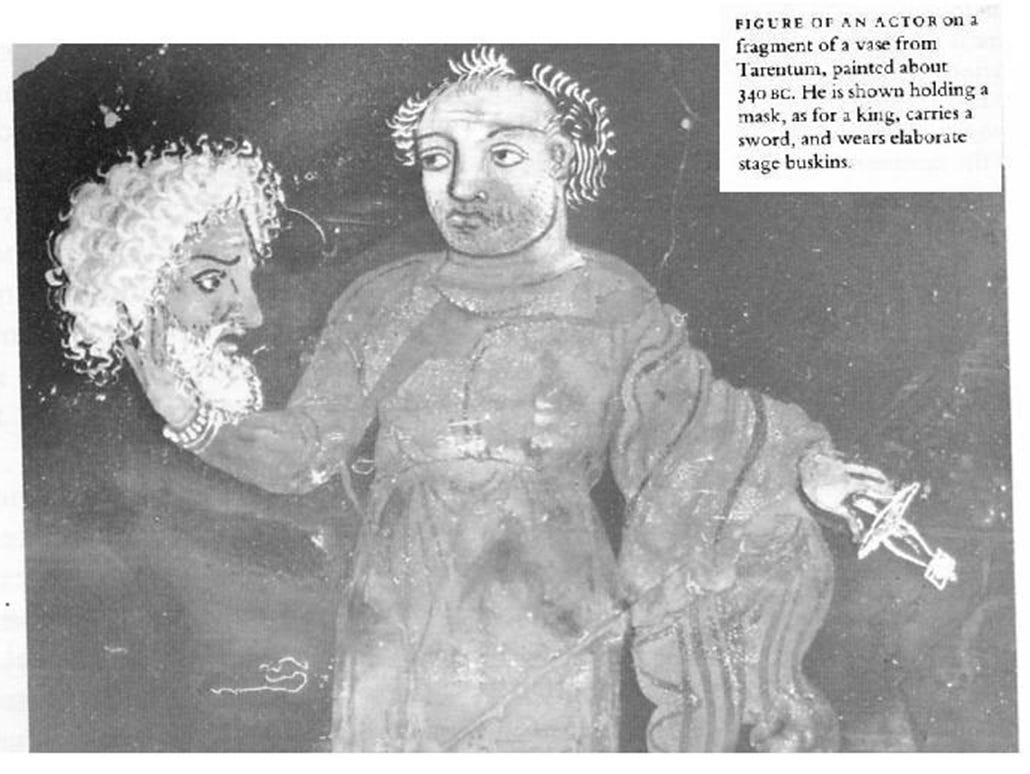
– Invention of the theatre : the Dionysika, the tragedy, the per-son and the karakter
Klimt – son of an impoverished engraver and goldsmith; enters the Tech College for the Arts (not the Academy of Fine Arts) with his brother at age 14, and under the mentorship Hans Makart and together with Franz Matsch they formed the Kuenstler-Compagnie, a business which was well-placed to decorate the newly erected civic buildings going up along Vienna’s new Ring Strasse.
Early friezes – altar of Apollo, altar of Dionysus, Theatre Through the Ages
Nietzsche’s second Untimely Meditation, “The Uses and Abuses of History for Life” distinguishes three distinct modes of historicizing:
– Monumental
– Antiquarian
– Critical
Each mode can degenerate into an unbalanced historicism (e.g. of 1. uncritical veneration of monuments; of 2 consumerist fetishization of antiques; and of 3 anachronistic ‘historical re-enactments’ in bad documentaries). Each is an abuse of both life and history. The balanced use of history is the right mix of monumental respect, antiquarian passion, and critical awareness of the problem of anachronism. Analogy of a raft at sea, at the mercy of currents of which it is not even aware. To orient the raft, a keel with a weight at the bottom and a mast with a sail are necessary. The weighted keel is history, and the sail is creativity.
Klimt’s Faculty Paintings – Roof of new Great Hall at University of Vienna – 3 panels representing philosophy, medicine and law. These were destroyed by the Nazis in 1945, but we have sketches and preliminary work, some old photographs, and now a reconstruction of the works themselves. These proved massively controversial – the professors wanted some nice classical panels like the excellent ones he had done in the theatre. But Klimt had a message for the University. He chose this moment to stretch his wings and begin his truly creative career in search of his own new style. The message to the University was that imitation is a low form of culture, and that modern culture could not be great by merely imitating ancient culture (which had not itself been a mere imitation).
A new style was needed for a new era; that era’s own art. In Thus Spake Zarathustra Nietzsche distinguishes “free from” from “free for” – the problem of overcoming slavery, from the problem of fostering creativity. The teenager who asserts “you’re not the boss of me” to the parent’s instruction knows that they want to be free from domination. But ask them, “okay, what do you want to do?” and the reply is “I dunno” – the teenager does not yet know what they are free for. We come of age when we become autonomous (setting our own goals for ourself) and discover what we are free for. Part of Nietzsche’s message is that the human race as a whole needs to grow up, getting free from slavery (and its psychological shadows) and free for autonomy.
The paradox of autonomy is that it can not be dictated. In the Life of Brian, when Brian says to the crowd following him “you’re all free, think for yourselves” and the crowd answer back in unison “yes, we are all free and we think for ourselves,” it’s hilarious because we understand that the crowd do not understand what Brian is asking of them. This is the dilemma Nietzsche ponders in Thus Spake Zarathustra when he has Zarathustra warn his disciples against Zarathustra, exhorting them to depart from him and create their own ways of thinking for themselves. “One repays a teacher poorly if one imitates them” he says. This explains why the “higher men” in book four are such a disparate and heterogeneous bunch. They are the “new nobility” Nietzsche tells of in section 12 of “Old and New Tablets” in book three. Nietzsche’s new nobility are characterised not by their relationship to the past and their ancestry, nor even by their present and their current wealth and achievements, but solely by their relationship to the future.
The upshot of the controversy over Klimt’s faculty paintings was that Klimt lead a “secession” movement of twelve artists who defected from the Academy of Fine Arts and formed their own movement, commencing with their first exhibition in the spring of 1898 held in the Vienna Horticultural Society Building. This group of artists form a sort of group of “higher men” – a new nobility characterised by their creative vision, but dominated by no one specific style. Rather than adopt a specific style as had most other artist schools and movements, the artists of the Vienna Secession developed their work around an idea that runs back through Wagner and Nietzsche to Hegel and to Goethe of the Gesamtkunstwerk – the Gesamt art work.
Here’s where we make it explicit why I drew the whole/all distinction so carefully. Sammeln is the German word for “gather.” The idea of the Gesamt art work can thus be translated in two ways, reflecting two different ways to interpret the word in German; either as “whole art work” or as “total art work.” This distinction has many ramifications on the psychological and political levels. If you say “on the whole Australians like sport” you’re both right, and you’re also a holist who leaves room for those who don’t like sport. But of you assert “all Australians like sport” then you’re not only wrong, but in fact you’re also an “all-ist” – or as we say in less awkward language, a totalitarian, and the implication of your assertion is that someone who doesn’t like sport is thereby not an Australian. And on the psychological level, imagine a couple who have been together for years, who know each other very well. On a holistic interpretation, this means that on the whole, each knows what the other is probably thinking, or is about to say, but that surprises always remain possible as a matter of principle. But on an “all-istic” or totalitarian interpretation, the assumption is that one knows all about the other. This “know-all” attitude in human relationships is fatal, and a sure sign that a relationship is in danger, whereas the “see-whole” attitude is the key to a perspectivism which can escape the dangers of totalitarian ways of thinking.
Wagner had embraced the Gesamtkunstwerk idea, when he created Beyreuth, his opera house devoted to the annual festival performing his works. The music, the architecture, the fashion, the décor, the stage settings, the symbolic and mythological content of the plots of the operas; every element was considered in relation to the total work of art, the Bildung of the lives of the participants, which means not just their education but also their emotional attunement and cultivation of their inner experience. Nietzsche had participated enthusiastically in Wagner’s first Beyreuth festival, but at the second he says he “smelled a rat” called anti-semetism, and he recoiled in horror and fled midway during the week-long festival. He could see that Wagner was steering his interpretation of the Gesamtkunstwerk away from Goethe’s holism and toward a totalitarian direction.
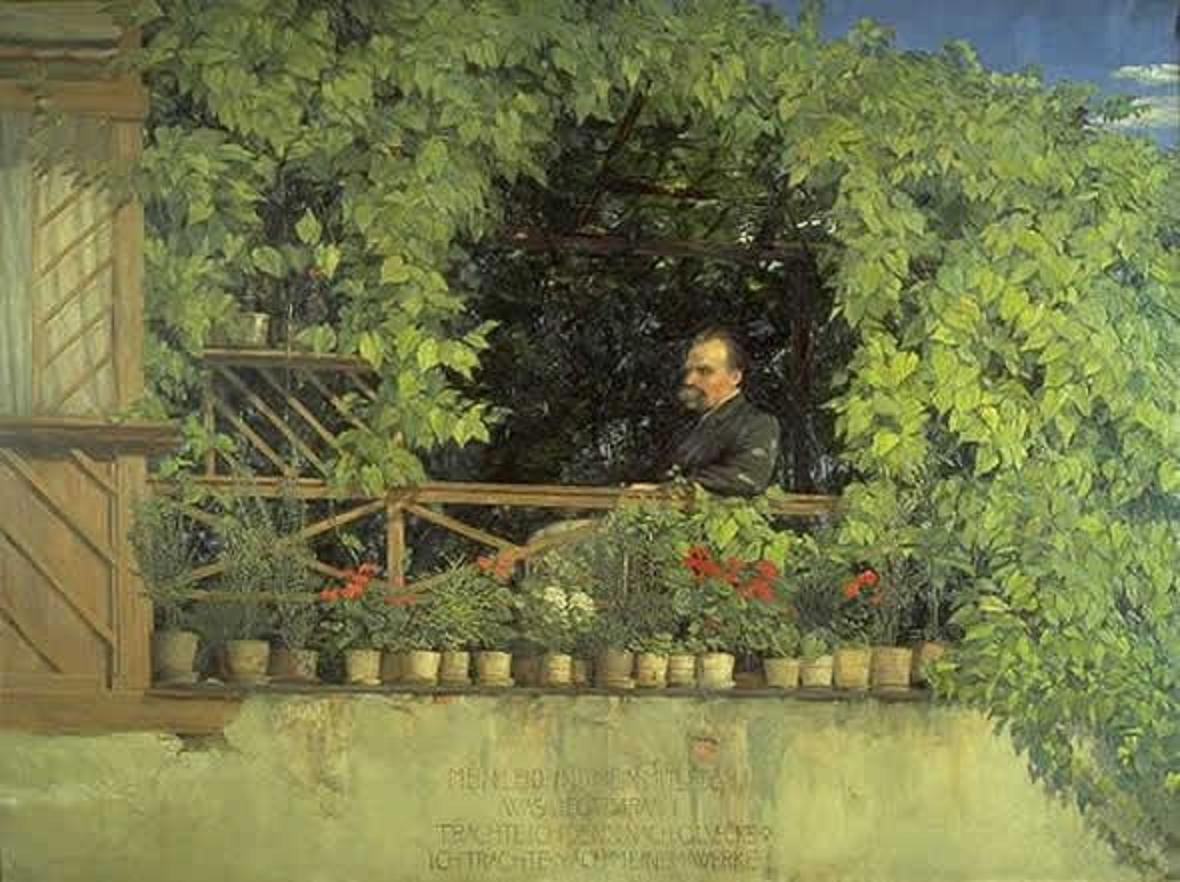
It was up to the painters, writers, architects, carpenters, metal-smiths and musicians of the Vienna Secession to steer the idea of the Gesamtkunstwerk back in the holistic direction. The secession exhibitions went from strength to strength, and soon the wealthy industrialist Karl Wittgenstein was persuaded to finance a headquaters for the movement’s exhibitions – the famous Secession Haus in Vienna designed by Joseph Maria Olbrich, the temple of this new nobility, and a shrine to the autonomy of these higher men. The art exhibitions, which were the altars in this temple of holism, did not dictate a style to its audience, but rather set a stage for the exercise of their autonomy, a place for us to think for ourself. The background was thus no less important than the foreground, and the architecture alongside the design, the furniture, the murals and friezes, the tickets and catalogues, the garden and carperts: no detail was too small to notice and no pain too great to take. But in no sense did the Vienna Secession’s Gesamtkunstwerk dictate interpretations, promote a politics, or champion or exclude any ethnicity or nationality. It celebrated the multicultural diversity of Vienna as its greatest asset, and aimed to find a new style of its own as a whole.
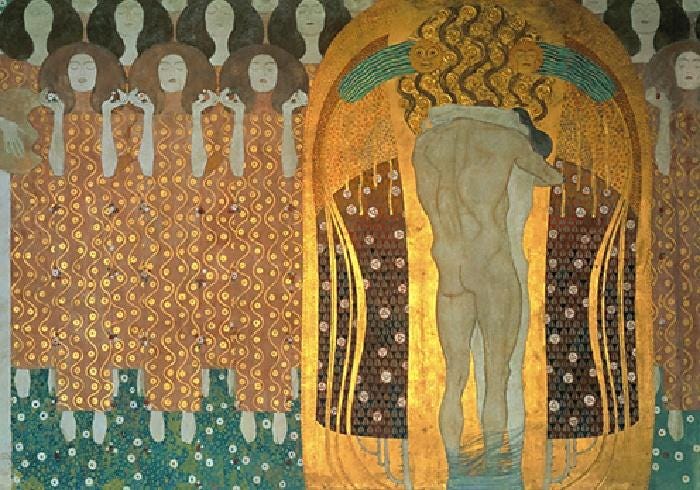
Beethoven frieze: detailed analysis, bringing out the balance of monumental, antiquarian and critical elements. Culminating motif: the “globe” of spirit emanating from the embrace of the lovers, echoed by the gilded dome atop the building. But it is also echoed in a different way by the sphinx in the background of the “philosophy” panel of the faculty paintings that the University of Vienna hated so much. In section 9 of the Birth of Tragedy Nietzsche had spoken of humanity as “that Sphinx of two species” – meaning that there is this riddle we call desire, and that this riddle is in the background of our being human. Klimt puts this Sphinx in the background of his Philosophy panel, but he also put the grinning huge ape in the middle of the Beethoven frieze. And here we touch on the meaning of aesthetics for Nietzsche. Just as our simian ancestors could not have imagined what it was about their body that would open the window of opportunity through which they would be able to leap (namely, their vocal chords), we can not grasp what it is about our bodies that contains in rudimentary form the potentials which open portals to a higher level, a potential Nietzsche calls by a term he appropriated from Goethe, Übermensch. But Nietzsche’s evolutionism is not Darwinian – he does not see a teleological progress in evolution, but a kind of unfolding of inner complication. Nietzsche’s model is not the sequence of gradually more erect apes culminating in homo sapiens familiar from old school textbooks, but rather the Russian Babushka dolls, recursively nested one inside the other. We all have our inner ape, but it has its inner monkey, which in turn has its inner possum, which has its inner mole, which has its inner fish, which has its inner jellyfish, which has its inner colony of single cells. We all carry our history within us, and it is all operative “down there” the whole time.
This living whole of history, this “community of souls” that we call the body already has capacities in a rudimentary form that we cannot yet comprehend. Art is our way of expressing this situation, and the invention of drama in ancient Greece stages this realization that we grope along the limits of literality and figurativity, seemingly with a foot on each side, when we undergo aesthetic experience. Now Klimt was no scholar, but Nietzsche comments in his last work in 1888 that word had reached him that he had been “discovered” in Vienna and that his work was being read there. To be “discovered” in Vienna at that time meant that you were read and discussed in that city’s famous cafes, legendary institutions which functioned almost like an informal university, and a dispersed forum of public debate and intellectual foment. Klimt absorbed Nietzsche’s thoughts not through study but by having them explained to him by those who had read him. Yet the Philosophy panel of the faculty works seems too close to these ideas of Nietzsche’s to not see an influence. A ladder of life seems to climb up itself, the bottom slipping endlessly into the mortal decay of senility, but the top growing at the same speed into the fountain of youth in the newborn child. And behind it all in the background is the riddle of desire.
Apart from his revolutionary work with the Vienna Secession, Klimt followed the riddle of desire through a series of commissions for portraits, which introduce a striking innovation in the history of art. The Klimts had always worked with metal, and experimenting first with abstract motifs on the frames of his works, he gradually began to translate mosiac-like techniques onto the canvas. Abstract designs punctuate the realism of the field, sometimes in the background, sometimes in the foreground, and sometimes oscillating undecidably between foreground and background. We see this in the famous portraits of Fritza Riedler, of Adele Bloch-Bauer, of Baroness Elisabeth Bachofen-Echt, and of Emilie Flöge. In these works Klimt introduces abstraction into western art, as he transmutes impressionism into expressionism. In Klimt’s wake this evolves into full-blown abstract expressionism, but in Klimt, the abstract and the concrete mix in a dynamic balance.
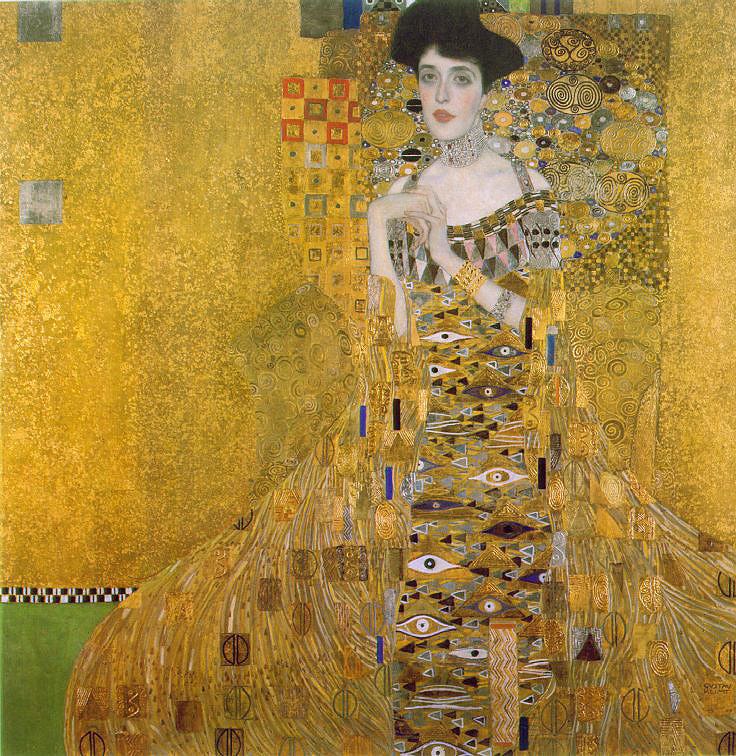
In contrast to the strain of thought running from Hegel to Freud, both of whom taught that everything can and should be made explicit, and that wisdom increases directly as we make everything more and more explicit, Klimt and the Viennese “higher men” (such as Karl Kraus and Adolph Loos) saw that reality always consists of a dynamic of revealing and concealing. “My unconscious knows more about the consciousness of the analyst than his consciousness knows about my unconscious” wrote Karl Kraus. They saw Freud as a scientist trying to invade the sphere of culture. Taking care of the mental health and happiness of a people is the job of culture. Klimt’s work is a revolutionary resistance to Freud’s scientization of the problems of repression, by returning art to its rightful place as keeper of the balance of revealing and concealing, meditating always on the dynamic of the implicit and the explicit. Art is thus the force truly able to conquer the repressive forces of puritanism, not science.
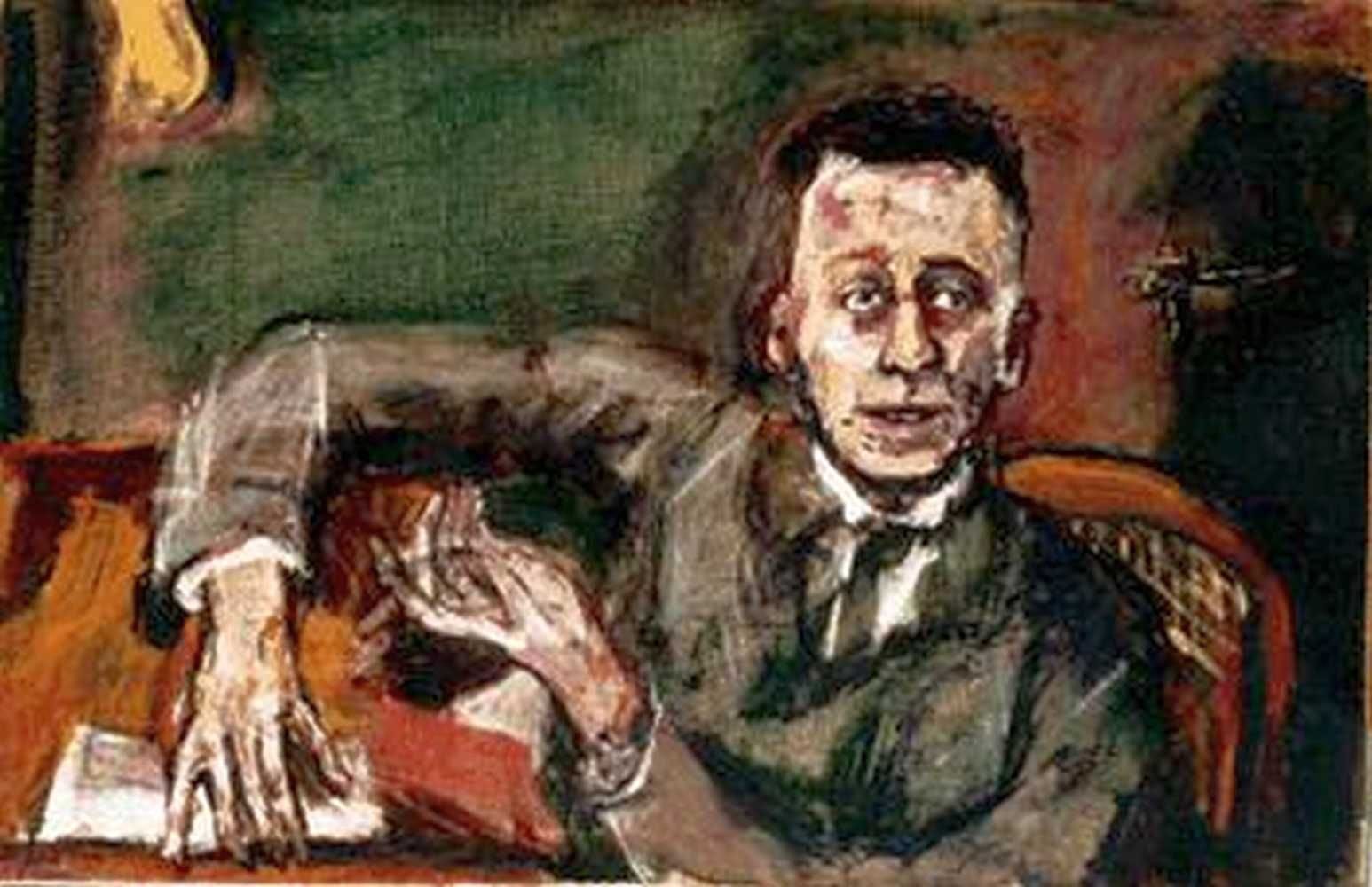
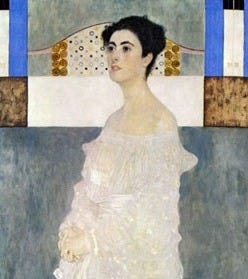
The first of those famous portraits by Klimt combining a mix of abstract and concrete elements which I mentioned earlier was of Margaret (“Gretl”) Wittgenstein. It was commissioned by Margeret’s mother, the wife of the wealthy Austrian steel baron who had funded the Secession Haus, Karl Wittgenstein. His youngest son Ludwig can now finally emerge out of the background and into the foreground of our story. The Wittgensteins were a dramatic and tragic family. Ludwig’s three eldest brothers all committed suicide, and the fourth, Paul, was a concert pianist who lost his right arm in the first world war, and went on to become one of the few famous one-armed concert pianists.
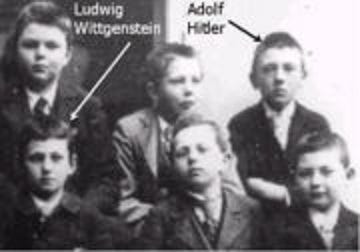
Ludwig Wittgenstein was born in the same year Nietzsche succumbed to his brain tumour – 1889. Ludwig was tutored at home in Vienna until he was fourteen, then sent to a school in Linz. Adolf Hitler, who was the same age, was also sent to the same school in the same year. But once the boys abilities were assessed, young Ludwig was promoted two grades, and young Adolf was demoted one, so they ended up three grades apart in the school, and didn’t know each other very well.
Ludwig showed a talent for engineering, and after school he went to England to study the new science of aeronautics at Manchester. After designing a new kind of propeller, Ludwig grew dissatisfied with the sciences and began to work on the foundations of mathematics and on formal logic. He went back to Vienna and visited Gottlob Frege at the University, who discussed logic with him, and said he should go and study with Bertrand Russell in Cambridge. This he did, making a huge impression on Russell and making friends with Frank Ramsey and other Cambridge philosophers.
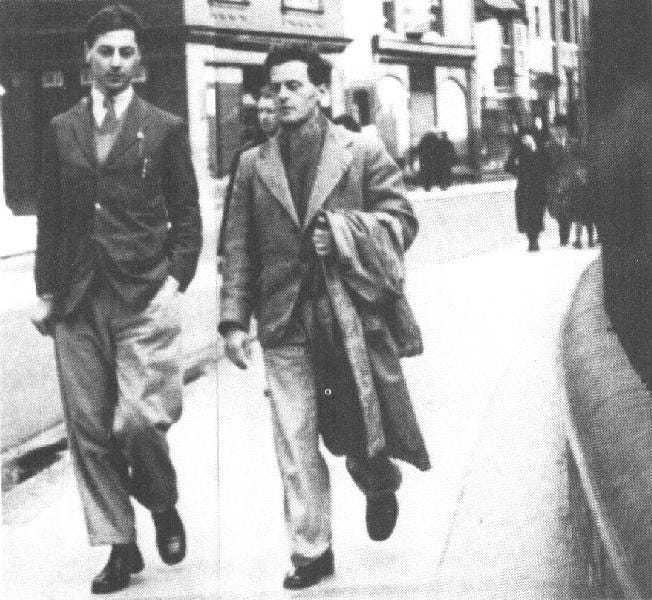
Then in 1911, Gretl moved to London with her new husband, Jerome Stonborough. Ludwig hated Jerome Stonborough, and was largely estranged from Gretl due only in part to her choice of husband. In any case, when Gertl and Jerome moved to London, Ludwig left Cambridge and went to Norway, so afraid was he that they might pay him a visit.
Like The Beatles, Wittgenstein’s philosophy falls into two distinct phases, the early Tractatus which is rigidly formal in its style, and very strict in its content, and the later work in which he has, as we say, let his hair down. The two paradigms – the early and the late Wittgenstein – give us two different perspectives on life in general and on aesthetics in particular, and I’m going to explain their contrast through considering Klimt’s portrait of Gretl Wittgenstein first from the Tractatus perspective, and then from the perspective of Wittgenstein’s later philosophy.
The Tractatus Logico-Philosophicus was not Wittgenstein’s choice of title for his book. The book began in notebooks Wittgenstein began keeping in Norway in 1911, and developed through the next decade, as he moved into the ever more eccentric life-choices Ludwig made, first passing his share of his father’s massive inheritance on to all his surviving siblings except Gretl when Karl died of cancer in his jaw on Christmas day 1911, and becoming a humble primary-school teacher in the rural back-blocks of Austria, and then volunteering in WWI, only to be captured and spending most of the war in an Italian prisoner of war camp. By the time the war was over, Ludwig had completed the remarkable book we now know as the Tractaus Logico-Philosophicus, although he called it Der Satz – “The Proposition.” Luckily for Nick Cave, the publishers to whom he sent this strange work just after the war knocked it back. When G.E.Moore read the manuscript in Cambridge, he suggested the much more imposing title by which we know it today, and organised together with his Bertrand Russell not only to have it published, but also to award the degree of Doctor of Philosophy on the basis of it.
The Tractatus is not about any one proposition, but about propositions in general. It’s main thesis is that all meaningful language can be analysed down to propositions, and that propositions generate meaning by putting names into logical relations with each other, and these are pictures of the physical relations between objects. Logic makes pictures with names, and a true picture is one whose logic is a mirror-image of the actual relations of the objects designated by those names. So propositions are made up of two things: names, and logical connectives. Names are not in themselves meaningful. This is the deep meaning of Shakespeare’s immortal proposition “a rose by any name would smell as sweet.” Names designate arbitrarily, and are just a conventional agreement among language users. They have reference but they are not yet meaningful until we put them in a sentence with other names, and assert something that is either true or false, like, say, “the glass is on the table.” This is called the “picture theory of meaning,” because it explains meaning as making a logical picture of a physical situation.
This picture-theory of meaning is quite compelling from a common-sense point of view. But it seems to have a problem, in that what we think of as some of our most meaningful language, like aesthetics and ethics, is not merely the asserting of propositions about objects. Things like aesthetics and ethics Wittgenstein says are shown by what we say, rather than being statements about objects themselves. Again, this clicks with common sense. Objects in and of themselves are neither good nor bad, beautiful nor ugly. It is rather their use that makes them so. The same knife might be a good thing if you’re tied to a train-track, but a bad thing in the hand of a murderer. The same dress might be a thing of beauty on one woman which it fits like a glove, and an ugly instrument of torture on a woman for whom it is three sizes too small.
Wittgenstein goes all the way with this thought. He says that ethics and aesthetics should be entirely implicit and be shown, not said, and that what can be said be clearly restricted to propositions about objects. This is a kind of formalisation of what we call tact or discretion – that the implicit is crucially important, and that knowing the difference between what should and what shouldn’t be said is the lion’s share of wisdom.
But Wittgenstein is talking about the difference between what can and can’t be said, not just what should and shouldn’t be said. People who say things about ethics or aesthetics aren’t just tactless according to the Tractatus, but actually deluded. They are mistaking meaningless sentences for meaningful sentences, and fatally confused. They act, for example as if there were “good” people and “bad” people, and that the problem with the world was simply to get rid of the bad people. Or they act as if there were “beautiful” people and “ugly” people, and that evolution means getting rid of the ugly people and breeding a world in which everyone is beautiful. These are not innocent confusions. These are the insidious delusions at the root of the Nazis violent programs of social engineering and racist eugenics.
According to the Tractatus, we can’t sort people like objects because people are not objects. People are meanings, or rather whole clusters of meanings called “worlds.” This cannot be said, but it can be shown. In fact we can’t help showing something with everything we say. Our tone, our timing, our context, the balance of what we make explicit and what we leave implicit – all these things always show what we can’t say, and the lesson of the Tractatus is that we shouldn’t try to say it. But of course the Tractatus can’t say this, or it would be contradicting it’s own central claim. It has to show it by not saying it, and indeed there is no aesthetic or moral theorizing in the Tractatus. It aims to show you its aesthetics and its ethics by saying nothing about them but by having them in the background of everything it does say. And one thing it does say is that ethics and aesthetics are the same. The lack of ornament, the crystalline structure of numbered propositions, the strict adherence to meaningful propositions and the utter elimination of all small-talk and gossip.
But this way of thinking has a strange consequence, which is brought out nicely in a renaissance painting by Velasquez of which Klimt was especially fond, Las Meninas. It’s a fascinating painting. The scene depicted is of the painting of a picture of the King and Queen of Spain. But the King and Queen do not appear in the picture, except as reflections in a mirror on the wall at the back of the room. Instead we ourselves as viewers occupy their position, and see the back of a large canvass, and Velasquez himself, brush in hand, staring straight at the King and Queen (i.e. at us), surrounded by the Infanta, and her attendants and various other members of the court. The walls are hung with large portraits, and at the back of the room, Velasquez has painted himself as an older man, leaving the room, halfway out of the door.
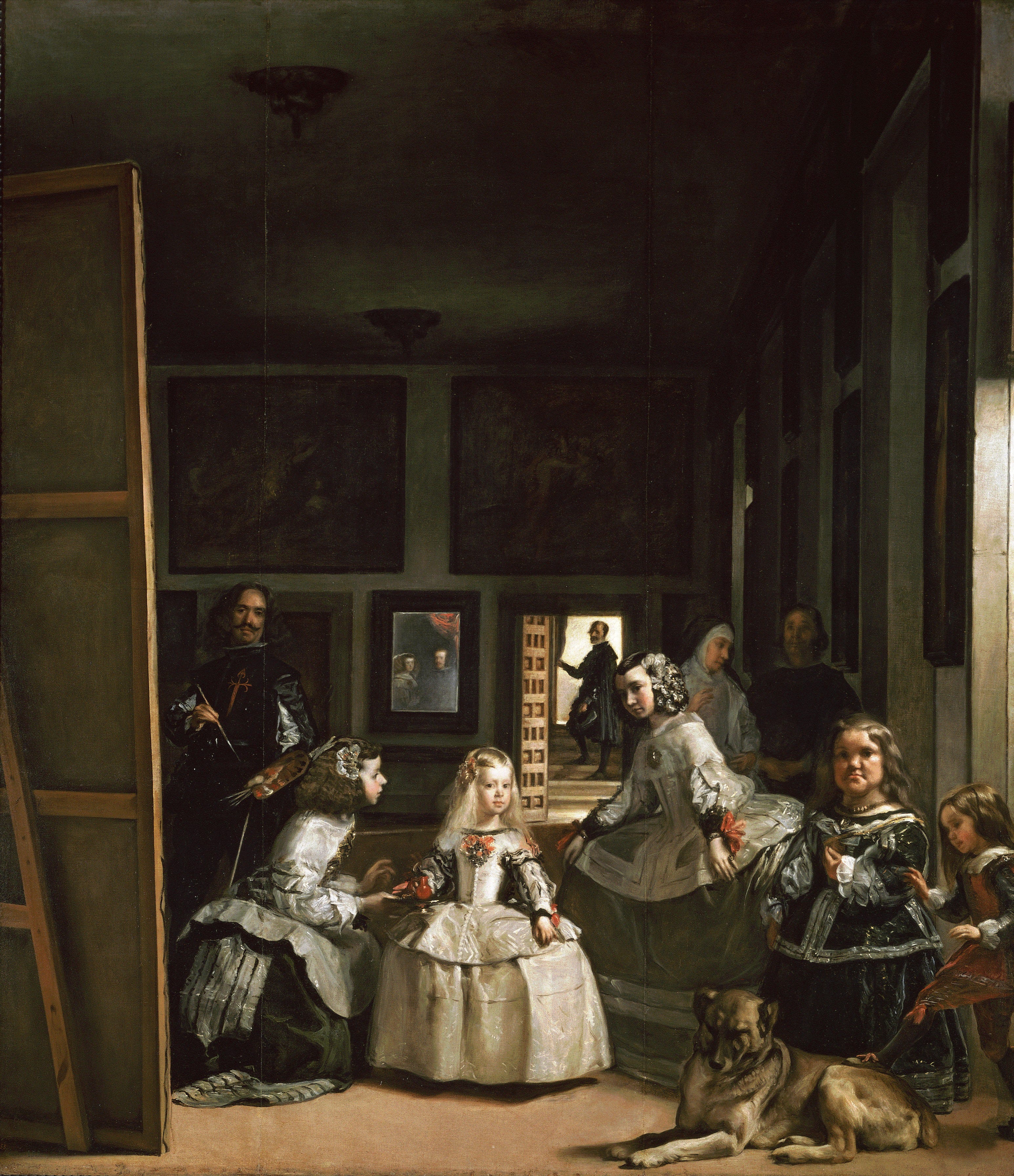
This painting shows that the subject is not an object, and that the subject limits what picturing can do. This is important, for picturing is essential to subjectivity – picturing (representing) is what subjects do, what subjectivity is. But can we picture what picturing itself is? Can we represent representing? Las Meninas shows that we can only do this up to a point. We have pictures in the painting, we have a mirror, we have an artist painting, but the viewer themself must still transcend the representation itself. Representation needs something extra to complete it, something outside the picture looking at it.
Hence the subject is realised to be not something we can picture, but rather as the point around which the activity of picturing revolves. But this activity is a lonely one – it is the very definition of privacy: namely, that your point of view is immediately accessible only to you yourself alone. Others only appear in your world as objects, although we understand that bodies have a meaning which inanimate objects don’t. Other people are meanings, not objects. The “I” is alone with its world – or, in Latin, the “ipse” is “solo.” The solipsism maintained in the Tractatus disturbed many of its readers, as it did its author. It is really this worry that drives the breakthrough into the later philosophy, with what is called the “private language argument.”
But before we move to the later perspective, I want to pause and to look at Klimt’s portrait of Gretl Wittgenstein from the Tractatus perspective. Then we will look at it again from the perspective of Wittgenstein’s later philosophy, and reflect upon whether we see the work differently.
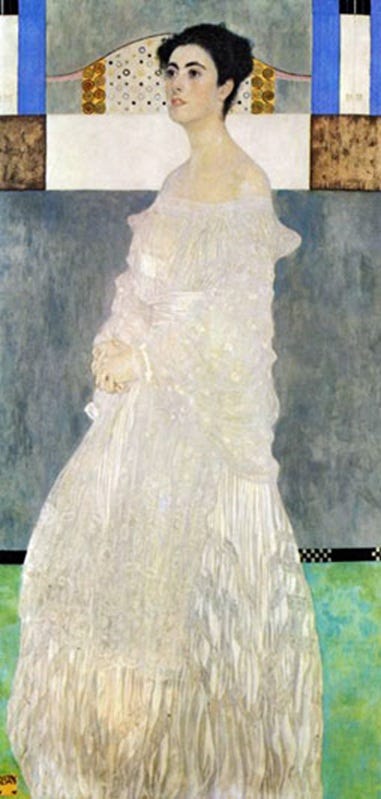
From the Tractatus perspective, we need to ask on the one hand, what this picture says, and on the other, what it shows.
1. What Klimt’s portrait of M.W. “says.”
This portrait is remarkable in the history of art, for it is one of the very first works in which abstraction enters the concrete work of art. The background consists of a regular pattern of rectangular shapes, inlaid with a curved panel of circular designs behind Margaret’s head. In the foreground is the subject of the portrait, gazing at an angle into the middle distance, rather than directly at the viewer. Her face expresses her intelligent mind, but when taken in tandem with the commentary of the hands, their fingers tangled in anxiety, the effect is uneasy, even strained, and her magnificent gown sits uncomfortably off-the-shoulder. What is being pictured here? Gretl herself seems to hover uneasily between a background of abstract thinking and a foreground of glamour. And indeed this pictures her position as on the one hand as a public figure in Viennese society and on the other, an intellect cut from the same cloth as her brothers Ludwig and Paul. Her presence in the painting is more cerebral than sexual (which is unusual for Klimt), and she seems more at home in the abstract composition of the background than the diaphanous silk of her high-society dress. The logic of the painting pictures this juxtaposition, and captures the substantial tensions focussed within this woman. All this it “says.”
This portrait was commissioned by Gretl’s mother as a wedding present, and Margret was not at all happy with it. In fact she had another artist re-paint the mouth, but even so she still didn’t like it, and stuck it in a closet, where it remained until it was re-discovered in the 1950s. Gretl did not like what this painting said about her.
2. What Klimt’s portrait of M.W. “shows.”
This portrait shows several things about both Klimt and Gretl. Firstly, it shows Klimt’s genius for creativity. Klimt had earlier experimented with decorated frames, blurring the line between the inside and the outside of the artwork. But here he could be said to bring the frame into the work itself, by turning the background into a kind of frame. This shows that Klimt is thinking about representation and its limits, about the differences between foregrounds and backgrounds, and also about the difference between the concrete and the abstract, and about how that relates to the difference between the implicit and the explicit. On the concrete side, certain things are made explicit (Gretl’s face), and others left implicit (Gretl’s hands). And on the abstract side, there is also an explicit/implicit balance, but a different one. The abstract patterns make explicit the rigid structure of the Palace Wittgenstein, but also implicitly references the geometric harmony and relative purity of the mathmatical and the musical, the pillar-like windows in black-and-white resembling the piano keys around which the Palace revolved, with musical performances on the two grand pianos in the house every Friday night, always including luminaries of the Austrian musical world.
Wittgenstein finally found a publisher for the Tractatus in 1922, and by then he had given away his inherited fortune, one million marks to deserving impoverished artists, and the remainder to his siblings – all except Gretl. Ludwig had fallen under the influence of Tolstoy, who had published an abridgment and synthesis of the 4 Gospels called The Gospel in Brief, with all the metaphysics removed, and all the social justice and personal moral messages retained. Of all the things significantly not said in the Tractatus but shown all the more clearly the more one understands the work, is the importance of what we confusedly call “God” (see 6.432 – 6.45). And if the meaning of ethics and aesthetics cannot be said, but only shown, then even moreso, the meaning of religion (which is what ethics and aesthetics themselves show) can in no way be put into words. What Wittgenstein does say is “The intuition of the world sub specie aeterni is its intuition as a – limited – whole. The feeling of the world as a limited whole is the mystical.”
Wittgenstein’s implicit experience of the whole leads him not only to renounce his worldly wealth, but also to turn away from academia and become a primary school teacher in the rural backblocks of lower Austria. It didn’t go well, as he hadn’t the patience required for the job. He eventually returned to Cambridge and started teaching philosophy again. His later philosophy is related to his Tractatus phase in somewhat the manner in which the Newtonian physics is related to the Einstinean. So long as we restrict ourselves to local regions, small velocities and everyday objects, Newton is “right” for all practical intents and purposes. Likewise for the picture theory of meaning. Picturing is one of the mundane things we do with language, and if we consider only picturing, then the Tractatus is still kind of “right” as far as picturing goes.
But Wittgenstein came to realise more and more just how much more language does than just picturing. We command, we exhort, we expostulate, we groan and grunt and hum and harr, we laugh and cough and ask and forbid and flatter... There are dozens of uses of language, and to think that they can all be reduced to kinds of picturing is, Wittgenstein came to admit, naïve. Rather than the one activity of picturing, language is rather a family of activities, resembling one another in some ways but not all. If we try to see the big picture, we need a generalised kind of relativity. And this relativity begins with what is called the “private language argument.”
There are various ways to put this argument, but I think the following way gets to the heart of the matter easily. It establishes that there is no such thing as a private language. Compare Robinson Crusoe and Casper Hauser. Robinson Crusoe of course you know. The famous castaway alone on his island still has his experience, same as before he got shipwrecked, right? But not so Casper Hauser. He grew up in a dungeon, never even learning to walk, let alone talk. He was finally liberated at about 40 years of age, and eventually learnt to walk and talk, and when he was asked about “what it was like” before he learnt to talk, he said there’s nothing to tell, because nothing happened. The point is, Robinson Crusoe didn’t grow up on the island. If a child grows up in isolation, it’s not at all clear that they experience the world in the same way. Through many ingenious ways, Wittgenstein shows how language and experience are so deeply entangled that they cannot be separated. What we think of as our most private possessions, our sensations, are not private at all. On the contrary, we experience objects as “what anyone would see if they were here.” This generic accessibility is in fact the hallmark of objectivity. But this means that we have experience only because it is shared. And language is the name of this sharing.
So from this sketchy indication, we can say that from Wittgenstein’s later perspective, the picturing function of the painting – i.e. that it is a picture of the individual Margaret Stonborough-Wittgenstein, who lived in Vienna in the complex Wittgenstein family – this is only one of the painting’s meanings, only one way in which it is significant. It is also, as we’ve touched on, a significant work in the history of art, quite apart from who it is a picture of, due to its introduction of abstraction, an idea which would rapidly flourish through abstract expressionism to become a major feature of modern painting – abstract art. But it is also a significant document of a moment in time (Vienna 1905) and is an artifact which resonates with cultural meaning in the context of that culture at that point in history. Then there’s the painting’s commercial meaning, the facts about who owns it and what its insured for and its provenance.
That’s four kinds of meaning which the painting has – it’s meaning as a picture, its meaning in the history of art, its meaning as a cultural artefact, and its meaning as an economic commodity. Clearly these four are connected, but they are also separate. And this list is not exhaustive – the painting might have other kinds of meanings – say, sentimental meanings to an owner, or scientific meanings to a paint expert, or biographical meanings to a biographer. There are as many meanings as there are systems of meaning-generation which involve this painting, including this use we are engaged in here, using the painting as an occasion for doing philosophy – for thinking about what meanings are, how they are made and shared, how they express forms of life and ways of thought.
This pluralistic painting is thus many things in one canvass. Now think of each of the works in the exhibition in this way, and include the factor that which of these plural meanings emerge is context-dependent. In the exhibition they form one another’s contexts, and so in a sense are able to play these games with each other – to exhibit these interactions, and to enable a multiplicity of meanings to emerge, the more each work is appreciated both in itself and then in its interaction and juxtaposition with the others. The exhibition is a whole, a Gesamtkunstwerk. Now think of what this means in terms of that deep thought in the Tractatus that seeing things sub specie aeterni means seeing them as a limited whole. You cannot see all the exhibition – in all this time, we haven’t even exhausted the single portrait of Margaret Stonborough-Wittgenstein. But you can see the exhibition as a whole – see the whole of the exhibition in each and every piece, but also the exhibition as your exhibition. We all grasp what we can of these brilliant works, and what exactly that is is different for all of us. Each of us makes it a whole in our own way, but we all make it a whole in some way or other. I hope that in these lectures you have been able to deepen and broaden what that whole is for yourself, and that you’ve discovered some new ways to think about the various balances of the implicit and explicit, the background and foreground, the concrete and the abstract, and perhaps also gotten a bit clearer on what wisdom is, and what the love of it is, which is called philosophy. That we can balance and juggle all these multiple meanings and difficult practices not just laboriously, but even playfully and joyfully, that is I think what Klimt teaches us in the end.
We come finally to the question “what is a paradigm?” Thomas Kuhn used this word to designate something like an intellectual epoch, the cluster of scientific theories and sets of values and ways of thinking. But Wittgenstein uses the word more like the ancient Greeks used it. A paradigm is a special sentence which in some way shows the whole of the language. The most familiar one in English is “The quick brown fox jumps over the lazy dog.” This sentence shows the whole of the language in the sense that it uses every letter in the alphabet. A paradigm is a way to see the whole, and of course there are always a multitude of ways to do that. So unlike Kuhn’s paradigms, which are mutually exclusive and displace one another, Wittgenstein’s paradigms are more like languages. Plenty of people know two or more languages. But no one is both a Newtownian and an Einstinian, or both an evolutionist and a creationist. These are two different ways of thinking about paradigms.
But they are not the only two ways. For a paradigm in art is neither one nor the other but is related to both. Movements in the history of art are sequential, but at the same time there’s no contradiction in being both, say, a traditional landscape painter and a cubist portrait painter, or being a trad jazz banjo player in one band, and a heavy metal guitarist in another. So there’s a third way of thinking about paradigms, and clearly we could come up with more if we thought about it.
I’ve bracketed Klimt between Nietzsche and Wittgenstein, because both teach that it is our grammar that is decisive for our ways of thinking and acting, and both teach that the inner/outer distinction is not at all what it seems to be. In Klimt’s introduction of abstraction into his concrete representations, he was implicitly reflecting upon precisely this, and upon how representation works and what its limits are, and upon how representation and symbolism can be juxtaposed in a new way not beholden to the old superstitious religion. Abstraction in representation does not gesture toward otherworldly beings in the way, say, religious symbolism in Renaissance painting had. But it indicates representation’s limits, and shows that thinking does not stop where picturing ends. The aim is not to reveal all, but to see the whole as a balance between what can be made explicit with what remains implicit. Despite all three achieving this balance only in a human-all-too-human way, all three are paradigmatic individuals related by a very strong family resemblance.
link to Klimt and Wittgenstein course page
(with thanks to John Armstrong for proposing my name to give this lecture course)
Tractatus Logico-Philosophicus by Ludwig Wittgenstein
abridged by David Rathbone
Wittgenstein’s original title:
Der Satz - “The Proposition”
1 The world is all that is the case.
1.1 The world is the Gesamtheit of facts, not of things.
1.11 The world is determined by the facts, and by these being all the facts.
1.12 For the Gesamtheit of facts determines both what is the case, and also all that is not the case.
1.13 The facts in logical space are the world.
1.2 The world divides into facts.
1.21 Any one can either be the case or not be the case, and everything else remain the same.
2 What is the case (the fact) is the state of affairs.
2.172 The picture cannot represent its form of representation; it shows it.
2.174 The picture cannot place itself outside of its form of representation.
2.203 The picture contains the possibility of the state of affairs it represents.
2.21 The picture agrees with reality or not; it is right or wrong, true or false.
2.22 The picture represents what it represents, independently of its truth or falsehood, through the form of representation.
2.225 There is no picture which is a priori true.
3 The logical picture of the facts is thought.
3.02 What is thinkable is also possible.
3.1 In the proposition the thought is expressed perceptibly through the senses.
3.141 The proposition is not a mixture of words (just as the musical theme is not a mixture of tones). The proposition is articulate.
3.144 States of affairs can be described but not named,
3.202 The simple signs employed in propositions are called names.
3.221 Objects I can only name. Signs represent them. I can only speak of them. I cannot assert them. A proposition can only say how a thing is, not what it is.
3.262 What does not get expressed in the sign is shown by its application. What the signs conceal, their application declares.
3.3 Only the proposition has sense; only in the context of a proposition does a name have meaning.
4 Thought is significant propositions.
4.001 The Gesamtheit of propositions is the language.
4.003 Most propositions and questions, that have been written about philosophical matters, are not false, but senseless. We cannot, therefore, answer questions of this kind at all, but only state their senselessness. Most questions and propositions of the philosophers result from the fact that we do not understand the logic of our language. (They are of the same kind as the question whether the Good is more or less identical than the Beautiful). And so it is not to be wondered at that the deepest problems are really no problems.
4.01 The proposition is a picture of reality. The proposition is a model of the reality as we think it is.
4.022 A proposition shows its sense. The proposition shows how things stand, if it is true. And it says, that they do so stand.
4.05 Reality is compared with the proposition.
4.1212 What can be shown cannot be said.
5 Propositions are truth-functions of elementary propositions.
5.6 The limits of my language mean the limits of my world.
5.61 What we cannot think, that we cannot think: we cannot therefore say what we cannot think.
5.62 This remark provides the key to the question, to what extent solipsism is a truth. What solipsism means, is quite right, only it cannot be said, but it shows itself. That the world is my world, shows itself in the fact that the limits of language (the language which I understand) means the limits of my world.
5.621 The world and life are one.
5.63 I am my world. (The microcosm).
5.631 The thinking, representing subject” there is no such thing.
5.632 The subject does not belong to the world but is a limit of the world.
5.633 Where in the world is a metaphysical subject to be noted?
5.64 Here we see that solipsism strictly carried out coincides with pure realism.
6 The general form of a proposition is [p, ξ, N(ξ)]
(this says that all complex propositions are compounded out of simple propositions)
6.42 There can be no ethical propositions
6.421 It is clear that ethics cannot be expressed. Ethics is transcendental. (Ethics and aesthetics are one).
6.423 Of the will as the subject of the ethical we cannot speak.
6.43 If good or bad willing changes the world, it can only change the limits of the world, not the facts; not the things that can be expressed in language. In short, the world must thereby become quite another. It must so to speak wax or wane as a whole. The world of the happy is quote another than that of the unhappy.
6.4311 Death is not an event of life. Death is not lived through. If by eternity is understood not endless temporal duration but timelessness, then he lives eternally who lives in the present. Our life is endless in the way that our visual field is without limit.
6.45 The contemplation of the world sub specie aeterni is its contemplation as a limited whole. The feeling of the world as a limited whole is the mystical.
6.5 For an answer which cannot be expressed the question too cannot be expressed. The riddle does not exist. If a question can be put at all, then it can also be answered.
6.522 There is indeed the inexpressible. This shows itself; it is the mystical.
7 Whereof one cannot speak, thereof one must remain silent.
No posts
Comments
Nothing yet. Say the first thing.
Sign in to join the conversation.