On 12 July 2025, I posted the following comment on a video about the notorious scandals concerning Epstein and Trump on a video on the topic on the YouTube news channel The Young Turks (the links in the original comment appear here as embedded videos) :
Trump is covering up a lot more than just a sex scandal. Exhibit A: Donald Trumps’s tangled web of intrigue with the FBI and the KGB goes all the way back to the 1980s. Appointing Patel was just the last step in getting the FBI in his pocket, which began with replacing Comey with Barr.
Exhibit B: corruption was rife at the MCC where Epstein was held after his arrest. He died around 3am, guards found him at 6:33am, and the FBI turned up at 1:30pm and sent the contents of his cell to the laundry to destroy all incriminating evidence.
Exhibit C: Virginia Giuffre told us she was filmed with powerful men for Epstein to use for blackmail
Exhibit D: David Schoen tells us Epstein did not commit suicide, but that he was closely involved with Ehud Barak
This comment was well received and even got highlighted by TYT. It contained nothing particularly new. Both the Slice documentary, and the Crime Waves podcast to which I linked have been on YouTube for about a year, and the other two links, to a “Times Radio” documentary on Virginia Guiffre, and to Zev Brenner’s interview with Epstein lawyer David Schoen, were more recent but still not exactly breaking news. It seemed to me that these four pieces of the Epstein/Trump jigsaw puzzle do somehow fit together, and that it was worth commenting upon the connection between them in the ongoing attempt to try to see the big picture a little more clearly: Trumps alleged history of money-laundering; Epstein’s alleged suicide in the NYC MCC; Virginia Guiffre’s allegation that Epstein filmed her with powerful men whom he subsequently blackmailed; and Epstein’s alleged ties to Israel in general, and Ehud Barak in particular.
As indicated in a previous post I made on my blog, I had for some time been attempting to make non-trivial comments on YouTube videos which interested me: mostly philosophy videos related to Kant or to Nietzsche, but sometimes on videos of a more political nature. The number of comments I had posted was approaching one thousand across several years. None of them were the trivial one-liners typical of YouTube comments; all were at least a few sentences long, with some approaching a page in length. I had been meaning for some time to convert more of what I thought were the more interesting of these into blog posts, but unfortunately was yet to get around to it.
There is a widespread misconception that YouTube comments are moderated by human beings, located somewhere or other in Google headquarters. But with roughly two and a half million videos uploaded to YouTube each and every day (that’s about two thousand per minute), and with many of these videos having hundreds or even thousands of comments, it would take millions of individuals working around the clock to read all of those comments. Obviously, this is not happening. But it is a task ideally suited to AI. Clearly, it is “the algorithm” which runs YouTube, and not human beings, and AI is moderating the comments.
Immediately after posting the above comment, every further comment I made got deleted. After a while, I tried to query this with the YouTube automated assistant. But trying to reason with AI is like hitting your head on a brick wall, for the fact of the matter is that AI cannot think, and trying to reason with it is like talking to an idiot, and what’s worse, a dogmatic idiot. After a short exchange, my account was summarily deleted without warning for “spamming,” along with every comment I had ever made. At a guess, I would say that each comment averaged about 100 words. So that’s approximately a hundred thousand words of writing down the tube, so to speak – an entire PhD’s worth!
It must be admitted that commenting on YouTube videos, if you’ll pardon a crude phrase, is like pissing in the ocean. One’s words are swallowed up in the deluge of content pouring out every moment and swept away with the mind-boggling mass of dross spewed forth by what is misleadingly referred to by YouTube as a “community.” Hence my idea to try to preserve at least some of what I had written as posts on my blog. Unfortunately, I had not thought to download my archive of comments, assuming naively that they were safely stored away in my Google account for future reference. C’est la vie.
I may yet try to reconstruct a few of what I think were some of the more significant ones, such as the long one I wrote attempting respectfully to explain to Mister Plastic Pills why he doesn’t actually understand Kant on objectivity/subjectivity and radically misrepresents him; and another on I-forget-which-channel concerning Bonhoffer’s fascinating theory of stupidity, which actually did trigger a somewhat interesting exchange between a group of commentors, although, as I said, it can’t really be called a “community,” because everyone’s anonymous, and so it is actually a simulacrum of community.
The interesting thing here is the exact nature of the one comment that the YouTube AI decided was beyond the pale, which fortunately I did save before it was deleted along with my account. Because although I am more or less a nobody with zero social media “influence,” the algorithm nevertheless identified me as enough of a threat to target me, eliminate me, and presumably put me on some kind of list or other. Any lingering doubt I had regarding the significance of what I had said is now effectively dispelled: this censorship demonstrates that I must in fact have put my finger on something of some significance and actually did touch upon some kind of raw nerve. The comment in question contained four distinct claims.
The claim that Donald Trump was laundering money for the Italian and Russian mafias in New York in the 1970s and 80s is made in the excellent documentary I linked to, entitled An American Affair: Trump & the FBI (2020, directed by Fabrizio Calvi & David Carr-Brown). This documentary is worth watching in full: highlights include Woody Guthrie’s song about Trump’s father; the clip of Trump on Letterman saying that the mafia are “very nice people, you just don’t want to owe them money”; the emphasis on what Trump learnt from Roy Cohn; and especially, the allegation of Trump’s laundering of the proceeds of crime for David Bogatin and associated Russian mob figures. As former FBI agent Jim Moody puts it: intentional blindness in receiving money for real-estate purchases “two or three times” might be explained away, but Trump, says Moody, did this over thirteen hundred times:
This is a spectacular allegation. Trump having served a kind of apprenticeship with RoyCohen explains a great deal concerning Trump’s modus operandi during his second term as President: ruthlessly persecuting political opponents in a manner reminiscent of Putin sending Alexei Navalny to Siberia; making tariff “deals” with countries around the world by sending them letters detailing “an offer you can’t refuse”; appointing a cabinet of bimbos and himbos all blatantly unqualified for their position, their only real credential being obsequious obeisance to The Don with “apprentices” all living in fear of his catchphrase “you’re fired!”; taking control of both the FBI and the DOJ, a tactic straight out of the mafia playbook’s chapter on the importance of getting law enforcement in your pocket. Even mainstream commentators are saying Trump’s recent failed attempt to indict James Comey after firing his daughter amounts to Trump “acting like a mafia boss.” And now, under blatantly false pretexts, Trump is deploying the American military against his own citizens first in LA and DC, and now in Portland. Perhaps he’s been watching Portlandia and feels the need to express his outrage. But joking aside, he question remains, why this counts as a seditious insurgency, while this does not.
Declan Hill’s ‘Crime Waves’ podcast out of the University of New Haven on the Epstein case is really worth listening to. Reviewing the evidence (forensically, not conspiratorially) seems to me to substantiate the second claim beyond reasonable doubt; that Epstein was in fact was murdered
Was it to prevent him turning informant in order to cut a plea deal? Or was he murdered by Nicholas Tartaglione, the fellow prisoner who was a crooked ex-cop with a penchant for strangling people? I don’t know. But the disturbing thing is just how thoroughly the myth of his suicide has been established as the “truth” by the ludicrous duo of Cash Patel and Dan Bongino, and how dogmatically and uncritically mainstream media subsequently asserts that his death was a suicide. And how ready it is to attack anyone who thinks otherwise as a “conspiracy theorist.”
The third claim is that Epstein was engaged in blackmail. The tragic Virginia Giuffre specifically told us that she was filmed having sex with powerful men for Epstein to use for blackmail
. The question is what has happened to those thousands of video recordings which Epstein made through the elaborate CCTV setup in his Manhattan residence, recordings which the FBI seized from his safe soon after his arrest? The shocking thing is not that Epstein was murdered (hardly all that surprising), but that his video recordings have now disappeared, and that Cash Patel is so blatantly covering this up.
My fourth and final claim is that all this seems somehow to involve Ehud Barak, a general in the IDF and Israeli politician who was the Prime Minister of Israel from 1999 to 2001 as well as the Minister of Defense and leader of Israel’s Labor Party, then serving a second term as Defense Minister from 2007 to 2013. Financial ties between Epstein and Barak run deep, and involve business activities of Israeli surveillance companies in the Ivory Coast, Mongolia and Syria:
The brilliant Whitney Webb is one of the best tour-guides for a deep dive down this warren of rabbit holes:
Hers is a much greater grasp of the intricacies of this endless web of deceit, crime and intrigue than I could hope (or actually desire) to attain. But although rich in detail, Webb’s knowledge of the philosophical concept of panoptic power is lacking, as she herself admits. As Foucault elaborated in his book Discipline and Punish, Jeremy Bentham’s idea for a prison which he called the Panopticon was laid out as a circular building with the prisoner’s cells positioned around the rim, and the guard’s quarters in the centre at the hub. The plan was that the guard could see into each prisoner’s cell, although any given prisoner could not know if at any point in time if they were actually being watched or not. The actual surveillance was less important than establishing in the mind of the prisoner the permanent possibility that they might be being surveyed. Thus the prisoners’ consciousness would be shaped by this permanent possibility, and a kind of paranoia could be installed in their mind as a tool of discipline, so that in effect the prisoners would discipline themselves, and the jail could be staffed by only one guard, or even no guard, so long as the prisoners believed that a guard was there, and might possibly be watching them at any given point in time.
In fact, Jeremey Bentham’s Panopticon was never actually built in the UK, although one was one eventually constructed in Australia: Perth’s Roundhouse Prison. In the long run, it was not with bricks and mortar that Bentham’s idea was instantiated, but with wires and lenses, with the development first of CCTV technology, and then later, with today’s achievement of total surveillance in the form of the internet, virtual currency, mobile phone technology, and keeping track of it all, artificial intelligence, now achieving more or less constant surveillance of everything everyone does all the time.
From this perspective, the interesting question concerning AI is not so much the abstract philosophical one of whether AI is conscious, but the more concrete one of what AI’s instantiation of panoptic power does to our own thinking. It is not so much a question of how this panoptic surveillance controls us “from the outside” which is interesting, but how it disciplines us “from within,” the impact it has on our form of self-consciousness, and how it is slowly reshaping what power is, and what our own consciousness and self-consciousness are becoming.
To reflect critically upon this, we need first to get clearer on what power itself is. Nietzsche’s definition is Foucault’s starting point, that power is the feeling of being obeyed. There are thus not only quantities of power, Nietzsche tells us, but also qualities of power, lower and higher forms of power. A king, for example, who is obeyed out of fear possesses a relatively low form of power, whereas a king who is obeyed out of love possesses a higher form of power. The higher form or quality of power is more powerful, because obedience out of fear is an unstable kind of power. The subjects obey because they have to or else, but given the chance, they will disobey and rebel and try to throw off the yolk of tyranny. Even lower is the mere bully, who commands a grudging obedience withdrawn as soon as possible. But the king who is loved enjoys a higher quality of power, because his subjects will not only offer the minimum of obedience, but actually be trying to think of ways to show more obedience, to find better ways to show loyalty and respect because it is genuinely felt.
And so lower forms of obedience are obsequious and insincere (what Nietzsche calls base) and are sickly and weak and constantly plagued by the fear of betrayal, whereas higher forms are more genuine and stable (what Nietzsche calls noble), establishing a healthy will to power which grows ever stronger like a healthy tree. Panoptic power is thus weak for it devolves upon coercion, whereas autonomous power is stronger because it is rooted in freedom. Insofar as modernity concerns the overcoming of slavery, it can be described as the internalization of the master-slave relationship. Rather than being either a master or a slave, the modern individual masters themself and serves their own ends. This internalization can be either healthy or sick, noble or base, grounded in fear or in love, in an alienated self-consciousness or an integrated self-consciousness.
Although prevailing wisdom would have us think that religion and politics are two separate spheres, Nietzsche in his section §472 of volume I of Human All Too Humanentitled “Religion and Government”helps us to understand the continuity between the two, a continuity which has now become so clearly manifest in Trump’s America. The panoptic self-disciplinary consciousness is in a sense a transition of a religious idea into a political reality. It was once believed to be only God who saw into the minds of all men, and a core aspect of Christian religious belief was the conviction that this is so. The evolution from the polytheisms of ancient Egypt, ancient Greece, or the archaic polytheistic religion out of which Judaic monotheism evolved, to the Neoplatonic Christianity of Augustine at the root of today’s Christianity, is the shift from a community of gods who are primarily concerned with the relationships of power and struggle between each other, dramas which only incidentally involve human beings, to a lone creator deity intimately concerned with each and every mortal, and aware of all the goings-on within each of our hearts and minds. Like the prisoners in the panopticon, Christian self-consciousness is an awareness that one exists in the permanent possibility of being monitored.
The inherent tension of the Christian religion is rooted in the conflict between two interpretations of this situation, interpretations which might be called the gnostic and the Platonic interpretations. Under the gnostic interpretation, two roughly equal principles are at war, God and Satan, and Christian self-consciousness is permeated by the fear of judgement day, upon which one’s life will be weighed in God’s balance, and one’s soul will then be sent to heaven, which is under God’s rule, or to hell, which is under Satan’s. Under this interpretation, God’s power is a mixture of love and fear, of the noble and the base, the higher power of love and the lower power of fear. But under the Platonic interpretation, there really is no opposite principle to divinity, the Devil being only a fallen angel, in other words, a rebellious creature who does not represent an alternative to God’s love, but can at most reject it, angels having been created free as also are humans. This construes God’s power as higher, based solely upon a love which is not mixed with fear, and limited only by the freedom free creatures have to reject that love.
Those who think that they can understand an author by reading only the titles of his works and by rehearsing a few catch phrases gleaned from a cursory skim through his pages sometimes think that they understand that Nietzsche was a bombastic iconoclast who claimed for himself the provocative title of The Antichrist, pronouncing “God is dead,” and leave it at that. But those who have read his works carefully and as a whole understand that Nietzsche’s revaluation of Christian values not only respects Jesus of Nazareth as “the noblest human being” (Human All Too Human I §475), but that Nietzsche’s project is motivated by Jesus’ scorn for the “priestly ruse,” epitomised in the gospels by the Pharisees, who Jesus attacks – in fact, the only people Jesus attacks at all, who is otherwise a consummate pacifist, teaching his followers to repudiate the militaristic value of revenge, and to replace it with the pacifists’ virtue of forgiveness, always “turning the other cheek.”
Nietzsche tells us in The Genealogy of Morals that somewhere back in the mists of prehistory, the priest worked a revaluation of heroic values. The hero sacrifices the comfort of the quiet life of the individual for the sake of higher values, such as protection of the community, or winning love. The suffering experienced by the hero is real, but its meaning is sublimated into a trial that he overcomes, and by which he is eventually made stronger. But the priest redefines the meaning of sacrifice. Unlike the hero who puts his own life on the line, the priest takes a vulnerable individual and lays them on the alter, and then murders them in front of the community, who are traumatized by the spectacle. The priest says that he has “given” the sacrificed individual to invisible higher beings (the gods), who will now be more kindly disposed to the community, having been propitiated by the offering, and the traumatized community believe him.
The priest’s revaluation of the heroic ideal is called by Nietzsche“ascetic idealism.” Ascetic idealism is an idealization of the meaning of suffering. Under the heroic ideal, the meaning of suffering is sublimated into a self-affirming overcoming: as the sports coach still says to his team to this very day, “no pain, no gain.” But under the priestly ideal, suffering is used as a bargaining chip in an imaginary transaction with supposed higher beings, who the priest asks his community to believe have power over them. This would be akin to a team member returning to training a week later and showing the coach self-inflicted burns on his arms and cuts on his legs, saying “look coach, I have been suffering all week, look how much I have gained through my pain!” Of course, the coach can only slap his forehead and groan “no, no, no, you don’t get it – I didn’t mean pain for its own sake, I meant overcoming the unavoidable pain involved in training hard every day.”
The name “Jesus Christ” is typically misunderstood to be a first name (“Jesus”) and a surname (”Christ”). But it is not. To the historic individual’s name “Jesus” (an Aramaic contraction of Joshua ben Joseph of Nazareth) the descriptor “Christ” (the Greek word for sacrifice) was later appended by the concerted Pharisee Paul of Tarsus some 50 years later. In other words, Paul named his lord “Jesus the Sacrifice” as he invented the Christian priesthood, and built this name “Jesus Christ” into the foundations of the new religion of Christianity. In this new figure of Jesus Christ, the priestly ruse thus folds back on itself in a symbolic manner.
Here we arrive at the heart of Nietzsche’s project of revaluing Christian values. Nietzsche is the opposite of a fundamentalist Christian, but he is also the opposite of an atheist. The atheist believes that nothing in the bible is true; the fundamentalist believes that everything in the bible is true. Nietzsche’s view is that nothing in the bible is literally true, but that everything in the bible is symbolically true. This is a very different “opposite” to the sense in which an atheist is the “opposite” of a fundamentalist Christian. Unlike the atheist who is anti- Jesus Christ, or the fundamentalist who is pro- Jesus Christ, Nietzsche’s position is pro-Jesus but anti-Christ. In other words, he thinks that the Christ part of the “Jesus Christ” hybrid is the Pharisee’s posthumous revenge upon Jesus of Nazareth, the priestly ruse trying to get the last word, and trying to undo the radical ethical work Jesus of Nazareth had done.
The clue to this opposition is also found in Human All Too Human I §475. In the very same sentence in which he calls Jesus “the noblest human,” he called Spinoza “the purest sage.” This is because like Spinoza, Nietzsche tells us that we don’t yet know what a body can do.
Imagine if you will our distant simian ancestors, hanging out in a tree, and a genie appeared to them and granted them three wishes for how they would like to evolve. One of them might ask for longer and stronger claws and teeth. Another of them might ask for an extra hand on the end of its tail. Another, for thicker hair to keep it warmer in winter. But would it occur to any of them to ask for slight changes in their vocal cords so they could make more subtle and nuanced sounds come out of their mouths? Never. Surely, the apes would think that would be a waste of a wish. And yet we, with the benefit of a few million years hindsight now know that the evolution of language was the key to opening the window of opportunity through which our amazing evolutionary history leapt. Point being that from the ape’s point of view, language was literally inconceivable, but from our point of view, language is crucial.
Shifting this imaginary thought experiment forward to ourselves, we can see what both Spinoza and Nietzsche mean when they say that we cannot yet know what (else) a body can do. And we can thus see what is wrong with the whole “transhuman” or “posthuman” nonsense we hear so much about. All of our ideas about how human beings could be improved upon are, as Nietzsche puts it, “human-all-too-human,” just as the ape’s ideas would have been “simian-all-too-simian.” If the apes had been in charge of their own evolution, they would have remained stuck on a simian level, and in fact prevented the evolutionary innovations that actually did eventually take place, resulting in us. And likewise, if we think we should take charge of our own evolution and “improve” the human animal that we are, we shall just as surely remain stuck in our own human conceptions of what we “should be”, rather than allowing the actually inconceivable evolution which will eventually inevitably occur.
Without presuming to comprehend what higher capacities we might possess in rudimentary form today, Nietzsche’s hint is that our symbolic capacity is in a sense what makes us interesting animals. The bible, along with all religious writings, are in way screens upon which the human race has projected its symbolic faculties. Upon these screens we have shone our collective imagination. The transhumanists just like the fundamentalists think that we understand what this means, and that in our religious texts we have a literal blueprint for utopia, and what’s more, a utopia which is approaching either through technology or through eschatology. But Nietzsche is much more modest: all these mythologies he thinks are necessarily elusive and not at all something we can approach through trying to get there. Nevertheless, they do show us symbolic truths if we can “bring them down to Earth” as he says. This is a little like Ludwig Feuerbach’s earlier attempt to preserve a Christianity free of metaphysical superstition. Feuerbach maintained that we should in sense become atheists, but instead put Man in the place once occupied by the superstition we used to call God, maintaining that we should still go to church every Sunday to pray, but that instead of praying “I believe in God the Father almighty, maker of Heaven and Earth, and in his son Jesus Christ… etc.,” we should instead recite the prayer “I believe in Man the Father almighty, maker of Heaven and Earth, and in his sons and daughters, you and me… etc.”
To Nietzsche, Feuerbach’s new religion of Humanism is hopelessly naïve, for “Man” in this sense is no less of a superstition than was the old “God” – an idealized abstraction just as prone to uncritical veneration and no less immune to the pitfall of literalism. So he wrote his Zarathustra with its myths of the Übermensch and eternal return(which only a fool would take literally), as a work of sheer symbolism, and its value is strictly symbolic, intended as a paradigm for all interpretation. It makes us interpret, and reminds us that interpretation is our higher faculty, our ability to be creative in mythology.
Likewise, for Nietzsche the bible’s value is wholly symbolic, and its virtue and its value is to be found only through its interpretation as symbolism. The bible’s historical accuracy is irrelevant, no more relevant than the literal accuracy of your dreams. The naively superstitious might take their dreams as literal, thinking they are some sort of second sight or extra-sensory precognition. But the critical thinker understands them as symbolic, standing in need of interpretation if their meaning is to be understood. The most we can say is that in the myths of God which we find in the bible, divinity is symbolized, and through interpreting this symbolism, we can come to understand ourselves and our higher capacities in a new way.
It is in this spirit that we can approach such bible verses as the following in the context of interpreting the astonishing developments in American politics represented by Christian Nationalism (or Christian Zionism) in general, and Donald Trump in particular, and reflect critically upon what all this has to do with artificial intelligence.
Matthew 13:12 “For whosoever hath, to him shall be given, and he shall have more abundance: but whosoever hath not, from him shall be taken away even that he hath.” Matthew 25:40 “And the King shall answer and say unto them, Verily I say unto you, Inasmuch as ye have done it unto one of the least of these my brethren, ye have done it unto me.” Matthew 6:24 “No man can serve two masters: for either he will hate the one, and love the other; or else he will hold to the one, and despise the other. Ye cannot serve God and mammon.” Matthew 19:24 “And again I say to you, it is easier for a camel to go through the eye of a needle than for a rich man to enter the kingdom of God.” 1 Timothy 6:10 “For the love of money is the root of all evil: which while some coveted after, they have erred from the faith, and pierced themselves through with many sorrows.”
In a nutshell, what verses such as these symbolize is the location of the roots of evil not in any natural scarcity of resources, but rather in what the poet Robert Burns back in 1784 aptly called man’s inhumanity to man. The innovations in technology which have exploded since then, far from ameliorating this inhumanity, have only intensified it and moved it into ever more subtle domains, until today, in the words of Whitney Webb: “the goal is to completely erode privacy.” She is in effect restating without realizing it what Nietzsche had said in 1878 in Human All Too Human I §472 regarding “the abolition of the distinction between private and public.”
In the post with which I inaugurated my Critical Idealism blog in 2009, Nietzsche’s Concept of Chaos, I pointed out that to call Nietzsche a “prophet” is a radical falsification of his thinking:
As early as 1872, Nietzsche pointed out that the role of prophet was not one with which he was comfortable. “The ‘prophet’ pose”, he said, “is such a presumptuous one that it seems almost ridiculous to deny that I have the intention of adopting it” (On the Future of Our Educational Institutions, translated by J.M.Kennedy in Levy (ed.) The Complete Works of Friedrich Nietzsche vol.3 , introduction, p.10.)
More accurately we should call Nietzsche “sensitive” like an animal somehow aware of an approaching storm long before most of us dull humans (as he says in Gay Science #316). Human All Too Human I §472 is another striking example of such sensitivity, in which Nietzsche tells us he senses the approaching privatization of the government’s functions, and the transfer of public wealth to the private sector, a movement of political culture which has become ubiquitous today. This passage from 1878 seems to be describing the American political landscape of 2025 so well that it deserves to be quoted at length. Nietzsche tells us that he sees developments coming in which
… the people who are still moved by religion, and who used to adore the state as something half-divine or wholly divine, develop an attitude decidedly hostile to the state; they attack government measures, try to impede, cross, disturb as much as they can, and because their opposition is so heated, they drive the other party, the irreligious one, into an almost fanatical enthusiasm for the state; also contributing secretly to this is the fact that, since they parted from religion, the nonreligious have had a feeling of emptiness and are provisionally trying to create a substitute, a kind of fulfillment, through devotion to the state. After these transitional struggles, which may last a long time, it is finally decided whether the religious parties are still strong enough to resurrect an old state of affairs and turn the wheel back -- in which case, the state inevitably falls into the hands of enlightened despotism (perhaps less enlightened and more fearful than before) -- or whether the nonreligious parties prevail, undermining and finally thwarting the propagation of their opponents for a few generations, perhaps by means of schools and education. Yet their enthusiasm for the state will also diminish then. It becomes more and more clear that when religious adoration, which makes the state into a mysterium, a transcendent institution, is shaken, so is the reverent and pious relationship to the state. Henceforth, individuals see only the side of it that can be helpful or harmful to them; they press forward with all the means in their power to get an influence over it. But soon this competition becomes too great; men and parties switch too quickly; too impetuously, they throw each other down from the mountain, after they have scarcely arrived at the top. There is no guarantee that any measure a government puts through will endure; people shy away from undertakings that would have to grow quietly over decades or centuries in order to produce ripe fruit. No longer does anyone feel an obligation toward a law, other than to bow instantaneously to the power that introduced it; at once, however, people begin to undermine it with a new power, a new majority yet to be formed. Finally (one can state it with certainty) the distrust of anything that governs, the insight into the uselessness and irritation of these short-lived struggles, must urge men to a quite new decision: the abolition of the concept of the state, the end of the antithesis “private and public.” Step by step, private companies incorporate state businesses; even the most stubborn vestige of the old work of governing (for example, that activity which is supposed to secure private parties against other private parties) will ultimately be taken care of by private contractors. Neglect, decline, and death of the state, the unleashing of the private person (I am careful not to say “of the individual”) -- this is the result of the democratic concept of the state; this is its mission. If it has fulfilled its task (which, like everything human, includes much reason and unreason), if all the relapses of the old illness have been overcome, then a new leaf in the storybook of humanity will be turned; on it one will read all sorts of strange histories, and perhaps some good things as well.
The problem of corruption is not so much a matter of corrupt individuals, but rather the problem of a corrupt culture, a kind of “innocent corruption” which, as Nietzsche says, “flourishes like a fungus” (Human All Too Human I §468). Exploitation is now normalized throughout the whole world (West, East, North and South) standing as an icon of the system pioneered by the mafia, and at the apex of which Donald Trump perches precariously like Scrooge McDuck counting his gold, gloating in the glow of the inhumanity which has propelled him upwards. What Netanyahu does not understand any more than does Trump is that Christian values and Jewish values cannot be conjoined with a simple hyphen into “Judeo-Christian values,” but are in fact diametrically opposed – Judaism valuing revenge, whereas Christianity teaches “turn the other cheek” (Matthew 5:38); Judaism valuing the exclusive electivism of a chosen people, whereas Christianity values universalism (“go and make disciples of all men”); Judaism valuing the accumulation of wealth, whereas Christianity teaches that one cannot serve two masters, God and Mammon, and that the love of money of the root of all evil; Judaism being militaristic, whereas Jesus is the pacifist par excellence (except for overturning the money-lenders’ tables in the temple). All this is obscured by the Christian Nationalism pervasive in the USA, which is actually a form of Zionism i.e. a militaristic Judaism. Trump may call himself a Christian as a matter of political expediency, but he displays Zionist values, not Christian values. He values hatred and revenge above turning the other cheek; he values wealth over charity; he values militarism, not pacifism; he values himself as an exclusive chosen one, not inclusivity as a universal value. He can only claim to be a Christian because he has never actually read the Gospels, let alone understood and embraced them. To him, Jesus would be a loser, and the Pharisees the real winners of history. But for those who have actually studied comparative religion, it is Islam and Christianity whose values are more closely aligned, with Judaism (at least in its Zionist as opposed to its Orthodox denomination), contrasting most strongly with both of them.
Donald Trump thus symbolizes a new development in the evolution of hypocrisy, representing a kind of innocent hypocrisy which no longer feels the need to hide its double standards from scrutiny. Trump considers himself above not only the law of the land, but also above the laws of logic, contradicting himself whenever it is expedient to do so. The real difference between Trump and a mafia Don is that Trump is quite literally shameless – his corruption is hidden in plain sight. For even the mafia try to hide their wrong-doing from public display. But for Trump, this is the weakness of the mafia, of Vladimir Putin, of the CIA, of Mossad, of MI6 and of ASIO, and of all the other enemies of transparency. Like vampires, all these agencies are committed to the power of hiding and are afraid of the light of day, thinking that transparency is their kryptonite and shame their one great Achille’s Heel. But Trump has changed this weakness into a strength with an innocent shamelessness, asserting the power of his “innocent corruption.”
Thus Trump can say of Gaza that the Israelis need to “finish the job” and get it “over and done with” quickly. Imagine if a world leader said in 1945 that the Nazis needed to get the holocaust finished up quickly and get it over and done with? The very thought is so repugnant one feels sick even entertaining it. But like the frog in slowly warming water, we have grown so used to what Trump stands for that we simply roll our eyes, shrug our shoulders, and turn our backs. But in truth Trump’s failure to condemn what Israel has done, let alone to stop it continuing, is an outrage that should not be countenanced. No condemnation is strong enough. Words fail me. To quote the gospel’s shortest verse: “Jesus wept.” And I too, along with Jesus, weep.
The common phrase of popular wisdom “if it ain’t broke, don’t fix it” has it seems been forgotten on a massive scale in the twenty-first century America. Trump’s catchcry upon which he has built his political movement, “make America great again” is in fact premised upon a huge insult to the USA. America was great in so many ways before the Trumptastrophe began. Of course, it was far from perfect, but America was great in its ideals. It had plenty of flaws, but political dissidents were not “disappeared” to Siberia, comedians and journalists could criticise politicians without fear of being cancelled, intellectuals could pursue whatever research they chose without being defunded, society was not marred by the extreme polarization of wealth characteristic of the odious British class system, and fascism was reviled unlike the Germany and Italy of the first half of the twentieth century. The home of the brave and the land of the free at least aspired to instantiate truth and justice for all, and not just the rich. Racism was under attack and was gradually being repudiated, and religious freedom was upheld as an ideal. The critical projects of modernity were at least underway, and not under siege, as it seemed they increasingly were in the old world. Poverty was far from eradicated, but it was not rampant as was the case in Africa and Asia, and on the whole, the US seemed to be moving forward, and the world was at least trying to follow. It was faulty at best, but it wasn’t broke.
Then along came Donald J. Trump to fix it.
In the eighteenth century, debates raged in science concerning what heat was. As we now know, heat is due to the kinetic energy of molecular vibration. But for a time, an alternative theory was proposed that heat was a substance called phlogiston (or, in France, caloric) which was thought to be a kind of aethereal matter which flowed from cold bodies to hot bodies causing their temperature to change. We could easily imagine someone at the time who supported this theory, asking “is all phlogiston natural, or could we make artificial phlogiston?” With the benefit of hindsight, we can see that the answer to this question is neither a yes nor a no, but rather that the question itself is misguided because it is built on mistaken presumptions.
Today we see many people asking, can computers be artificially intelligent, or is intelligence only a natural quality of biological beings? This question is as misguided in just the same way. For there is no such thing as “intelligence.” The widespread misapprehension that not only is there is a substance called intelligence, but that it’s quantity can be measured in each individual is enshrined in the all-pervasive myth of IQ, as measured by an IQ test. Almost no-one who accepts this arrant nonsense reflects upon what the word “quotient” actually means.
A quotient is a ratio established by dividing two numbers. IQ tests were invented to assess childhood mental development, and the IQ score is arrived at by dividing a child’s assessed mental ability by their biological age, then multiplied by 100. If a child’s work is assessed as being typical of their age group, then their IQ is 100, for example, a six-year-old successfully completing the tasks able to be done by most six-year-olds, then their IQ is 6/6 x100 = 100. But if a prodigious six-year-old is able to do the work of a nine-year-old, then their IQ is 9/6 x100 = 150. If they can do the work most children cannot do until they are 12, then their IQ is 12/6 x100 = 200. But if they can only do the work of a three-year-old, then their IQ is 3/6 x100 = 50. And so on.
Putting the question of assessment itself to one side for a moment, does this mean that a 40-year-old with the mental age of an 80-year-old has an IQ of 200? Or a 60-year-old with the mental age of a 30-year-old has an IQ of 50? A moment’s reflection reveals to anyone who can think that the very concept of IQ simply does not apply to adults at all, and if it has any validity, it applies only as developmental tool in assessing education outcomes in children.
But apart from this obvious limitation, is it possible to assess intelligence even in children? In fact, not only are such assessment tests extremely dubious, they also have a history tied to the most horrendous projects of eugenics, many of which are detailed by Stephen Jay Gould in his brilliant book The Mismeasure of Man.
Of course, I am not denying that human beings exhibit a huge range of cognitive abilities, mental aptitudes, social skills, creative capacities, logical and mathematical gifts and linguistic development, to name only some of the qualities we all possess in widely varying amounts. But to think that there is thus some one thing called “intelligence” that each person has a specific quantity of, and that this quantity can be measured and assigned a number as simply as we can measure one’s weight or their height, is not just simplistic. It is outright delusion, and patently false.
If there is no such thing as intelligence, then of course, there is no such thing as artificial intelligence. It is a misleading label for something which is entirely misunderstood, a modern myth built on a confused understanding of what is actually going on: the all-too-natural ability of humanity to hide its cruelty behind a mask of benevolent innovation. The following very clever video captures not only something important about what is actually going on, but also “perhaps some good things as well,” and in an unexpected way restores a little hope for the country whose founding ideals of truth, justice and transparency I actually do in fact love, along with my own. I think it’s as good a note to end on as any that I, cancelled by Google and squashed by the powerful oligarchs who are hiding behind their mask of “AI” which is neither artificial nor “intelligent” (whatever that means), but rather the latest innovation in man’s all-too-natural inhumanity towards man, can find today. I give you Casey the Clever Car Guy:
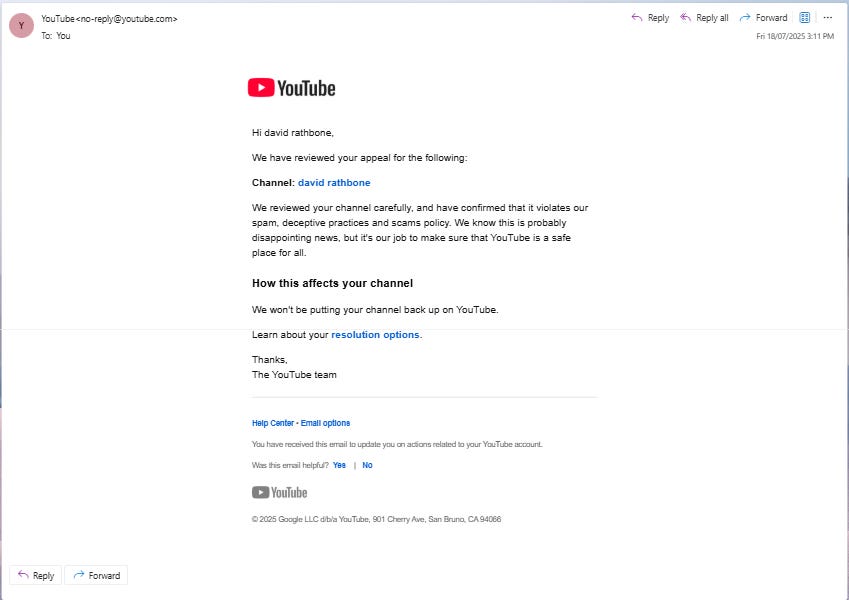
From: YouTube (no-reply@youtube.com) Fri 18/07/2025 3:11 PM Hi david rathbone, We have reviewed your appeal for the following: Channel: david rathbone We reviewed your channel carefully, and have confirmed that it violates our spam, deceptive practices and scams policy. We know this is probably disappointing news, but it’s our job to make sure that YouTube is a safe place for all. How this affects your channel We won’t be putting your channel back up on YouTube. Thanks, The YouTube team You have received this email to update you on actions related to your YouTube account. Was this email helpful? Yes | No

Comments
Nothing yet. Say the first thing.
Sign in to join the conversation.