

There’s a number that predicts how long you’ll live more accurately than:
Whether you smoke
Whether you have diabetes
Whether you have high blood pressure, or
Whether you’re overweight
Your doctor almost certainly hasn’t measured it.
You probably don’t know yours.
And the research showing its predictive power is so consistent across populations, age groups, and disease states that the American Heart Association formally recommended in 2016 that it be treated as a clinical vital sign – measured routinely alongside blood pressure and heart rate.
That metric is known as your cardiorespiratory fitness, or CRF.
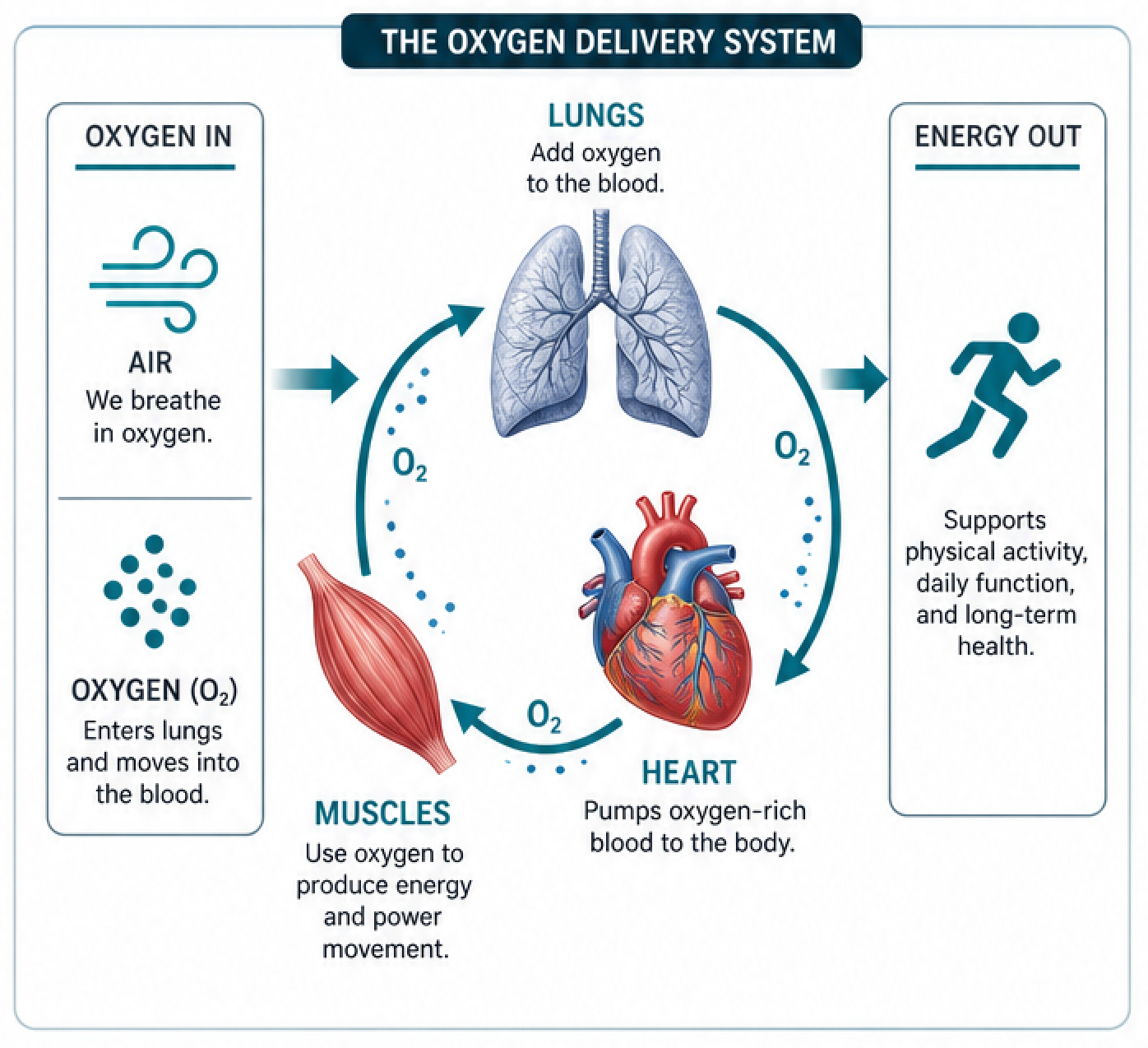
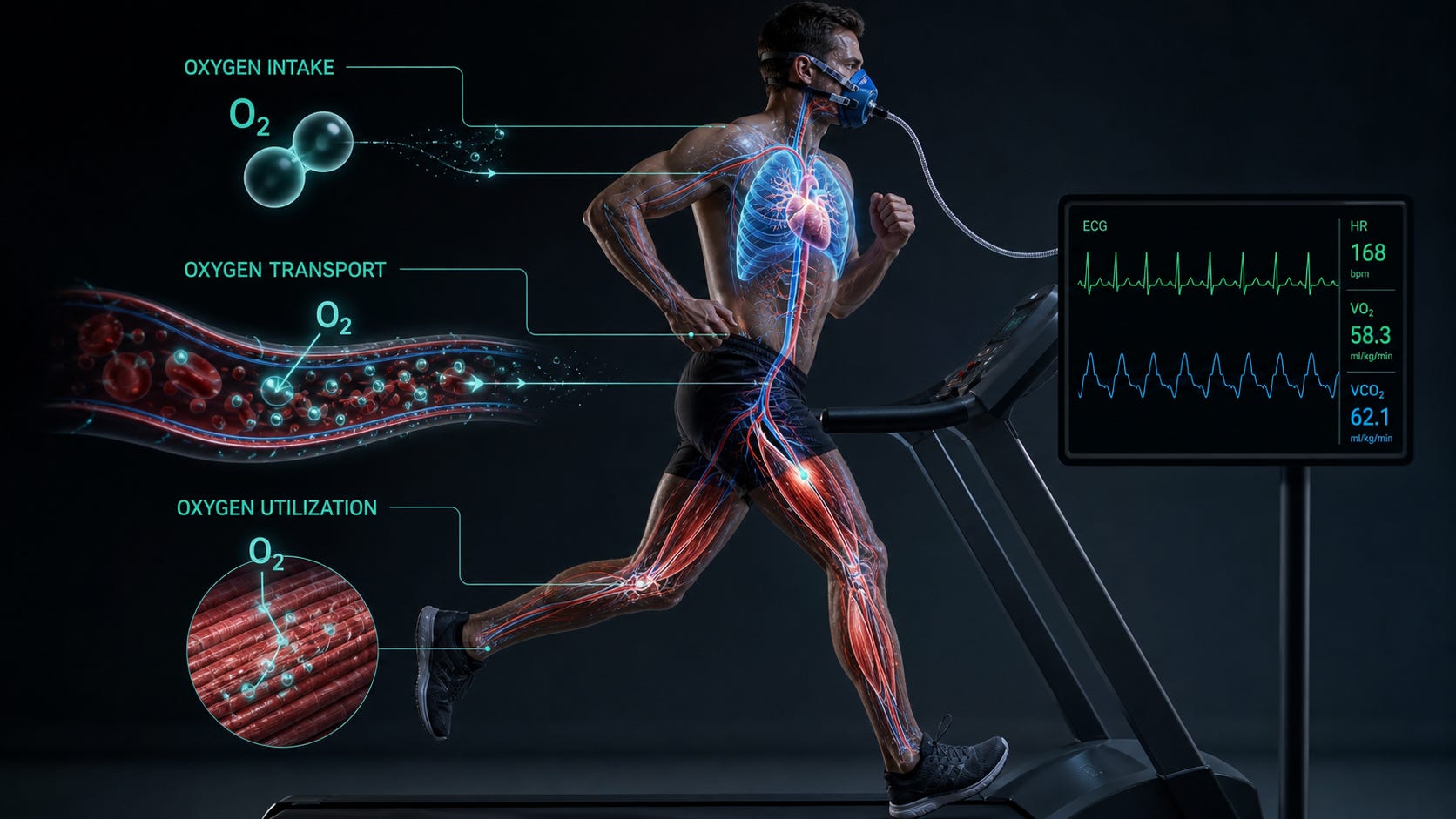
It reflects how efficiently your heart, lungs, and muscles work together to deliver and use oxygen during sustained physical effort.
And the data on what happens when it’s low are genuinely striking.
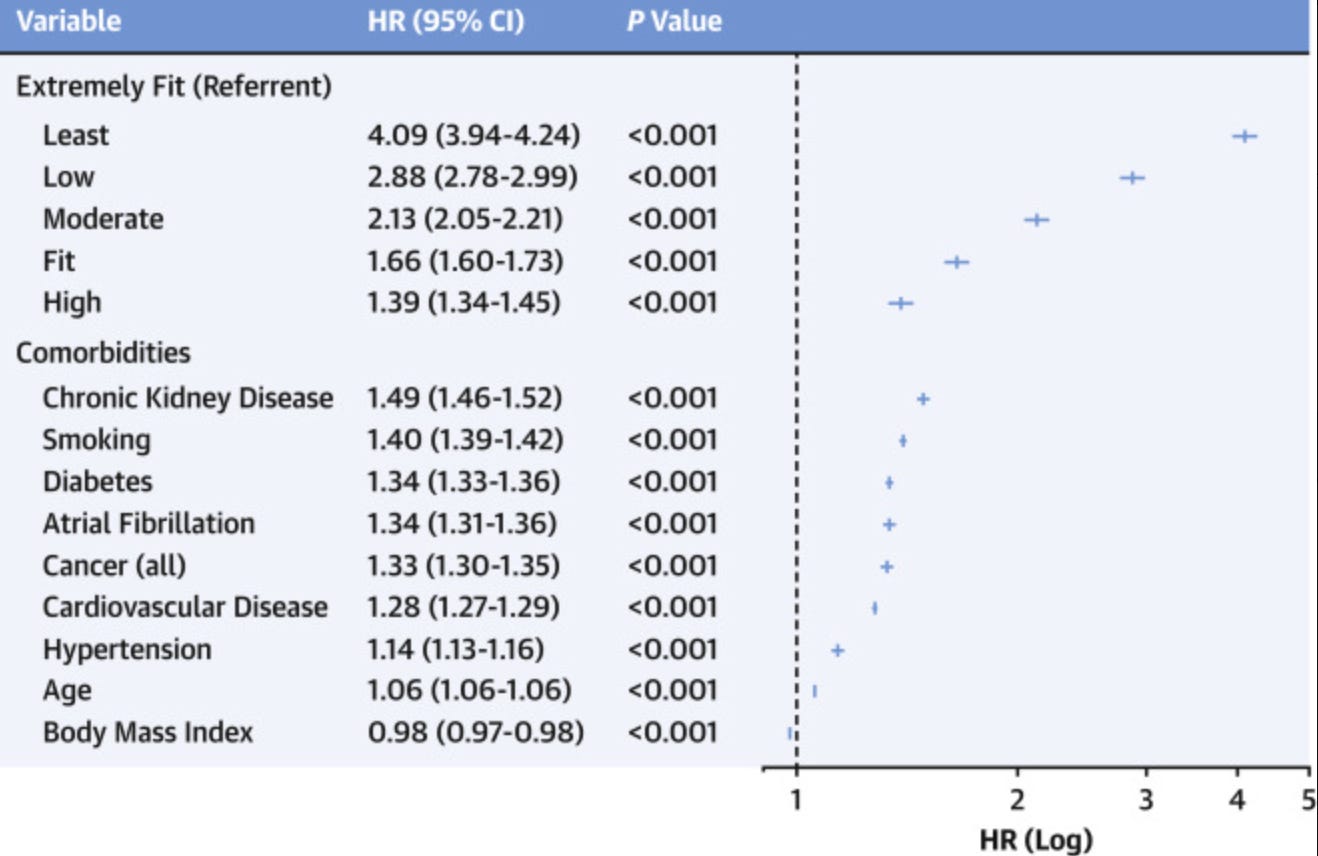
In a landmark study of 750,302 U.S. veterans, Kokkinos et al. (2022) directly compared the mortality risk associated with low CRF against every major chronic disease and risk factor tracked in clinical medicine.
Being in the least fit category carried a more than 4-fold increased risk of dying from any cause compared to the most fit individuals.
To put that in context, here’s what the same study found for other conditions:
Chronic kidney disease: 49% increased risk
Smoking: 40% increased risk
Diabetes: 34% increased risk
Atrial fibrillation: 34% increased risk
Cancer: 33% increased risk
Cardiovascular disease: 28% increased risk
Hypertension: 15% increased risk
In exercise physiology, a MET is a metabolic equivalent of a task. It’s a unit that compares the energy cost of an activity to resting.
One MET is roughly the energy you use sitting quietly, and it’s conventionally about 3.5 mL of oxygen per kilogram per minute.
1 MET = resting
2 METs = about twice resting energy use
4 METs = about four times resting energy use
A brisk walk might be around 4 METs, meaning it takes about four times the energy of resting.
Researchers have discovered that every 1-MET increase in peak exercise output was associated with a 14% reduction in mortality, consistent across men, women, and all racial groups.
An overview of 26 meta-analyses encompassing more than 20.9 million observations from 199 unique cohort studies confirmed that high versus low CRF was associated with a 53% lower all-cause mortality, with each 1-MET increment linked to an 11–17% reduction in mortality risk (Lang et al., 2024).
A separate dose-response meta-analysis found that compared to the lowest CRF, intermediate fitness reduced all-cause mortality by 33% and the highest fitness by 53%, with similar graded reductions for cardiovascular and cancer mortality (Han et al., 2022).
Take Home Message: Low cardiorespiratory fitness carries a greater mortality risk than smoking, diabetes, hypertension, or cardiovascular disease. It isn’t one risk factor among many – it’s the dominant one.
One of the more remarkable findings in this literature is that higher CRF never stops being protective.
A prospective cohort study of more than 120,000 patients from the Cleveland Clinic found that elite CRF – above the 97.7th percentile – was associated with an 80% reduction in mortality risk compared to the least fit individuals, with no plateau or reversal at extreme fitness levels (Feldman et al., 2015).
The Kokkinos et al. (2022) data confirmed this: the lowest mortality risk appeared at approximately 14 METs for both men and women, with no erosion of benefit at any fitness level.
Men classified as extremely fit lived roughly six years longer than those at the 20th percentile.
This matters because it means there’s no point at which improving your fitness stops paying dividends.
Perhaps the most clinically provocative finding is what happens when you pit fitness against body weight directly.
A 2025 systematic review and meta-analysis of 398,716 individuals found that overweight-fit and obese-fit individuals had no statistically significant increase in all-cause mortality compared to normal-weight fit individuals (Weeldreyer et al., 2025).
By contrast, normal-weight unfit individuals had nearly double the mortality risk – meaning that an unfit lean person faces a greater risk of early death than a fit person with obesity.
In the Look AHEAD trial of adults with overweight or obesity and type 2 diabetes, each standard deviation increase in CRF was associated with 30% lower all-cause mortality and 55% lower cardiovascular mortality, while BMI adjusted for CRF had little or no independent effect on outcomes (Wills et al., 2022).
Excess adiposity drives insulin resistance and chronic inflammation – the same root-cause dysfunction that underlies high blood glucose, elevated blood pressure, abnormal cholesterol, and accelerated muscle loss.
But it does mean that if you’re choosing between losing weight and getting fitter, the fitness side of that equation carries more survival weight than you might realize.
Take Home Message: A fit person with obesity outlives an unfit lean person. CRF attenuates or negates the mortality risk associated with excess body weight, and it does so independently of other risk factors.
The AHA defines low CRF as falling below approximately the 20th percentile for age and sex, which corresponds to a peak exercise capacity of roughly 5–6 METs (Ross et al., 2016).
In practical terms, 5–6 METs is the energy cost of briskly climbing two to three flights of stairs.
If climbing two or three flights of stairs causes you to stop, feel dizzy, or become severely winded, you’re likely in the low-CRF category.
What’s important is that the most important transition in the entire fitness spectrum isn’t from good to great – it’s from the lowest category to the next highest category.
Moving from the bottom 20th percentile to the 21st–40th percentile produces a larger mortality reduction than any other fitness transition.
Even modest improvements in CRF yield disproportionately large survival benefits.
Quintile 1: <5 METs: High-risk. Associated with markedly elevated mortality. The AHA identifies this as a critical threshold. Patients unable to achieve 5 METs have substantially increased cardiovascular and all-cause mortality risk. This is roughly equivalent to being unable to walk briskly up a slight incline without stopping.
Quintile 2: 5–7 METs: Moderate risk. Moving from <5 to this range produces the single largest relative mortality reduction. More than half of the total mortality benefit of fitness occurs in this transition from very unfit to moderately unfit.
Quintile 3: 8–10 METs: Low-to-moderate risk. This range corresponds to the ability to jog at a moderate pace or climb several flights of stairs without stopping. Achieving ≥10 METs on a treadmill test is a commonly used clinical benchmark for “good” functional capacity and is associated with excellent prognosis.
Quintile 4: 10–12 METs: Low risk. Associated with strong survival advantage. Roughly equivalent to running a 10-minute mile pace sustained.
Quintile 5: >12–14 METs: Very low risk. The Kokkinos et al. data showed the lowest mortality at approximately 14 METs, with no upper ceiling to benefit. This level corresponds to competitive recreational athletes — running ~7:30-minute mile pace or equivalent sustained effort.
The Cooper 12-Minute Run Test is a validated field test with a correlation of r = 0.87–0.92 to laboratory-measured VO₂max and high test-retest reliability (Penry et al., 2011).
You don’t need a lab, specialized equipment, or a physician referral. You need a flat surface, a timer, and a genuine maximal effort.
What you need:
A flat, measurable surface (a standard 400-meter athletic track is ideal; a treadmill set to 0% incline works equally well)
A phone stopwatch or GPS watch
Comfortable running shoes
The protocol:
Warm up for 5–10 minutes. Walk briskly for 3–5 minutes, jog lightly for 2–3 minutes, then perform two or three short 10–15 second accelerations at moderate effort. You want your heart rate elevated but not fatigued.
Run, jog, or walk briskly for exactly 12 minutes, covering as much distance as possible. Pacing is the most common source of error. Start at roughly 80% of perceived maximum effort, then settle into a steady rhythm from minutes 4–8. Increase effort from minutes 9–11. In the final minute, move as fast as you can.
Don’t stop moving during the 12 minute test. If running becomes unsustainable, slow to a brisk walk. The test measures total distance, not whether you run continuously.
Record your distance in meters. On a track, count completed laps (each 400 m) plus any partial lap. On a treadmill, read the display directly.
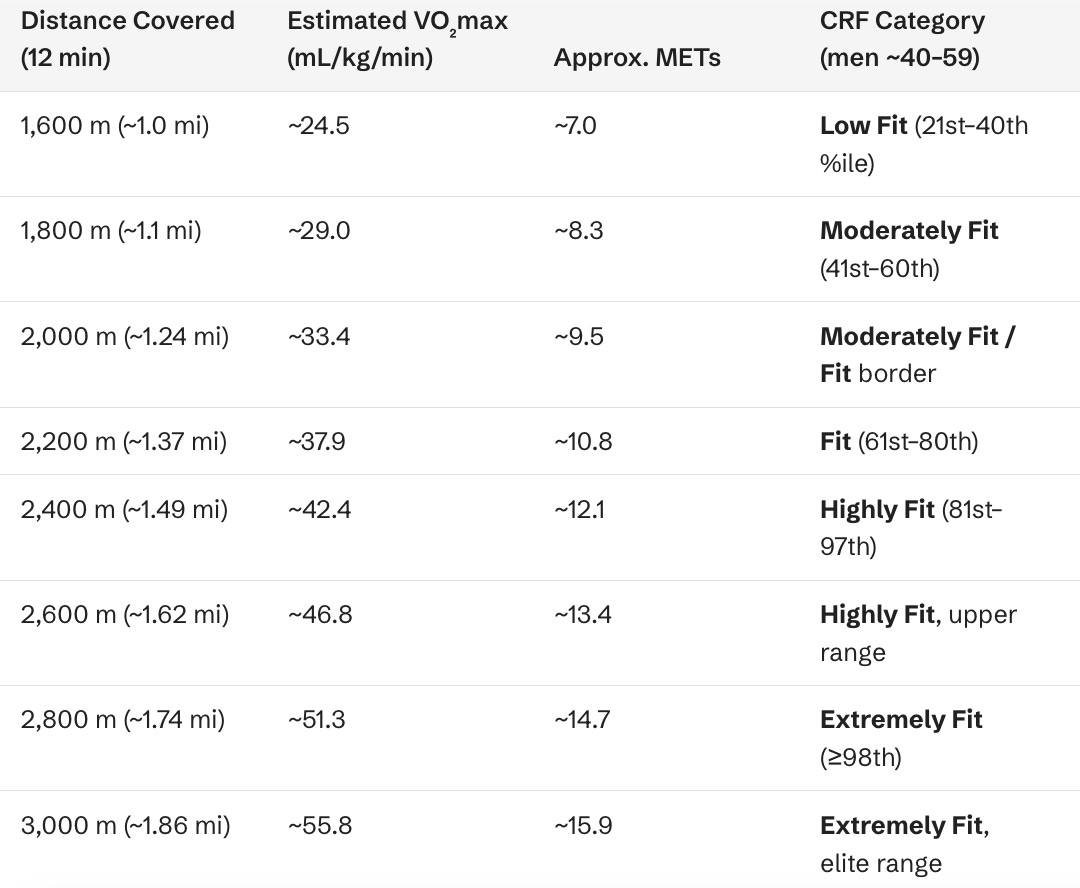
Calculate your estimated VO₂max using the Cooper formula:
Below is a table of selected distances that you can use to calculate your VO2 max and fitness category:
A few practical notes:
Any effort that isn’t truly maximal will underestimate your VO₂max.
Repeat the test one to two weeks later to confirm the result – the first attempt often underestimates due to unfamiliarity with pacing.
A flat surface is essential. Even slight hills distort the result.
If you have known heart disease, uncontrolled hypertension, chest pain, or significant cardiovascular risk factors, consult a physician before attempting a maximal effort test. Stop immediately if you experience chest pain, dizziness, or an irregular heartbeat.
Take Home Message: The Cooper 12-Minute Run Test gives you a validated, at-home estimate of your VO₂max in 12 minutes. Your result tells you which mortality risk category you’re in – and how much room you have to improve.
Walking is a meaningful starting point, but it won’t get most people far enough.
A national cohort study of 403,681 U.S. adults found that for the same total volume of moderate-to-vigorous physical activity, a higher proportion of vigorous activity was associated with 17% lower all-cause mortality compared to those performing only moderate activity (Wang et al., 2021).
A Cochrane review confirmed that high-intensity interval training produces greater improvements in VO₂max than moderate-intensity continuous training (Strauss et al., 2026).
The single most important action you can take is to add two sessions of vigorous-intensity exercise per week – defined as effort that makes sustained conversation difficult.
Most importantly: this doesn’t require a gym membership or sophisticated equipment.
Practical options include:
Interval running: Alternate 1 minute at hard effort with 2 minutes of easy jogging, repeated 6–8 times
Cycling intervals: 30 seconds at maximum effort, 90 seconds easy, repeated 8–10 times
Stair climbing at pace: Climb continuously for 10–15 minutes without stopping
Swimming: Alternate hard laps with easy recovery laps
Pair vigorous cardio with two sessions of resistance training per week – compound movements like squats, deadlifts, rows, and push-ups.
Muscle tissue is the primary site of glucose disposal; building it directly reduces insulin resistance, which is the upstream driver connecting high blood glucose, elevated blood pressure, abnormal cholesterol, and excess body fat to one another.
Cardiorespiratory fitness is the single most powerful modifiable predictor of how long you’ll live.
Being in the least fit category carries a more than four-fold increased mortality risk – a figure that exceeds the risk associated with smoking, diabetes, hypertension, and cardiovascular disease combined.
A fit person with obesity outlives an unfit lean person.
Every 1-MET improvement in fitness reduces mortality risk by 11–17%, and there’s no upper threshold at which higher fitness stops being protective.
Measure your CRF with the Cooper test, and know your VO2 max.
The good news is that the largest survival gain comes from the smallest initial improvement – moving out of the bottom fitness category produces a larger mortality reduction than any other transition.
Build a plan that includes vigorous-intensity exercise at least twice per week, resistance training twice per week, and enough daily movement to stay out of the sedentary category.
The root cause connecting most chronic disease – insulin resistance and chronic inflammation – responds directly to this kind of structured physical stress.
Address the root, and the branches get healthier.
If you’ve read this far, you already understand that fitness isn’t a lifestyle preference – it’s a clinical variable with measurable consequences.
The challenge most people face isn’t understanding what to do; it’s building a sustainable structure around nutrition, movement, and recovery that actually fits their life.
That’s exactly what our program is designed to do. We work with people managing high blood glucose, elevated blood pressure, excess weight, and chronic inflammation to address the root cause – not just the symptoms.
If you’re ready to understand your numbers and build a plan that moves you out of the high-risk category, we’d love to talk.
Click here to book a free call with our team and let’s figure out what a sustainable, long-term approach looks like for you specifically.
Ross R, Blair SN, Arena R, et al. Importance of Assessing Cardiorespiratory Fitness in Clinical Practice: A Case for Fitness as a Clinical Vital Sign: A Scientific Statement From the American Heart Association. Circulation. 2016;134(24):e653-e699. doi:10.1161/CIR.0000000000000461.
Kokkinos P, Faselis C, Samuel IBH, et al. Cardiorespiratory Fitness and Mortality Risk Across the Spectra of Age, Race, and Sex. Journal of the American College of Cardiology. 2022;80(6):598-609. doi:10.1016/j.jacc.2022.05.031.
Lang JJ, Prince SA, Merucci K, et al. Cardiorespiratory Fitness Is a Strong and Consistent Predictor of Morbidity and Mortality Among Adults: An Overview of Meta-Analyses Representing Over 20.9 Million Observations From 199 Unique Cohort Studies. British Journal of Sports Medicine. 2024;58(10):556-566. doi:10.1136/bjsports-2023-107849.
Han M, Qie R, Shi X, et al. Cardiorespiratory Fitness and Mortality From All Causes, Cardiovascular Disease and Cancer: Dose-Response Meta-Analysis of Cohort Studies. British Journal of Sports Medicine. 2022;56(13):733-739. doi:10.1136/bjsports-2021-104876.
Feldman DI, Al-Mallah MH, Keteyian SJ, et al. No Evidence of an Upper Threshold for Mortality Benefit at High Levels of Cardiorespiratory Fitness. Journal of the American College of Cardiology. 2015;65(6):629-30. doi:10.1016/j.jacc.2014.11.030.
Weeldreyer NR, De Guzman JC, Paterson C, et al. Cardiorespiratory Fitness, Body Mass Index and Mortality: A Systematic Review and Meta-Analysis. British Journal of Sports Medicine. 2025;59(5):339-346. doi:10.1136/bjsports-2024-108748.
Wills AC, Vazquez Arreola E, Olaiya MT, et al. Cardiorespiratory Fitness, BMI, Mortality, and Cardiovascular Disease in Adults With Overweight/Obesity and Type 2 Diabetes. Medicine and Science in Sports and Exercise. 2022;54(6):994-1001. doi:10.1249/MSS.0000000000002873.
Penry JT, Wilcox AR, Yun J. Validity and Reliability Analysis of Cooper’s 12-Minute Run and the Multistage Shuttle Run in Healthy Adults. Journal of Strength and Conditioning Research. 2011;25(3):597-605. doi:10.1519/JSC.0b013e3181cc2423.
Wang Y, Nie J, Ferrari G, Rey-Lopez JP, Rezende LFM. Association of Physical Activity Intensity With Mortality: A National Cohort Study of 403,681 US Adults. JAMA Internal Medicine. 2021;181(2):203-211. doi:10.1001/jamainternmed.2020.6331.
Strauss JA, Kirwan R, Ranasinghe C, et al. High-Intensity Interval Training for Reducing Cardiometabolic Syndrome in Healthy but Sedentary Populations. The Cochrane Database of Systematic Reviews. 2026;3:CD013617. doi:10.1002/14651858.CD013617.pub2.
No posts
Comments
Nothing yet. Say the first thing.
Sign in to join the conversation.