
0:00
-18:30
I sat in a meeting once at a medical school where someone brought a new idea to the table.
It wasn’t a radical idea. It was a thoughtful proposal about a different approach to teaching a particular topic — the kind of contribution that a room full of educators should, by every reasonable standard, welcome. The person had done the work. They’d thought it through. They came prepared.
What happened next wasn’t a discussion. It was a dismantling.
A senior leader in the curricular space — someone with significant clout, significant authority, and apparently significant investment in how things had always been done — made clear, immediately and unmistakably, that this idea was not welcome. Not through reasoned argument. Through tone. Through dismissal. Through the particular kind of academic aggression that doesn’t raise its voice but still fills the entire room.
The idea may or may not have been right for that moment. That’s actually not the point. The point is what happened to everyone else in the room after that.
They went quiet. And they stayed quiet. Because the message had been received, clearly and completely: bring an idea here and this is what happens to you.
That moment cost the institution far more than one rejected proposal. It cost them every idea that was never brought forward again.
I want to push this further than most leadership conversations go, because I think the stakes deserve it.
The same dynamic that silenced a room full of educators has killed patients.
There is a well-documented pattern in clinical settings where a nurse identifies a problem — a medication concern, a deteriorating vital sign, something that doesn’t look right — and doesn’t speak up. Not because they don’t know. Because they’ve learned what happens when they do. A physician who publicly humiliates staff for questioning them trains the entire unit to stay silent. And when silence becomes the safest professional choice, patients pay the price.
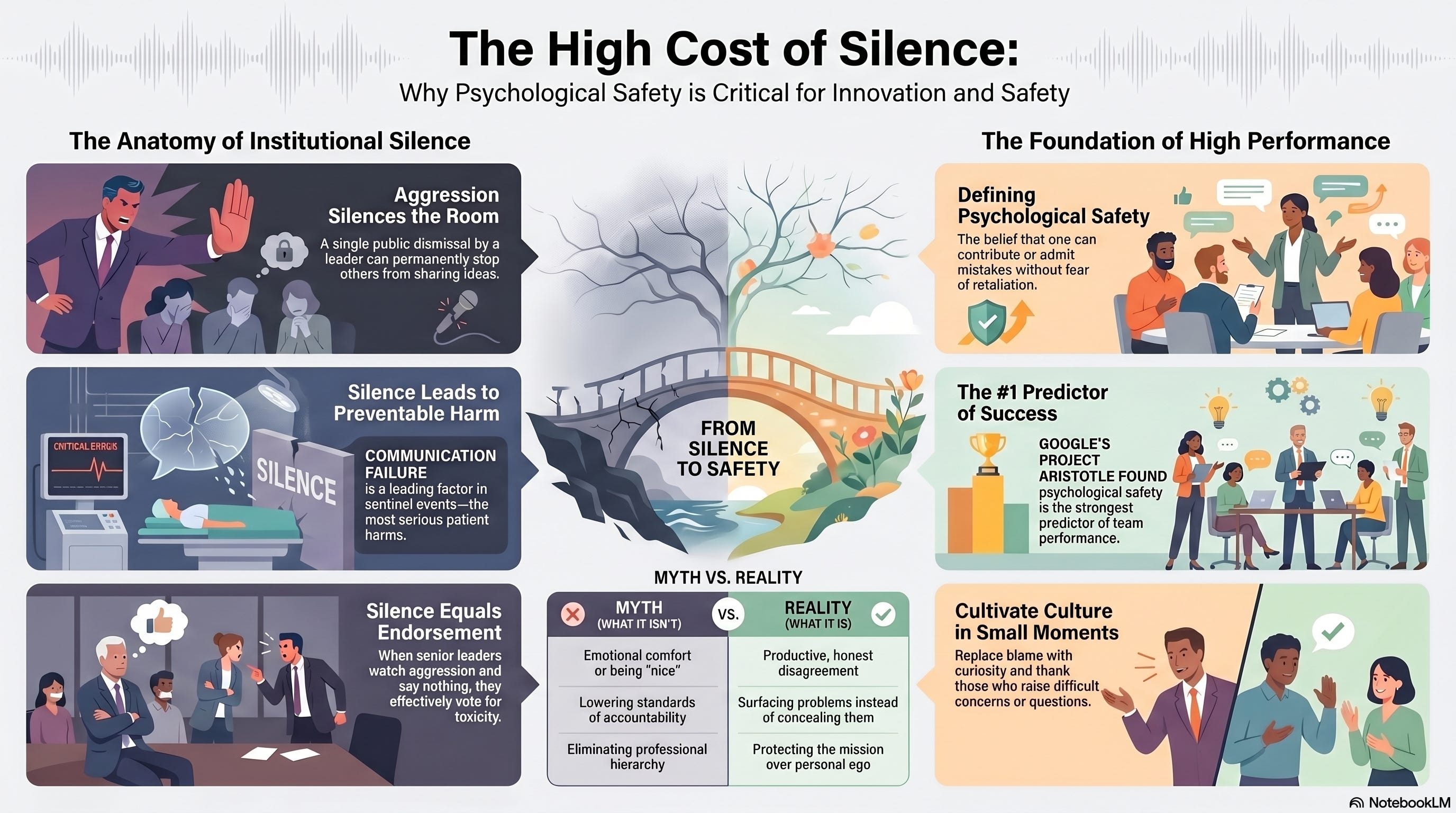
This is not hypothetical. The Joint Commission has identified communication failures — specifically the failure of team members to speak up — as a leading contributing factor in sentinel events, the most serious preventable patient harms. The culture that produces those failures isn’t born in a single moment of aggression. It’s built slowly, interaction by interaction, every time someone speaks up and gets cut down, and nothing happens to the person who cut them down.
Which brings me to the part that troubles me most: what happens — or doesn’t happen — above the aggressor.
In every toxic environment I’ve experienced or observed, from department meetings to presidential suites, the pattern is the same. The aggressive leader behaves badly. Everyone sees it. And the person above them says nothing.
I’ve written before about the idea that what you tolerate, you endorse. That principle holds here with particular force. When a president, a dean, or a department chair watches a colleague publicly diminish someone’s contribution and responds with silence, they haven’t stayed neutral. They’ve cast a vote. They’ve told the entire organization exactly where the safe boundaries of honesty lie.
The research on this is worth understanding clearly, because psychological safety is one of the most misunderstood concepts in organizational leadership.
Dr. Amy Edmondson of Harvard Business School, who has studied team performance and organizational learning for decades, defines psychological safety as the shared belief that individuals can speak up, contribute ideas, ask questions, and acknowledge mistakes without fear of humiliation, punishment, or retaliation.
That definition matters because of what it doesn’t say. Psychological safety is not about comfort. It is not about avoiding disagreement. It is not about making everyone feel good all the time or eliminating accountability.
In fact — and this is the counterintuitive part — psychologically safe environments often involve more disagreement than unsafe ones. The difference is that the disagreement is honest and constructive rather than political and defensive. People argue about ideas instead of protecting their positions. They surface problems instead of concealing them. They ask hard questions instead of performing certainty they don’t have.
This distinction is important in academic culture specifically, because universities like to believe that intelligence produces good collaboration. It doesn’t, automatically. I have been in rooms full of brilliant people who couldn’t have an honest conversation to save their lives — or, in some cases, to save their students’ — because the culture had been trained into silence.
Expertise does not replace trust. And credentials do not make anyone immune to the instinct to protect themselves when the environment punishes vulnerability.
In 2012, Google launched an internal research initiative called Project Aristotle, attempting to identify what separated their highest-performing teams from everyone else. They expected the answer to be something measurable and technical — the right mix of expertise, the right number of introverts and extroverts, the right cognitive profiles.
What they found instead was psychological safety. It was, by a significant margin, the strongest predictor of team performance. The best teams weren’t the ones with the most impressive individual credentials. They were the ones where people felt safe contributing honestly, asking what might seem like naive questions, and acknowledging when they didn’t know something.
The implications for higher education are significant and largely unexamined.
Universities invest heavily in strategic planning, faculty recruitment, technology infrastructure, and leadership development. They produce mission statements about innovation and collaboration and intellectual rigor. And then they sometimes — not always, but often enough to matter — build cultures that quietly punish the very behaviors those mission statements claim to value.
You cannot tell people that intellectual courage is foundational to the academy and then reward the person who shuts the conversation down.
Higher education has some features that make psychological safety particularly fragile.
Tenure and promotion structures create real and perceived vulnerabilities for faculty at every stage. Junior faculty members are acutely aware that their words, positions, and affiliations are being observed and evaluated. Adjunct faculty, already operating without the protections that tenure provides, often feel entirely excluded from the conversations that shape the institutions they serve.
Staff members navigate rigid hierarchies while often holding the most granular knowledge of how systems actually function — or fail to function. They are frequently the first to see operational breakdowns, student concerns, and cultural tensions. And they are frequently the last to be asked.
Shared governance, which should be the mechanism for bringing faculty voices into institutional decisions, can become its own theater of managed consensus when the culture discourages genuine dissent.
The result is a specific kind of institutional deterioration. It doesn’t happen all at once. It accumulates. Faculty stop bringing forward ideas. Problems stay hidden longer than they should. Burnout increases because effort feels futile. People begin protecting themselves rather than advancing the mission.
From the outside, the institution may still appear functional. Committees meet. Reports are produced. Strategic initiatives move forward.
But internally, the trust that makes learning possible has quietly eroded — and the institution becomes progressively less capable of adapting to challenges that it can no longer honestly name.
Leadership behavior is the primary variable. Not policy. Not structure. Not climate surveys, though those matter.
What shapes culture most powerfully is what happens in small moments.
A dismissive comment in a faculty meeting — the slight eye roll, the too-quick rebuttal, the tone that signals this isn’t worth the group’s time — can silence a person’s contributions for months. Possibly permanently. And the people who witness it draw their own conclusions about what’s safe to say in that room.
Conversely, a leader who thanks someone for raising a difficult concern — who says I’m glad you brought that forward and means it — signals something to everyone else watching. Who says I don’t know, and I’d like to think about that more carefully. Who responds to a mistake with curiosity rather than blame.
These moments don’t feel like policy. They feel like personality. But they are culture, accumulated interaction by interaction, until the environment either opens or closes.
The academic leader in my earlier story may have believed they were maintaining standards. They may have genuinely thought the idea wasn’t ready. But the manner of the response — the public dismissal, the use of positional authority to end a conversation rather than redirect it — communicated something about power that no one in that room forgot.
And above that leader, someone made a choice to say nothing. Which was its own communication.
If your institution is serious about psychological safety — and I believe increasingly that this isn’t optional, it’s operational infrastructure — then the work begins with honest assessment.
Not a satisfaction survey. A real question: do people here actually feel safe telling the truth?
Do faculty feel safe raising curriculum concerns without fear of professional consequences? Do staff feel safe identifying operational problems without being labeled as difficult? Do junior colleagues feel safe contributing ideas without waiting to see how the room reads before they speak?
The answers to those questions tell you more about your institution’s capacity for learning, adaptation, and innovation than any strategic plan ever could.
Because the institutions that will navigate what’s coming — the enrollment pressures, the financial constraints, the workforce shortages, the technological disruption, the genuine uncertainty about what higher education is for — will not necessarily be the best-resourced ones. They’ll be the ones where people feel safe enough to think critically, speak honestly, and learn together in real time.
And that starts, always, with what happens in the room when someone brings an idea to the table.
Make it safe for them to do that.
Or accept the cost of the silence that follows when you don’t.
Expertise does not replace trust. And credentials do not make anyone immune to the damage of a culture that punishes honesty.
Comments
Nothing yet. Say the first thing.
Sign in to join the conversation.