
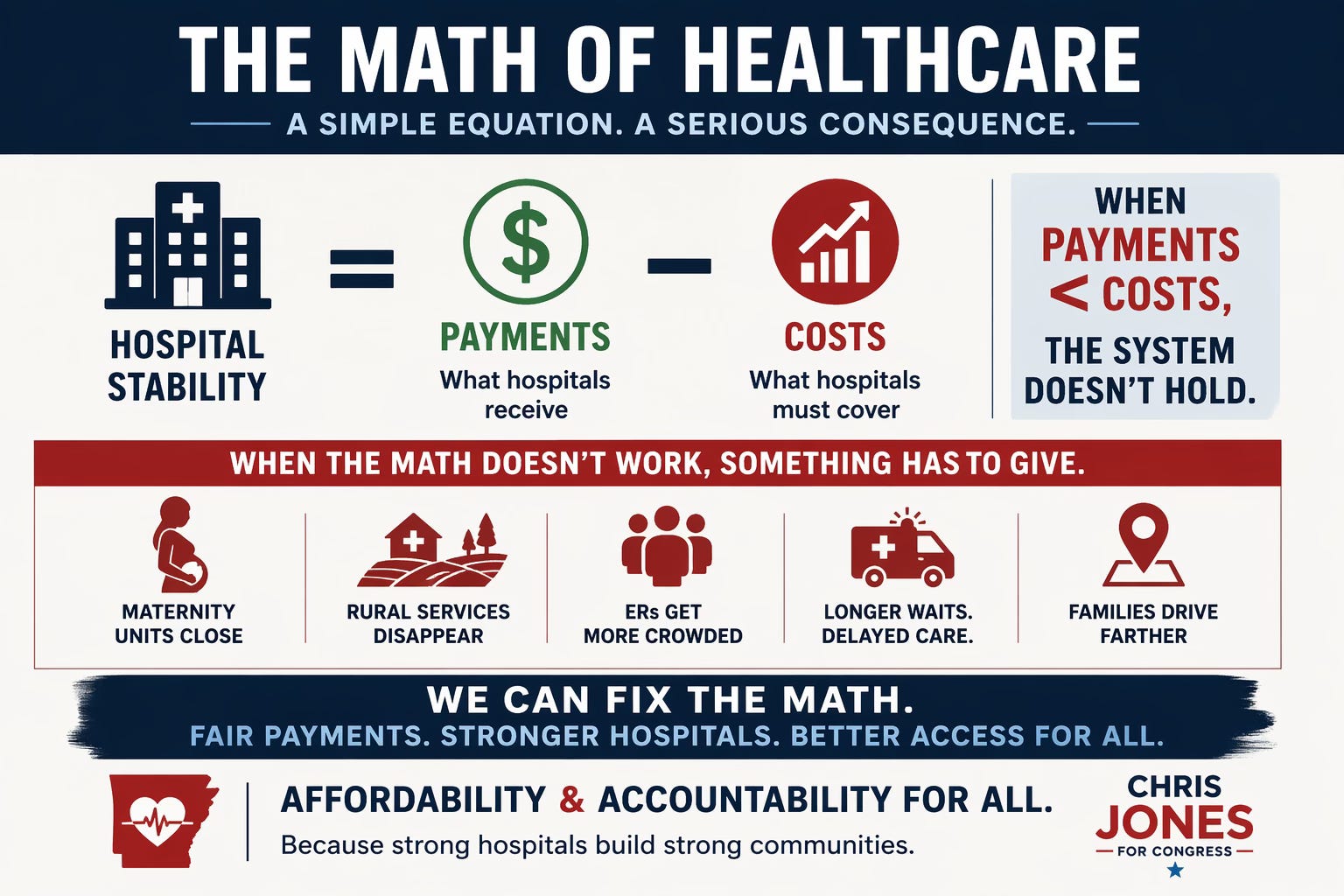
There’s a simple equation driving what’s happening in healthcare right now:
Hospital Stability = Payments − Costs
When payments are less than the costs incurred Payments < Costs, the system doesn’t hold.
Something has to give.
And right now, across Arkansas and across the country, hospitals are being paid too little while their costs keep rising.
That’s the problem.
This is happening here and nationwide.
Hospitals everywhere are facing the same pressure. Reimbursement isn’t keeping up with inflation. Workforce costs are rising. Systems are being pushed to the edge.
Arkansas just happens to be on the front lines of it.
The Crisis
And here’s what that problem looks like in real life:
Hospitals are scaling back services.
Birthing hospitals are closing.
Rural services are shrinking.
Access is getting tighter.
In Arkansas, more than 70% counties no longer have birthing hospitals. That means more families are driving farther just to deliver a baby.
Zoom out, and the picture gets even clearer. Across the country, hundreds of hospitals are at risk of closure. Rural hospitals, in particular, are being pushed to the brink.
This is systemic and deeply problematic.
I hear it directly from people across this district. My wife is an emergency room physician, so I also hear her direct experiences.
Crowded emergency rooms. Longer wait times. Delayed care. And those ERs are already under pressure.
When hospitals cut services, those same ERs get even more crowded.
That’s how a national system failure becomes a local crisis.
It’s easy to pass it off as a headline. But regular people experience a longer wait, a harder drive, and a risk that didn’t used to be there.
This didn’t happen overnight. And it didn’t happen by accident.
Hospitals are being squeezed by a payment system that is not keeping up with reality.
Medicare reimbursement rates are set at the federal level. Medicaid is shaped by federal policy. And many of the rules that determine how hospitals are paid come directly from Washington.
That means the same pressure showing up in Arkansas is showing up across the country.
When those payments fall behind while costs rise, hospitals don’t have room to absorb the difference.
So they make cuts.
That’s math.
And right now, that math is broken at a national level.
If we’re serious about fixing this, then we have to fix the system that created it but keep the people front and center in the solution.
That means action in Congress (I know. Action and Congress are polar opposite).
When I’m in Congress, here’s exactly what I will do:
1. Fight for fair reimbursement
I will push to reform Medicare payment formulas so they reflect the real cost of care, especially in rural and lower-income states like Arkansas.
2. Protect rural hospitals and critical services
I will work to establish targeted federal support for hospitals that provide essential services like emergency care and maternity care so those services don’t disappear. Beyond the small allocation that was given to fill the funding gap that the Big Ugly Bill created. Note: it’s not enough to fill the gap.
3. Stop policies that make the problem worse
I will oppose cuts to hospital payments that come at the same time costs are rising, and push for accountability in how those decisions are made.
4. Strengthen Medicaid support
I will work to increase federal investment so states can raise reimbursement rates and reduce the financial pressure on hospitals.
This is what Affordability and Accountability for All looks like in practice.
Affordability means people can actually get care without being pushed to the brink.
Accountability means fixing systems that are clearly failing the people they’re supposed to serve.
Right now, Arkansas families are already feeling the consequences of a system that isn’t working.
But make no mistake. This is a national issue with local consequences.
And if we don’t act, it will get worse everywhere.
More closures.
More crowding.
More communities left without care.
It may feel like fate. It’s not. It all comes down to a policy choice.
And policy choices can be changed.
That’s what this election is about.
Because when a hospital loses services, a community loses stability.
And when people can’t get care, everything else starts to break down.
We can fix this.
But it’s going to take leadership that understands both the math and the people behind it.
That’s the work ahead.
And it’s work I’m ready to do.
Blessings,
Chris
No posts
Comments
Nothing yet. Say the first thing.
Sign in to join the conversation.