
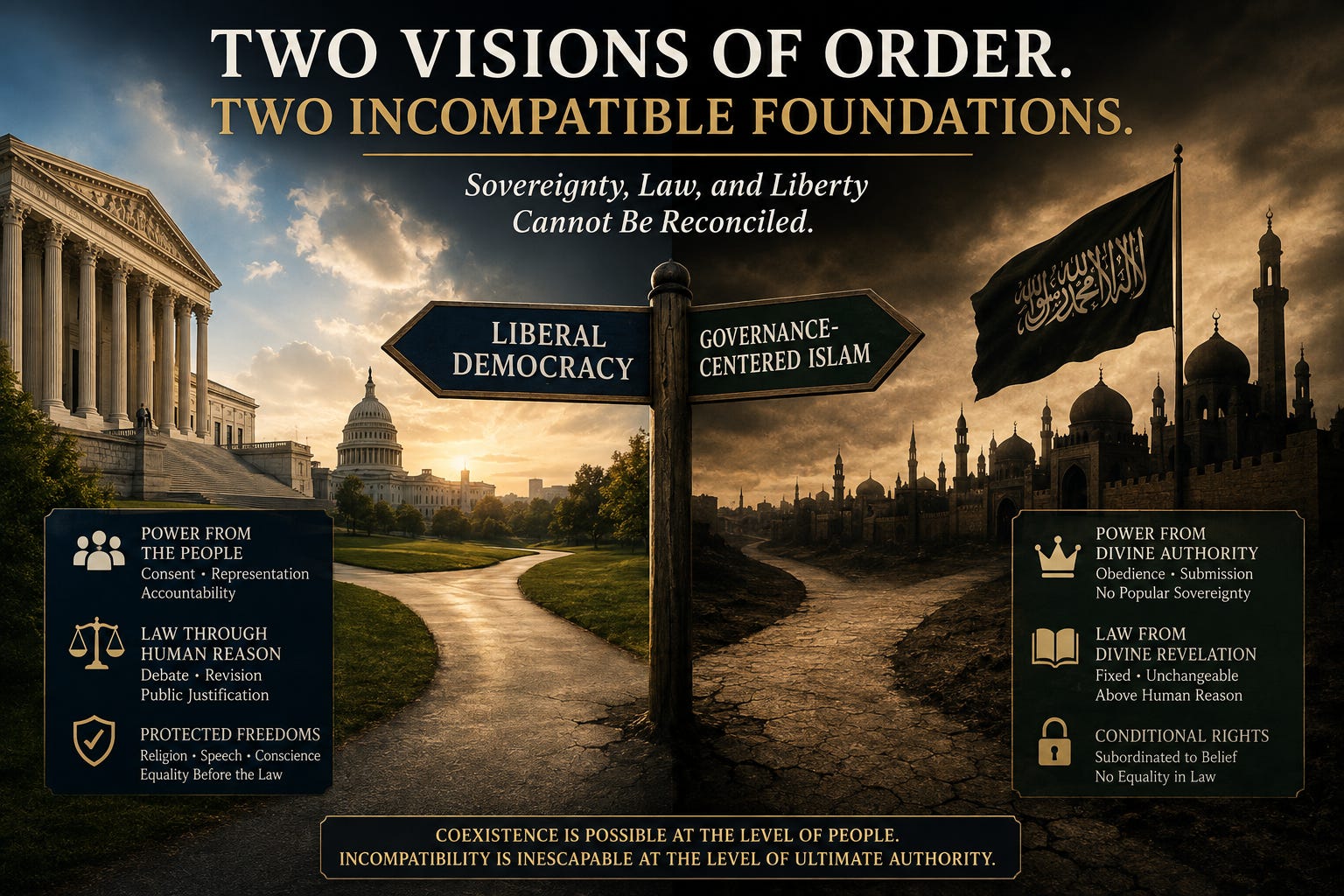
This article is offered as an exercise in comparative political philosophy, political theology, constitutional theory, and the scholarly study of religion. It is not intended as an attack upon Islam as a religion, Muslims as individuals or communities, or the sincerity, dignity, character, citizenship, or religious commitments of persons who identify as Muslim. Nor should the arguments presented here be interpreted as attributing a single political ideology, legal interpretation, or conception of government to the extraordinarily diverse Muslim population of the world.
The subject of this inquiry is considerably narrower. The article critically examines governance-centered interpretations of Islam—particularly those political-theological models in which a determinate interpretation of divine law is asserted as possessing binding authority over the state, positive law, and political community. The central question is therefore institutional and philosophical: What happens when a political system locates ultimate legal sovereignty in divine revelation rather than in constitutionally organized popular sovereignty, and to what extent can such a system be reconciled with the foundational commitments of liberal constitutional democracy?
That question should not be confused with the substantially different question of whether Muslims can participate successfully in democratic societies. They demonstrably can and do. Nor does disagreement with a particular interpretation of Islamic political theology constitute, by itself, hostility toward Muslims. Political doctrines, jurisprudential systems, theological propositions, constitutional theories, and claims concerning legitimate government are legitimate subjects of scholarly examination, criticism, comparison, and debate.
The analysis consequently distinguishes among Islam as a religious tradition, Muslims as persons and communities, classical Islamic jurisprudence, Islamic political thought, Islamism as a modern political phenomenon, and particular projects of shari’a-centered governance. These categories overlap historically and intellectually, but they are not interchangeable. Treating them as synonymous would obscure precisely the distinctions that serious scholarship requires.
The same critical standard applies to Christianity and Western political traditions. This article does not presume that Christianity has historically been synonymous with religious liberty, pluralism, or democratic government. Christian societies and institutions have their own histories of religious establishment, coercion, exclusion, persecution, and resistance to political pluralism. Accordingly, the comparison undertaken here concerns particular doctrines and institutional arrangements rather than assertions of inherent civilizational superiority.
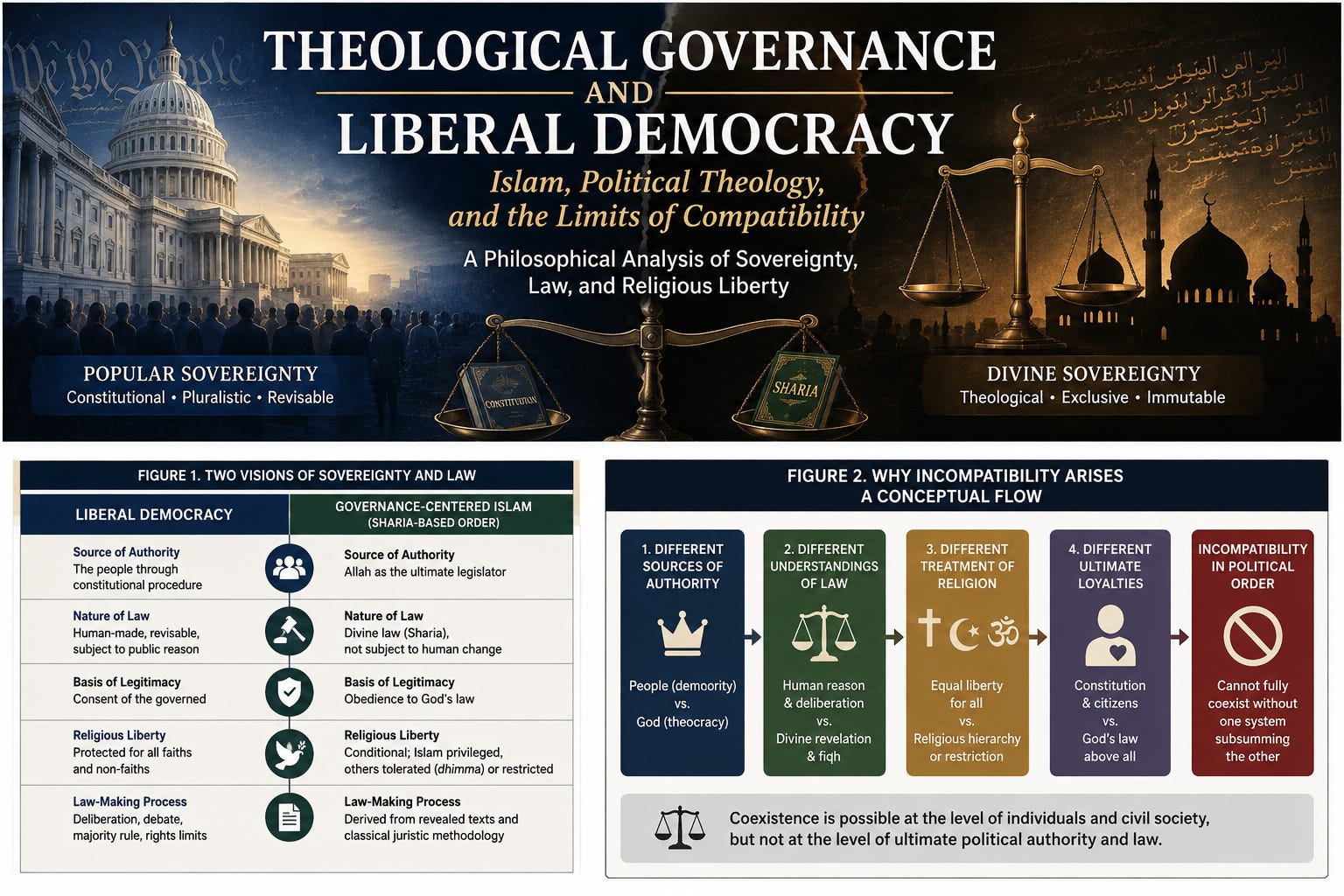
Readers should therefore understand the term incompatibility, where it appears in this article, in a specific analytical sense. It does not signify racial, ethnic, cultural, or personal incompatibility between Muslims and non-Muslims. Neither does it mean that Islam is incapable of interpretation, development, internal disagreement, or accommodation with democratic institutions. Rather, it identifies a potential constitutional incompatibility between competing claims of final political authority. If a political system maintains that a particular interpretation of divine law is legally supreme, coercively enforceable, and beyond meaningful democratic revision, while liberal constitutional democracy maintains that citizens possess equal political standing within a constitutional order whose positive laws remain subject to public contestation and lawful revision, a substantive philosophical tension arises concerning sovereignty, legislation, religious liberty, and the limits of governmental authority.
Indeed, Muslim scholars and political thinkers themselves disagree profoundly about these questions. Some defend stronger relationships between shari’a and state authority; others construct theories of Islamic democracy; still others argue that religious commitments are better protected when the state does not coercively enforce religious law. These internal debates are essential to the analysis because they demonstrate that neither Islam nor Islamic political thought constitutes a monolithic intellectual system.
For these reasons, criticism of a particular Islamic theory of government should not be conflated with prejudice against Muslims. At the same time, concern about prejudice should not place religious or political doctrines beyond scholarly criticism. Intellectual consistency requires that claims advanced in the name of Islam, Christianity, secularism, liberalism, conservatism, socialism, nationalism, or any other comprehensive worldview remain open to the same standards of historical investigation, logical analysis, evidentiary scrutiny, and reasoned disagreement.
Accordingly, the purpose of this article is neither apologetic nor polemical. It is analytical. Its conclusions should therefore be evaluated according to the quality of its definitions, evidence, reasoning, engagement with competing scholarship, and treatment of counterarguments—not according to assumptions about the motives of either the author or those who disagree with its conclusions.
The governing principle of the discussion is straightforward: respect for persons does not require immunity of ideas from criticism. Muslims are entitled to the same dignity, religious liberty, equal citizenship, and freedom from discrimination as every other person. Islamic political and theological propositions, like Christian, secular, and other political propositions, remain legitimate objects of rigorous scholarly examination. Maintaining both commitments simultaneously is not contradictory; it is fundamental to serious academic inquiry.
Abstract
This article examines the compatibility of governance-centered Islam with liberal democracy and modern Christian political theology. It advances a qualified thesis: where an Islamic political project treats divine revelation or a determinate body of shari’a as legally supreme, politically enforceable, and insulated from democratic revision, it stands in structural tension with liberal-democratic commitments to equal citizenship, freedom of conscience, popular authorization, and revisable positive law. The claim concerns political-theological regimes and doctrines rather than Muslims as persons or Islam as an undifferentiated tradition. Drawing on Hallaq, Feldman, March, An-Na’im, Abou El Fadl, Esposito and Voll, and the Second Vatican Council, the article argues that the decisive issue is which authority possesses final jurisdiction when divine normativity and constitutional decision conflict. Strong shari’a-supremacist governance is incompatible with liberal democracy, while important Islamic traditions attempt reconciliation by limiting state coercion, pluralizing interpretation, or grounding political authority in popular participation. The defensible conclusion is therefore conditional incompatibility, not an essential incompatibility between Islam and democracy.
Keywords: Islam, Islamism, shari’a, liberal democracy, political theology, sovereignty, religious liberty, constitutionalism
Comments
Nothing yet. Say the first thing.
Sign in to join the conversation.