

Link analysis is among the most powerful—and most easily misused—methods available to intelligence analysts. It can reveal relationships, intermediaries, resource flows, communication pathways, vulnerabilities, and patterns that remain hidden when information is examined in isolation. Yet the visual authority of a network chart can create an illusion of certainty. Every node represents an identification decision. Every link represents an evidentiary claim. Every apparent gap may reflect either reality or a failure of collection.
From a practitioner’s perspective, attacking a network begins long before an operational action is taken. It begins with defining the intelligence problem, establishing lawful collection requirements, evaluating sources, resolving identities, testing alternative explanations, and determining which parts of the network actually perform indispensable functions. Critical thinking is therefore not an additional step attached to link analysis. It is the discipline that makes link analysis defensible.
Few intelligence products are as visually persuasive as a well-constructed link chart. Names, organizations, telephone numbers, financial accounts, vehicles, locations, digital identifiers, and events appear as nodes connected by lines. Some nodes are larger than others. Certain clusters are tightly grouped. A few individuals seem to sit at the center of everything.
The chart creates an immediate impression: Now we understand the network.
Perhaps we do. Perhaps we have merely organized our ignorance.
The first lesson of network analysis is also the easiest to forget: the network is not the chart. The chart is a model constructed from selected information, bounded by collection access, shaped by software, and interpreted through the analyst’s assumptions. It does not reproduce reality. It represents an argument about reality.
The FBI has described social network analysis as a systematic method for mapping and measuring social relationships. Its basic unit contains two actors and the relationship between them. Quantitative measures such as degree, betweenness, and closeness can help analysts assess prominence, access, or control over flows. Yet those measures elaborate on the network represented in the data; they do not independently determine what the network means. (FBI Law Enforcement Bulletin)
This distinction is crucial. A person with many recorded contacts may be a leader, but that person may also be a dispatcher, service provider, family member, recruiter, victim, informant, or simply someone whose communications were easier to collect. A person occupying a bridge position may be operationally important, or the apparent bridge may exist only because other connections remain undiscovered.
Centrality is a mathematical property of a dataset. Importance is an analytic judgment about a real-world system. The two should never be treated as synonymous.

The phrase attack the network should not be interpreted narrowly. Depending on the lawful mission, authorities, and operational environment, the intended effect might be to:
Understand the network more accurately.
Expose hidden participants or functions.
Prevent recruitment or resource acquisition.
Protect potential victims or vulnerable infrastructure.
Interdict a financial, logistical, or communication flow.
Isolate a broker or facilitator.
Constrain the network’s freedom of action.
Support investigation, arrest, prosecution, sanction, or administrative action.
Increase friction and reduce operational efficiency.
Encourage fragmentation, defection, or internal distrust.
Disrupt a specific capability without attempting to dismantle the entire organization.
Generate additional intelligence about previously hidden components.
A practitioner should therefore begin with an effect, not a person.
“Who is the most connected individual?” is rarely an adequate intelligence requirement. Better questions include:
Which function allows this network to operate?
What resources must move for the activity to continue?
Which relationships are difficult for the network to replace?
Where does information cross organizational or geographic boundaries?
Which nodes possess unique access, expertise, legitimacy, or authority?
How would the network adapt if a particular function were disrupted?
What action would reduce the threat without producing unacceptable second-order effects?
An analyst who begins with a preferred target will often build a chart that justifies that target. An analyst who begins with a clearly defined intelligence problem is more likely to discover what actually matters.
Analysts do not normally observe an entire network. They observe traces: communications, transactions, travel, documents, reports, interviews, digital records, surveillance, forensic associations, public information, and human reporting. These traces produce what might be called the collection shadow—the portion of the network visible through available sources.
The shadow is not neutral.
Telephone data privileges telephone contact. Financial records reveal formal transactions more readily than informal exchanges. Social-media collection favors visible accounts and observable interactions. Human reporting may illuminate personal relationships while missing technical or financial infrastructure. Investigative records may contain more information about people already suspected than about equally important individuals who have escaped attention.
Consequently:
A missing link does not prove that no relationship exists.
A recorded contact does not prove a meaningful relationship.
A central node is not automatically the leader.
A disrupted node does not necessarily produce network collapse.
Research on incomplete networks reinforces this caution. Centrality measures can be sensitive to missing nodes, missing links, sampling bias, and other errors in the underlying data. The apparent importance of an actor may change substantially when previously unseen portions of a network are added. (PLOS Complex Systems)
The disciplined analyst therefore asks not only, “What does the data show?” but also:
What features of the network would my collection methods be unable to show?
That question often reveals more than another round of chart expansion.
Poor collection cannot be repaired by sophisticated software. If the intelligence requirement is vague, the analyst will accumulate data without knowing what evidence is needed or what decision the analysis must support.
The collection process should begin with five determinations.
What decision will the intelligence support? A strategic assessment, criminal investigation, force-protection measure, collection decision, resource allocation, or operational disruption may require different data and different thresholds of confidence.
What qualifies an entity for inclusion? Is the analyst examining an organization, activity, market, communication system, financial structure, ideological movement, logistical chain, or combination of these?
Boundary decisions should be documented. Otherwise, the chart expands indefinitely and eventually incorporates people whose relevance is merely associative.
A line between two nodes must mean something specific. “Associated with” is usually too vague to be analytically useful.
Possible relationships include:
Communicated with
Transferred funds to
Traveled with
Shared an address
Participated in the same event
Provided logistical support
Exercised authority over
Introduced or recruited
Supplied goods or services
Expressed hostility toward
Used the same digital infrastructure
Different relationships should not be collapsed into one generic line. A family relationship, a commercial transaction, and an operational command relationship do not carry the same meaning.
Networks change. Relationships expire, alliances fracture, communication methods shift, and replacements emerge. A chart that combines several years of data without temporal differentiation may depict a network that never existed at any single moment.
What evidence permits the analyst to create a node or link? Is the relationship directly observed, documented, corroborated, reported by one source, or analytically inferred?
The threshold should be explicit and consistently applied.
For U.S. criminal intelligence systems covered by 28 C.F.R. Part 23, information about an individual generally may be collected and maintained only when reasonable suspicion connects that individual to criminal activity and the information is relevant to that activity. The regulation also restricts collection concerning political, religious, or social views unless directly related to criminal conduct. The Bureau of Justice Assistance describes these protections as a functional national minimum standard for criminal intelligence information sharing, even where agencies voluntarily adopt them. (Electronic Code of Federal Regulations; Bureau of Justice Assistance)
Legal compliance is not external to analytic rigor. Improperly collected, poorly sourced, or irrelevant information is simultaneously an ethical liability and an analytic contaminant.
A network chart should preserve the distinction among four categories:
Observed fact: A documented communication, transaction, meeting, transfer, or event.
Reported information: A source claims that a relationship or activity exists.
Corroborated assessment: Multiple independent sources support the relationship.
Analytic inference: The relationship is judged likely based on indirect evidence.
These categories should not look identical in the finished product.
If a confirmed financial transfer and a speculative personal association appear as the same solid line, the visualization misrepresents the evidence. The chart may be graphically clean while analytically dishonest.
The current Intelligence Community analytic standards require analysts to describe source quality and credibility, explain uncertainty, distinguish intelligence information from assumptions and judgments, consider alternatives, acknowledge contrary information, and use visual information in a manner consistent with all other tradecraft standards. (ODNI, ICD 203)
These principles apply directly to link analysis. Visual presentation does not relieve the analyst of the obligation to show reasoning. It increases that obligation because audiences often interpret graphics more quickly—and less critically—than prose.
ElementRequired analytic disciplineDiagnostic questionDecision requirementTie collection and analysis to an identifiable decisionWhat must the customer understand or decide?Network boundaryEstablish inclusion and exclusion criteriaWhat makes an entity part of this network?Entity resolutionReconcile aliases, identifiers, duplicates, and possible misidentificationsAre these records the same entity, or merely similar?Link definitionType, direct, weight, date, and source each relationshipWhat exactly does this line mean?Source provenancePreserve origin, access, reliability, credibility, and currencyWhy should this information be believed?Temporal analysisShow when relationships formed, changed, or endedDid these connections exist at the same time?Functional analysisIdentify roles, resources, dependencies, and flowsWhat work does each node perform?Alternative analysisTest competing explanations for observed patternsWhat else could produce this pattern?Collection-gap analysisIdentify consequential unknowns and collection biasWhat missing information could reverse the judgment?Effects assessmentEstimate adaptation, substitution, and second-order consequencesWhat happens after an intervention?Legal and ethical reviewApply authority, relevance, minimization, retention, and dissemination rulesAre we authorized to collect, retain, and share this information?Confidence statementCommunicate evidentiary strength and uncertaintyHow strongly does the evidence support the judgment?
The Bureau of Justice Assistance defines association or link analysis as collecting and analyzing information showing relationships among individuals suspected of criminal activity, providing insight into the operation, and informing investigative strategy. It also defines a collection plan as directed information gathering tied to a specific objective, potential sources, and timeframe. Those definitions reinforce an important point: link analysis and collection management are inseparable. (BJA Minimum Standards for Intermediate-Level Analytic Training)
Quantitative network measures can be useful, but only when the analyst understands what each measure represents.
Degree measures the number of direct connections associated with a node. It may indicate activity, popularity, accessibility, or exposure. It does not necessarily indicate authority.
Betweenness identifies nodes positioned along paths connecting other portions of a network. Such nodes may function as brokers, translators, facilitators, or gatekeepers. They may also appear important because missing data conceal alternative pathways.
Closeness estimates how efficiently a node can reach other parts of the represented network. In incomplete or
Link analysis is among the most useful—and potentially misleading—methods available to intelligence professionals. Properly employed, it reveals relationships, roles, dependencies, flows, vulnerabilities, and gaps that conventional reporting may obscure. Improperly employed, it creates visually impressive charts that confuse contact with complicity, centrality with leadership, correlation with causation, and collected information with objective reality. This article examines intelligence collection and network analysis from a practitioner’s perspective. It argues that attacking a network begins with defining the decision, establishing defensible collection standards, evaluating the evidentiary basis of every node and link, testing alternative explanations, and anticipating how the network may adapt. The central lesson is straightforward: software can draw the network, but only disciplined critical thinking can determine what the network means.
Every node is a claim. Every link is an argument.
That principle should be written above every analyst’s workstation.
A link chart can be persuasive precisely because it appears concrete. Names are placed inside boxes. Lines connect people, organizations, accounts, locations, devices, vehicles, events, and financial instruments. Colors suggest roles. Thickness suggests strength. Central nodes appear important. Peripheral nodes appear marginal. Before long, the visual product begins to look less like an analytic model and more like an objective photograph of reality.
It is not.
A network chart is a representation constructed from selected information, source access, collection priorities,, inclusion rules, software settings, temporal boundaries, and analyst judgments. It may be exceptionally useful, but it remains a model. It shows what the intelligence process has detected and what the analyst has decided to represent. It does not automatically show the full network, the true meaning of every relationship, or the consequences of acting against particular nodes.
From the practitioner’s position, therefore, link analysis cannot be separated from intelligence collection, critical thinking, and decision support. The analyst’s responsibility is not merely to find connections. It is to determine which connections are meaningful, how confidently they are understood, what remains unknown, and what actions might produce the intended effect without creating greater risk.
The phrase attack the network should not be reduced to the removal of prominent individuals. Networks can be attacked, influenced, constrained, or disrupted in multiple ways. Depending on the lawful mission and operational environment, the intended effect may be to:
Understand the network more completely.
Identify its functions and dependencies.
Expose concealed relationships.
Restrict access to money, information, technology, territory, or personnel.
Separate key actors from facilitators or support structures.
Interrupt the movement of resources.
Reduce the network’s freedom of action.
Generate additional intelligence.
Support investigation, prosecution, interdiction, sanctions, defense, or other authorized action.
Deter participation or encourage disengagement.
Degrade the network’s ability to regenerate.
This distinction matters because the most visible person is not necessarily the most consequential node. A highly connected individual may be a public figure, recruiter, social intermediary, or expendable spokesperson. A quiet facilitator with few visible links may control access to money, transportation, documents, technology, safe locations, or trusted communications.
The analyst must therefore ask a more sophisticated question than Who is at the center of the chart?
The proper question is:
Which people, relationships, resources, and functions enable this network to produce the behavior we are trying to understand or prevent?
That question shifts analysis from personalities to capabilities.
The Bureau of Justice Assistance defines association or link analysis as the collection and analysis of information indicating relationships among individuals suspected of criminal activity, providing insight into the operation and helping identify effective investigative strategies. It also defines collection as the directed gathering of information from available sources for a specific objective. These definitions correctly place link analysis inside a broader intelligence process rather than treating it as a stand-alone visualization exercise. Bureau of Justice Assistance
At its most basic level, link analysis examines three elements:
Two entities.
A relationship between them.
Evidence supporting the existence and meaning of that relationship.
The entities may include people, organizations, locations, events, accounts, devices, vehicles, businesses, documents, or commodities. Relationships may involve communication, ownership, employment, kinship, financial exchange, physical proximity, transportation, direction, conflict, or shared participation in an event.
The FBI has described social network analysis as a systematic method for mapping and measuring relationships. Common metrics include degree centrality, which measures direct connections; betweenness centrality, which identifies nodes occupying paths between other nodes; and closeness centrality, which estimates how readily a node may reach the rest of the network. These measures can illuminate structure, but they do not determine what the structure means. FBI Law Enforcement Bulletin
A metric generates a question, not an operational conclusion.
High degree centrality may indicate prominence—or simply intense collection against one individual. High betweenness may identify a broker—or a communications service used by unrelated actors. A dense cluster may represent organizational cohesion—or a neighborhood, family, workplace, or online community whose members have no common illicit purpose.
This is where critical thinking becomes indispensable.
One of the most important practitioner lessons is that the collected network is not identical to the actual network.
Collection produces a shadow of reality. Some relationships are visible because they occur through accessible channels. Others remain hidden because actors communicate face-to-face, employ intermediaries, compartmentalize activity, use unfamiliar technology, change identifiers, or deliberately create false signals. Collection may overrepresent individuals who are careless, communicative, already known, or technologically visible. It may underrepresent disciplined actors who communicate rarely or operate indirectly.
Consequently:
A visible node is not necessarily an important node.
An invisible node is not necessarily an absent node.
An observed contact is not necessarily a meaningful relationship.
The absence of contact is not proof that no relationship exists.
Repeated collection against one person can make that individual appear artificially central.
A network diagram may reveal collection priorities as much as adversary structure.
Research on incomplete networks confirms the analytical problem: missing or incorrect nodes and links can alter centrality rankings and other structural conclusions. The sensitivity varies according to the metric, network structure, and pattern of missing information. Analysts should therefore treat network scores as conditional on the available dataset, not as immutable facts about the real world. PLOS Complex Systems
The collection plan must be designed to reduce these distortions.
Analysts frequently inherit databases containing thousands or millions of records. The temptation is to load everything into a visualization platform and search for interesting patterns. That approach usually produces noise.
The practitioner should begin with four questions:
What decision must be supported?
What behavior, capability, or threat are we trying to understand?
What would we need to know to reduce uncertainty?
What information would change the decision?
These questions convert a general topic into an intelligence requirement. That requirement can then be decomposed into indicators and specific information needs.
For example, “Map the organization” is too vague. More useful requirements might include:
Who controls the allocation of resources?
Which actors connect otherwise separated subgroups?
What functions depend on a single provider?
Which relationships are recent, recurring, directed, or transactional?
What evidence would indicate that the network is preparing to change its behavior?
Where is the network redundant, and where is it fragile?
What lawful intervention would reduce capability without unnecessarily expanding harm?
Collection should answer defined questions. It should not become an indiscriminate accumulation of information.
Every network analysis requires a boundary. The analyst must decide which entities, behaviors, locations, time periods, and relationship types belong within the model.
Poor boundary decisions create two opposite dangers.
An excessively narrow boundary can omit facilitators, external support, financial intermediaries, online communities, logistical providers, ideological influencers, or connections to other networks. An excessively broad boundary can sweep ordinary acquaintances, family members, coworkers, neighbors, service providers, or incidental contacts into the analysis.
A defensible boundary statement should specify:
The analytic problem.
The geographic scope.
The relevant time period.
The entity types included.
The relationship types included.
The evidentiary threshold for adding a node or link.
Known exclusions and limitations.
The conditions requiring the boundary to be revised.
Boundary setting is not a clerical step. It is an analytic judgment with legal, ethical, and operational consequences.
Analysts should distinguish at least four categories of relational information:
Observed: Directly documented through a reliable collection method.
Reported: Provided by another source but not independently confirmed.
Corroborated: Supported by multiple sufficiently independent sources.
Inferred: Assessed from patterns, context, or indirect evidence.
These categories should not be visually indistinguishable.
A telephone record may establish that two devices communicated. It does not necessarily prove who possessed each device, what was discussed, or whether the communication reflected coordination. Co-location data may indicate that two devices were in the same area. It does not automatically establish that their users met. A shared address may signify residence, employment, mail forwarding, an outdated record, identity fraud, or a commercial service.
The analyst’s language must preserve these distinctions:
“Records indicate communication between two accounts” is evidence.
“The individuals coordinated the activity” is a judgment.
“The communication was probably operational” is an assessment requiring supporting logic and an explanation of uncertainty.
The current version of Intelligence Community Directive 203 requires analysts to distinguish intelligence information from assumptions and judgments, describe source quality, explain uncertainty, consider alternatives, acknowledge contrary information, and identify important information gaps. These standards are directly applicable to responsible network analysis. Office of the Director of National Intelligence
Entity resolution is one of the least glamorous and most important parts of link analysis.
The same person may appear under multiple names, aliases, transliterations, usernames, telephone numbers, addresses, or organizational affiliations. Conversely, multiple people may share the same name, residence, account, device, business address, or identifying characteristic.
A mistaken merge can create a false hub. A mistaken separation can conceal one.
Before relying on centrality scores or structural conclusions, analysts should document:
Known identifiers and aliases.
The source of each identifier.
The basis for concluding that records refer to the same entity.
Conflicting identifiers.
The date range during which an identifier was valid.
The confidence attached to the resolution.
What evidence could confirm or disprove the match.
Analysts should also guard against circular corroboration. Three databases may appear to confirm an identity when all three derived the information from the same original report.
Multiple records are not necessarily multiple sources.
A line on a chart is analytically inadequate unless the analyst can explain what it represents.
Links should be differentiated by:
Type: communication, financial, familial, organizational, logistical, ideological, adversarial, supervisory, or other defined relationship.
Direction: who initiated, supplied, directed, paid, contacted, or transferred something to whom.
Frequency: isolated, occasional, recurring, or sustained.
Strength: determined through a documented evidentiary rule rather than visual preference.
Time: when the relationship began, changed, became dormant, or ended.
Source: which reporting establishes the connection.
Confidence: how strongly the available evidence supports the asserted relationship.
Temporal information is especially important. A static chart can make relationships from different years appear simultaneous. It can preserve associations that no longer exist, overlook emerging relationships, or conceal changes in roles.
Networks are processes, not portraits.
Link analysis can intensify confirmation bias because the chart visibly rewards the analyst for adding connections. Once an individual has been labeled as a suspect, leader, facilitator, or extremist, ambiguous information may be interpreted in ways that reinforce the existing designation.
For each important relationship, the analyst should ask:
What else could explain this connection?
Is the relationship criminal, operational, social, professional, familial, incidental, or adversarial?
Could two entities share an intermediary without knowing each other?
Is the apparent pattern produced by collection practices?
Could deception be creating false connections?
What evidence is inconsistent with the leading interpretation?
What would we expect to observe if the assessment were wrong?
Which competing explanation best accounts for the full body of evidence?
Analysis of competing hypotheses, assumption checks, quality-of-information reviews, indicators, and structured challenge sessions are particularly useful. The purpose is not to generate alternatives merely to satisfy a checklist. It is to identify plausible explanations that would materially change the interpretation of the network or the consequences of action.
Networks survive because they perform functions. These functions may include leadership, recruitment, financing, communication, transportation, procurement, concealment, technical support, document production, ideological justification, dispute resolution, or access to legitimate institutions.
The practitioner should map functions against nodes and ask:
Which functions are essential?
Which functions are concentrated?
Which are distributed across several actors?
Which actors perform multiple functions?
Which roles are easily replaced?
Which functions depend on outside providers?
Where does trust substitute for formal authority?
Which relationships move resources?
Which relationships move information?
Which relationships provide legitimacy or protection?
What happens if a function is interrupted?
This analysis prevents the common error of equating positional prominence with operational value.
A leader may be replaceable. A trusted broker may not be. A central communicator may be visible but expendable. An obscure technician, financier, courier, administrator, or document facilitator may represent a more consequential dependency.
Networks respond to pressure.
Removing, arresting, exposing, sanctioning, isolating, or otherwise acting against a node may produce the intended disruption. It may also cause the network to fragment, decentralize, change communication methods, elevate more radical actors, form new alliances, retaliate, increase operational security, or shift functions to previously peripheral participants.
Therefore, the analyst should provide an effects assessment that considers:
The intended effect.
The most likely network response.
Plausible alternative responses.
The time required for adaptation.
Available replacement personnel.
Redundant pathways and resources.
Potential intelligence loss.
Risks to uninvolved persons or institutions.
Indicators that the intervention is succeeding.
Indicators that the network is regenerating.
Conditions under which the original assessment should be reconsidered.
The goal is not simply to identify a vulnerable node. It is to understand the system-level consequences of acting against it.
A person should not become analytically suspicious merely because a line connects that person to someone under investigation.
This is especially important in law-enforcement intelligence. For federally funded multijurisdictional criminal intelligence systems, 28 C.F.R. Part 23 requires reasonable suspicion that an individual is involved in criminal conduct before criminal intelligence information about that person is collected and maintained. It also restricts collection involving political, religious, or social views and associations unless the information directly relates to criminal activity. Electronic Code of Federal Regulations
The Bureau of Justice Assistance describes these provisions as a de facto national minimum standard for many criminal intelligence programs and emphasizes submission standards, access controls, dissemination restrictions, periodic review, and the purging of unreliable or outdated information. Bureau of Justice Assistance
Even when a particular regulation does not apply, the underlying professional principle remains sound: collect, retain, analyze, and disseminate information only for an authorized purpose and with appropriate protections.
Analytic restraint is not an obstacle to effective intelligence. It is part of effective intelligence.
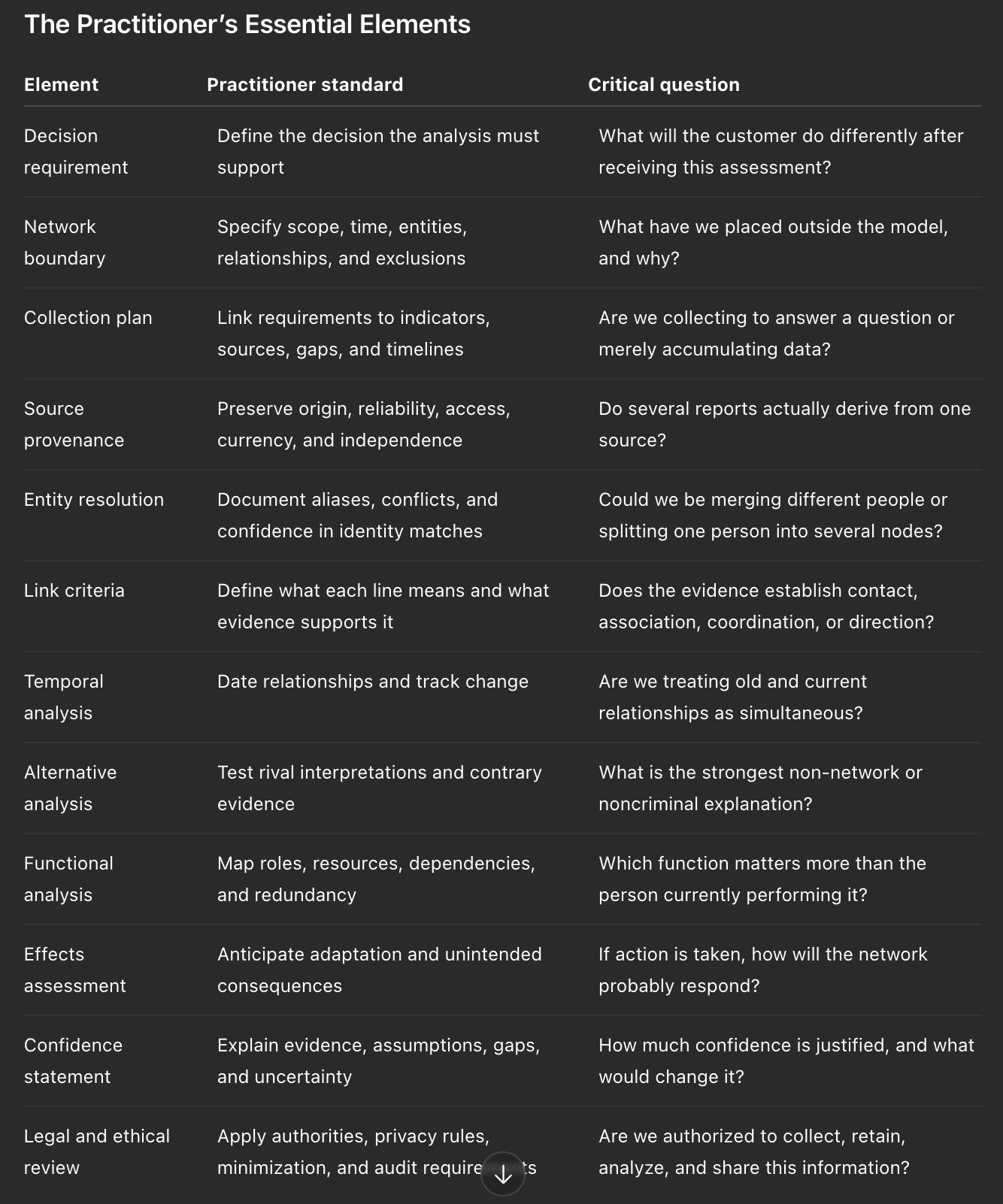
Before presenting a link analysis to a decision-maker, the analyst should be able to answer the following:
What is the primary analytic judgment?
Which evidence most strongly supports it?
Which links are observed, reported, corroborated, or inferred?
What does each relationship type mean?
Which sources are independent?
Where are the largest collection gaps?
How might collection bias be shaping the chart?
What alternative explanations were considered?
Which nodes are structurally central, functionally essential, or merely visible?
How current is the network model?
What consequences could follow from acting on the assessment?
What indicators would show that the judgment is wrong or becoming outdated?
If these questions cannot be answered, the chart is not ready to drive consequential decisions.
Association may establish relevance, but it does not independently establish knowledge, intent, complicity, or criminal conduct.
Network metrics describe structural position within the collected dataset. They do not automatically identify authority, influence, intent, replaceability, or operational importance.
The analyst sees the portion of the network that sources, systems, authorities, and priorities make observable.
Uncollected relationships can alter the apparent structure of the network. Gaps must be identified and incorporated into confidence judgments.
Relationships form, weaken, break, and reactivate. Static charts can misrepresent dynamic systems.
Understanding what a network must accomplish often reveals more than identifying who appears to lead it.
If the analyst cannot articulate a plausible competing explanation, the leading judgment has probably not been tested sufficiently.
An intervention may disrupt a network, but it also generates learning, adaptation, displacement, and unintended consequences.
A chart should not present inferred, weak, outdated, and corroborated links as though they possess equal evidentiary value.
Software can organize records, calculate metrics, and display relationships. It cannot accept responsibility for deciding whether a connection is meaningful, whether the evidence is sufficient, or whether the proposed action is justified.
Link analysis is powerful because human behavior is relational. Threats rarely emerge from isolated individuals acting without resources, influence, communication, opportunity, or support. Networks help analysts understand how those elements come together.
Yet the same relational complexity that makes link analysis useful also makes it dangerous. Visually persuasive connections can outrun the evidence. Quantitative measures can lend false precision to incomplete data. Collection priorities can become mistaken for network structure. Analysts can begin with a person of interest and progressively interpret every association through the assumption of guilt.
The disciplined practitioner resists that temptation.
The analyst defines the question before collecting the data, establishes clear boundaries, preserves source provenance, resolves identities, distinguishes observation from inference, tests alternatives, examines time and function, identifies gaps, explains uncertainty, and anticipates adaptation. The analyst also recognizes that legal authority and respect for civil liberties are not separate from tradecraft; they are among its essential constraints.
The network is not the chart.
The chart is an argument about the network. The quality of that argument depends not on how many nodes appear on the screen, but on whether the analyst can explain—with clarity, evidence, humility, and defensible reasoning—what those nodes and relationships actually mean.
Dr. Charles M. Russo is an intelligence and criminal justice practitioner, educator, author, and scholar with more than three decades of experience spanning national security, law enforcement, counterterrorism, criminal justice, organizational leadership, and higher education. He holds a Ph.D. in Public Safety Leadership with a specialization in Criminal Justice and is a U.S. Navy veteran.
Dr. Russo previously served as an intelligence analyst with the Federal Bureau of Investigation and as a contractor supporting the Central Intelligence Agency’s Counterterrorism Center. His professional experience includes intelligence collection and analysis, counterterrorism, complex financial crime, forensic intelligence, threat assessment, investigative support, and the examination of interconnected actors, activities, resources, and organizations. This background has given him a practitioner’s understanding of both the value and limitations of link analysis: relationships must be collected lawfully, evaluated critically, placed in context, and distinguished from assumptions about intent, culpability, or organizational importance.
As a professor, Dr. Russo teaches intelligence analysis, criminal justice, homeland security, terrorism, forensic intelligence, research methods, leadership, and critical thinking. His scholarship emphasizes structured analytic techniques, evidentiary reasoning, argumentation, cognitive bias mitigation, analytical integrity, and the responsible use of emerging technologies. He is the author of Precision in Perspective: Critical Thinking for the Analytical Mind, Safeguarding Analytical Integrity: Why Political Ideology Must Be Excluded from Intelligence Analysis, and The Philosopher in the Fusion Center.
His work is guided by a central principle reflected throughout this article: intelligence analysis is not the mechanical organization of information. It is the disciplined construction and evaluation of judgments under conditions of uncertainty. In network analysis, every node represents a claim, every link requires evidentiary support, and every consequential conclusion must remain open to challenge, revision, and accountability.
This article is provided exclusively for educational, scholarly, and professional-development purposes. It presents general principles concerning intelligence collection, link analysis, network analysis, structured analytic tradecraft, critical thinking, and decision support. It is not intended to provide operational targeting guidance, investigative direction for a specific matter, legal advice, or instructions for conducting unauthorized surveillance, intelligence collection, disruption, cyber activity, military action, or law-enforcement operations.
The term attack the network, as used in this article, refers broadly to the lawful and authorized analysis of networks and the consideration of measures intended to understand, expose, constrain, disrupt, deter, investigate, prosecute, or otherwise reduce harmful capabilities. It should not be interpreted as advocating violence, extrajudicial action, political suppression, unlawful monitoring, or action against individuals merely because of their beliefs, identities, affiliations, communications, or proximity to a person or organization of interest.
Nothing in this article should be understood as establishing that an association, communication, shared location, financial transaction, family relationship, professional connection, social-media interaction, or other link proves criminality, hostile intent, ideological commitment, conspiracy, organizational membership, or operational coordination. A link chart is an analytic representation, not a determination of guilt. Relationships must be evaluated according to their evidentiary basis, context, temporal relevance, source credibility, legal significance, and plausible alternative explanations.
Intelligence and law-enforcement professionals must conduct all collection, retention, analysis, dissemination, investigative, and operational activities under applicable constitutional requirements, statutes, regulations, executive authorities, agency policies, judicial orders, rules of engagement, privacy protections, civil-liberties safeguards, information-sharing agreements, and professional ethical standards. Requirements may differ across federal, state, local, tribal, territorial, military, intelligence, academic, private-sector, and international environments. References to 28 C.F.R. Part 23, Intelligence Community Directive 203, military doctrine, or other professional standards are included for educational context and should not be treated as a substitute for agency counsel, command guidance, or current governing policy.
Particular care must be exercised when information concerns constitutionally protected speech, political participation, religious practice, social association, academic activity, journalism, advocacy, or membership in lawful organizations. Protected beliefs and activities must not be treated as indicators of criminality or threat without an authorized purpose, an appropriate evidentiary predicate, and a direct relationship to conduct legitimately within the collecting organization’s jurisdiction.
Any examples, scenarios, categories, or analytic questions presented in the article are generalized and illustrative. They are not based on, and should not be interpreted as disclosing, classified information, protected investigative material, intelligence sources or methods, operational details, or confidential information concerning identifiable persons or organizations. Similarities to actual individuals, investigations, organizations, networks, or events are coincidental unless a publicly available source is expressly identified.
The views expressed are those of Dr. Charles M. Russo in his individual capacity. They do not necessarily represent the official positions of any current or former employer, academic institution, government agency, military organization, professional association, publisher, client, or affiliated organization. Reference to prior professional service is provided solely to establish the author’s relevant background and does not imply institutional endorsement, authorization, or access to nonpublic information.
Intelligence assessments are necessarily produced from incomplete, uneven, and sometimes conflicting information. Network models, centrality measures, visualizations, and analytic software may assist professional judgment, but they cannot eliminate collection gaps, source limitations, data errors, deception, cognitive bias, or uncertainty. Analysts and decision-makers remain responsible for independently verifying information, documenting assumptions, considering alternatives, protecting uninvolved persons, and ensuring that any subsequent action is lawful, necessary, proportionate, authorized, and supported by an appropriate evidentiary standard.
Because laws, regulations, technologies, professional standards, and agency policies change over time, readers should consult the most current authoritative guidance before applying any concept discussed in this article. Neither the author nor the publisher assumes responsibility for actions taken solely on the basis of this material or for consequences resulting from its misuse, misinterpretation, or application outside a properly authorized professional context.
No posts
Comments
Nothing yet. Say the first thing.
Sign in to join the conversation.