

Generative artificial intelligence has significantly increased the speed and volume of information production, but linguistic fluency does not necessarily indicate factual accuracy, evidentiary strength, or decision relevance. This article applies the concepts of signal and noise to generative-AI output. Signal is defined as information that is accurate, relevant, traceable, appropriately qualified, and useful for judgment, while noise includes not only false information but also irrelevant detail, unsupported claims, fabricated citations, false precision, hidden assumptions, and rhetorically persuasive language lacking evidentiary substance. The article examines how confabulation, automation bias, information homogenization, and excessive confidence in AI systems can obscure the distinction between plausible language and warranted knowledge. It argues that human critical thinking remains essential because determining what should be believed requires contextual understanding, evidence evaluation, inference testing, alternative explanations, uncertainty assessment, and accountable judgment. To support responsible AI use, the article introduces the SIGNAL Protocol: Specify the question, Inspect the evidence, Generate alternatives, Name uncertainty, Assess relevance and risk, and Locate human accountability. Generative AI can assist with producing, organizing, and challenging ideas, but human beings must retain responsibility for determining which outputs constitute meaningful signal and which merely add persuasive noise.
We have mistaken an abundance of language for an abundance of knowledge.
Generative artificial intelligence can produce explanations, reports, summaries, recommendations, lesson plans, strategic assessments, and research outlines in seconds. Its sentences are polished. Its organization is often impressive. Its confidence is nearly effortless.
Yet none of these qualities guarantees that the output is true, relevant, well-supported, or useful.
Generative AI has dramatically lowered the cost of producing language. It has not lowered the intellectual cost of determining whether that language deserves to be believed. In many circumstances, it has increased that cost by producing more material than a human reader can comfortably evaluate—and by presenting weak claims with the same rhetorical fluency as strong ones.
The central problem of the generative-AI era is therefore not simply access to information. It is the recovery of signal from noise.
That task remains distinctly human.
The distinction between signal and noise emerged from communication and information theory. In its technical sense, a signal carries information through a communication channel, while noise interferes with the accurate transmission of that information (Shannon, 1948).
Applied to generative AI, however, the distinction must be expanded. A generative model is not merely transmitting a preexisting message. It is constructing an output through probabilistic pattern generation. The noise is not necessarily introduced after the message has been created; it can be produced as part of the message itself.
In an epistemic sense, signal is information that is:
Accurate enough for its intended purpose
Relevant to the question or decision
Supported by appropriate evidence
Traceable to credible sources
Properly qualified by uncertainty
Proportionate to the consequences of error
Noise includes more than obvious falsehoods. It can include irrelevant facts, unsupported assertions, redundant language, distorted summaries, invented citations, misplaced certainty, generic recommendations, hidden assumptions, and plausible claims that do not actually answer the question being asked.
This distinction is contextual. A statement may be factually accurate and still function as noise if it is irrelevant to the decision. Conversely, an acknowledgment of uncertainty may be an important signal because it accurately identifies the limits of available knowledge.
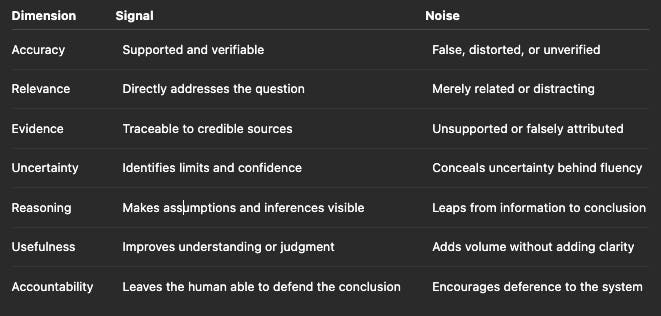
The critical question is therefore not, “Did the AI give me an answer?” It is, “What epistemic status should I assign to this answer?”
Generative AI produces noise through several distinct mechanisms.
Large language models generate text by predicting statistically plausible sequences of tokens. Linguistic plausibility and factual truth may overlap, but they are not the same thing. A sentence can sound entirely natural while being factually wrong.
The National Institute of Standards and Technology uses the term confabulation for confidently presented erroneous or false generative-AI content. Such content may include fabricated facts, citations, explanations, or logical steps. NIST identifies confabulation as particularly consequential when AI is used in domains requiring contextual expertise or high-stakes decisions (Autio et al., 2024).
Confabulation is dangerous because it does not always announce itself through absurdity. The most hazardous falsehood is often not the ridiculous claim. It is the credible-looking statement that fits what the reader already expects to be true.
An AI system may provide correct information that does not resolve the actual problem. A lengthy response can create the impression of completeness while avoiding the central issue.
Suppose an analyst asks whether a particular incident indicates an emerging threat. The AI may offer a competent description of the threat category, provide historical background, and list general risk factors. Yet it may never establish whether the evidence in the present case supports the proposed inference.
The output contains information, but little signal.
Relevance requires an understanding of purpose. What decision must be made? What claim is under examination? What evidence would change the conclusion? What information is merely interesting rather than necessary?
These are questions of judgment, not word generation.
Generative AI can assign impressive specificity to weakly supported claims. It may produce percentages, rankings, timelines, or confidence estimates that appear analytical without possessing a defensible evidentiary foundation.
A precise answer is not necessarily an accurate answer. “There is a 73 percent probability” sounds more rigorous than “this may occur,” but unless the estimate is derived from reliable data and an appropriate method, the number is decorative rather than evidentiary.
False precision turns uncertainty into theater.
AI-generated citations can create the appearance of scholarship without its substance. Some citations may be real but fail to support the associated claim. Others may combine genuine authors, plausible titles, incorrect publication details, and nonexistent articles.
A reference list is not evidence that research occurred. A citation becomes signal only when the source exists, is credible, has been examined, and supports the precise proposition for which it is cited.
The human obligation is not merely to ask for sources. It is to inspect them.
Generative AI is particularly capable of producing the probable, conventional, and familiar. This can be useful when a user needs a standard structure or preliminary summary. It becomes dangerous when dominant patterns are mistaken for comprehensive knowledge.
Unusual cases, minority interpretations, low-frequency events, and dissenting perspectives may disappear into the statistical center. The result is an answer that appears balanced because it is smooth, not because it adequately represents the evidence.
Research published in Nature demonstrates a related systemic risk. When generative models are trained indiscriminately on recursively generated material, uncommon features of the original data distribution can disappear and model performance can deteriorate—a process called model collapse (Shumailov et al., 2024). At the broader informational level, an internet saturated with synthetic material risks becoming increasingly repetitive, self-referential, and detached from original human observation.
Noise can therefore accumulate not only within a single answer but across the entire information environment.
Human beings naturally rely on cognitive shortcuts. We often treat coherent, familiar, and easily processed statements as more credible than awkward or complicated ones. Generative AI is extraordinarily effective at satisfying these preferences.
It is patient. It is grammatically polished. It can explain difficult material in an agreeable tone. It does not hesitate unless designed to do so. It can produce a conclusion even when the evidence would justify intellectual restraint.
These qualities encourage automation bias: the tendency to defer excessively to an automated system. NIST specifically identifies overreliance and unjustified perceptions of superior AI quality as risks arising from human-AI interaction (Autio et al., 2024).
The danger is amplified when the user already wants the answer to be true. AI can become an instrument of confirmation rather than inquiry. A sufficiently leading prompt can elicit a polished defense of an assumption that should have been questioned at the beginning.
The system then appears to have validated the user’s position when it has merely elaborated the premise it was given.
Critical thinking is sometimes reduced to fact-checking. Fact-checking is necessary, but it is insufficient. A response can contain individually accurate facts and still support an invalid conclusion.
Human critical thinking must evaluate at least five elements:
The claim: What precisely is being asserted?
The evidence: What information supports the claim, and how credible is it?
The inference: Does the conclusion actually follow from the evidence?
The alternatives: What other explanations remain possible?
The consequences: What would happen if the conclusion were wrong?
These activities turn the human from a passive recipient into an epistemic evaluator.
A 2025 study of 319 knowledge workers, based on 936 reported uses of generative AI, found that greater confidence in AI was associated with less critical-thinking activity, while greater confidence in one’s own ability was associated with more. The researchers also found that AI shifted critical-thinking work toward verification, integration, and stewardship of the final product (Lee et al., 2025).
This is an important distinction. AI does not necessarily eliminate human thinking. It changes where that thinking must occur. The human may spend less effort producing an initial draft, but must devote greater intellectual discipline to examining, testing, revising, contextualizing, and accepting responsibility for it.
Efficiency in composition should create room for deeper evaluation. It should not become an excuse to eliminate evaluation.
A practical way to preserve human judgment is to subject important AI-generated material to a deliberate SIGNAL review.
Before evaluating the answer, clarify the problem.
What exactly am I trying to determine?
Is this a factual, interpretive, predictive, ethical, or policy question?
What decision will this information influence?
What would count as an adequate answer?
An unclear question makes relevance almost impossible to assess.
Identify which claims require verification.
What is the original source?
Does the source actually exist?
Is it primary, authoritative, and current?
Does it support the specific claim?
Has the AI confused evidence with commentary?
Never allow the AI-generated summary to become a substitute for the underlying evidence.
Ask what else could explain the available information.
What is the strongest competing interpretation?
What evidence would contradict the proposed conclusion?
Has the system ignored a minority or inconvenient view?
Would changing the initial framing produce a different answer?
AI can assist in generating alternatives, but the human must assess whether they are genuinely distinct and plausible.
Every responsible conclusion has boundaries.
What is unknown?
What evidence is absent?
Which assumptions are carrying the argument?
How confident should I be, and why?
What new information would cause me to revise the conclusion?
The absence of certainty is not an analytical failure. Concealing uncertainty is.
Not every error carries the same consequences.
A generative mistake in a brainstorming exercise is different from an error affecting a student’s grade, a criminal investigation, a medical recommendation, a financial decision, or an institutional policy.
The greater the consequence, irreversibility, and human impact of the decision, the stronger the verification requirement must become.
Finally, identify the person responsible for the conclusion.
Who will approve or act on this output?
Can that individual explain the reasoning without referring vaguely to “the AI”?
Can the conclusion be defended from evidence?
Is there a process for correction, appeal, or reconsideration?
AI can generate, compare, summarize, and challenge. It cannot absorb moral or professional responsibility on behalf of the user.
Accountability cannot be prompted away.
The solution is not to reject generative AI. That position would ignore its genuine usefulness. AI can help expose assumptions, generate counterarguments, reorganize complex material, compare competing frameworks, translate technical language, identify information gaps, and produce preliminary drafts.
The proper objective is disciplined collaboration.
Instead of asking only, “Write an argument supporting this conclusion,” ask:
What assumptions does this conclusion require?
What evidence would weaken it?
Present the strongest opposing argument.
Distinguish established facts from reasonable inferences and speculation.
Identify claims requiring external verification.
What relevant perspectives may be missing from this analysis?
Under what conditions would this recommendation fail?
Do not provide a numerical confidence estimate unless it can be methodologically justified.
These prompts do not make the system infallible. They make its output more useful for human examination.
The human must still evaluate the response.
The educational implications are substantial. If students use AI primarily to produce completed answers, they may become highly efficient at submitting language they have never intellectually possessed.
The central educational question should not be whether a student can obtain an AI-generated response. That ability requires little distinction. The better question is whether the student can interrogate, verify, revise, defend, and, when necessary, reject that response.
Students should be asked to:
Identify unsupported AI-generated claims
Verify citations against original sources
Compare AI answers produced from differently framed prompts
Mark facts, inferences, assumptions, and speculation separately
Construct the strongest objection to an AI-generated conclusion
Explain what evidence would change their judgment
Defend their final conclusions independently of the tool
UNESCO’s guidance on generative AI calls for a human-centered approach that preserves meaningful, ethical, and pedagogically appropriate use rather than allowing technological adoption to outrun human capacity and institutional judgment (Miao & Holmes, 2023).
AI literacy must therefore include more than prompt construction. It must include epistemology: how we know, what justifies belief, how uncertainty should be represented, and when a conclusion is warranted.
Generative AI is not destroying the signal. It is surrounding the signal with unprecedented quantities of plausible language.
That distinction matters.
The machine may help us locate evidence, articulate ideas, test possibilities, and explore alternatives. It may also produce confident errors, irrelevant sophistication, false precision, invented authority, and intellectual uniformity. The same system can generate signal in one context and noise in another.
The difference is determined partly by design, partly by the quality of the prompt, partly by access to reliable sources, and ultimately by the quality of human judgment applied to the result.
The essential human skill of the generative-AI era will not be the ability to produce more content. Machines have already made production abundant.
The essential skill will be disciplined discrimination: knowing what matters, what follows, what is supported, what remains uncertain, and what should not be believed merely because it has been elegantly stated.
Generative AI can give us more words.
Critical thinking must determine which words deserve our confidence.
Autio, C., Schwartz, R., Dunietz, J., Jain, S., Stanley, M., Tabassi, E., Hall, P., & Roberts, K. (2024). Artificial Intelligence Risk Management Framework: Generative Artificial Intelligence Profile (NIST AI 600-1). National Institute of Standards and Technology. https://doi.org/10.6028/NIST.AI.600-1
Lee, H.-P. H., Sarkar, A., Tankelevitch, L., Drosos, I., Rintel, S., Banks, R., & Wilson, N. (2025). The impact of generative AI on critical thinking: Self-reported reductions in cognitive effort and confidence effects from a survey of knowledge workers. Proceedings of the 2025 CHI Conference on Human Factors in Computing Systems, Article 1121, 1–22. https://doi.org/10.1145/3706598.3713778
Miao, F., & Holmes, W. (2023). Guidance for generative AI in education and research. UNESCO. https://www.unesco.org/en/articles/guidance-generative-ai-education-and-research
Shannon, C. E. (1948). A mathematical theory of communication. Bell System Technical Journal, 27(3), 379–423; 27(4), 623–656.
Shumailov, I., Shumaylov, Z., Zhao, Y., Papernot, N., Anderson, R., & Gal, Y. (2024). AI models collapse when trained on recursively generated data. Nature, 631, 755–759. https://doi.org/10.1038/s41586-024-07566-y
Dr. Charles M. Russo is a philosopher, educator, author, and intelligence professional whose work examines critical thinking, analytical integrity, human judgment, and the responsible use of artificial intelligence. A U.S. Navy veteran and former FBI intelligence analyst and CIA Counterterrorism Center contractor, he brings more than three decades of experience across national security, criminal justice, organizational leadership, and higher education. He teaches intelligence analysis, criminal justice, research methods, and doctoral research while mentoring emerging scholars and analytical professionals.
This article is intended for educational and scholarly discussion. It does not argue that generative AI should be rejected or treated as inherently unreliable. Rather, it examines the epistemic responsibilities that accompany its use. AI capabilities, limitations, and safeguards vary across models, configurations, and applications. Individuals and organizations should evaluate AI-generated material according to its context, supporting evidence, institutional requirements, and potential consequences before relying upon it.
No posts
Comments
Nothing yet. Say the first thing.
Sign in to join the conversation.