
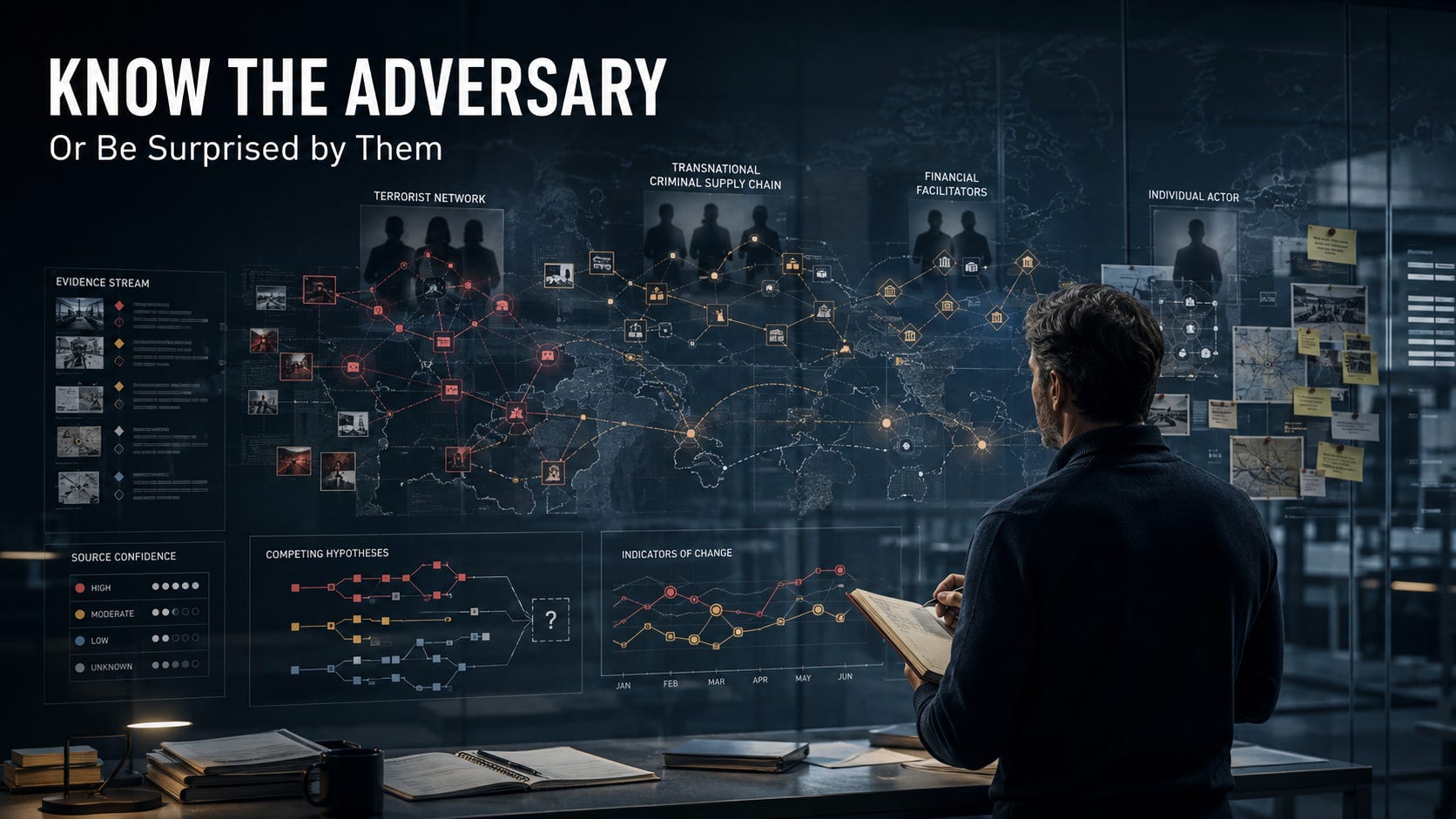
An adversary profile is not a biography. It is a living analytical model of behavior, capability, intent, constraints, relationships, and adaptation.
Intelligence analysts are often told to “know the enemy,” but the phrase is frequently reduced to collecting names, affiliations, incidents, and organizational charts. That is not enough. Whether the subject is a terrorist organization, transnational criminal organization, violent network, facilitator, financier, or individual actor, analysts must understand how the opponent interprets the environment, defines success, allocates resources, manages risk, learns from disruption, and exploits institutional assumptions. Analytical techniques—including link analysis, timelines, key-assumptions checks, indicators, red teaming, and Analysis of Competing Hypotheses—help structure this work. They do not, however, replace critical thinking. This article draws on public government and intelligence sources and several real-world cases to explain how analysts can develop more defensible adversary assessments, recognize adaptation, avoid mirror imaging, and provide decision-makers with intelligence that goes beyond description to explanation, warning, and anticipation.
Comments
Nothing yet. Say the first thing.
Sign in to join the conversation.