
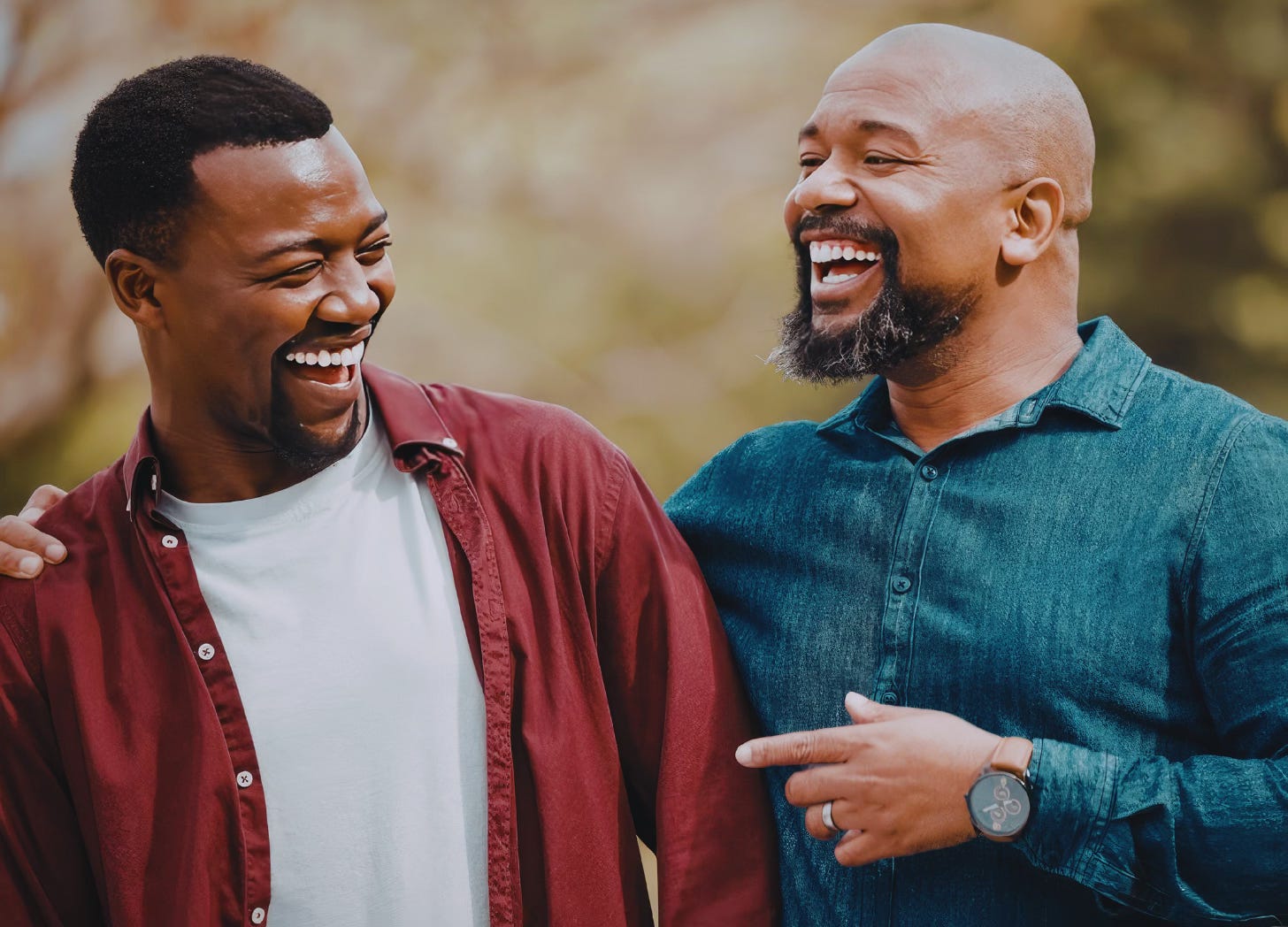
It’s time for my annual Father’s Day post imploring Black men to take care for their physical and mental health. In the year since I’ve last posted this, my family has lost another of our male elders, and I have had numerous friends and colleagues who have lost sons, brothers, fathers, uncles, and cousins to untimely deaths. Once again, I’m posting this love letter to Black men, with a few updates and added resources during this Men’s Health Month.
Our family gatherings used to be full of men: Black men who worked hard and loved harder; who served as church deacons and trustees; who served in the military or retired after decades working for the same company; who made their way out of sharecropping and poverty to buy homes, start businesses, and become civic leaders; who manned the grill at family gatherings and made pancakes on Saturday mornings; who showed up for every wedding and graduation; who taught us how to play cards and change our oil.
The men in our family defy every stereotype about Black men except one: they die too soon.
The men in our family defy every stereotype about Black men except one: they die too soon.
In the photo carousel on the digital frame in my den, there is a picture of most of the men and boys on my mother’s side of the family, taken nearly 10 years ago in my grandmother’s living room. At the time, there were only ten of them – six adults (including my husband and brother) and four boys (including my son). Only one of them – my eldest maternal uncle – was over the age of 60.
It’s slightly better on my father’s side of the family, where a few have managed to celebrate their 70th birthday. My eldest living uncle on that side died last month at the age of 81, an extremely rare octogenarian. But among my in-laws, my husband, his brother, and their cousins are now the oldest men in the family. They are only in their mid-fifties.
It’s not that death doesn’t also come early for Black women; it does. But it comes even sooner for Black men.
According to the Centers for Disease Control and Prevention (CDC), the projected life expectancy of Black women is 77.6 years. The projected life expectancy for Black men is 70.3 years, the shortest lifespan of all groups in the US except for Native American men. That means the average Black man may not make it to retirement. They will work to the point of death. It also means that the families of Black men will not benefit from the elder wisdom that comes after having lived for more than seven or eight decades. Black adults will have to navigate middle-age without the benefit of their fathers and uncles. Fewer and fewer children will have memories of their grandfathers or great-grandfathers.
It’s not just a matter of dying early. Black boys and men are suffering higher rates of many physical and mental health problems than do males from other racial/ethnic groups. Among Black men ages 20 and over, 38.7 percent meet the criteria for obesity. And while I want to guard against fat-phobia, I also want us to acknowledge the deleterious health impact of carrying excess weight for our bodies, especially when 56.8 percent of Black men suffer from hypertension. Black men are more likely to have (and die from) diabetes. Black men are 30 percent more likely to die from heart disease, 60 percent more likely to die from stroke, and nine times more likely to die from HIV/AIDS than non-Hispanic White men. And one in six Black men will be diagnosed with prostate cancer during their lifetime.
Like their female counterparts, Black men also suffer from the burden of strength. While Black men’s feelings of vulnerability may be hidden behind the myth of the StrongBlackMan, there are signs that they are experiencing significant emotional distress. The suicide rate for Black men in 2017 was 11.4 deaths per 100,000 people. That is lower than the rate for all men (22.4), but more than four times the rate of Black women (2.8).
I desperately want to normalize Black men living past 70, hell, past 60.
I desperately want to normalize Black men living past 70, hell, past 60. I want to normalize Black men thriving. I grieve each time I hear news of the premature death of a Black man, whether it’s a celebrity or the loved one of a friend or colleague. That news comes often, and it occurs across income bracket and regardless of health insurance coverage and healthcare access.
Over the past few years, death has come far too early for people like Chadwick Boseman, Takeoff, Coolio, Stephen “Twitch” Boss, Jamal Edwards, Lance Riddick, Trugoy the Dove, Kevin Lemons, DMX, Black Robb, Shock G, Biz Markie, Michael K. Williams, D’Angelo, and Malcolm Jamal Warner (and many others whose names are less well-known). It has come too early for my father-in-law and for my uncles: David, Farrell, Darryl, Greg, Randy, Willie (aka Sonny), Tommy, Anthony, Ronald, Otis, and Jerome. And in just the past few months, it has come too early for Sollomon, Cyrus, and Kohen.
I have little hope that Amerikkka will care for the lives of them and other Black people. Many of the conditions impacting the health of Black men and boys are beyond their control. But G-Money and CMB had it right: we all we got. We cannot wait for this country to value the lives of Black people. We must do this work ourselves.
This year for Father’s Day, I’d like Black men to commit to their own health, including their physical, mental, spiritual, and relational health and well-being. That means:
Putting as much time into your health as you do into your hustle.
Having a relationship with a primary care doctor that you trust (take time to find this person if you don’t already have one).
Attending preventative care and screening appointments.
Taking medication and complying with medical advice.
Getting good nutrition, hydration, sleep, and exercise.
Having healthy and mutually beneficial sexual and intimate relationships.
Spending time with people you love and who love you.
Being able to connect with another person on an emotional level.
Seeing a therapist and acknowledging any struggles with anxiety, depression, or another mental health issues.
Don’t ignore that symptom because you hope it will go away on its own. Stop minimizing pain because “I’m a man and I can take it.” Don’t hold back on seeking medical care because you think your family needs the money more or because you need to get that project done first. More than anything, your family needs you. And we need you to be well.
So this year, when we ask you what you want for Father’s Day, don’t say “nothing.” Tell us how we can support your health and wellness. We love you and want you to be well. Please want that for yourself too.
There are some Black male writers and creatives who are reinventing what it means to be a thriving Black man. They write and talk about fatherhood, popular culture, health, grief, justice, leadership, and what it means to live a good life. I learn a lot from them and hope that you will too. So be sure to follow them. Subscribe to their newsletters and podcasts. Read, listen, and heal!
Social Media, Newsletters, & Blogs
Podcasts
Websites & Therapist Directories
Boris Lawrence Henson Foundation (founded by Taraji Henson)
Do you have other suggested resources or health tips for Black men and boys? Leave a comment and share them below.
If you enjoyed this post, be sure to share, like, and subscribe (it encourages the algorithm to direct more traffic this way). I do a lot of my writing in coffee shops (locally owned, of course) so if you feel so moved (and are able), you can buy me a coffee or become a paid subscriber. Thank you for supporting my writing!
No posts
Comments
Nothing yet. Say the first thing.
Sign in to join the conversation.