
James Dobson died almost a year ago, on August 21, 2025.
In the days after his death, my social media feed was full of grief. Not generally for the loss of the person, but for the trauma caused by his teachings.
Stephanie Jo Warren, who writes the Substack A Crack in the Stained Glass and runs social media accounts under the name, The Strongwilled Child, wrote, “For those raised under his rule, for those taught that discipline was love, that obedience was devotion, his passing is neither a moment of solace nor celebration—but a solemn reckoning.”1
The generations of us raised on Dobson’s religious brand of control-based parenting are intimately familiar with its effects because we live with this legacy every day. And we are beginning to speak out about the harm on social media, in books, and in the therapy office.
The full post is available for paid subscribers; you can subscribe for just $5 per month (or $50 per year) and cancel any time. If you cannot afford a subscription, please email me for a complimentary annual subscription. Thank you to Founding Subscribers whose subscriptions offer scholarships for those who cannot afford one.
In my last post, I shared the definition of Religious Authoritarian Parenting (RAP), a term coined by therapist Krispin Mayfield and writer D.L. Mayfield of the STRONGWILLED Project. They define RAP as “an approach to childrearing that prioritizes obedience to authority over all other aspects of childhood development.”2
I also wrote about the four parenting styles (authoritarian, authoritative, permissive, and neglectful) in the following post. Gentle or connected parenting is a form of authoritative (high warmth with moderate to high structure) which is the most effective style based on decades of replicated research.
One astute comment I received on that post was that religious authoritarian parenting has a different flavor than how the research defines authoritarian parenting:
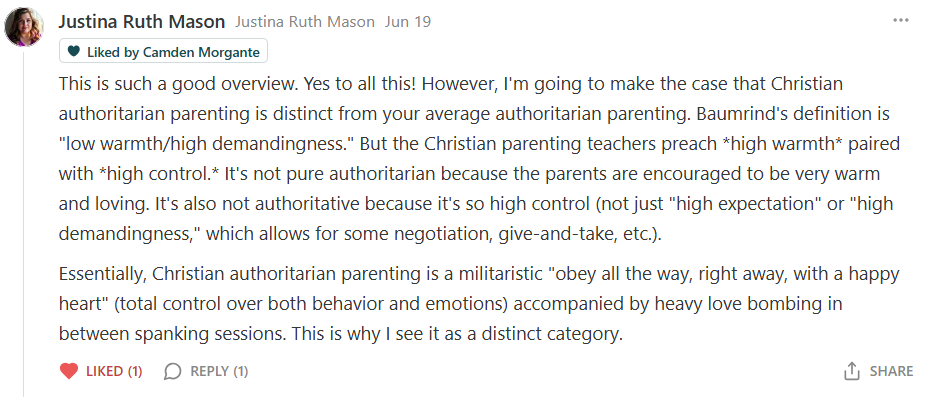
While Dobson called his approach authoritative and said it was a balance of control and warmth, we all know the actual practice of it was control sometimes paired with faux warmth, a kind of manipulative warmth intended to elicited a fawning, compliant response from children. I argue that this could actually be more damaging than low-warmth authoritarian parenting because it is confusing to the child and sends dangerous messages about love, pain, and control. I will write more about this in a later Substack when I share the research on the long-term effects of spanking and trauma responses.
The scientific research is still catching up to our lived experience of the damage of control-based parenting. We are just beginning to recognize the lasting trauma of high control religion, and the effects of high control parenting often mirror those. When I asked those among my social media audience and other online forums who experienced religious authoritarian parenting to tell me in their own words3 what some of these unanticipated and long-lasting consequences were, I heard these themes in their answers:
Comments
Nothing yet. Say the first thing.
Sign in to join the conversation.