
Attorney Brian Festa of We The Patriots USA, a pro bono firm focused on medical and religious freedom cases, outlines ongoing legal battles over states’ elimination of religious exemptions to school vaccination requirements. These efforts highlight tensions between public health mandates and First Amendment protections for religious liberty, particularly in private and religious educational settings.
Festa describes the case of three Amish community schools in New York, which faced fines exceeding $150,000 for continuing to accept religious exemptions after the state repealed them in 2019. New York, like California, Connecticut, and Maine, abolished such exemptions for all schools—public, private, and parochial. West Virginia effectively bars them as well. The Amish schools, operating as private religious institutions, allowed families to opt out based on sincerely held beliefs opposing vaccination. After losing at the district court and initially at the Second Circuit, the case was remanded by the Supreme Court in light of Mahmoud v. Taylor (2025), which affirmed parents’ rights to opt children out of certain school curricula on religious grounds, and related rulings extending similar principles to public health contexts. Despite this, the Second Circuit again dismissed the challenge, distinguishing vaccination mandates as less invasive of religious freedom than curricular content—a distinction Festa criticizes, noting that vaccination effects are irreversible while classroom teaching can be countered at home.
We The Patriots is litigating a nearly identical case involving Milford Christian Church and its Little Eagles Preschool in Connecticut. After Connecticut eliminated religious exemptions in 2021, the preschool continued honoring them. State inspectors threatened closure unless unvaccinated children were either vaccinated or expelled. A federal lawsuit filed in 2023 reached oral argument at the Second Circuit in April; a decision is expected imminently and is likely to follow the Amish precedent. Festa anticipates an adverse ruling, after which the firm plans to petition the Supreme Court. A parallel suit was filed in July against a public school district in Turner, Maine, on behalf of an eighth-grader whose parents seek a religious exemption. These cases position the organization to challenge exemptions losses across multiple federal circuits.
Festa explains the strategic focus on religious free exercise rather than a broader bodily autonomy claim. Citing Dobbs v. Jackson Women’s Health Organization, which rejected an unenumerated constitutional right to bodily autonomy in the abortion context, he noted that courts have not recognized a general right against compelled medical interventions outside narrow settings. Religious objections often center on the historical use of aborted fetal cell lines in vaccine development and testing, as well as other ingredients or manufacturing processes that conflict with faith-based principles. A Supreme Court victory could establish nationwide precedent protecting parental rights to religious opt-outs, whether limited to religious schools or applied more broadly to all educational settings. Such a ruling would endure far longer than temporary political or executive measures.
Collectively, these cases represent a multi-year campaign to restore religious exemptions and affirm parental authority. Supreme Court review offers the most durable path to protecting these liberties for current and future generations, given the lasting nature of constitutional precedent.
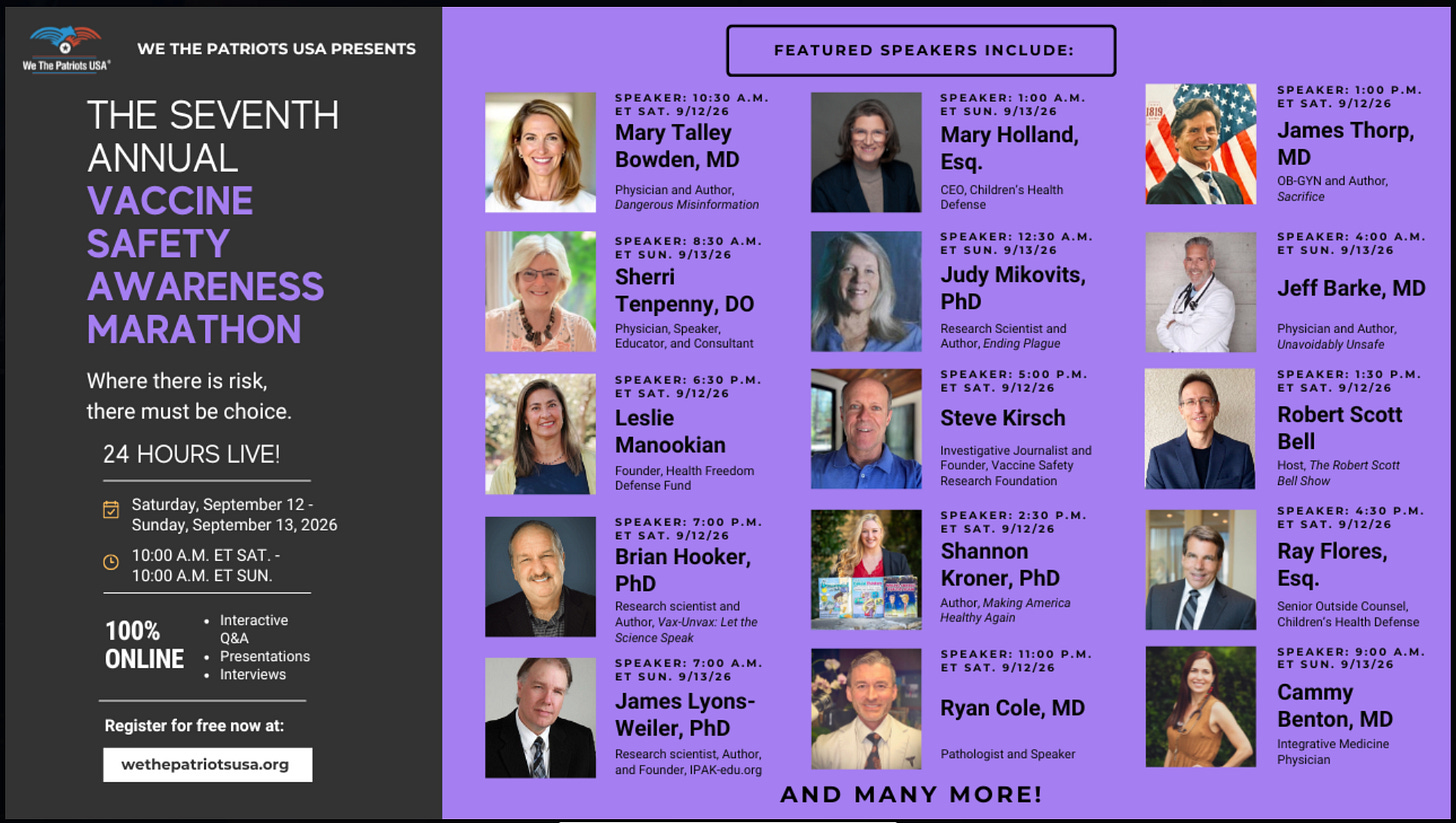
We the Patriots is a pro-bono, non-profit legal firm focusing on medical and religious freedom cases. Register for their upcoming Vaccine Safety Awareness Marathon:
Comments
Nothing yet. Say the first thing.
Sign in to join the conversation.