
You are doing the things. You cleaned up your food. You are moving. You are being, by every measure you were handed, good. And the scale will not move, or it is creeping the wrong way for reasons no one can explain to you.
So you get the same speech you always get. Eat less. Move more. It is calories. It is discipline. And underneath the advice is the quiet suggestion that if it is not working, you must not be trying hard enough.
I want to offer you a different possibility, because for a lot of people it is the true one. If your mast cells and your histamine are driving inflammation, your metabolism is being held in a stuck, inflamed, fat-storing state. And you cannot out-discipline an inflamed terrain. No one can.
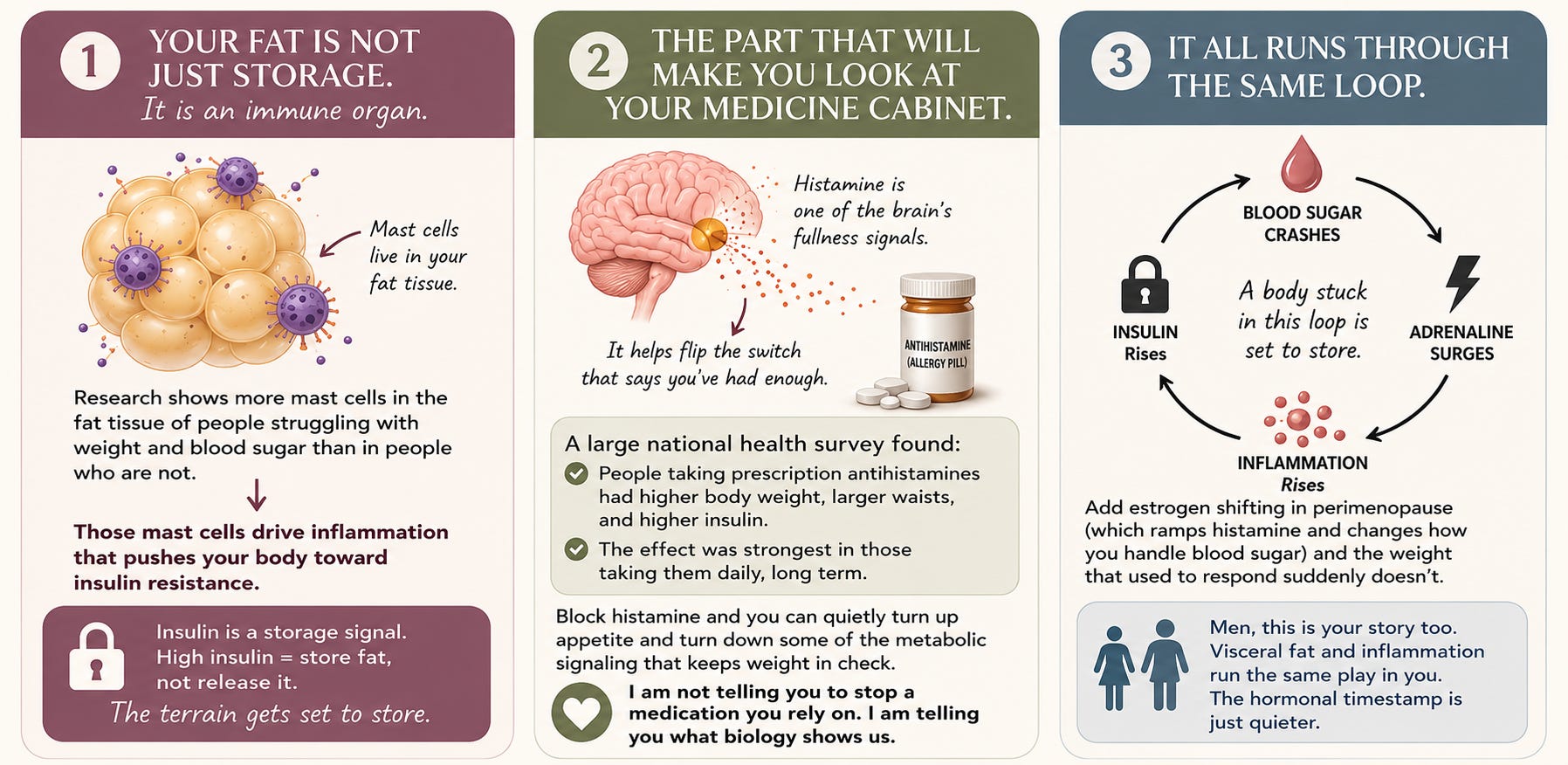
Here is something most people are never told. Your fat tissue is not an inert bag of stored calories. It is metabolically active immune tissue, and mast cells, the same cells behind your histamine symptoms, physically live inside it. Research has found more mast cells in the fat tissue of people struggling with weight and blood sugar than in people who are not.
Those mast cells and the inflammation they drive push your body toward insulin resistance. And insulin is a storage signal. When it runs high, your body is being told to hold onto fat, not release it. So the terrain itself gets set to store. You are not fighting your willpower. You are fighting your biochemistry, and it has a head start.
Your fat is not just storage. It is an immune organ full of mast cells, and inflammation there keeps your metabolism locked in storage mode.
Now the mechanism that surprises people most, and it is the kind of thing that does not fit in a caption.
Histamine is not only behind your hives and your reactions. In your brain, it is also one of the signals for fullness. It helps flip the switch that says you have had enough. So sit with what happens when you turn that signal down.
There is a large national health survey that looked at exactly this. People taking prescription antihistamines, the ordinary allergy pills, had higher body weight, larger waists, and higher insulin than matched people who were not, and the effect was strongest in the ones taking them daily, long term. The proposed reasons line up with the biology. Block histamine and you can quietly turn up appetite and turn down some of the metabolic signaling that keeps weight in check.
I am not telling you to stop an antihistamine you rely on, and I will say that louder on Friday. I am telling you that the same molecule you have spent years trying to lower is wired into appetite and metabolism, so aggressively suppressing it everywhere can come with a cost you were never warned about.
Histamine is one of the brain’s fullness signals. Which is part of why the allergy aisle can turn out to be quietly tied to weight gain.
If you read the blood sugar piece, this will click fast. The crashes, the adrenaline surges, the insulin, the inflammation, they feed each other in a loop, and a body stuck in that loop is a body set to store. Add estrogen shifting in perimenopause, which ramps histamine and changes how you handle blood sugar, and the weight that used to respond suddenly does not. And before the men reading this leave, visceral fat and inflammation run this same play in you, the hormonal timestamp is just quieter.
Most people carrying this are being managed with another diet. Almost none are being investigated for what is actually holding their metabolism down. Those are very different things, and the gap between them is where years of shame get manufactured.
You are not lazy and you did not fail. You have been trying to out-discipline an inflamed terrain, and that was never a fair fight.
Knowing your metabolism is stuck in an inflamed loop is the reframe. It is not yet a plan, and I am not going to leave you with a lightbulb and a shrug.
So Friday, behind the paywall, I am going deep on how to actually move it. The labs worth considering to see whether inflammation and insulin are the real brake (and the ones people never think to run), the order I work in, which starts by calming the terrain and not by cutting more calories, and the honest, careful version of the antihistamine conversation, including what to do instead of white-knuckling. Here is the part that surprises people: the first move is not a smaller plate.
Think of the last time you did everything right and the scale ignored you. Tell me about it in the comments, and whether anyone ever looked past the calories with you.
(and upgrade to paid so Friday’s workup lands in your inbox)
Becky
Ratliff JC, et al. Association of prescription H1 antihistamine use with obesity: results from the National Health and Nutrition Examination Survey. Obesity (Silver Spring). 2010;18(12):2398-2400. https://pubmed.ncbi.nlm.nih.gov/20706200/ (antihistamine use, higher weight, waist, and insulin.)
Liu J, et al. Genetic deficiency and pharmacological stabilization of mast cells reduce diet-induced obesity and diabetes in mice. Nat Med. 2009;15(8):940-945. https://pubmed.ncbi.nlm.nih.gov/19633655/ (mast cells in adipose tissue, obesity, insulin resistance.)
Provensi G, et al. Brain histamine and the control of food intake. (histamine H1 signaling and satiety.) https://pubmed.ncbi.nlm.nih.gov/26948960/
Theoharides TC. The impact of psychological stress on mast cells. Ann Allergy Asthma Immunol. 2020;125(4):388-392. https://pubmed.ncbi.nlm.nih.gov/32687989/ (stress chemistry and mast cell activation.)
Educational and informational only. Not medical advice and not a substitute for a clinician who knows your history. Do not start, stop, or change any medication, including an antihistamine, based on this article. This is not weight-loss advice or a diet plan, it is an explanation of a mechanism worth investigating with your own provider.
No posts
Comments
Nothing yet. Say the first thing.
Sign in to join the conversation.