
While researching and writing On Human Adoption, I sent Colonel Gerry Walker, the Chief Secretary of The Salvation Army New Zealand, Fiji, Tonga and Samoa Territory, a paper from 1993. (Yes, I was being intentionally provocative, and yes, that was not very scholarly of me.)
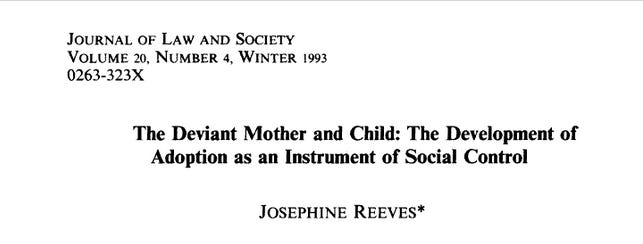
“The Deviant Mother and Child: The Development of Adoption as an Instrument of Social Control”.1 The author describes adoption as an incomparably final means of reordering the deviant family:
“Through placing the mother in the hot seat of moral responsibility, whilst refusing her access to the means (usually economic) to determine and control her environment. Demand and supply of adopters and adoptive children are central to the development and importance of adoption as an instrument of social control.” Josephine Reeves
The essay examines the construction of the innocent mother and child versus the “infected” mother and child, showing how society determined which children were acceptable for middle-class “salvation” and which were not.
All footnotes are behind the paywall
I did not expect an answer, but Walker emailed right back, saying he was on holiday in Europe and promising to read it. A week later, he’d delegated the task to his consigliere, Murray Houston - whose efforts on behalf of the Salvation Army to shut down anyone attempting to hold it to account appear multiple times in On Human Adoption - who emailed me a response:
“The article appears to be primarily based on the United Kingdom’s legal and social environment, which, as you have noted, does not mention the Salvation Army in any context and only mentions New Zealand a couple of times in passing. The Salvation Army has no comment to make on the article, either generally or in relation to any facts or opinions that are mentioned in the article.”
The Salvation Army operated in a grey zone of responsibility, where the social understanding of the services they offered obscured their purpose. Dressed in the uniform of righteousness, they exploited vulnerability; their ‘service’ focused on separating mothers from their babies in order to supply them to infertile married couples.
A Salvation Army policy document outlines the maternity hospitals’ policy on private married mothers and the unwed: “On no account may the two classes of patient occupy the same room…”.2
Annie (not her real name), a mother whose child was forcibly taken from her in a Salvation Army home, points out that although the Bethany homes appended the word “mothers” to the unwed or unmarried, they disabled these girls and women from entering motherhood: “Even my pregnancy didn’t belong to me”.
It’s not difficult to imagine how unmarried, religiously inspired matrons like Brigadier Gladys Goffin, for many years the matron of the Bethany maternity home in Napier, New Zealand, believed they were engaged in the moral struggle for souls; the illegitimate child an oblation, an offering to wipe out the sin of fornication.3
This makes me consider the role of a teenage girl from 2000 years ago, with her illegitimate child and the invisible missing father. I wonder about the contentious bodies of each Bethany inmate and how they exposed the physical impossibility of the pregnant virgin. I wonder about the magical thinking the teenage Mary must have engaged in and how that need gave rise to the myth of redemption in her child’s body. Anything rather than focus on that moment when she realised she could not escape the hand in her hair, the knee that pinned her splayed thigh, the grunt in her ear.
Consensual or not, the myth of the virgin mother persists. For the women and girls who entered Bethany, there was no salvation in an incarnational narrative of God’s child sent to redeem them. The Salvation Army matrons did not distinguish the circumstances of conception; every unwed mother was an apostate, every child baseborn.
Women like my mother, like the many mothers I interviewed and thousands of others who were forced to sign over their sickness benefits, to cook and clean, to have their movements and diets restricted, to be psychologically abused, denied birthing advice, often left to labour unassisted, possibly drugged, to have their breasts bound, denied legal advice, and coerced into signing their consent as though it were a confession.
They were given no alternative but to surrender their infants under a guillotine of secrecy, separating mother and child forever. They were given the choice of no choice.
Officially, the Salvation Army appears to deny that its role in forced stranger adoption ever occurred, or, if it did, that it was simply the way things were back then. This attitude is shared internationally.
In Canada, the Salvation Army was named as a defendant in a class-action lawsuit by Manitoba Family Services. The class action by Slater Vecchio LLP said mothers were subjected to psychological manipulation.
A court document filed as part of the class action said: “The homes were meant to indoctrinate, dehumanise and isolate unmarried mothers and seize their newborns from them”.
The Army retaliated by subsequently filing third-party claims against Manitoba child and family services agencies. Rather than acknowledge any accountability, the Army denied liability regarding the coercion claims while shifting a portion of the legal accountability toward the bodies that regulated or managed child welfare at the time.
Class action against the Salvation Army
An assistant professor at Osgoode Hall Law School said that by suing Manitoba Family Services, the Salvation Army is trying to reduce culpability in its involvement in the adoption process: “The Salvation Army is saying. “Look, we just gave these mothers a home”.4
On Human Adoption is available here
Josephine Reeves, “The Deviant Mother and Child: The Development of Adoption as an Instrument of Social Control”, Journal of Law and Society, vol. 20, no. 4, Winter 1993, p. 421.
Kerryn Pollock and Natasha Naus, Heritage of Health: A Brief History of Medical Practices, Maternity Homes and Motorways in Te Aro, Wellington (Wellington: Wellington City Council, 2006), p. 20.
New Zealand Herald, 16 November 1971, section 1, p 14.
CBC News, 2 December 2023.
Comments
Nothing yet. Say the first thing.
Sign in to join the conversation.